
April 16, 2026 - PBS News Hour full episode
4/16/2026 | 56m 45sVideo has Closed Captions
April 16, 2026 - PBS News Hour full episode
April 16, 2026 - PBS News Hour full episode
Problems playing video? | Closed Captioning Feedback
Problems playing video? | Closed Captioning Feedback
Major corporate funding for the PBS News Hour is provided by BDO, BNSF, Consumer Cellular, American Cruise Lines, and Raymond James. Funding for the PBS NewsHour Weekend is provided by...
April 16, 2026 - PBS News Hour full episode
4/16/2026 | 56m 45sVideo has Closed Captions
April 16, 2026 - PBS News Hour full episode
Problems playing video? | Closed Captioning Feedback
How to Watch PBS News Hour
PBS News Hour is available to stream on pbs.org and the free PBS App, available on iPhone, Apple TV, Android TV, Android smartphones, Amazon Fire TV, Amazon Fire Tablet, Roku, Samsung Smart TV, LG TV, and Vizio.
Providing Support for PBS.org
Learn Moreabout PBS online sponsorshipAMNA NAWAZ: Good evening.
I'm Amna Nawaz.
GEOFF BENNETT: And I'm Geoff Bennett.
On the "News Hour" tonight: Israel and Lebanon agree to a 10-day cease-fire.
But will the militant group Hezbollah abide by a truce it did not negotiate?
AMNA NAWAZ: As White House budget Director Russell Vought testifies before Congress, we check in on his efforts to implement Project 2025.
GEOFF BENNETT: And a look at the Trump family's business dealings during this administration, the profits they have made, and the ethics in question.
KYLE KHAN-MULLINS, "Forbes": Donald Trump won the White House again.
And the Trumps have kind of stopped caring about the appearance of conflicts of interest.
(BREAK) AMNA NAWAZ: Welcome to the "News Hour."
President Trump announced a cease-fire deal today that would suspend fighting between Israel and Hezbollah for 10 days.
GEOFF BENNETT: Hezbollah has not said whether it will comply with the cease-fire, which took effect a short time ago.
President Trump also says leaders from Israel and Lebanon are expected to meet soon in hopes of reaching a broader peace agreement.
Our Stephanie Sy begins our coverage.
STEPHANIE SY: In cities across Southern Lebanon today, cries of anguish, at least four paramedics whose mission was saving lives suddenly stripped of their own by another Israeli attack on emergency personnel.
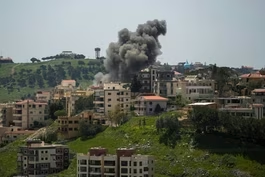
Early today, Israel bombed another town in Southern Lebanon, barely visible here, engulfed in plumes of smoke.
Another attack turned a critical bridge into rubble.
It was the last link for almost a tenth of Southern Lebanon to the rest of the country.
Hours later, President Donald Trump announced a cease-fire on social media and said he spoke to both the Israeli and Lebanese presidents.
DONALD TRUMP, President of the United States: I had a great talk with both of them today.
They're going to be having a cease-fire.
And that will include Hezbollah.
STEPHANIE SY: He also announced a meeting between the nation's leaders.
DONALD TRUMP: It's very exciting.
I think we're going to have a deal where we're going to have a meeting, first time in 44 years, and Lebanon will be meeting with Israel.
And they're probably going to do it at the White House.
STEPHANIE SY: Israeli Prime Minister Benjamin Netanyahu called a potential peace agreement between Israel and Lebanon a historic opportunity, but added Israeli forces will remain in Lebanon and that a potential peace deal must include the dismantling of Hezbollah.
BENJAMIN NETANYAHU, Israeli Prime Minister (through translator): To achieve this cease-fire, Hezbollah insisted on two conditions, first, that Israel must withdraw from all Lebanese territory back to the international border.
Second, a cease-fire based on the quiet-for-quiet model.
I agreed to neither of these.
STEPHANIE SY: Netanyahu also hinted at a long-term occupation of Southern Lebanon, describing a security zone that would stretch the length of the Israeli border.
"That is where we are, and we are not leaving," he said.
But in a statement to the "News Hour," Hezbollah said: "Any cease-fire must be comprehensive across all Lebanese territory and must not allow the Israeli enemy any freedom of movement.
Regarding Israeli presence, the existence of Israeli occupation on our land grants Lebanon and its people the right to resist it."
Hezbollah's major sponsor, Iran, still holds sway over a key strategic asset, the Strait of Hormuz, although Defense Secretary Pete Hegseth denied that was the case today.
PETE HEGSETH, U.S.
Defense Secretary: You can't control anything.
To be clear, threatening to shoot missiles and drones at ships, commercial ships, that are lawfully transiting international waters, that is not control.
That's piracy.
That's terrorism.
The United States Navy controls the traffic going in and out of the strait because we have real assets and real capabilities.
STEPHANIE SY: There are at least 800 ships stuck in the Persian Gulf right now, afraid to enter the volatile strait.
Despite that, President Trump sounded a note of optimism.
DONALD TRUMP: We have a very good relationship with Iran right now, as hard as it is to believe.
And I think it's a combination of about four weeks of bombing and a very powerful blockade.
The blockade is maybe more powerful than the bombing.
STEPHANIE SY: The U.S.
military is supplementing the blockade with active interdiction operations beyond the Middle East.
As the U.S.
unleashes what it calls Operation Economic Fury on Iran, American allies are also feeling the pain.
With oil supplies choked, the head of the International Energy Agency warned that Europe has -- quote -- "maybe" six weeks of jet fuel left.
FATIH BIROL, Executive Director, International Energy Agency: What is happening now is the largest energy crisis we have ever faced in the history.
It is a huge amount of oil which is vital for the global economy.
STEPHANIE SY: Tensions in the strait are pushing economies and the U.S.-Iran cease-fire to the brink.
For the "PBS News Hour," I'm Stephanie Sy.
AMNA NAWAZ: For insights on the announced cease-fire by the U.S., Israel and Lebanon, we turn now to author and journalist Kim Ghattas.
Her most recent book is "Black Wave," which is about the rivalry between Saudi Arabia and Iran.
She's now a visiting professor at Dartmouth College.
Kim, welcome back to the "News Hour."
Let's start with the Israeli government here.
We saw there Prime Minister Netanyahu was just on Lebanese territory days ago to visit Israeli troops.
It seems clear they intend to stay.
So why did he sign on to a cease-fire right now?
KIM GHATTAS, Dartmouth College: Benjamin Netanyahu and Israel generally signed on to a cease-fire because President Trump requested that they do so to give a chance to the U.S.-Iran negotiations that are unfolding.
As I like to say, beware of small nations.
As the U.S.
and Iran were entering those negotiations, Iran was threatening that it would not abide by a request for a cease-fire if the war continued in Lebanon, a small nation where much of this started 43 years ago with the Israeli invasion of Lebanon of 1982 and the creation and the birth of Hezbollah.
So Benjamin Netanyahu was under pressure to respond to President Trump's demand that there be a cease-fire so that the U.S.-Iran negotiations could proceed.
And that's what we're seeing unfold right now, and we will have to see whether they extend beyond the first 10 days that have been agreed.
AMNA NAWAZ: What about the thinking of the Lebanese government here?
Why would they accept this cease-fire?
KIM GHATTAS: Well, the Lebanese are exhausted.
This is their second war in a year-and-a-half waged by Hezbollah against Israel, but affecting all of Lebanon.
We saw a day of carnage in Beirut last year -- last week, forgive me, on Wednesday, 100 strikes in just 10 minutes across the country, including the capital, Beirut, which was devastating for a country the size of Connecticut.
And so Lebanon is not just accepting a cease-fire.
It was demanding a cease-fire.
And it had put already on the table several weeks ago a proposal to have direct negotiations with Israel to come to a cease-fire proposal, which at the time was rejected by Benjamin Netanyahu.
And President Trump wasn't that interested then, but he is interested now.
Lebanon has also conditions.
I mean, we're hearing President Trump saying that there could be a meeting soon between the Lebanese leader and the Israeli leader.
I don't see that happening, Amna, if the Israelis are still occupying parts of Lebanon and Benjamin Netanyahu is able to walk around the south of the country.
AMNA NAWAZ: Kim, perhaps one of the biggest questions is Hezbollah in all of this.
You saw part of the statement that they put out to us here at "PBS News Hour" saying any cease-fire has to be comprehensive across all Lebanese territory, must not allow what they call the Israeli enemy any freedom of movement.
Will Hezbollah abide by this cease-fire?
KIM GHATTAS: We will have to see.
For now, they will.
There is celebratory gunfire in Beirut in Hezbollah areas.
They claim this as their victory, that they forced the enemy into this cease-fire.
But what the Lebanese government is very keen to make clear is that it is the Lebanese government that will negotiate going forward.
And the Lebanese don't want to be included in an Iran negotiating track.
They want to assert their sovereignty and have their seat at the table, as controversial as it may be in Lebanon in the eyes of some that the Lebanese would be sitting down with Israelis, as we saw on Tuesdays.
It's the first time this happened since the 1980s, since 1983.
Lebanon has not had a seat at the table for regional negotiations while it was under Syrian occupation, And now as Iran tries to assert itself as the sort of patron of Lebanon.
Lebanon wants its own seat at the table.
It is going to be very difficult to manage this, especially as the agreement, as we have seen the statement put out by the State Department, really essentially is a return to the status quo ante before this latest eruption.
And it depends on how much the U.S.
can put pressure on Israel to make some concessions.
And it's going to depend on the diplomatic chops and the diplomatic ability of the Lebanese government and the Lebanese negotiator to move forward and also show that they can indeed prevent Hezbollah from striking Israel.
AMNA NAWAZ: That is author and journalist Kim Ghattas joining us tonight.
Kim, thank you so much.
Always good to speak with you.
GEOFF BENNETT: To help us understand the global stakes of the impasse at the Strait of Hormuz, especially its impact on the deepening humanitarian crises, we're joined now by Jorge Moreira da Silva, executive director of the U.N.
's operational arm and head of the U.N.
Task Force on the Strait.
Thanks for being here.
JORGE MOREIRA DA SILVA, U.N.
Office for Project Services: Thank you, Geoff.
GEOFF BENNETT: So, as I mentioned, you are leading this U.N.
task force during what is this volatile moment in the Strait of Hormuz.
Where are you most concerned about the ripple effects right now?
JORGE MOREIRA DA SILVA: We are mostly concerned about the consequences of the disruption on fertilizers.
I know that everyone is talking about energy, oil and gas, but the fact that there is so much dependence from so many countries, particularly in Africa and in South Asia, from fertilizers from the Gulf will very likely trigger a massive food security crisis with devastating consequences on the poor.
That's why we can't delay.
We must find a solution to unblock the strait.
Of course, freedom of navigation is critical.
We must have everything going through the strait, but until we get this freedom of navigation, we can't miss the planting season.
Planting season is from now until May.
If we miss the planting season, the farmers, particularly in Africa, won't have productivity.
The prices will go up and hunger and starvation will be spread around the world.
GEOFF BENNETT: When you say we have to find a solution, the U.N., as I understand it, is trying to create a mechanism for what you call safe, predictable transit through the strait.
What does that actually look like right now in practice?
JORGE MOREIRA DA SILVA: In language that is less technocratic, in practical terms, we need to build confidence and trust to ensure that we can deconflict so that the vessels can cross the strait with no risk.
We must monitor and verify to ensure that the cargo that is loaded is fertilizers and related raw materials, and we need to track the vessels and report.
This is not rocket science.
We have done this in Yemen.
We have done this in Gaza.
We have done this on the Black Sea grain initiative.
It's something that my team is already ready to put on the ground.
What are we missing?
We are missing a political deal.
GEOFF BENNETT: If access remains constrained, how do you prioritize which countries, which regions get the fertilizer and get the raw materials?
JORGE MOREIRA DA SILVA: A week ago, the main concern was Sudan, Somalia, Mozambique, Kenya, Sri Lanka, countries that are most dependent from fertilizers from the Gulf.
Now we know more.
We know that the entire fertilizer market is disrupted, that even the producers of fertilizers in South Africa, in Morocco, in China, in Turkey are being affected, because they don't have the raw materials.
If they don't get the fertilizers, the productivity goes down.
You don't have the ability to put the agriculture functioning properly, and we have massive devastation and hunger and starvation.
If we don't get a solution quickly, we will have 45 million people, more, forced into food insecurity.
GEOFF BENNETT: It sounds like we're already at the point at which aid groups cannot compensate now for this disruption.
JORGE MOREIRA DA SILVA: We have seen this movie, this script, a crisis that starts locally, it becomes regional, and then it's global.
I have my team ready.
Look, I have identified already the monitors to put on the ground.
I have already developed with my team the digital platform to approve all of the vessels.
I can -- in seven days, my team can in seven days put everything functioning.
We just need a political will.
GEOFF BENNETT: From the humanitarian crisis in Gaza to this crisis now we're talking about connected to the Strait of Hormuz, is the international community moving with enough urgency?
JORGE MOREIRA DA SILVA: We are living in the worst consequences, in the worst conditions ever since the World War II in terms of conflict.
One quarter of the people in the world live under conflict.
One was the last time that we spoke about Afghanistan or Myanmar or Somalia or Sudan or Mali or Haiti or Ukraine?
So it's important that we don't jump from one crisis to the other, forgetting the others that were already happening and didn't disappear.
So this is a moment where solidarity must be boosted.
It's one planet, one society, and we are all on this together.
If we don't find collective solutions, we will all be significantly affected.
GEOFF BENNETT: When you say you have a team ready to move right now, what really can the U.N.
do, absent a deal between the U.S.
and Iran and Israel?
JORGE MOREIRA DA SILVA: We will be condemned to deal with the consequences.
If you don't let the U.N.
act now, if you don't let the U.N.
bring the monitors to the Strait of Hormuz to monitor, verify, to deconflict the cargo, the fertilizers, we will -- you'll need the U.N.
later to bring the food for the people that are facing starvation and hunger.
You'll need U.N.
later to bring the sheltering and the housing and the humanitarian need for the people that was put on poverty because of this impasse.
So we really need to find a solution now.
It's much cheaper, it's better, and it's, from a human rights point of view, the right thing to do.
GEOFF BENNETT: Jorge Moreira da Silva, thank you for being with us.
JORGE MOREIRA DA SILVA: Thank you, Geoff.
AMNA NAWAZ: In today's other headlines: Pope Leo is warning of a world ravaged by a handful of tyrants who spend billions on war.
His comments came during a visit to Cameroon, where the government has mired in a longstanding conflict with separatist fighters.
But his message also comes amid ongoing tensions with the Trump administration over its war in Iran, which the pontiff has openly criticized.
Today, the pope took particular aim at those using Christian theology to justify violence.
POPE LEO XIV, Leader of Catholic Church: Woe to those who manipulate religion in the very name of God for their own military, economic or political gain, dragging that which is sacred into darkness and filth.
AMNA NAWAZ: His remarks follow criticism by Vice President J.D.
Vance that Leo should -- quote -- "be careful" when he talks about matters of theology.
Defense Secretary Pete Hegseth has frequently invoked Scripture to justify America's military efforts in Iran.
In Virginia, police say that former Lieutenant Governor Justin Fairfax shot and killed his wife last night before killing himself.
KEVIN DAVIS, Fairfax County, Virginia, Police Chief: This has been an ongoing domestic dispute surrounding what seems to be a complicated or messy divorce.
AMNA NAWAZ: Authorities said Mr.
Fairfax was facing a court-ordered deadline to move out of his family's home and that the couple's two teenage children were in the house during the shooting.
Fairfax was once a rising star in the state's Democratic Party, nearly succeeding governor Ralph Northam in 2019.
His political career was derailed by sexual assault allegations, which he denied.
President Trump nominated Erica Schwartz to be the next director of the Centers for Disease Control and Prevention.
She served as deputy surgeon general during Trump's first term and was directly involved in the federal response to the COVID-19 pandemic.
Her nomination comes after a year of leadership shakeups at the agency and a number of controversial policy changes overseen by Health Secretary Robert F. Kennedy Jr.
Those include an overhaul of childhood vaccine recommendations.
Schwartz will need Senate confirmation before taking on the role.
In the meantime, Secretary Kennedy spent the day defending his health agenda in two appearances before lawmakers.
Speaking before the House Ways and Means Committee, Kennedy justified a 12 percent cut to his department's budget.
Republicans on the committee praised him as a breath of fresh air.
But Democrats challenged him on a number of fronts, including vaccines.
REP.
LINDA SANCHEZ (D-CA): A deadly measles outbreak in Texas killed an unvaccinated 6-year-old, the first such death in a decade.
Do you agree with the majority of doctors that the measles vaccine could have saved that child's life in Texas?
ROBERT F. KENNEDY JR., U.S.
Health and Human Services Secretary: It's possible, certainly.
AMNA NAWAZ: At one point, the longtime vaccine skeptic conceded that a vaccine could have prevented a deadly case of the measles, but otherwise he largely held his ground.
Today's hearings were the first of seven appearances for Kennedy over the coming week.
The Senate voted today to lift a federal ban on mining upstream from Minnesota's Boundary Waters Canoe Area Wilderness.
MAN: The yeas are 50.
The nays are 49.
And the joint resolution is passed.
AMNA NAWAZ: The Republican-led measure now goes to the president for his signature.
It's a major win for a Chilean company which wants to mine nickel and copper from forests near the U.S.-Canada border.
Environmentalists warn it will contaminate the ecosystem of lakes and bogs, one beloved by Minnesotans and one Native American tribes rely on for fishing and rice harvesting.
The mining project still needs state permits and could face court challenges before construction begins.
Officials on the Northern Marianas say some communities may not have power or water for weeks after a monster typhoon tore through the Pacific islands this week.
Super Typhoon Sinlaku, the strongest tropical cyclone this year, left roads impassable for repair crews.
Back stateside, Wisconsin is under a state of emergency after days of heavy rains submerged streets and stranded cars, leading to multiple water rescues.
DAVID ROBSON, Tow Truck Driver: The water is up here to me.
You know what I'm saying?
And I'm 5'11''.
So the water is up here to me.
AMNA NAWAZ: Flood watches and warnings remain in effect across much of Wisconsin and neighboring Michigan through tonight.
Elsewhere, hail hammered parts of nearly a dozen states, including Iowa, and a possible tornado tore through Clinton, Missouri, toppling homes and power lines.
In the meantime across, much of the Southern and Eastern U.S., mid-spring will feel like the height of summer well into the weekend.
An abnormal heat wave is shattering records in places like New York City and Washington, D.C.
Russia launched its deadliest attack on Ukraine this year, killing at least 16 people overnight and today.
Huge fires erupted in the capital of Kyiv after an hours-long aerial barrage.
More than 100 people were injured.
Russia's Defense Ministry said it was in retaliation for Ukrainian strikes on targets inside Russia.
It comes as Ukrainian President Volodymyr Zelenskyy has been visiting European nations seeking more air defense systems to block these attacks.
On Wall Street today, stocks ticked higher as investors search for clues on when the Iran war will end.
The Dow Jones industrial average rose 115 points on the day.
The Nasdaq closed at another new record, adding around 80 points.
The S&P 500 posted its 11th gain in the last 12 sessions.
And a British scholar has solved a mystery around where exactly Shakespeare bought his only home in London.
King's College Professor Lucy Munro says this 17th century property plan found in London's city archives shows the exact location of the house he bought in 1613.
The home was already marked by this sign saying that Shakespeare purchased lodgings near this site.
Turns out the house was not near, but right there after all.
It's believed the property was destroyed in the Great Fire of 1666.
The discovery raises new questions about how Shakespeare spent his final years before his death in Stratford-upon-Avon in 1616.
Still to come on the "News Hour": a growing number of small private liberal arts colleges close their doors; we look at the Trump family's business dealings during this administration; and Dave Chappelle discusses his support for his local public media.
AMNA NAWAZ: The director of the Office of Management and Budget was on Capitol Hill today, making the case for the Trump administration's proposed budget for next year.
Russ Vought argued that a big military spending increase means about a 10 percent cut to domestic programs.
RUSSELL VOUGHT, Director, Office of Management and Budget: Senator, I fully support this budget.
We go through a long policy process.
It's needed for the Department of War.
It's one time.
It's designed to have paradigm-shifting investments, like I mentioned in my opening comments, to be able to fund now what this president is willing to do, multiyear agreements.
And it's necessary to keep us safe.
AMNA NAWAZ: Vought has been key to implementing the Trump agenda.
Before joining the administration last year, he was a driving force behind Project 2025, a controversial policy playbook by the conservative Heritage Foundation.
Liz Landers is here now for a check-in on how many of those proposals have since become official government policy.
Liz, good to see you.
LIZ LANDERS: Yes.
AMNA NAWAZ: So let's just talk about Project 2025.
Remind us what was in it and who else was behind it.
LIZ LANDERS: The Heritage Foundation, which is a conservative think tank here in Washington, authored this.
And it was really a blueprint for the presidency should Trump win again in 2024.
And Russ Vought was one of the main authors and architects of Project 2025.
In it, he talks about executive powers.
Now he heads up the Office of Management and Budget, and he has a huge amount of power there over the budget and the personnel decisions happening inside this administration.
There are a number of other people within the administration right now too who had sections in Project 2025, including Peter Navarro.
He wrote a section on trade.
He's now one of the president's top trade advisers.
Brendan Carr wrote a section about changes to the FCC.
He now oversees that agency and has been pretty aggressively going after TV channels.
And then Trump's border czar, Tom Homan, is also listed as a contributor in there.
The president himself, though, insisted during that campaign cycle that he didn't know what Project 2025 was.
Listen to what he said in July of that year.
DONALD TRUMP, President of the United States: I don't know what the hell it is.
It's Project 25.
He's involved in Project -- and then I read some of the things and they are extreme.
I mean, they're seriously extreme.
But I don't know anything about it.
I don't want to know anything about it.
But what they do is misinformation and disinformation.
LIZ LANDERS: But, Amna, many of the policies in Project 2025 have been tracked in the last year or so that the president has been back in office.
Many of them have been implemented.
AMNA NAWAZ: Meanwhile, as we just reported, the president's budget calls for a large increase in military spending.
That comes as the U.S.
is in the middle of this war with Iran that he launched.
Is the current Trump foreign policy in line with what was in Project 2025?
LIZ LANDERS: Well, Russ Vought said today on the Hill that there was a more than 40 percent budget increase for this next fiscal year for military spending.
And that would help pay for, among other things, new Navy ships to grow the fleet to 400.
That's an even bigger number than what Project 2025 called for.
They called for 355 Navy ships.
Project 2025 says that China is the biggest foreign threat to the United States.
In Project 2025, they called it a totalitarian enemy.
President Trump, of course, is going to go to China soon next month.
But Iran is mentioned as a concern.
It's mentioned more than 50 times in Project 2025.
There's a section devoted to it that talks about the opposition to the regime, criticizing the Biden and Obama administration policies, especially the JCPOA and some of their easing of sanctions.
It says that the Iranian people deserved a democratic government, but it's up to them to decide that.
Here's one quote: "The U.S.
must prevent Iran from acquiring nuclear technology and delivery capabilities and more broadly block Iranian ambitions."
Certainly seems to be hewing to what the president has been doing so far.
Also mentions leveraging more sanctions on Iran.
The first Trump administration did that, and we heard yesterday from the treasury secretary that the Trump administration is looking at doing that again.
AMNA NAWAZ: Meanwhile, on the domestic front, we know a large part of the Project 2025 domestic policy agenda has already been implemented.
What do we know about that?
LIZ LANDERS: There's analysis from the Center for Progressive Reform that says that the Trump administration has initiated or completed 53 percent of Project 2025's domestic agenda as of February this year.
That's 283 of the 532 recommended actions.
Let's look at two of these examples.
One of them, on LGBTQ front here, Project 2025 directed the NIH to fund studies on negative effects of gender-affirming care.
One of the first things that the president signed as an executive order when he came back into office was directing HHS to -- quote -- "publish a review of the existing literature on best practices for promoting the health of children who assert gender dysphoria, rapid-onset gender dysphoria, or other identity-based confusion."
Amna, another domestic policy point too was on reproductive rights.
The Center for Reproductive Rights says that 85 percent of Trump's reproductive health actions have stemmed from these recommendations, one of them prohibiting Planned Parenthood from receiving Medicaid funds.
That happened last summer when Congress passed their budget bill that was in there.
AMNA NAWAZ: That's our White House correspondent, Liz Landers, with an important update.
Liz, thank you.
LIZ LANDERS: Of course.
GEOFF BENNETT: After years of financial decline, Hampshire College, a private liberal arts college in Amherst, Massachusetts, has announced it will close its doors at the end of the year.
But the college is hardly alone.
A new estimate projects that nearly 450 of the nation's 1,700 private nonprofit four-year colleges and universities are at risk of closing or having to merge within the next decade.
Jon Marcus tracks this closely as the senior higher education reporter at The Hechinger Report, and joins us now.
Thanks for being with us.
JON MARCUS, The Hechinger Report: Thank you for having me.
GEOFF BENNETT: So, Hampshire College faced a serious threat of closure some six years ago and managed to survive.
What happened this time?
JON MARCUS: I mean, it's kind of surprising that it lasted this long.
It had very supportive alumni that were financially backing it.
But it finally just ran out of -- ran out of rope.
The accrediting agency that accredits the institution was going to pull its accreditation.
That takes a lot.
It's a long time before an accrediting agency will do that.
And that was, I guess, the beginning of the end.
GEOFF BENNETT: When you say it ran out of rope, last year, the school, as I understand it, they wanted to enroll 300 students, brought in roughly half of that.
How much of this crisis comes down to enrollment?
JON MARCUS: A lot of it.
You mentioned the number of colleges that are at risk now.
Largely, that's the result of the fact that enrollment has already been declining significantly since 2011.
We have about two million, more than two million fewer students in college, and too many colleges to serve the students that are left.
Since the pandemic, colleges like Hampshire have run out of federal support that was provided during the pandemic to help them get through it.
And now we're facing another decline of 18-year-olds that begins in the coming fall.
Hampshire was unusually dependent on revenue from tuition, which meant it was dependent on an on enrollment.
And that was a big problem for them as well.
And that's the problem for the other colleges at risk.
They tend to be small, regional, meaning that they're not well-known outside of their home states, and heavily-tuition dependent.
Like, Hampshire, for example, had a very small endowment, very little investment income.
And those are the institutions that we're going to see in trouble.
GEOFF BENNETT: And you found that many of these students who are enrolled at these colleges and universities that end up closing, they do not go on to graduate elsewhere?
Why?
JON MARCUS: About half of them don't transfer.
They don't continue on in college at all.
Of the half that do, only half of them manage to earn degrees.
There's a lot of reasons for that.
Often, their credits won't transfer.
So they have to take courses again.
They run out of money.
Not surprisingly, a lot of them are just demoralized.
Many of these students -- and I have met many students who have been at colleges that closed -- transfer to another college, and then that college closed.
There's just only so long you can expect a student to persist in an environment like that.
GEOFF BENNETT: So, according to The Hechinger Report, nearly 300 colleges and universities closed between 2008 and 2023.
Is this crisis spreading beyond private institutions?
JON MARCUS: Yes.
Well, it's spreading beyond private nonprofit institutions.
Private nonprofit institutions are the ones at risk right now.
A lot of private for-profit colleges and universities -- think cosmetology schools, those kinds of institutions -- they went through a period in the 2010s where they closed at high rates.
Even large universities and colleges are struggling a little bit financially.
I don't expect they will close, but public universities and colleges tend not to close.
Some of them, though, will merge.
Many of them are canceling programs and majors.
So this is a fairly widespread problem.
GEOFF BENNETT: Are there any takeaways here for small liberal arts colleges?
JON MARCUS: Small liberal arts colleges are -- or at least small liberal arts endowment-dependent, tuition-dependent colleges that are regional and not nationally known are the ones that tend to be at risk.
They also -- many of them are also facing another unhappy trend that's happening right now, which is that they're losing international students.
Fewer international students are coming here.
The one thing that they tend to be protected from are some of the broader changes that have happened under the current presidential administration because they're not particularly dependent on things like federal, research funding.
So they have that going for them, but they're losing students.
They're losing international students, who tend to pay more.
And they're in particular trouble if they're in the Northeast or the Midwest, where the demographics are worse.
And we have found in our reporting that religiously-affiliated institutions are also at particular risk.
More than half of the colleges that have closed since COVID were religiously affiliated.
GEOFF BENNETT: Jon Marcus, senior higher education reporter at The Hechinger Report, thank you for sharing your reporting with us.
JON MARCUS: Thank you very much for asking.
AMNA NAWAZ: In his second administration, President Trump's family, including his son-in-law, Jared Kushner, and sons Eric and Don Jr., are expanding their business ventures, earning hundreds of millions of dollars, and prompting fresh concerns about influence peddling and conflicts of interest.
Here again is Liz Landers.
LIZ LANDERS: This past weekend, as top American representatives descended upon Pakistan for peace talks with Iran, the U.S.
team led by Vice President J.D.
Vance and Middle East envoy Steve Witkoff also included the president's son-in-law, Jared Kushner.
He's emerged as one of the administration's key foreign policy advisers, even though the White House confirms he holds no official government position.
JARED KUSHNER, Former Senior Presidential Adviser: Technically, I have not joined the administration, so I'm still just a volunteer like other businessmen who volunteer to help the government when asked.
LIZ LANDERS: A volunteer tasked with negotiating sensitive matters of war and peace.
His full-time job is running a multibillion-dollar venture capital firm, Affinity Partners.
And that company has raised billions of dollars almost entirely from the Middle East, the same region where Kushner is currently negotiating on behalf of the president.
Kushner founded Affinity Partners in 2021 after the first Trump administration and when his role as an official White House adviser had ended.
Maureen Farrell with The New York Times has been tracking his business deals.
MAUREEN FARRELL, The New York Times: He had a close relationship with Mohammed bin Salman during the first Trump administration.
Very shortly after he left the administration, Jared Kushner went back to Saudi Arabia, this time as a fund-raiser.
And Saudi Arabia's Public Investment Fund, or PIF, invested $2 billion into Jared Kushner's investment fund.
LIZ LANDERS: When Trump returned to the White House in January 2025, Kushner and his wife, Ivanka Trump, did not come back to Washington.
But then last summer, Kushner was dispatched by the president to work on the war in Gaza.
He and Witkoff met with regional leaders and successfully brokered a peace agreement to end the fighting and secure the release of hostages.
After that deal was struck in October, Kushner was asked during a "60 Minutes" interview about his potential conflicts of interest.
He said in part: JARED KUSHNER: What people call conflicts of interest, Steve and I call experience and trusted relationships that we have throughout the world.
If Steve and I didn't have these deep relationships, the deal that we were able to help get done that freed these hostages would not have occurred.
LIZ LANDERS: Two months later, Kushner and Witkoff traveled to Russia to meet with President Vladimir Putin to discuss a cease-fire in the war with Ukraine.
And earlier this year, Kushner accompanied his father-in-law during a trip to Davos, Switzerland, for the high-flying World Economic Forum, a who's who of business elites and world leaders.
In a regulatory filing last month, Kushner's Affinity Partners reported more than $6.1 billion in assets.
About 99 percent of those assets belonged to non-u.s.
Investors, with most of the funds tied to Saudi Arabia, the United Arab Emirates and Qatar.
And Affinity Partners was looking to raise more.
Farrell was first to report in The New York Times in March that Kushner had held preliminary talks with the Saudis about raising billions of additional dollars for Affinity Partners.
MAUREEN FARRELL: He's out there negotiating peace deals with governments, working with various governments in the Middle East.
He's already been working with them in the private sector, investing their funds and getting big fees from these governments.
So it raises all sorts of questions about, who is he working for?
How does he draw the lines as this is all happening?
LIZ LANDERS: In a statement to "PBS News Hour," Affinity Partners acknowledged Kushner did speak with Saudi Arabia's Public Investment Fund about raising new money, but only because it has an agreement to give the Saudis right a first refusal.
Quote: "Affinity had early conversations with its anchor investor and does not intend to take any additional capital while Jared is volunteering for the government.
An SEC-registered investment firm, Affinity has abided by all laws and regulations and will continue to do so."
As a government volunteer and not an employee, Kushner is exempt from the usual financial disclosure laws.
But Democratic members of Congress are still pressing the administration to answer whether Kushner is using his influence for personal financial gain.
In a March 19 letter to the White House, Senator Ron Wyden and Representative Robert Garcia wrote -- quote -- "His actions raised the potential for Mr.
Kushner to be subject to conflicts of interest, which could threaten the security of the American people."
And Kushner isn't the only member of the Trump family expanding their business interests.
In their father's first term, President Trump's sons Don Jr.
and Eric mostly focus on managing the family business, the Trump Organization's portfolio of hotels, golf resorts and other real estate, but not anymore.
Kyle Khan-Mullins is a reporter for "Forbes."
What changed?
KYLE KHAN-MULLINS, "Forbes": Well, what changed is that Donald Trump won the White House again.
And the Trumps have kind of stopped caring about the appearance of conflicts of interest.
LIZ LANDERS: He has said, since 2024, the Trump sons have been aggressively investing in a host of emerging technologies, like cryptocurrency, where deregulation has significantly boosted the Trump sons' fortunes.
But it's a handful of other new business ventures that have been raising the most attention lately.
As the war in Iran escalated in the past month, the urgent need for the U.S.
to scale up its drone technology came into sharper focus.
We learned Donald Trump Jr.
and Eric Trump have invested in at least three drone companies since 2024.
The most recent deal involves drone maker Powerus, which announced last month it would merge with a golf course holding company backed by the Trump sons with plans to create a new publicly traded company.
As Powerus looks to expand into military drone technology, it will compete for government contracts under the Pentagon's $1.1 billion drone dominance initiative after the Trump administration in December banned all new foreign-made drones citing national security.
Powerus has also been pitching drone intercepts to several Gulf nations to help them ward off Iranian drone attacks, positioning Powerus and the Trump sons to potentially profit from a war their father began.
And as that war continues to spike global energy prices, the Trump sons' investment in nuclear fusion power has gained attention too.
WOMAN: The Trump Media and Technology Group is announcing plans to merge with TAE Technologies.
That is a fusion power company.
LIZ LANDERS: Late last year, President Trump's social media company, in which his son Don Jr.
is a member of the board, agreed to merge with TAE Technologies in a deal that would create one of the first publicly traded nuclear fusion companies.
The deal is valued at more than $6 billion.
The company said they intend to begin construction on the first utility scale fusion power plant later this year.
But, first, TAE needs to prove fusion power can work at scale.
Scientists have spent decades trying to harness fusion, the process that powers the sun, and progress has been incremental at best.
Don Jr.
has also taken an active role in a range of business activities that fall outside the scope of the Trump Organization.
Since 2024, he has joined the boards of four companies and has been named an adviser to six others.
Why do you think he's involved with so many different organizations and businesses?
KYLE KHAN-MULLINS: So, Don Jr., he's a man in demand.
He has always been the more politically active, more politically connected of the two brothers.
So, if you're a company that's looking to get into the good graces of the federal government, why would you not hire the president's outspoken son?
LIZ LANDERS: While they sometimes appear at White House events, Eric and Donald Trump Jr.
are not government officials and are not subject to federal ethics rules or disclosure requirements.
KYLE KHAN-MULLINS: They certainly do have rights to be making a living.
That's absolutely true.
What the second Trump administration has kind of revealed is that all those ethics rules have turned out to be a little bit like the pirates code from "Pirates of the Caribbean," more like guidelines than actual rules.
LIZ LANDERS: Without those rules, the president's son-in-law and his two oldest sons have seen their fortunes dramatically increase.
KYLE KHAN-MULLINS: "Forbes" estimated that the Trump brothers, Eric and Don Jr., they were worth about $40 million, $50 million each before the 2024 election.
About a year later, we valued Eric at $400 million and Donald Trump Jr.
at about $300 million.
So, they both multiplied their wealth many times over.
LIZ LANDERS: For the "PBS News Hour," I'm Liz Landers.
AMNA NAWAZ: For more than 25 years, comedian Dave Chappelle has called the small village of Yellow Spring, Ohio, home.
I recently traveled there to understand why he's invested millions of dollars into this community and why he believes the local public media station is crucial to the town's future.
It's part of our arts and culture series, Canvas.
DAVE CHAPPELLE, Comedian: Everybody who comes into town from this way,they get to see this new building.
AMNA NAWAZ: Walk through Yellow Springs, Ohio, with Dave Chappelle and it's clear how much this small town means to one of the world's most famous comedians.
DAVE CHAPPELLE: I think this was an unlikely pairing, but a powerful one.
AMNA NAWAZ: Born and raised in the Washington, D.C., area, Chappelle first started coming here as a child.
His father, the late William Chappelle, was a professor at Antioch College in Yellow Springs.
DAVE CHAPPELLE: My parents split up when I was very young and my dad relocated here.
So I would spend parts of every year visiting him here.
And then in, say, like, '98, he fell really ill, and I would drive back and forth from New York to check on him and then ended up buying a house here.
There's only like 3,800 people living in this town.
It's a small town, but it is a real community.
Everyone kind of knows everybody.
And I like that.
AMNA NAWAZ: Chappelle and his wife Elaine have raised their three kids here.
Is it hard or weird to be Dave Chappelle in a town of 3,800 people?
I mean, you raised your kids here, right?
Your family's here.
This is your home.
DAVE CHAPPELLE: I don't think it's any harder than -- it was maybe easier in some ways?
AMNA NAWAZ: Yes.
DAVE CHAPPELLE: People will tell me if my kids are messing up or anything.
AMNA NAWAZ: They tell you that?
DAVE CHAPPELLE: Oh, yes, I just saw your kid over there doing this and that.
This is a small-town community, not too many surprises.
So it's a good contrast for what the rest of my life is.
And it keeps you humble.
These people don't care about any of the stuff I do.
I have been very busy in Ohio.
And a lot of people say, what are you doing out there?
AMNA NAWAZ: What Chappelle has always done is tell jokes.
DAVE CHAPPELLE: The town that I have been living in for the last 25 years, I bought most of it.
(LAUGHTER) DAVE CHAPPELLE: I like it there.
AMNA NAWAZ: Including in a 2025 Netflix special about how much property he now owns in Yellow Springs, where more than 80 percent of residents are white.
DAVE CHAPPELLE: If I was white and the people in this town were Black, you know what they'd say?
They would say I was gentrifying the town.
(LAUGHTER) DAVE CHAPPELLE: But there's no word for what I'm doing to these people.
(LAUGHTER) AMNA NAWAZ: How much of it do you own now?
DAVE CHAPPELLE: I got a lot of property.
AMNA NAWAZ: Chappelle says many of his purchases started during the pandemic, as several businesses in town struggled to survive.
DAVE CHAPPELLE: So I just bought the buildings.
I waived people's rent for a couple of years so they get back on their feet.
And the town moved on.
But that's like behind the scenes.
I don't really talk about that publicly, but that's why I did it.
It's not like I want to be a land baron in Ohio or far from it.
But it was expediency.
It was just the right thing to do at the time.
MAN: I'm so glad that you bought that space.
AMNA NAWAZ: It's all part of a larger effort, one he says could help protect this town's future by preserving its past.
ANNOUNCER: This is station WYSO, owned and operated by Antioch College, Yellow Springs, Ohio.
DAVE CHAPPELLE: In 1958, the local NPR station, WYSO, or WYSO, first went on the air from Antioch College.
The station called the small liberal arts college home until 2018, after a string of financial troubles hit the school.
Facing an uncertain future, WYSO was nearly forced to move out of Yellow Springs.
LUKE DENNIS, General Manager, WYSO: We didn't want to leave this place.
Our name, WYSO, stands for Yellow Springs, Ohio.
AMNA NAWAZ: Luke Dennis is WYSO's general manager.
He says Chappelle offered a lifeline at a critical moment.
LUKE DENNIS: He listens to our station and heard that we might have to leave this community to find a new facility, and actually reached out to us and said: "I'm thinking about buying the old Union Schoolhouse.
Do you think it could be renovated to suit your needs, and then we could enter into a lease agreement?"
AMNA NAWAZ: Chappelle spent about $15 million to save this 1870s schoolhouse, one of the first integrated schools in the region, and renovate it for WYSO's needs.
In those summers you spent here with your dad and the time you spent here, did you listen to WYSO?
DAVE CHAPPELLE: All my life.
AMNA NAWAZ: Really?
DAVE CHAPPELLE: Yes, it's a big part of the local life here.
(CHEERING) AMNA NAWAZ: Last week, after more than four years of construction, offices for his production company upstairs, a separate entrance and wing for WYSO downstairs, Chappelle and local leaders welcomed them to their new home.
DAVE CHAPPELLE: It's hard to think of what's comparable in another community like WYSO is for us.
But that's our New York Knicks or our Golden State Warriors.
That's our team.
You know what I mean?
That's -- we're very proud of them.
MAN: Midday music on WYSO.
AMNA NAWAZ: There are state-of-the-art studios, beautifully redesigned spaces, and nods to the station's long history.
What does WYSO mean to this community?
LUKE DENNIS: It means local, local, local.
And the way that we have come back to life, back to health and stability has been to just invest really big in our local service.
AMNA NAWAZ: That includes nine local reporters covering 14 counties in Southwest Ohio, reaching about 65,000 listeners.
ADRIANA MARTINEZ-SMILEY, Reporter, WYSO: Arming people with information, I think, is what allows people to be more civically engaged.
AMNA NAWAZ: Ohio-born and raised, Adriana Martinez-Smiley covers the environment and indigenous affairs.
ADRIANA MARTINEZ-SMILEY: To be able to contribute to this community in that way as a journalist, which I view as being a public service, is something that I was very excited to take on.
JERRY KENNEY, WYSO Host: And this is 90.3 WYSO News.
AMNA NAWAZ: Jerry Kenney been with the station since 1991, from local volunteer to local host of "All Things Considered."
JERRY KENNEY: When I first started listening to this radio station, there were so many programs and voices that I had not heard before, programs like "This Way Out," which was a gay and lesbian news magazine, WINGS, the Women's International News Gathering Service.
It became a really special experience for me to tune in.
AMNA NAWAZ: But this unlikely pairing, as Chappelle puts it, raises some questions.
Was there any hesitation or second thought about a major celebrity basically stepping in to back you right now?
What is that relationship?
Is it a benefactor?
Is it a landlord?
LUKE DENNIS: I'm glad you asked.
There was a lot of hesitation, because our independence is our most important asset.
And we have spent 68 years earning it, and you could destroy it in a moment, right?
We are utterly independent from Dave Chappelle.
DAVE CHAPPELLE: I ain't doing trans jokes no more.
You know what I'm going to do tonight?
Tonight, I'm doing all handicap jokes.
(LAUGHTER) DAVE CHAPPELLE: Well, they're not as organized as the gays.
(LAUGHTER) AMNA NAWAZ: That independence could include reporting on Chappelle himself, no stranger to generating headlines, from jokes about the transgender community to his decision to perform at a comedy festival in Saudi Arabia last year.
You told an audience in Saudi Arabia last year it's easier to talk there than it is in the U.S.
right now.
Is that true?
You feel that?
DAVE CHAPPELLE: It was for me that night.
AMNA NAWAZ: Why do you say that?
DAVE CHAPPELLE: Because the kings said I could say whatever I want.
(LAUGHTER) DAVE CHAPPELLE: And I know I got a lot of criticism.
AMNA NAWAZ: You did.
Did that surprise you?
DAVE CHAPPELLE: No, it doesn't -- but they're mad about anything.
Where is this clean money that everyone's speaking of?
There's actual slave owners on my local currency.
So, I don't know whose money is clean or dirty.
It's like, I go there with good intentions.
I do what I do and they pay me well for it.
That's the extent of it.
And if they could have seen that crowd screaming like I was doing magic tricks just for jokes, it's like watching a baby taste sugar.
How satisfying is it?
If you can't say everything you want to say and then you see a guy just saying anything, man, that's inspiring.
That's empowering.
They need to know that that's like the last great thing we have got in America.
And they're threatening that.
Recently, in the news, I have been getting a lot of grief again.
AMNA NAWAZ: Did you have to have conversations about that or what that looked like, how they maintain their editorial independence?
DAVE CHAPPELLE: I don't know that we ever really discussed it.
AMNA NAWAZ: Yes?
DAVE CHAPPELLE: But, in my mind, I'm just the landlord.
It's a church and state-type thing.
I don't want to tell them how to do anything that they do.
AMNA NAWAZ: So if you, for example, say something that generates headlines, they can cover that the same way any other journalist would?
DAVE CHAPPELLE: Well, I hope they'd be a little nicer than most of the journalists would be.
But I also know -- I'm realistic.
I don't -- I can't control that.
The more you empower institutions like PBS or like NPR, the more they can be ours, of and for the people.
I think now, more than ever, it's been proven that that's necessary.
There has to be some baseline of truth.
And good journalism is a godsend at a time like this.
So I support it.
Because this is very exciting.
AMNA NAWAZ: This 19th century schoolhouse has now assumed its new role in Yellow Springs, with an eye to the next generation in this corner of Ohio.
DAVE CHAPPELLE: It's not always easy, but with a good family and with good friends and good community, I really do feel like the whole world is less daunting and less scary.
And I only know what's going on because I listen to you guys in the morning.
So keep it positive, would you?
AMNA NAWAZ: And you can see more of our conversation with Dave Chappelle on the next episode of our podcast "Settle In."
You can find that on YouTube or wherever you get your podcasts.
And that is the "News Hour" for tonight.
I'm Amna Nawaz.
GEOFF BENNETT: And I'm Geoff Bennett.
For all of us here at the "PBS News Hour," thanks for spending part of your evening with us.
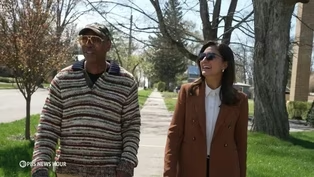
Dave Chappelle on backing his local public radio station
Video has Closed Captions
Dave Chappelle on investing in his Ohio town and backing its local public radio station (10m 8s)
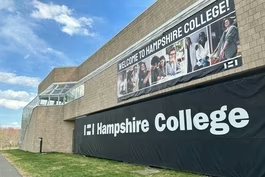
Hampshire closure highlights strain on liberal arts colleges
Video has Closed Captions
Hampshire College closure highlights financial strain on small liberal arts schools (5m 26s)
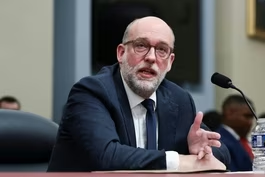
How much of Project 2025 has Trump enacted?
Video has Closed Captions
How much of Project 2025 has Trump enacted? (5m 38s)
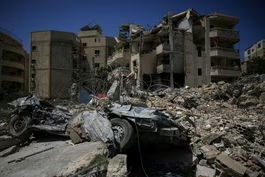
Israel agrees Lebanon ceasefire as U.S. pushes for deal
Video has Closed Captions
Israel agrees to 10-day ceasefire in Lebanon as U.S. pushes for broader peace deal (4m 33s)
News Wrap: Pope warns of 'tyrants' spending billions on wars
Video has Closed Captions
News Wrap: Pope warns of 'tyrants' spending billions on wars (6m 52s)
Tracking the Trump family’s deals, profits in his 2nd term
Video has Closed Captions
Tracking the Trump family’s business deals and profits in his 2nd term (8m 59s)

UN official warns Hormuz dispute disrupting food supply
Video has Closed Captions
UN official warns Strait of Hormuz dispute is disrupting global food supply (5m 35s)
Will Hezbollah abide by Israel-Lebanon ceasefire?
Video has Closed Captions
Why the Israeli and Lebanese governments accepted a ceasefire – and will Hezbollah abide? (4m 45s)
Providing Support for PBS.org
Learn Moreabout PBS online sponsorship
- News and Public Affairs

Today's top journalists discuss Washington's current political events and public affairs.

- News and Public Affairs

FRONTLINE is investigative journalism that questions, explains and changes our world.
One Question with Becky Ferguson











Support for PBS provided by:
Major corporate funding for the PBS News Hour is provided by BDO, BNSF, Consumer Cellular, American Cruise Lines, and Raymond James. Funding for the PBS NewsHour Weekend is provided by...