
February 24, 2026 - PBS News Hour full episode
2/24/2026 | 57m 46sVideo has Closed Captions
February 24, 2026 - PBS News Hour full episode
Tuesday on the News Hour, President Trump prepares to deliver the State of the Union address amid falling approval numbers. As Ukraine marks four years of fighting against Russia's invasion, we speak to the European Union's ambassador to the U.S. about the future of the war. Plus, investigations indicate the Justice Department has withheld parts of the Epstein files that name President Trump.
Problems playing video? | Closed Captioning Feedback
Problems playing video? | Closed Captioning Feedback
Major corporate funding for the PBS News Hour is provided by BDO, BNSF, Consumer Cellular, American Cruise Lines, and Raymond James. Funding for the PBS NewsHour Weekend is provided by...
Support provided by:

February 24, 2026 - PBS News Hour full episode
2/24/2026 | 57m 46sVideo has Closed Captions
Tuesday on the News Hour, President Trump prepares to deliver the State of the Union address amid falling approval numbers. As Ukraine marks four years of fighting against Russia's invasion, we speak to the European Union's ambassador to the U.S. about the future of the war. Plus, investigations indicate the Justice Department has withheld parts of the Epstein files that name President Trump.
Problems playing video? | Closed Captioning Feedback
How to Watch PBS News Hour
PBS News Hour is available to stream on pbs.org and the free PBS App, available on iPhone, Apple TV, Android TV, Android smartphones, Amazon Fire TV, Amazon Fire Tablet, Roku, Samsung Smart TV, and Vizio.
Providing Support for PBS.org
Learn Moreabout PBS online sponsorshipGEOFF BENNETT: Good evening.
I'm Geoff Bennett.
AMNA NAWAZ: And I'm Amna Nawaz.
On the "News Hour" tonight: President Trump prepares to deliver the State of the Union address amid falling approval numbers.
GEOFF BENNETT: As Ukraine marks four years of fighting against Russia's brutal invasion, we speak with the European Union's ambassador to the U.S.
about the uncertain future of the war.
JOVITA NELIUPSIENE, European Union Ambassador to the United States: We don't see a good will on the Russian side to really negotiate the peace.
AMNA NAWAZ: And investigations indicate the Justice Department has withheld parts of the Epstein files that name President Trump.
(BREAK) AMNA NAWAZ: Welcome to the "News Hour."
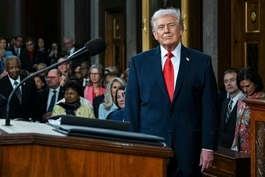
President Donald Trump will deliver the first State of the Union of his second term later tonight.
It comes amid an ongoing partial government shutdown and a massive buildup of U.S.
military assets in the Middle East.
GEOFF BENNETT: Congressional correspondent Lisa Desjardins and White House correspondent Liz Landers are both on Capitol Hill tonight with more on what to expect.
Liz, we will start with you.
President Trump is promising a lengthy speech.
Where are you going to be listening for tonight?
LIZ LANDERS: Well, Geoff, I think everybody should anticipate this going a while.
The president himself said that yesterday previewing this in comments, saying that he has a lot to talk about.
And the White House press secretary, Karoline Leavitt, says that the president is going to say that the union is strong, prosperous and respected and that she says he is going to make the economy a front-and-center issue in today's speech, making the case to the American people directly as to why the Republicans should continue to lead in the House and the Senate as we go into this midterm year.
I think we should expect to hear from the president to talk about that signature tax and spending bill that passed last summer, which included some of those provisions like no tax on tips and some of the tax cuts, but also impacted some Americans who use benefits like Medicaid and SNAP.
We should also anticipate to hear from him about some of the foreign policy accomplishments that he sees, including those strikes in Iran last summer and also the extraction of Nicolas Maduro from Venezuela just a few months ago.
And she says as well that we should anticipate seeing some notable guests up here on Capitol Hill tonight, including Erika Kirk, the widow of the slain conservative activist Charlie Kirk, and also the U.S.
men's hockey team fresh off their win at the Olympics.
They were flown here to Washington on a government plane earlier today and went by the White House.
And we're expecting them to be up in the chamber watching the president deliver the State of the Union speech later.
But, Geoff, this all comes with the background of our latest PBS/NPR/Marist poll that came out yesterday that shows that most Americans don't see the State of the Union as strong right now.
In fact, 43 percent of Americans say that the State of the Union is strong, whereas 57 percent of Americans say that it is not strong.
Americans are also concerned about the system of checks and balances that we have in our democracy here.
And, Geoff, the ultimate test of all of the president's accomplishments that he's going to tout tonight will be the upcoming midterm elections here in November.
Will Republicans be able to buck history and keep their majority in the House and the Senate, Geoff?
AMNA NAWAZ: All right, over to Lisa Desjardins now.
Lisa, Liz just laid out some of the dynamics in the nation the president's going to be speaking to.
Tell us more about the dynamics in Congress that the president has to think about.
LISA DESJARDINS: Well, first of all, there is increased security.
A perimeter fence is up around the Capitol, as are Kyle Midura photographed today.
There's also increased manpower, Capitol Police on 16-hour shifts today.
Inside the chamber, something else different too.
The president may see fewer Democrats.
A significant number of them are boycotting this address altogether, some of them going to an alternate event on the National Mall.
Those who are attending, Democratic leaders have asked them to be respectful and to not interrupt.
One question mark, though, is Representative Al Green, who did interrupt and was asked -- removed from the chamber, asked to leave last year.
I saw him seeming to look for an aisle seat earlier today.
Now, as for the rest of the dynamics here, we know that the Democratic official response is coming from Abigail Spanberger, the newly inaugurated governor of Virginia.
She will be speaking in Williamsburg, Virginia.
That is a note of history, where the first democratically elected legislature met in the British colonies.
She's expected to talk about the cost of living and to argue that President Trump has caused chaos for Americans.
The Spanish-language response will be from Senator Alex Padilla of California.
As to the length of the speech that Liz mentioned, I have to tell you my Republican sources up here, very good sources who are plugged in, told me they are expecting this speech to be over two hours long, maybe more.
GEOFF BENNETT: Well, we will certainly settle in.
Hey, Lisa, while we have you, I know you're tracking this controversy surrounding Republican Congressman Tony Gonzales.
Fill us in.
LISA DESJARDINS: Right.
Tony Gonzales, the Republican from Texas, he is now under calls.
At least seven of the Republicans here have called for him to resign after published reports show text messages between him and a former staff member, where he seems to be asking her to engage in a sexually explicit conversation, which she is rebuffing.
Other text messages earlier indicated the two were having an affair.
Gonzales denied that.
But that staffer last year killed herself.
She died by suicide.
Self-immolation was the cause of death.
He has denied wrongdoing.
But these text messages have really changed this controversy.
A lot of eyes on him.
He has a primary next week.
He said today he will not resign.
But Speaker Johnson really didn't want to answer questions about him today, and I think his fate is up in the air.
GEOFF BENNETT: Lisa Desjardins and Liz Landers, our thanks to you both.
Well, for analysis on tonight's speech, we're joined down by our panel of political analysts.
That's Republican strategist Kevin Madden, Democratic strategist Faiz Shakir, and Tiffany Smiley, former Republican Senate candidate in Washington state.
And, Tiffany, we will start with you.
So this new PBS News poll that Lisa was talking about and Liz were talking about finds that six in 10 Americans believe the country is worse off than a year ago.
This is one of the moments where the president commands the national stage uninterrupted.
What does he need to do, to say, to signal to really change that trajectory?
TIFFANY SMILEY (R), Former Washington Senatorial Candidate: Right, and we're seeing his job approval numbers pretty low, but this is his opportunity to make the case to the American people.
When President Trump came into office, he faced the highest inflation, certainly in my lifetime.
So he had to take a very aggressive, ambitious approach to getting our economy back on track.
And he, from the very beginning, told the American people, I'm going to move swiftly and quickly.
And we're going to have to wait.
Some of these policies are going to take time to come into effect.
But, certainly, when President Trump talks and you feel his energy and you feel his vision and his hope for the future, it feels really good.
But we know from Biden that you simply cannot tell the American people how to feel.
They actually have to feel it.
So this is the case that Trump is going to have to make today.
And I think he will focus on affordability.
He will focus on the economy.
There are things trending in the right direction, 359,000 jobs.
Jobs are up.
Interest rates are down.
Gas prices are down.
You think of his historic -- he historically passed the No Tax on Tips Act this last summer.
So Americans, as they start to file their tax returns, they're going to start to see more money in their pockets.
You match that with this speech, which I anticipate to be very energetic, painting a vision of hope and future for the economy, that it won't just be good for the next three years, but perhaps it'll be good for my three boys and the next generation.
I think it will give a lot of people hope.
You match that with them feeling like more money is in their pocket, and I think it will be a very good night for Republicans.
Not only that.
President Trump has a job to make sure that the Republicans are listening and that they take that message of affordability and his economic plan across the country through the midterms.
AMNA NAWAZ: Let me pick up on that point, Tiffany, you make and bring that to Kevin.
He's not just talking to the American public tonight that's increasingly skeptical of his agenda.
He's speaking to Republicans in Congress, to a majority that has largely been lockstep with his policy agenda.
Do you see some shaping of that midterm messaging happening tonight?
KEVIN MADDEN, Republican Strategist: Well, I think the most important thing is that he actually doesn't submit to talking to the room and he does talk to the American public and he gives them a message that there's a unified Republican agenda on addressing the core concerns that they have.
Tiffany was exactly right.
The main issue here is affordability.
If you -- we look back a year ago, when he first gave an address to a joint session of Congress, that was framed around a lot of promise and it was framed around a lot of optimism.
And he had a political mandate from the 2024 election.
Here we are a year later.
The most important thing that the president can do is square his message with the reality.
And the reality is that Americans are feeling a little bit still of a pinch on inflation and rising prices.
So, talking about that affordability in terms of how he's addressing it, what he's going to do next, that there's a unified plan and agenda, that's going to be the most important thing, because politics is never about litigating the past.
It's always about promising where you can go in the future.
And so this is a concentrated moment with a very important audience of Americans at home watching that he can deliver that message.
GEOFF BENNETT: And, Faiz, what can we take away from how Democrats are approaching this, the more than two dozen Democrats who are boycotting, they're having their own sort of counterprogramming, and also the choice of Abigail Spanberger, the new Democratic governor of Virginia, elected in a competitive state?
What does that say about how Democrats are... FAIZ SHAKIR, Democratic Strategist: In many ways, Democrats have the upper hand here, because you are allowing Trump to dig his hole and bury himself in it tonight.
He will obviously need a job of trying to convince people that the reality isn't the reality, and I think he has a danger here of trying to hector and harangue people to say, hey, dummies, I'm doing a great job, when most people are going to say, hey, do you even know and understand my life?
One of the biggest challenges he has is to align himself with America's priorities.
There's a reason why he doesn't get out on the road and do big rallies and addresses, because he's lost much of the nation.
When you talk about the reality and you say, what did the One Big Beautiful Bill do for my life, how did my student loans go down, they didn't go down.
They went up.
How did health care get -- how did I get affected with health care?
Well, you probably lost it.
How did it affect my taxes?
Well, you're probably paying more.
How did -- what happened to my electricity rates?
Well, they probably went up.
And so that's the reality that people are facing.
And we didn't even get into immigration and how people are feeling, and losing the support of this immigration agenda.
So you're going to see a lot of efforts by him to mask over that and tell people they're dummies.
And all Democrats have to do is present that we want to be a check and an accountability arm on Donald Trump.
Let's make a change.
And that's a pretty easy case to make.
AMNA NAWAZ: Tiffany, pick up on that point, because Kevin even mentioned this earlier, that Americans don't want to hear a litigation of the past.
They want to hear your promises for the future.
President Trump has a habit of going back to the previous administration and laying a lot of blame for the problems and issues and challenges he's facing today.
Can he stay on message on that affordability message that is the number one issue for the American public?
TIFFANY SMILEY: Yes, I have no doubt that he will bring up Biden and the terrible economy that he inherited.
He absolutely will because it's Donald Trump.
But then I think he also will highlight the good things that are happening that -- the things that I mentioned that are trending in the right direction.
Gas prices are down.
Prices in groceries are coming down.
I'm a mom of three boys.
I go to the grocery store.
I know how expensive steaks are.
But it's starting to go in the right direction.
And I'm feeling that.
So, soon, the American people will start to feel that.
And I think those poll numbers will start to change in maybe six months, three months, once these policies really try to take effect.
But I think the Democrats' downside in all of this is that they are playing theatrics.
Almost -- is there like 50 of them who won't be showing up?
They're having state of the swamp, which I say go get your -- go get go to the swamp and get your picture with the swamp creatures.
So I think the Democrats would have been smart to stand in place, to stand with Donald Trump and to not show these political theatrics that the American people are sick of.
The American people are sick of you versus me, us versus them.
They want to see unity.
They want to see everyone for America.
I think everyone in that room wants to see America win, minus a few Democrats, who are still playing political games.
So I think that will play into it as well this evening.
GEOFF BENNETT: What about that, Faiz?
FAIZ SHAKIR: Well, it's hard to -- for Trump to make a case of unity.
We have seen a year of so much dissension and discord, attacks on the media.
I don't have to tell you guys.
Attacks on institutions of learning, universities all across the board, individuals, his retribution and grievance against anybody.
Tish James, John Bolton, you name it, have seen themselves the subject of lawsuits.
He would have to be begging you to just have amnesia or not remember anything of the last year.
And I don't think he does.
I think people have lost -- he's lost the thread with them and they have checked out on him.
So I'm not optimistic that he can get any of them back.
And the question now for Democrats is, can we build an agenda of confidence where you realign America and say not just for the two years of checking on Donald Trump, but for four, six, eight years to come, let's go in a different direction, one that really does deliver for working-class Americans?
AMNA NAWAZ: Kevin, we have been told to expect a long speech tonight.
(LAUGHTER) AMNA NAWAZ: When you look at this, if you were advising the president, if you're crafting this message from a messenger who we know often does ad-lib, often does attack the previous administration, does lay blame on his political adversaries, how do you think he should be approaching this message tonight?
KEVIN MADDEN: Well, first of all, I think meetings, sermons and speeches, they're always better when they're shorter than when they're longer.
So I would be crafting a speech that has a motto that's make the main thing the main thing.
You have an opportunity here to really deliver a message to the American people.
It takes -- when it takes fewer words to do that, I think it has more impact.
So I would be very focused on the affordability issue.
I would talk in not great detail, like actually broad strokes about how I'm going to address food prices, how I'm going to address health care prices.
And I think the interesting thing about State of the Unions is they are a chance to offer a unifying message.
I don't think any voters are really lost.
And your political capital comes from offering a message for the future that is more optimistic than your opponent's.
And so I think that's where this speech can go, if it's going to have an impact, that should go if it's going to have an impact.
GEOFF BENNETT: And, Tiffany, this president cannot be accused of being inaccessible.
I mean, he's in the White House Briefing Room talking to reporters for nearly an hour on end.
He's on TRUTH Social all the time.
In this era where he is constantly communicating... TIFFANY SMILEY: Yes.
GEOFF BENNETT: ... how can he make his time tonight, how can he make it beneficial and useful?
TIFFANY SMILEY: Well, I think that's what's amazing about President Trump is that he does dominate the airwaves and he is in constant communication.
I mean, it's almost like nearly every day, right?
So this is another day in Donald Trump's world, but it's a little more strategic and it's a little more focused and speaking directly to the American people and speaking to the future and what we can hope for and what we can believe in.
And I think if he does a good job of that, that message will carry across the country.
I think it was even just today that consumer confidence is a tick up.
So there's certain things that are really sort of the wind in his sails coming into this speech, and I think he will be optimistic and positive.
It will be a different kind of President Trump than catching him getting on Air Force One or catching him at the White House or catching him in a Cabinet meeting.
I think he will be disciplined and focused and really deliver the message of affordability and the economy that he promised when he came into office.
AMNA NAWAZ: All right, that's Tiffany Smiley, Kevin McCarthy, Faiz Shakir.
We look forward to all of your insights later with us as well tonight.
And you at home can join us for tonight's State of the Union and the Democratic response.
We will have President Trump's address to the nation, plus analysis from our correspondents and our panel of experts.
That is at 9:00 p.m.
Eastern.
In the day's other headlines: "Today Show" co-host Savannah Guthrie says her family is offering a $1 million reward for information leading to the recovery of her mother, Nancy.
In a video message, Guthrie said she and her family -- quote -- "still believe in a miracle" and hope her mother will be found alive, but they also acknowledge it may be too late.
SAVANNAH GUTHRIE, Co-Host, "The Today Show": We also know that she may be lost.
And if this is what is to be, then we will accept it.
But we need to know where she is.
AMNA NAWAZ: Guthrie also announced a $500,000 donation to the National Center for Missing and Exploited Children to support other families facing similar circumstances.
It's been more than three weeks since the 84-year-old Nancy Guthrie went missing from her Arizona home.
Authorities have received more than 20,000 tips, but have yet to make significant progress on finding those responsible.
Millions of people are still digging out from yesterday's winter storm that dropped record amounts of snow across parts of the Northeast.
Meteorologists called the storm the strongest in a decade, with more than two feet of snow blanketing much of New England.
Parts of Rhode Island got more than three feet shattering records.
Officials there have lifted a statewide travel ban, but say the cleanup could take a while.
GOV.
DANIEL MCKEE (D-RI): A full recovery is going to take time, but I can tell you the people behind me and the people that are out doing the work right now and doing everything they can to make sure that recovery is as quick as possible.
AMNA NAWAZ: Hundreds of thousands were still without power today, with more than 200,000 outages in Massachusetts alone, and roughly 2,200 flights were canceled, mostly in the New York area and Boston.
Officials say it could take days for full service to resume.
And, believe it or not, another storm is right around the corner.
This one is originating in the Great Lakes area and could deliver a few more inches of snow to areas already hard hit by this week's blizzard.
On Capitol Hill today, a bipartisan aviation safety bill failed in the House.
It would have required airplanes to carry locator technology, which federal investigators say could have prevented last year's midair collision near Washington that killed 67 people.
MAN: Two-thirds not being in the affirmative, the rules are not suspended and the bill is not passed.
AMNA NAWAZ: The so-called ROTOR Act fell just one vote shy of passing.
It breezed through the Senate back in December, but this week the Pentagon withdrew its support over cost and security concerns.
Instead, the military and airline groups have rallied around a new bill, which lawmakers say is more comprehensive, though it does not have the support of the National Transportation and Safety Board.
The Trump administration is suing the University of California for what it's calling an antisemitic, hostile work environment.
The lawsuit alleges that officials at its Los Angeles campus, or UCLA, -- quote -- "allegedly allowed virulent antisemitism to flourish on campus, harming students and staff alike."
It's the latest attempt by the Trump administration to punish the university for its handling of pro-Palestinian protests in 2024.
And it comes just months after the DOJ tried to cut research funding at UCLA and demanded more than a billion dollars to settle the charges, which the school has refused to pay.
Mexican President Claudia Sheinbaum says there is -- quote -- "no risk" to visitors planning to attend World Cup matches in her country following recent unrest sparked by the death of a major cartel figure.
Speaking to reporters today, Sheinbaum said security forces are working to restore order and that, as she put it, all the guarantees are in place for the tournament.
Her comments come after the death of the man known as El Mencho triggered roadblocks, fires and security clashes, notably in the Jalisco state.
Residents there are worried about losing tourism revenue, with the capital of Guadalajara set to host a number of the World Cup matches.
MARIA DOLORES AGUIRRE, Tapalpa, Mexico Resident (through translator): The government is going to have to have a lot of security.
I think it will have an impact because everyone just saw what happened.
And, of course, people are going to think twice about coming.
Yes it will have an impact.
AMNA NAWAZ: At least 70 people died in the operation that led to El Mencho's death and its aftermath.
A number of international tourists also found themselves trapped in the affected areas and the U.S.
State Department issued a shelter-in-place advisory, though that has since been lifted and flights have resumed.
The director of the Louvre Museum is stepping down months after a shocking jewel heist at the world's most visited museum.
Laurence des Cars had faced increasing criticism since last October's brazen heist, when burglars made off with an estimated $102 million worth of crown jewels.
The theft exposed security gaps at the Louvre.
And, at the time, des Cars offered to resign, but was refused.
Today French President Emmanuel Macron accepted her resignation, calling it -- quote -- "an act of responsibility at a time when the world's largest museum needs calm."
On Wall Street today, stocks rebounded after Monday's losses.
The Dow Jones industrial average added 370 points on the day.
The Nasdaq rose more than 230 points, or around 1 percent.
And the S&P 500 also closed with a solid gain.
And actor Robert Carradine has died.
Part of a family of famous actors, Robert first gained national attention in 1984's "Revenge of the Nerds."
ANTHONY EDWARDS, Actor: We're allowed to have girls in our dorm room?
ROBERT CARRADINE, Actor: Not girls, Gil, women.
We're college men now.
ANTHONY EDWARDS: Isn't college great?
ROBERT CARRADINE: It's going to be a great year.
(LAUGHTER) AMNA NAWAZ: With his guttural laugh and can't-miss glasses, Carradine played Lewis Skolnick that film and a number of sequels.
He went on to co-host a competition show called "King of the Nerds."
Carradine worked steadily for 40 years in film and TV,winning over a new audience as Lizzie McGuire's father on the Disney show of the same name.
His family says Carradine had lived with bipolar disorder for 20 years and that he died by suicide.
Robert Carradine was 71 years old.
Still to come on the "News Hour": the European Union's ambassador to the U.S.
weighs in on the Ukraine war and Trump's tariffs; a veteran whose wife was detained by ICE speaks out; and journalist Norah O'Donnell discusses her new book on overlooked women who shaped U.S.
history.
GEOFF BENNETT: Russia's full-scale invasion of Ukraine began four years ago today.
Europe's largest and most brutal conflict since the Second World War has claimed hundreds of thousands of lives, over 15,000 of them estimated to be civilians.
AMNA NAWAZ: European leaders met again today to pressure Russia as the many rounds of peace talks over the last year have produced few results and as beleaguered Ukrainians struggle to deal with the war's terrible toll.
Nick Schifrin reports.
And a warning: Some images in this story are disturbing.
NICK SCHIFRIN: In Kyiv this morning, a moment of silence for a nation in mourning, four years of war and sacrifice, of air raid sirens and cemeteries filled, four years of grief, of mothers who will never again see their children, the ultimate sacrifice made by more than 100,000 Ukrainian soldiers.
As the hell of this war rages, the front lines become so deadly, it's known as a 12-mile-wide valley of death; 1.6 million Russian and Ukrainian soldiers have either been killed, injured or missing since the start of the war.
That number will reach two million this spring.
More than 60 percent are Russian.
It is usually illegal to enter Russian military cemeteries.
But a woman posted this YouTube video from St.
Petersburg and a poem placed next to the grave of a 30-year-old Russian soldier: "No need to cry for me.
So many of us are dying here, countless of us.
The blood of boys is everywhere."
In Ukraine, it's been the deadliest year of the war.
The targets include kindergartens, one in Kharkiv, where parents and emergency workers ran to rescue 48 children, who all survived, also hospitals, its patients rescued on stretchers, nursing homes evicting the most vulnerable, and entire cities, Irpin, once a bustling Kyiv suburb, now burned out and silent, like the graves of its former residents.
No one nowhere has been spared the war's horrors.
Nearly four years ago, Olha Stiahluk lost her 21-year-old son, Yuri.
OLHA STIAHLUK, Mother of Fallen Ukrainian Soldier (through translator): What someone once considered to be a tragedy, a misfortune, now compared to this, to all this, what's happening here, you grasp what a terrible war this is.
NICK SCHIFRIN: Terrible especially from the sky.
We filmed this week in Izium, already once captured just 18 miles from the front.
Today, they try to protect themselves using nets to catch drones.
But 22-year-old Yulia Kondzha has nowhere to hide with her 1-year-old, Yuliana.
YULIA KONDZHA, Izium, Ukraine, Resident (through translator): There is no shelter.
We sit between the walls, where there are no windows, doors, so that it is a little safer.
My daughter is not afraid yet.
She is too young to understand.
But, still, the attacks have become much more frequent, much more.
NICK SCHIFRIN: Russia has also targeted Ukraine's energy infrastructure, plunging millions into freezing darkness during the coldest winter in over a decade.
That has helped Russia make slow advances even at enormous cost.
In four years, Russia has captured an additional 12 percent of Ukrainian territory, now controlling about one-fifth of the country, including most of the Donbass and the Zaporizhzhia nuclear power plant.
Those are the main territorial sticking points, as Russian, Ukrainian and American negotiators met last week for trilateral talks.
VOLODYMYR ZELENSKYY, Ukrainian President (through translator): One thousand and four hundred and sixty-two days of the full-scale war.
Of course, we all want the war to end, but no one will allow Ukraine to end.
We want peace, strong, dignified, lasting.
That is why there are so many rounds of negotiations and a battle for every word, for every point, for real security guarantees.
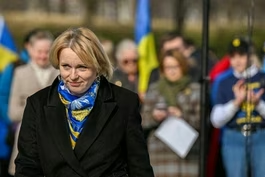
NICK SCHIFRIN: And to discuss this sober anniversary, as well as questions around the future of American tariffs after the Supreme Court on Friday struck down President Trump's tariff structure, I'm joined by the European Union Ambassador to Washington Jovita Neliupsiene.
Thank you very much.
Welcome back to the "News Hour."
JOVITA NELIUPSIENE, European Union Ambassador to the United States: Well, thank you for having me.
NICK SCHIFRIN: Let us begin with Ukraine on this anniversary.
The big step that Europe wanted to take today on this anniversary was to send or confirm a big loan to Ukraine and take a further step to punish Russia.
But Hungary and Slovakia have blocked that package.
Can you overcome those blocks?
JOVITA NELIUPSIENE: Europe actually made the decision, and the leaders a few weeks ago at the European Council made the decision and promised that the loan will be online.
NICK SCHIFRIN: A $90 billion loan to Ukraine.
JOVITA NELIUPSIENE: Exactly.
And I think that what is most important is that everyone keeps its word.
We have to create a space for the leaders to honor their word.
And I'm sure that, by Easter, we will get there, because this is... NICK SCHIFRIN: By Easter?
JOVITA NELIUPSIENE: This is the money which Ukrainians need, not only for their defense, and for making sure that Ukrainian economies get afloat.
NICK SCHIFRIN: Today, Ukraine's ambassador to the United States revealed what she called a demarche from Washington for a Ukrainian attack on an export terminal in the Black Sea in Russia.
The terminal in Novorossiysk exports not only Russian oil, but also Kazakh oil, and that's operated by a consortium, including Exxon, Chevron, Shell, and others.
And Ambassador Stefanishyna said the U.S.
told Ukraine not so much to refrain from attacking Russian energy, but to refrain from attacking U.S.
interests.
So, we are here in Washington.
Do you believe that Washington should be dictating to Ukraine what it can and cannot attack in Russia?
JOVITA NELIUPSIENE: Well, I'm not aware about American contacts with Ukrainians, but let's be clear.
We have an aggressor who actually for the whole winter have been doing nothing less, nothing more, just attacking civilian energy infrastructure.
I don't think that there is a conversation happening or should happen how Ukraine should protect itself.
NICK SCHIFRIN: European intelligence officials I have spoken to recently, and you will know this better than I, have told me and other journalists that Russia is not taking these negotiations seriously.
Is there a fundamentally different assessment between the United States and Europe about how Russia is approaching these negotiations?
JOVITA NELIUPSIENE: We don't see a good will on Russia, Russian side to really negotiate the peace, because there is no proof whatsoever.
One day, you are in a negotiation room, and the same night you actually are bombing energy infrastructure or other kind of civilian infrastructure in Ukraine.
I don't think that this is the proof of the genuine willingness to negotiate.
NICK SCHIFRIN: Let me switch to tariffs.
Of course, on Friday, we got the Supreme Court decision striking down President Trump's tariffs and the deal that the U.S.
has made with the European Union.
This was largely based on a law called IEEPA.
That is what the Supreme Court said the president could not use.
I was told today that the U.S.
trade representative, Jamieson Greer, has delivered a message to Europe: If you respect the trade deal, the tariff rate imposed on Europe will not exceed 15 percent, will not exceed the agreed-upon rate.
Is that accurate that the U.S.
trade representative has given you that information?
JOVITA NELIUPSIENE: Our commissioner for trade, Sefcovic, had several conversations already with the Ambassador Greer, as well with Secretary Lutnick.
And the one request we had is actually to have as much clarity as possible right now.
What we see from the documents is actually 10 percent plus, so-called MFN, which is the... (CROSSTALK) NICK SCHIFRIN: Most favored nation, right.
JOVITA NELIUPSIENE: Most favored nation treatment, which is established by World Trade Organization.
If we take 10 percent and this MFN, it's actually -- in some cases, it's lower.
In some cases, it's higher than 15 percent.
NICK SCHIFRIN: Have they guaranteed you that they won't exceed 15 percent?
JOVITA NELIUPSIENE: I would not want to go into the nitty-gritties.
It's still to be seen how it will be implemented.
What is important for us is actually we will honor the deal as much as we can, but the same should be happening on the U.S.
side.
And the problem what we see is right now is actually that it's temporary and the possible... NICK SCHIFRIN: The new tariffs that the president is now citing, he can only have for a small amount of time.
They're not allowed to be permanent.
JOVITA NELIUPSIENE: Yes, so it's really, for business, any kind of business, be it on the European side of Atlantic or on the American side of Atlantic, the predictability is the key for how you work.
And I think that we will not shy away of defending our interests and our companies.
NICK SCHIFRIN: The European Parliament has paused its approval of the deal from last summer.
Yesterday, President Trump posted on TRUTH Social.
He warned countries -- quote -- "not to play games."
Can you guarantee to the administration that you will respect this deal even as the Parliament is trying to push pause?
JOVITA NELIUPSIENE: I think that our part of the deal, we already implemented part of that.
The deal is always two-sided.
You have to have on both sides a clear understanding of what is going to happen.
And the European Parliament communicated quite clear, quite openly saying, like, we need clarity.
When we have a clarity what is going to happen and how much it will be, what exactly we will be charged, then we can actually proceed, because our part, our regulation is on the table and the Parliament can move.
I do believe that this is a very carefully negotiated deal and it has a value in itself on our side, and we do understand on American side.
So we have to do utmost to make sure it stands, because it actually created certain predictability for business.
So now we really have to move and see how we can make it work.
NICK SCHIFRIN: Ambassador Jovita Neliupsiene, thank you very much.
JOVITA NELIUPSIENE: Thank you.
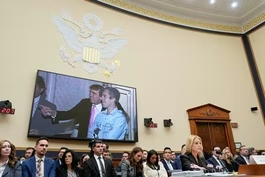
GEOFF BENNETT: A new NPR investigation reveals the Justice Department withheld portions of the Jeffrey Epstein files that contain allegations involving President Trump, including material tied to claims that Mr.
Trump sexually abused a minor and that some pages mentioning him were removed from the public record.
Democrats on the House Oversight Committee called that out today, saying that DOJ's withholding of information could amount to a crime.
For more on that and the surrounding fallout, we're joined now by Julie K. Brown, investigative reporter for The Miami Herald whose reporting helped expose much of the Epstein network.
Julie, welcome back to the program.
It's great to have you.
JULIE K. BROWN, The Miami Herald: Thank you.
GEOFF BENNETT: I want to start with this NPR reporting that the Justice Department withheld some Epstein files related to allegations that President Trump sexually abused a minor, which we should say the White House denies.
What stands out to you about it?
JULIE K. BROWN: Well, I think what stands out is that we don't have the reports, even though we know they exist.
This stems from an interview that they conducted that came out of a tip to the FBI about this woman who has said that she -- when she was 13, that she was sexually assaulted by Donald Trump.
Now, her -- one of her interviews is contained in the Epstein files, although it is heavily redacted, so it's hard to know exactly what she told the FBI.
But as a result of that, we were able to see some of the report numbers and the Bates stamps on it.
And an independent journalist actually named Roger Sollenberger was the person that found out that -- compared that number to the documents that the Southern District of New York prosecutors gave to Ghislaine Maxwell's lawyers as part of her criminal case.
GEOFF BENNETT: You broke this story eight years ago with your investigative reporting.
With the benefit of time in hindsight, what do you see more clearly now about how power insulated Jeffrey Epstein and how much of that protective structure still exists?
JULIE K. BROWN: Well, I think it shows that it absolutely does exist.
I mean, the fact that we aren't getting the full picture, that these files are so heavily redacted, that there are names of men in these files that have been redacted, yet some of these victims' names have not been redacted from the files, it goes -- it shows that this case is still an example of how there are two systems of justice in this country, one for people who have money and power and one for people who don't.
GEOFF BENNETT: Well what key questions remain unanswered?
And where do you think the public and the media might be misunderstanding or oversimplifying what these documents can and can't do?
JULIE K. BROWN: Well, I think that, because I have been on this case for so long, I probably look at it a different way.
And I look at it from the point of view that the Justice Department has never really done their job on this, that the FBI and the Justice Department never took these victims seriously, that they had a preference, I guess, for letting this case just die.
And it would have died if it wasn't for these victims now who have mobilized and become a force for justice and for change.
And it's because of them that we're still talking about this case.
And they're still fighting for the truth here.
And I don't know how much longer the government's going to be able to sit on these files or cover up who is in them.
GEOFF BENNETT: Well, say more about that, because we have seen some private sector fallout in this country, resignations, some reputational fallout, but comparatively little government accountability.
Meantime, overseas, in the U.K., there's been a more direct institutional reckoning.
What do you think accounts for that?
What explains it?
JULIE K. BROWN: Well, I think that right now in our country, we really aren't holding people in authority accountable at all.
I mean, we're seeing it with what's happening with our government, to some degree, with some of the people who work for our government, supposedly working for us, who are making money through their positions in government, instead of using their positions for the public and for a public good.
And I think, if you don't have the kind of government that really wants to work for the people, this is the kind of thing that happens.
I can't explain why European or British government feels that they are taking a different approach.
But I do think that our government for reasons that I think are evident to most people are covering up this crime.
And it is a crime.
It has nothing to do with politics.
It has nothing to do with whether someone's a Republican or a Democrat.
It was a crime against children and women.
And I think, until the public understands that we have to have leaders in our government that are going to fight for women and children, we won't see any accountability in this case.
GEOFF BENNETT: A number of those survivors will be at tonight's State of the Union address.
For them, this isn't history.
This is very much ongoing.
How should we be thinking about this moment from their perspective?
JULIE K. BROWN: I think we should hold all our elected leaders -- like I said, regardless of their political party, we should hold them accountable for how they are treating these victims.
We know that members of the Trump administration, for example, has never met with these victims and have been characterizing this as a hoax.
I think people that actually look at these files know that this is not a hoax, that this is a crime that actually happened.
We have to do things differently and not let this happen again.
GEOFF BENNETT: Julie K. Brown of The Miami Herald, thanks again for your time.
JULIE K. BROWN: Thank you.
AMNA NAWAZ: In the past few weeks, the Department of Homeland Security has posted regular lists of criminals it's deporting as part of its crackdown on illegal immigration.
A Web site now allows the public to view arrests.
Despite the Trump administration's claim it's focused on the worst of the worst, data from the nonpartisan TRAC clearinghouse shows nearly 75 percent of ICE detainees have no criminal conviction.
Our Lisa Desjardins is back now with a look at one example, the wife of a Marine veteran.
Lisa spoke with the husband yesterday.
LISA DESJARDINS: Diana Butnarciuc entered the U.S.
in 2008 on a tourist visa and soon asked for asylum from her native country of Moldova.
That asylum claim was in the courts for years until it was finally denied in 2020.
But, in the meantime, she worked legally, paid taxes, and married a Marine veteran.
In 2020, they applied for her to get a status as his spouse.
They waited six years for her official interview for that.
But when they went to that appointment earlier this month, Diana was instead detained and told she would be deported.
That would block her from return for at least 10 years.
Her husband, Marine veteran Patrick Baja, joins me now.
Patrick, tell us what happened when you went to that appointment at Citizenship and Immigration Services.
PATRICK BAJA, Husband of Diana Butnarciuc: Yes, well, we went to the appointment thinking this is our shot finally.
We are getting the interview that we waited six years for.
And we planned on the interview just as expected.
Once we got into the interview, it was about five minutes.
And we were interrupted by the ICE agents.
The ICE agents entered and they detained my wife.
LISA DESJARDINS: Had you thought something like that could happen?
And did you have time to understand that you might be saying goodbye in that moment?
PATRICK BAJA: Yes, we always knew that there was a risk of something like that happening.
But our lawyer had spoken to USCIS the day before.
And they had never seen anybody detained by ICE ever in that office.
So we were the first ones for them to ever see that happen to.
That moment was very confusing, again, very emotional, just every negative emotion you can think of, confusion.
We -- I didn't -- I couldn't process it and it neither could she.
LISA DESJARDINS: She has two U.S.
citizen daughters from her previous marriage.
How do you think they see this?
PATRICK BAJA: They're feeling the same way as I am, very confused, very emotional, obviously wanting to see their mother.
They miss her dearly and they are just trying their best to live without her.
But, again, it's very, very difficult for them.
LISA DESJARDINS: DHS put out a statement about her case.
And they said that she "has received full due process through her countless appeals.
She has no lawful status to remain in the U.S."
They also said: "Detention is a choice and that she could self-deport."
Patrick, how do you respond to that?
PATRICK BAJA: Yes, again, it's confusing, because that's not what we heard.
We have spoken into many lawyers, and they said that we were on the correct path, doing the right thing.
LISA DESJARDINS: Now, as you know, Diana entered this country legally.
We have talked to other detainees who entered illegal, but she entered legally.
However, she ultimately was under a removal order.
It hadn't been enforced, but do you think she had an obligation to leave?
Under the laws of this country, she was under removal order years ago.
PATRICK BAJA: We were told that she had a removal order, but we appealed it and tried our best to get that completed as soon as we could, because we were told that that was an option.
We're doing the right things, trying to follow the protocol, trying to do everything we could the right way.
LISA DESJARDINS: Yes, there is a real question in cases like yours of, should there be some deference?
I know again that you are a Marine veteran.
I want to ask about her, one question.
Does she have any criminal record, Diana?
PATRICK BAJA: Not at all, squeaky clean.
LISA DESJARDINS: So then I wonder how you see it when the administration says that they are getting the worst of the worst and criminals and how you see this immigration crackdown overall.
PATRICK BAJA: Yes, again, I understand.
Again, me being a military guy, I understand rules, I understand laws, I understand orders.
But, again, with her not having a criminal record and them saying that they're going for the ones that are criminals just doesn't add up to me.
LISA DESJARDINS: You are recognized as 100 percent disabled because of your service to this country specifically.
And I want to ask you, if Diana is deported, what that would mean for you.
And it would also mean she likely could not return for 10 years.
I wonder what you would do as her husband.
PATRICK BAJA: It's been devastating since the beginning, and I don't even know what to expect.
She is my everything.
I mean, I need her every single day.
And already life without her this past week-and-a-half has been a challenge, to say the least.
LISA DESJARDINS: How are you holding up?
What's getting you through?
PATRICK BAJA: I don't even know.
Honestly, I'm just putting one foot in front of the other, trying to do my best, trying to do my best for her to try to exhaust all options of getting her out of there and doing anything I can to help her.
LISA DESJARDINS: Patrick Baja, thank you very much for talking with us.
PATRICK BAJA: Thank you for your time.
I appreciate you.
AMNA NAWAZ: America's 250-year history features prominent men who built and shaped the nation, but less is known about the women whose contributions were just as important.
In her new book, "We the Women: The Hidden Heroes Who Shaped America," Norah O'Donnell writes about 35 remarkable women, each of whom played pivotal roles in influencing the country we live in today.
I spoke with Norah recently, and I began by asking her why these stories needed to be told.
NORAH O'DONNELL, Author, "We the Women: The Hidden Heroes Who Shaped America": The truth is, a lot of women's stories have been lost to history because historians and others didn't think they were important enough to save, quite frankly.
So in uncovering and excavating these great stories, I found myself to be sort of inspired by these women, because they were brave, courageous, gutsy, patriotic.
And I also wonder how much my own sense of self would have changed as a young girl had I learned about these stories.
And, look, that's not just my impression.
In researching this book, the National Women's History Museum says 15 percent of what we learn in school focuses on the achievements and accomplishments of women.
AMNA NAWAZ: Wow.
NORAH O'DONNELL: That has to change.
It's not that women weren't doing stuff.
They were doing plenty.
It's just we haven't highlighted their stories.
AMNA NAWAZ: Well, the book is a good place to start for some ideas we should be learning more about.
I want to touch on just a few so the folks get a sampling of what's in here.
There are some familiar names obviously people will recognize, Eleanor Roosevelt and Patsy Mink, a lot of names I was learning about for the first time as well.
Mercy Otis Warren, you write about her, the intellectual, a writer, historian.
She spent decades crafting a multi-volume history about the American Revolution.
And then John Adams dismissed her, saying: "History is not the province of the ladies."
Why is her story important to know?
NORAH O'DONNELL: Mercy Otis Warren is called the first lady of the American Revolution.
And she looks at the Constitution, what John Adams is doing, and she's an anti-federalist.
She says too much power in the federal government.
We need to focus more on individual liberties, Mercy Otis Warren, a Jeffersonian Republican, and hence becomes the secret muse of the Bill of Rights.
I mean, she was praised by all of the leading men of that era, and yet John Adams didn't like that she criticized him for having too much power in the federal government, the Constitution.
So he said, by the way, history is not the province of ladies.
But I think her story is so important because it's not that she didn't matter in the time period she did.
It's that those of us in the past 250 years didn't think that her story was important enough to be in our textbooks.
AMNA NAWAZ: You write about Charlotte Forten, the abolitionist whose journals, as you write, offer a rare glimpse into the life of a free Black woman in the antebellum North.
What should we know about her?
NORAH O'DONNELL: Well, the Forten family of Philadelphia is one of the most important families of all time in Philadelphia, free family, owned a sail-making company, very wealthy.
But what's really noteworthy about Charlotte is she kept a diary.
And so historians today said, this is really the only recording of we have of a free Black woman in the antebellum North.
She was writing during the Civil War, and then she went south to teach.
And so her writings are considered so important to know what that period was like in time.
And why her story is important is because it's emblematic of all things.
Women's letters weren't kept, women's diaries weren't kept, things that they wrote about, because they weren't considered important.
And that's why the study of women's history also, I think, has been neglected because a lot of the material has literally been lost to history.
It's been burned or discarded.
AMNA NAWAZ: There was a story of a woman, I have literally never heard her name before, and it fascinated me, partly because the image you include in the story is so striking.
She's the very first Native American woman to be buried at Arlington National Cemetery after her death in 1938 Zitkala-Sa, a member of the Yankton Sioux Nation, tell us about her.
NORAH O'DONNELL: Well, Zitkala-Sa as a young girl was taken from her reservation, educated in these boarding schools, well-known writer, composer, great intellectual, won these oratory contests.
But what's notable about Zitkala-Sa is that she was advocating for the rights of indigenous people, for their citizenship in America, and she tied the Declaration of Independence and the very ideals that all men are created equal and said, why does this not apply to indigenous people?
And I think, Amna, that is -- her story is so important because that is the story of America.
All throughout history, groups have been saying, let's live up to the ideals that are in the Declaration of Independence, those important words, we hold these truths to be self-evident that all men are created equal.
Abolitionists said, why doesn't that apply to Black people or African American people?
Suffragists said, why isn't it all men and women that are created equal?
And that's really why the study of history is so important, I think, and also remembering how much these women have been at the center of every great moral and political struggle in American history.
AMNA NAWAZ: While I have you here, I do have to ask about your current journalism home at CBS.
I'd be remiss if I didn't, because you know it's been the subject of a lot of questions and scrutiny, under new leadership.
You have seen some headlines about departures and producers expressing concerns about a culture of fear and uncertainty.
How should people on the outside, reading all of this, look at this?
Do you think those concerns are overblown?
Do you share any of those concerns?
NORAH O'DONNELL: I mean, look, it is a very tough time in the media industry, and it's a tough time, I think, for journalists.
Do I think that some of what is written is overblown?
I do, actually.
I do.
I mean, you can -- what I do is, I focus on my work.
I can't control what's happening at the corporate level at all, but I can control what I do every day.
I recently did an interview with President Trump for "60 Minutes."
I felt no pressure journalistically.
That didn't exist for me.
So -- and that was the same "60 Minutes" team that I worked on with the pope and with my interviews with Joe Biden.
So things have not changed for me personally in terms of my work, and I just focus on building trust, my own personal integrity, and doing the hard work that needs to be done, because, believe me, our job is more important than ever.
AMNA NAWAZ: Well, the new book is out now.
It's called "We the Women: The Hidden Heroes Who Shaped America."
The author is Norah O'Donnell.
Norah, great to see you.
Thanks for being here.
NORAH O'DONNELL: Thank you.
Thank you.
GEOFF BENNETT: Don't forget to stay with us for live coverage of President Trump's State of the Union and the Democratic response.
That starts at 9:00 p.m.
Eastern here on PBS and online.
And that is the "News Hour" for tonight.
I'm Geoff Bennett.
AMNA NAWAZ: And I'm Amna Nawaz.
On behalf of the entire "News Hour" team, thank you for joining us.

4 years into Russia's invasion, Ukrainians face war's toll
Video has Closed Captions
4 years into Russia's invasion, Ukrainians struggle with war's terrible toll (4m 22s)
Analysis of Trump's 2026 State of the Union address
Video has Closed Captions
Analysis of Trump's 2026 State of the Union address (25m 47s)
EU ambassador to U.S. on Ukraine war and Trump's tariffs
Video has Closed Captions
EU ambassador to U.S. on state of Ukraine war and Trump's tariffs (6m 36s)
Investigation reveals DOJ withheld Epstein files on Trump
Video has Closed Captions
Investigation reveals DOJ withheld Epstein files mentioning Trump (6m 17s)

Marine veteran says wife's ICE detention is 'devastating'
Video has Closed Captions
Marine veteran says wife's ICE detention is 'confusing' and 'devastating' (6m 4s)

Norah O'Donnell spotlights women who shaped U.S. history
Video has Closed Captions
Norah O'Donnell spotlights overlooked women who shaped U.S. history in 'We the Women' (6m 45s)
Providing Support for PBS.org
Learn Moreabout PBS online sponsorship
- News and Public Affairs

FRONTLINE is investigative journalism that questions, explains and changes our world.

- News and Public Affairs

Amanpour and Company features conversations with leaders and decision makers.
One Question with Becky Ferguson











Support for PBS provided by:
Major corporate funding for the PBS News Hour is provided by BDO, BNSF, Consumer Cellular, American Cruise Lines, and Raymond James. Funding for the PBS NewsHour Weekend is provided by...