
February 25, 2026 - PBS News Hour full episode
2/25/2026 | 57m 46sVideo has Closed Captions
February 25, 2026 - PBS News Hour full episode
February 25, 2026 - PBS News Hour full episode
Problems playing video? | Closed Captioning Feedback
Problems playing video? | Closed Captioning Feedback
Major corporate funding for the PBS News Hour is provided by BDO, BNSF, Consumer Cellular, American Cruise Lines, and Raymond James. Funding for the PBS NewsHour Weekend is provided by...
Support provided by:

February 25, 2026 - PBS News Hour full episode
2/25/2026 | 57m 46sVideo has Closed Captions
February 25, 2026 - PBS News Hour full episode
Problems playing video? | Closed Captioning Feedback
How to Watch PBS News Hour
PBS News Hour is available to stream on pbs.org and the free PBS App, available on iPhone, Apple TV, Android TV, Android smartphones, Amazon Fire TV, Amazon Fire Tablet, Roku, Samsung Smart TV, and Vizio.
Providing Support for PBS.org
Learn Moreabout PBS online sponsorshipAMNA NAWAZ: Good evening.
I'm Amna Nawaz.
GEOFF BENNETT: And I'm Geoff Bennett.
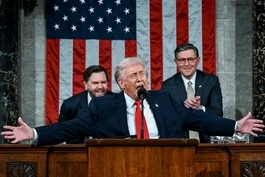
On the "News Hour" tonight: President Trump promotes his agenda and airs his grievances in the longest State of the Union speech in history.
We fact-check some of his claims.
AMNA NAWAZ: The controversial nominee for surgeon general faces congressional scrutiny over her medical qualifications.
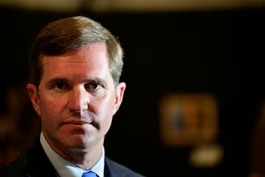
GEOFF BENNETT: And the Democratic governor of Kentucky discusses the messages that are resonating with voters in his red state.
GOV.
ANDY BESHEAR (D-KY): Most people aren't as political as we think they are.
And when they're getting up in the morning, they're not thinking about the next political race.
They're thinking about their job and whether they can support their family.
(BREAK) GEOFF BENNETT: Welcome to the "News Hour."
President Trump touted the economy and his immigration policies in a record-long State of the Union address, and he will soon take those messages on the road.
AMNA NAWAZ: The White House is hoping President Trump can convince Americans to stay the course, as Democrats today slam the speech for being too partisan, divisive, and out of touch with people's economic hardships.
To recap the big night and to fact-check the president's remarks, we start with our White House correspondent, Liz Landers.
REP.
MIKE JOHNSON (R-LA): Members of Congress, I have the high privilege and distinct honor of presenting to you the president of the United States.
(CHEERING) LIZ LANDERS: President Trump, in a marathon address, praised his second-term agenda as a transformation for America.
DONALD TRUMP, President of the United States: It is indeed a turnaround for the ages.
LIZ LANDERS: And promised in many ways to stay the course, even as his approval ratings have plummeted.
DONALD TRUMP: The state of our union is strong.
(CHEERING) LIZ LANDERS: The longest State of the Union ever given, Mr.
Trump spoke for an hour and 48 minutes.
In front of likely his largest TV audience before the midterms, the president's speech was an opportunity for a much-needed reset.
Our latest PBS/NPR/Marist poll shows six in 10 Americans say the country isn't a worse place than a year ago.
Addressing one of voters' greatest concerns right away, Trump put affordability front and center.
DONALD TRUMP: Just hold on a little while.
We're getting it down, and soon you will see numbers that few people would think were possible to achieve.
LIZ LANDERS: He rattled off positive economic data on inflation, gas prices, mortgage rates, and the soaring stock market.
And he put blame on Democrats.
DONALD TRUMP: Suddenly used the word affordability.
They knew their statements were a dirty, rotten lie.
Their policies created the high prices.
Our policies are rapidly ending them.
LIZ LANDERS: One policy promise the president made last night, Trump said he would offer Americans a new type of retirement account that would resemble plans offered to federal workers, complete with matching government contributions.
DONALD TRUMP: We will match your contribution with up to $1,000 each year, as we ensure that all Americans can profit from a rising stock market.
LIZ LANDERS: Four Supreme Court justices were seated in the front row.
DONALD TRUMP: It just came down, very unfortunate ruling.
LIZ LANDERS: Face-to-face with the president just days after the court handed him his term's biggest legal defeat on tariffs.
Trump promised to soldier on with the cornerstone of his economic agenda.
DONALD TRUMP: Congressional action will not be necessary.
It's already time-tested and approved.
LIZ LANDERS: On foreign policy, the president addressed rising tensions with Iran ahead of talks expected in Geneva tomorrow.
DONALD TRUMP: My preference is to solve this problem through diplomacy.
But one thing is certain.
I will never allow the world's number one sponsor of terror, which they are by far, to have a nuclear weapon.
Can't let that happen.
LIZ LANDERS: That moment drawing some of the biggest bipartisan applause of the night, as did some of the president's high-profile guests.
DONALD TRUMP: Here with us tonight is a group of winners who just made the entire nation proud, the men's gold medal Olympic hockey team.
(CHEERING) LIZ LANDERS: Welcoming the team into the chamber, Mr.
Trump promised to award the Presidential Medal of Freedom, the country's highest civilian honor, to team USA goalie Connor Hellebuyck.
And there were more awards and made-for-TV moments, presenting two Congressional Medals of Honor to service members, as well as bestowing purple hearts to D.C.
National Guardsman Andrew Wolfe and posthumously to fellow Guard member Sarah Beckstrom.
Both were shot in D.C.
last year.
This speech was also marked by protests from Democrats.
On Jeffrey Epstein, some members wore "Redacted" pins, calling for the Justice Department to release more of the files.
And a number of the late sex offender's own victims were guests of the Democrats in the chamber, the protests, mostly silent, but not all.
The greatest contrast of the night, and possibly the most heated, came when the president defended his immigration crackdown.
DONALD TRUMP: The first duty of the American government is to protect American citizens, not illegal aliens.
LIZ LANDERS: Mr.
Trump chastised Democrats while Republicans stood and applauded for more than a minute.
DONALD TRUMP: You should be ashamed of yourself, not standing up.
You should be ashamed of yourself.
LIZ LANDERS: Democrats shouted back... DONALD TRUMP: The removal of criminal aliens.
REP.
ILHAN OMAR (D-MN): You have killed Americans.
LIZ LANDERS: ... about the shooting deaths of two American citizens, Renee Goode and Alex Pretty, in Minneapolis last month.
And, notably, there were boycotts.
More than two dozen fewer Democrats were in the chamber.
Many of them were at a counterprotest outside the Capitol.
SEN.
ADAM SCHIFF (D-CA): In November, are you ready to finish the job?
(CHEERING) SEN.
ADAM SCHIFF: In November, are you ready to throw the bums out?
LIZ LANDERS: And the official Democratic response.
GOV.
ABIGAIL SPANBERGER (D-VA): In his speech tonight, the president did what he always does.
He lied, he scapegoated, and he distracted.
And he offered no real solutions.
LIZ LANDERS: New Virginia Governor Abigail Spanberger focused where the president also focused, addressing Americans' affordability concerns.
REP.
ABIGAIL SPANBERGER: Is the president working to make life more affordable for you and your family?
We all know the answer is no.
LIZ LANDERS: Reaction today fell along partisan political lines.
J.D.
VANCE, Vice President of the United States: I think that we've got a lot of momentum here, but the president said this last night, we inherited a mess.
Our ask to the American people is let us continue to fix this mess.
REP.
TED LIEU (D-CA): So Donald Trump is lying, and the American people can either believe what Donald Trump says, or they can believe their monthly bills, but they cannot believe both.
LIZ LANDERS: Presidents often hit the road after the speech to sell their policies directly to the American people.
President Trump will push his economic message in Texas at the end of this week, Amna, ahead of that state's primary elections on Tuesday.
AMNA NAWAZ: Liz, as you just reported there, the president talked a lot about the strength of the economy.
Two claims he made I want to ask you about, one about the price of gas, and the other that getting rid of fraud would enable the U.S.
to have a balanced budget, as he put it, overnight.
What can you tell us about those?
LIZ LANDERS: Let's start with the second part about balancing the budget.
So that's implausible.
We crunched some numbers.
We looked at the math here.
The federal deficit in 2025 was $1.8 trillion.
The 2024 estimate of fraud in the U.S.
government accountability office had a range between $233 billion to $521 billion.
That's a lot of fraud.
But even if you eliminated all of the government fraud, the federal deficit would still only be reduced by a third there.
And then on that second point of gas prices, we looked at gas prices all across the country.
The president said that they are below $2.30 in most states.
That is not true.
Gas prices have fallen as he's been in office.
Since he was inaugurated last year, the price of gas was around $3.11 a gallon.
Now it's down to $2.97 a gallon today, as AAA says.
But no state has an average of under $2.30 a gallon, again, per those AAA statistics.
Same with GasBuddy.
The state with the lowest average price of gas is in Oklahoma, which has $2.40 a gallon, according to AAA.
AMNA NAWAZ: The president also made a claim about reducing the number of Americans receiving food assistance.
Take a listen to what he said.
DONALD TRUMP: And in one year, we have lifted 2.4 million Americans, a record, off of food stamps.
(APPLAUSE) AMNA NAWAZ: Liz, what should we understand about that?
LIZ LANDERS: So the data from the Agriculture Department found that a number of people who received these Supplemental Nutrition Assistance Program benefits, or SNAP benefits, as most people know them, that did decline by 2.6 million people on those benefits from November of last year.
However, that 2.4 million person statistic, the figure that the president refers to is likely Americans who are projected to lose those benefits following the passage of the one Big Beautiful Bill Act over the summer.
So that's not necessarily people who were able to afford to get off of these SNAP benefits.
That legislation expanded work requirements.
So this analysis came from the Congressional Budget Office report, which is why at the time Democrats were concerned about people losing access to those SNAP benefits.
AMNA NAWAZ: We also heard the president continue to make false statements about the elections, including this claim we'll play for people here that many undocumented immigrants are voting in federal elections.
Take a listen.
DONALD TRUMP: We stop illegal aliens and others who are unpermitted persons from voting in our sacred American elections.
The cheating is rampant in our elections.
It's rampant.
AMNA NAWAZ: What do we know about that, Liz?
LIZ LANDERS: That's an outright falsehood.
This has been disproven over and over again by the president's own Department of Homeland Security and a number of other places that have looked at whether there are noncitizens voting in this country.
It happens at an infinitesimally small level.
For example, the Department of Homeland Security did a study after the 2024 election; 49.5 million voter registrations were checked.
About 10,000 cases were referred for additional investigation of noncitizenship.
Amna, that's 0.02 percent of the names that were processed.
Another example, the Heritage Foundation, they looked at voter fraud cases that were brought by prosecutors.
Only 85 cases involving allegations of noncitizen voting were found over a two-decade, 20-year period, from 2002 to 2023.
And also these states do these individual voter roll checks as well.
One example, Georgia, a really important swing state, they did a 2024 audit.
Their secretary of state, Brad Raffensperger, found 20 noncitizens out of 8.2 million registered voters in that state.
And, Amna, of course, Georgia in particular is a state that has the attention of the president.
Right here, we're seeing there's not evidence of noncitizens voting in that state.
AMNA NAWAZ: All right, that is our White House correspondent, Liz Landers, reporting tonight.
Liz, thank you.
LIZ LANDERS: Of course.
GEOFF BENNETT: We start the day's other headlines with ongoing fallout from the Jeffrey Epstein files.
Larry Summers is leaving his teaching post at Harvard University.
The former Treasury secretary appeared hundreds of times in the most recent batch of files related to the late sex offender.
In a statement, Summers called his departure a difficult decision, saying he'll step down at the end of the school year.
Another academic in Epstein's sphere, Nobel laureate Richard Axel of Columbia University's Brain Institute, says he too will resign.
And Bill Gates reportedly apologized to staff at his foundation and insisted he didn't participate in Epstein's crimes.
That was first reported by The Wall Street Journal.
Gates denies doing anything illicit, and none of the men have been charged with any crimes.
A new round of winter weather is sweeping through the northeastern U.S., even as millions cope with the lingering effects of Monday's blizzard.
Forecasters expect another one to three inches of snow throughout the region today.
In New Jersey, the National Weather Service warned drivers to watch out for snow and black ice on the roads, while, in New York, streets and sidewalks were mostly clear after officials used huge amounts of salt and hired thousands of emergency shovelers to clear up the mess.
Meantime power is being restored for hundreds of thousands in places like Delaware, Massachusetts and Rhode Island.
In Brazil, rescue teams are searching for dozens of people still missing after intense rains and floods killed at least 46 people.
Workers retrieved bodies from debris and thick mud, with officials saying the sheer size of the affected area was complicating the search.
Also today, mourners gathered for the funeral of an 11-year-old boy who was killed in the floods.
His father remembered him as a boy with a big heart.
RICARDO DUTRA, Victim's Father (through translator): I'm trying to pick up the pieces because my wife and daughter are still in the hospital, but I only have good memories of my son.
It's about living and loving intensely.
GEOFF BENNETT: Authorities say at least 3,000 residents were forced to evacuate as of this morning, with officials warning that there could be more landslides from another bout of heavy rain expected tonight.
U.S.
Secretary of State Marco Rubio defended the Trump administration's capture of Venezuelan President Nicolas Maduro today.
Rubio was in Saint Kitts and Nevis for meetings with leaders of the 15-member Caribbean community bloc.
According to a State Department transcript, he told the group that -- quote -- "Venezuela is better off today than it was eight weeks ago."
It comes amid rising concerns over President Trump's policies in the Western Hemisphere that includes a series of boat strikes against alleged drug traffickers that have killed more than 150 people and a crippling oil blockade of Cuba that has paralyzed that country's economy.
Meantime, Cuba's Interior Ministry says its soldiers killed four people aboard a speedboat registered in Florida that they say had opened fire on officers in Cuban waters.
Officials provided few details, but say the incident took place about one mile off of Cuba's north coast.
They say six others were wounded.
It's unclear if any U.S.
citizens were on the boat.
In a social media post, Florida's attorney general said that he's ordered prosecutors to work with federal, state and law enforcement to begin an investigation, adding that the Cuban government cannot be trusted.
A U.S.
federal judge is blocking the Justice Department from an unsupervised wholesale search of Washington Post reporter Hannah Natanson's electronic devices.
In his ruling, Magistrate Judge William Porter said that allowing officials to do so would be a restraint on her First Amendment rights and called it the equivalent of leaving the government's fox in charge of The Washington Post's henhouse.
Federal agents seized several devices from Natanson's Virginia home in January, which her paper called outrageous.
The judge says he will review the contents of Natanson's devices himself.
A.I.
giant Nvidia posted another blockbuster earnings report this afternoon.
The company's profit nearly doubled in the fourth quarter to $43 billion, thanks to strong chip sales.
The better-than-expected result comes amid broader concerns that hopes for the A.I.
sector have been overblown.
Ahead of that report, stocks on Wall Street ended higher amid gains in tech shares.
The Dow Jones industrial average gained around 300 points on the day.
The Nasdaq added nearly 300 points of its own.
The S&P 500 closed higher for a second straight day.
Still to come on the "News Hour": the head of the Border Patrol union discusses President Trump's immigration crackdown; and Judy Woodruff delves into who the founding fathers left out and the effects of that 250 years later.
AMNA NAWAZ: Dr.
Casey Means, the popular wellness influencer and ally of Health and Human Services Secretary Robert F. Kennedy Jr., is the president's nominee for surgeon general.
And she faced tough questions on Capitol Hill in a long-awaited confirmation hearing.
GEOFF BENNETT: As a prominent voice in the so-called MAHA movement, some of her ideas, like prioritizing natural foods, reducing pesticides, and exercising consistently, are widely accepted.
But she's also been criticized for more controversial views, from her statements on vaccines and the consumption of raw milk.
Our William Brangham has this report.
DR.
CASEY MEANS, U.S.
Surgeon General Nominee: We are now the most chronically ill high-income nation in the world.
WILLIAM BRANGHAM: While celebrated as a potent fighter for the MAHA movement, Dr.
Casey Means was quickly pressed by some from the president's own party.
Right off the bat, Republican Senator Bill Cassidy, who's also a doctor, grilled Means on her past statements incorrectly linking vaccines to autism.
SEN.
BILL CASSIDY (R-LA): Do you believe that vaccines, whether individually or collectively, contribute to autism?
DR.
CASEY MEANS: Until we have a clear understanding of why kids are developing this at higher rates, I think we should not leave any stones unturned.
SEN.
BILL CASSIDY: There's been a lot of evidence showing that they're not implicated.
Do you not accept that evidence?
DR.
CASEY MEANS: I do accept that evidence.
I also think that science is never settled.
WILLIAM BRANGHAM: Dr.
Means is a wellness influencer.
She went to Stanford Medical School, but didn't finish her residency and doesn't have an active medical license.
Today, Dr.
Means said she believes vaccines save lives, but, as the U.S.
sees a dramatic rise in measles cases, she wouldn't commit to recommending that vaccine.
DR.
CASEY MEANS: I'm supportive of vaccination.
I do believe that each patient, mother or parent needs to have a conversation with their pediatrician about any medication they're putting in their body, in their children's bodies.
SEN.
BILL CASSIDY: You're the nation's doctor.
Would you encourage her to have her child vaccinated?
DR.
CASEY MEANS: I'm not an individual's doctor, and every individual needs to talk to their doctor before putting a medication in their body.
WILLIAM BRANGHAM: Democratic Senator Patty Murray pressed Means about her past comments on birth control.
SEN.
PATTY MURRAY (D-WA): You said Americans -- quote -- "use birth control pills like candy."
You also claimed, contrary to established science, that hormonal birth control has -- quote - - "horrifying health risks for women."
Should women trust the FDA, which approved all 18 methods of birth control?
DR.
CASEY MEANS: If there is not informed consent about their medical history, their lifestyle exposures, and their family history, I want those women, and I know you do too, to be able to have a thorough conversation with their doctor and know whether they are at higher risk for side effects when prescribed an medication.
SEN.
PATTY MURRAY: Saying that is one thing, but saying on different shows that birth control pills are a disrespect of life is very different.
WILLIAM BRANGHAM: Later, Democratic Senator Tim Kaine doubled back on vaccines.
SEN.
TIM KAINE (D-VA): Do you believe that there is no evidence that there's -- the flu vaccine has efficacy in reducing serious injury or hospitalization?
DR.
CASEY MEANS: I -- I -- I.... SEN.
TIM KAINE: This is an easy one, Doctor.
This is an easy one.
DR.
CASEY MEANS: I support the CDC's guidance on the flu vaccine.
WILLIAM BRANGHAM: Despite being repeatedly questioned on this, Dr.
Means argued that reforming the doctor-patient relationship will improve outcomes.
DR.
CASEY MEANS: The constraints on doctors are monumental, and many American parents are frustrated by what they feel like is lack of transparency on the issue of vaccines.
WILLIAM BRANGHAM: Today's confirmation hearing also illustrated some strange bedfellows who agree with part of Means' agenda.
SEN.
BERNIE SANDERS (I-VT): I have enjoyed and appreciated some of the remarks you have made in the past.
WILLIAM BRANGHAM: At times, Democratic socialist Senator Bernie Sanders and Dr.
Means were right in sync.
SEN.
BERNIE SANDERS: You would fight to ban TV ads of junk food?
DR.
CASEY MEANS: I think you will be frustrated by how much I will be talking about ultra-processed foods.
SEN.
BERNIE SANDERS: I won't be frustrated.
I would be delighted.
WILLIAM BRANGHAM: That said, all the Democrats, including Sanders, said they wouldn't support Means' nomination.
But with Republican control of the Senate, her nomination will likely succeed.
SEN.
BILL CASSIDY: The committee stands adjourned.
WILLIAM BRANGHAM: For the "PBS News Hour," I'm William Brangham.
GEOFF BENNETT: Kentucky Governor Andy Beshear has become one of the most closely watched Democrats in the country.
A two-term governor in a deeply red state, Beshear has won statewide office twice, even as President Trump carried Kentucky by wide margins.
In recent years, he's navigated devastating tornadoes and floods, culture war battles over abortion and LGBTQ rights, and the economic pressures facing working families.
Now, as Democrats, search for a message that can resonate beyond blue states and with the 2028 conversation already simmering, Beshear's approach to faith, civility, and bipartisan governance is drawing national attention.
Governor Andy Beshear joins us now.
Welcome to the "News Hour."
GOV.
ANDY BESHEAR (D-KY): Thanks for having me.
GEOFF BENNETT: So, as we said, you have won twice in a deeply red state.
What have you figured out that might be instructive for national Democrats?
GOV.
ANDY BESHEAR: Well, for me, it's about starting with the realization that most people aren't as political as we think they are.
When they're getting up in the morning, they're not thinking about the next political race.
They're thinking about their job and whether they can support their family.
They're thinking about the roads and bridges they drive.
They're thinking about their next doctor's appointment for themselves, their parents, or their kids.
They're thinking about the school they dropped their kids off at and whether they feel safe in their community.
So what I do is, I spend 80 percent of my time focused on those court issues that impact all the people of Kentucky and of the United States of America.
I think a second thing that I try to do is talk like a normal human being.
And a lot of advocacy speak has crept into especially the language of the Democratic Party.
It makes it sound like we're talking at people, instead of to people, or sometimes like we're even talking down to them.
I will give you one painful example.
In Kentucky, we got hit by the opioid epidemic harder than just about anyone.
We have all lost people we love and care about, but I haven't lost a single person to substance use disorder.
I have lost them to addiction.
Now, addiction has meaning.
It's that killer that takes someone from you.
Or, when you're in recovery, you deserve the credit of going up against that really difficult opponent that the word addiction makes people feel.
But I think the last point is the most important.
I don't just talk about my what, because Democrats are very good on the policy.
We can tell you policy point two, subpoint three, bullet point four, I, I, I underneath.
But we rarely talk about why we believe what we believe.
For me, that's my faith.
It's that golden rule that says we love our neighbors, ourself and the parable of the good samaritan that says everyone is our neighbor.
And so when I talk about different decisions I have had to make, different vetoes I have had to make, I respect voters enough to not just tell them the what, but also the why.
GEOFF BENNETT: Let me ask you this, because there is plenty of data to show that key industries in your state, farming and manufacturing, have faced major headwinds as a result of President Trump's economic and trade policies.
And yet voters there are still supportive of him by and large.
What explains that disconnect?
GOV.
ANDY BESHEAR: Well, they're waking up.
They're waking up because we are succeeding in spite of Donald Trump and not because of him.
Now, since I became governor, we have broken every record from private sector investment to new jobs.
Our average incentivized wage last year was $30 an hour.
We are actually making life better for our citizens, trying to expand health care, investing in those roads and bridges, and seeing public safety improve year after year.
But what Donald Trump has done hasn't made life easier.
It's made it harder.
His tariff policy has added $1,600 or $1,700 of cost to our families, who are already struggling with how costs nationally are rising.
His big ugly bill is going to devastate not just rural health care, but rural America.
It threatens to close 35 rural hospitals in my state.
So I think the American people are starting to see not just the fact that the Trump administration makes life harder, but that they go about their business with a level of cruelty that the American people just aren't going to accept.
GEOFF BENNETT: As we said, you are a two-term Democratic governor in a red state.
That alone puts you on the short list for 2028.
How seriously should we take this idea that you might run?
GOV.
ANDY BESHEAR: Well, I have got a lot of work to do this year first.
I have got to keep Kentucky on our winning streak.
I'm also head of the Democratic Governors Association.
So, before I can look at a race in 28, I have 36 races in 2026.
And we are going to win in places that people aren't expecting.
It's important to do that, because, when Democratic governors win, we do what Republicans don't.
We govern well.
We make sure that we're focused on our people and their everyday lives.
And we improve the lives for the people in our state.
But if folks out there, especially on the Democratic side, want a map in 2028 that's not just five states with zero margin of error, yes, it helps to flip a House seat in Des Moines.
But flipping the governor's office in Iowa is how we change that map.
GEOFF BENNETT: Governor, as you well know, there's a real hunger right now in parts of your party for a fighter, someone who meets confrontation with confrontation.
You're often described as measured, even too nice.
How do you respond to the Democrats who worry that your approach might not be the right one for the moment?
GOV.
ANDY BESHEAR: I wouldn't mistake kindness for weakness.
I have gone up against a Republican incumbent governor in Kentucky who was Donald Trump before Donald Trump.
And I'm the one still standing.
I went up against the rising star of the RNC that had the backing of Donald Trump and Mitch McConnell.
I just do it in a different way.
I was always taught that, if someone's yelling and you yell back at them, then no one can hear anything.
And I believe that, by 2028, Democrats, Republicans and independents are going to want anything but someone like Donald Trump.
And so a Democratic version of that, it doesn't heal the country.
It doesn't bring us back together.
I think people are going to want stability.
They're going to want their kids and I want my kids to have a United States that's stable, that we didn't have to worry about its future existence on a daily basis.
I think that's what all of our families crave and it's what they deserve.
GEOFF BENNETT: I want to come back to this issue of faith, because you announced a book coming out in the fall.
And it's described as "an insightful book that reclaims faith as a force for good in public life and rebukes those who use it to harm and discriminate."
That's what's on the publisher's Web site.
When so many white evangelicals have already fused their faith with a particular movement, the MAGA movement, Donald Trump, they backed Trump widely in the last three elections, is your book trying to persuade them or is it speaking to a different constituency altogether?
GOV.
ANDY BESHEAR: Well, the book is speaking to anyone, whether you're a person of faith or not, regardless of what your faith is.
It's about the fact that faith calls us to help people and not harm people.
One of the inspirations for the book for me was, I remember being in church on Sunday and my pastor said, you know when your faith has been hijacked when suddenly your God hates all the same people that you do.
And so, in writing the book, "Go and Do Likewise," the title, those are the last words of the parable of the good samaritan.
It's not just a story.
It's an instruction that we're supposed to lift people up and not kick them while they're down.
And what you're going to see in the book is, I'm going to call out when we have leaders that are making decisions that harm people, especially when they are against the example set by Jesus.
I think about Donald Trump's cuts to SNAP.
About 100,000 people are going to lose their SNAP benefits in Kentucky, and the fact that he became the first president in history to not fund SNAP during a government shutdown.
Well, the miracle of the fishes and the loaves, which is all about people having enough to eat, is in the first four books of the Gospel, the first four.
That means it's pretty darn important if you call yourself a Christian.
GEOFF BENNETT: Kentucky Governor Andy Beshear, thanks again for your time this evening.
We appreciate it.
GOV.
ANDY BESHEAR: Thank you.
AMNA NAWAZ: President Donald Trump's defense of his immigration agenda during last night's State of the Union address came as public support is falling.
In an NBC News poll released earlier this month, 49 percent of people said they strongly disapprove of how Trump has handled border security and immigration.
That's a 15-point jump since last April.
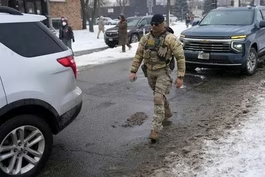
Joining me now is the National Border Patrol Council president.
That's Paul Perez.
He's representing nearly 18,000 Border Patrol agents.
And he attended the address last night as a guest of Texas Senator John Cornyn.
Paul, welcome to the "News Hour."
Thanks for being here.
PAUL PEREZ, President, National Border Patrol Council: Thank you for having me.
AMNA NAWAZ: So the president also mentioned last night we're in the midst of this ongoing partial government shutdown, Democrats blocking DHS funding as they push for changes in enforcement tactics.
Has your agency been impacted by that shutdown at all?
PAUL PEREZ: Yes, our agency is the only one that's impacted.
This is a -- they call it a partial government shutdown, but in fact it's only DHS that's not receiving the funding that we need.
That impacts everything from border security to FEMA operations.
And so it is going to impact the United States in one way or another.
AMNA NAWAZ: So, specifically how?
Do you have to make changes in terms of how you're deploying people or what you're able to do right now?
PAUL PEREZ: Well, so the good thing about the One Big Beautiful Bill is, it allows us to have certain funding for specific matters, but our civilian personnel, most of those people aren't going to get paid during the shutdown.
The money that we have for FEMA operations, hopefully, there's no major disasters because that's where there will be severe impacts.
But people like TSA, anybody that's traveling, there's going to be impacts there.
AMNA NAWAZ: So we know the Democrats are asking for some changes in enforcement tactics.
Asking federal agents to stop wearing masks is one of them.
Do your agents wear masks in the field and has that change something you would support?
PAUL PEREZ: They absolutely do wear masks, and there's a reason for that.
They have targeted our law enforcement officers.
The Democrats have targeted our law enforcement officers by asking them to take off their mask.
But the reason that they're wearing masks is because our agents and officers are getting doxxed.
They're being identified.
Their pictures are being put on the Internet.
They're looking for their homes.
They're looking for their families.
They go after them.
So it's about protecting ourselves, protecting our agents, protecting our families, more importantly.
But, yes, there's a reason.
They have politicized this by coming after our agents.
They have demonized and vilified our agents, calling us everything from Nazis, jackbooted thugs, without failing to realize that the Border Patrol is more than 50 percent Hispanic.
AMNA NAWAZ: Among the many things Democrats are asking for are also a higher bar for warrants, judicial warrants, instead of administrative warrants, when you're searching private properties.
I hear you saying you don't want to give on the masks.
Are there concessions you think that could be made here to change enforcement tactics on the ground?
PAUL PEREZ: That would be very difficult.
That would essentially shut down operations.
That would not allow us to target the people that we're going after.
AMNA NAWAZ: How would it shut down operations?
PAUL PEREZ: We'd have to go to a federal judge.
We'd have to request a judicial warrant when we have already got an administrative warrant for this person's arrest.
This is somebody that's already been through the system, they have already had to due process and they have been ordered deported, either in absentia or they have been going to their hearings and have been ordered to be deported and have not left.
So if we were to have to get judicial warrants, that would mean we have to go to the federal judge and have the federal judge sign on to that for every single person that we have got, which is almost a million people that we have got warrants for.
We would have to essentially stop and go do that for every single person.
There's absolutely no way we could continue.
And I think that Democrats know that.
It would stop it.
It would bring it to a grinding halt, because, number one, it's going to be up to the judges to decide whether they give that judicial warrant.
And once it's in their pipeline, it stays there until they make a decision.
So if you look at how many people we have got and how many times we'd have to go seek a judicial warrant, we wouldn't be able to apprehend or arrest anybody that we're doing targeted enforcement operations for.
AMNA NAWAZ: Paul, big picture here, the Democrats say they want accountability.
And they're asking for this after, as you well know, we have had American citizens who've been shot and killed by federal agents, including a Border Patrol agent in one case.
And you're also talking at a time that the majority of Americans feel like the immigration enforcement actions have gone too far.
This was related to ICE, but some six in 10 Americans say it's gone too far.
Why do you think that is?
Why did the American public see it that way right now?
PAUL PEREZ: Well, I think a lot of it is, the media's misleading the public into how things are going.
If you look at all these incidents, if you look at these operations, these are targeted enforcement operations that these arrest teams are going and executing.
It's American citizens it's people from the public that are going out there, they're interfering, they're impeding, and they're getting in the way of our law enforcement officers without local law enforcement help.
And so what that... AMNA NAWAZ: Paul, if I may, American citizens were shot and killed... PAUL PEREZ: That... AMNA NAWAZ: ... exercising their First Amendment rights.
That's not the media misleading people.
That happened.
PAUL PEREZ: But what you don't see, you don't see the full picture.
You don't see the actual interference, the impeding.
And what's happening with these American citizens that have been killed in both instances that we're referring to, one by an ICE officer and one by a Border Patrol agent, they interfered.
The woman in the car, she refused to follow orders.
The gentleman in the... AMNA NAWAZ: You mean Renee Good.
PAUL PEREZ: Yes, Renee Good and Mr.
Pretti.
AMNA NAWAZ: Yes.
Her partner disputes that, I should say, that she refused to follow.
But please.
PAUL PEREZ: I mean, but there's video to that.
And, again, the investigations are ongoing.
These agents and officers have utilized their training.
In the specific instance with Pretti, that was a target in enforcement in which the subject they were going after got away because of the interference and the impeding.
And so, yes, I get it.
People have lost their lives.
But the way the media spins everything, the way they attack our law enforcement officers, they make it seem as if we're out there doing things that are illegal, we're kidnapping American citizens, we're taking people off the streets.
That's not what's happening.
And because of that, it leads to the rhetoric.
It leads to the interfering.
It leads to these people coming out there thinking and believing that we're doing these bad things and causing them to interfere and interject themselves into lawful law enforcement actions.
And that's dangerous for everybody.
We have asked -- Tom Homan specifically asked for a couple of things, which was to allow us to go into the jails, into the prisons, and take these people under custody there, so that there doesn't need to be a protection -- a group of agents protecting the arrest teams.
If we could do that, if those things were happening from the get-go, if local law enforcement officers were allowed to work with us and not actually become federal immigration agents, but protect our arrest teams, these things wouldn't have happened.
AMNA NAWAZ: Do you think the incidents in which federal agents have fired pepper spray into cars, or broken windows and dragged people from their cars, or shot and injured, if not shot and killed other people, has that contributed to this sentiment that people feel the tactics have gone too far?
PAUL PEREZ: I think people look at that.
They see it.
It's a one-sided story.
There's also the story.
AMNA NAWAZ: How is that one-sided, sir?
(CROSSTALK) PAUL PEREZ: Well, because again, we're only seeing the videos of the aftermath.
We're only seeing the video of where they're removing somebody forcibly from the vehicle.
What we're not seeing as what led to that action.
So if somebody's interfering, if they're impeding, and they don't follow orders to remove themselves from the situation, if they have made a decision that they're going to arrest somebody, then they're going to arrest that person.
And then they have to comply.
If they fail to comply, then our agents and officers are trained to remove people from vehicles, people that are noncompliant.
What you don't see is that they have actually restrained -- they have used a lot of restraint.
We're not using Tasers.
We're not using our ASP Batons.
We're trying to use the minimum amount of force necessary to effect that arrest.
And, oftentimes, these people, they fight back, they physically assault our agents and officers.
And so they do have to use force.
That's what everybody's seeing.
They're not seeing the lead-up to that.
AMNA NAWAZ: I would assume, in the interest of more transparency, you would support body camera usage then across the agents?
PAUL PEREZ: Our agents have had body cameras for a couple of years now.
AMNA NAWAZ: Across the board?
That was something I believe Secretary Noem just said recently would be employed.
(CROSSTALK) PAUL PEREZ: We have got a few people that we -- that do not have body-worn cameras, but a good majority of our agents have had body cameras for a couple of years.
We haven't outfitted every single agent because it went by sector.
They were looking at where they needed them, where there was a lot more apprehensions.
And so that's how we were able to allocate those body cameras.
But not everybody has them.
AMNA NAWAZ: You would support everyone having them?
PAUL PEREZ: But everybody that's been on these deployments has used body-worn cameras.
AMNA NAWAZ: Well, I do want to ask you about those deployments, because I should also say I have spent a lot of time with your agents on the U.S.
southern border.
I have watched them handle large groups of people coming across the border, taking care of children when they're coming unaccompanied or when their parents are not there to take care of them.
They are now being deployed to interior cities, which is a very different environment, to Chicago and Minneapolis, and having to deal with urban environments and protesters who are exercising their First Amendment rights.
Are they being put in a situation that's unfamiliar to them without the right training and tools?
Do you worry about that?
PAUL PEREZ: I believe the training tools have always been there.
We have that type of training.
There have been instances where people have tried to ram through the ports of entry, and our agents have been out there to support our CBPOs, CBP officers, and they have got that training.
They have got riot control training.
Now, is it something that they do every day?
Absolutely not.
I don't think any law enforcement agency does that every day unless you're in large cities like Los Angeles, D.C., or New York City.
But, yes, our agents and officers have that training.
As far as what they're doing on the interior, that's over.
They're back to the border.
We have got almost all of our agents back to the border.
We have got the most secure border that we have ever had in the history of this country.
And so I think that's where they're going to stay.
AMNA NAWAZ: And we should point out those encounters at the southern border with migrants are down at 50-year lows.
So there is a big change there at the border.
Bottom line here, people say they believe some of these tactics are making Americans less safe.
What can you do, what can you say to earn back the trust of the American public?
PAUL PEREZ: Well, people have to look at the facts.
They have to understand who we're actually going after, who we're actually taking off the streets, who we're removing, putting on these deportation flights, or we're locking them up in the United States because they're that bad.
There are some people that we have apprehended that have spent time in state or federal prison that we're not going to just deport to another country because they're going to do time here in the United States.
And so that's what they have got to look at, the facts of who we're actually removing from the streets, making America safe again.
AMNA NAWAZ: If I may, to that point, the data shows some 74 percent of people who are currently detained have no criminal record.
So how does that jibe with the message of making America safer?
PAUL PEREZ: So, again, our targeted enforcement, we're going after the worst or the worst.
Now, what people... AMNA NAWAZ: Seventy-four percent of people, though, have no criminal record.
(CROSSTALK) PAUL PEREZ: What people don't see is that a lot of the people that we're apprehending in conjunction with those arrests are people that are there.
So we're not going to turn a blind eye to anybody that's illegal.
So if you're illegal while we're doing a targeted enforcement, whether it's a vehicle stop, whether it's a house where we go and take somebody into custody, if everybody there is illegal, they're going to be taken into custody.
And that's where a lot of those people that you refer to that are not -- that don't have criminal histories, that's where they're getting arrested as well.
AMNA NAWAZ: You would agree that that's different than the worst of the worst you're targeting, though?
Seventy-four percent of people would not be considered the worst of the worst in your mind?
(CROSSTALK) PAUL PEREZ: These -- the worst of the worst are the people that we're targeting.
These are the criminals.
These are the rapists, the murderers, those people that have warrants of arrest, not only in our country but other countries.
Those are the people that we're targeting.
And, again, other people that happen to be taken into custody, those count towards the arrest numbers, but the worst of the worst are the ones we're going after with targeted enforcement.
AMNA NAWAZ: That's the National Border Patrol Council president, Paul Perez, joining us here today.
Paul, thank you for your time.
PAUL PEREZ: Thank you.
AMNA NAWAZ: We really appreciate you being here.
PAUL PEREZ: Yes, I appreciate it.
GEOFF BENNETT: With the 250th birthday in sight, the Crossroads team is examining what it means to be an American and reflect on what the founders built, who they left out, and what in that 250-year history has been left unresolved.
Judy Woodruff traveled to Vermont, a state with the motto Freedom and Unity, to try to get answers to these questions for her series America at a Crossroads.
JUDY WOODRUFF: Dishes clatter, booths are cramped, and orders fly out of the kitchen.
It's lunchtime at the Country Girl Diner in Chester, Vermont, where the service is brisk and the answers to my questions are thoughtful.
What does it mean to people to be an American?
SCOTT MACDONALD, Vermont Resident: Seeing my country essentially split in half is very, very painful.
JUDY WOODRUFF: For customer Scott MacDonald, the country's bitter political divide is front of mind.
SCOTT MACDONALD: There was a time when you could just quietly disagree with somebody, and that seems to be gone.
JUDY WOODRUFF: Teacher Wendy Hayward told me understanding our past starts with how it's presented.
WENDY HAYWARD, Vermont Resident: The way we have taught history in this country has been an avoidance of what our history is.
JUDY WOODRUFF: The ideas here point to a deeper question, what kind of a country did the founders build, and who did they leave out?
WENDY HAYWARD: What really happened with slavery?
What really happened with minorities, women?
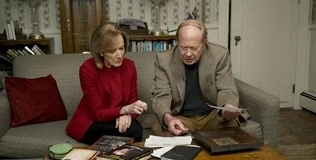
JOSEPH ELLIS, Author, "The Great Contradiction: The Tragic Side of the American Founding": I wanted to be able to go back to the founding.
JUDY WOODRUFF: I met Pulitzer Prize-winning surprise winning author and historian Joseph Ellis at the Echo Lake Inn in nearby Ludlow, Vermont, built shortly after the American Revolution.
JOSEPH ELLIS: This is G.W.
to Joseph Reed December 12, 1778.
JUDY WOODRUFF: He's spent much of his life reading primary documents written by Washington, Jefferson and other founding fathers.
JOSEPH ELLIS: You got to have one idea for one page.
JUDY WOODRUFF: Taking meticulous notes for his books, all written by hand.
JOSEPH ELLIS: We must acknowledge that all of these people were human beings.
They weren't gods.
JUDY WOODRUFF: In his latest book, "The Great Contradiction: The Tragic Side of the American Founding," Ellis acknowledges the founders were trying to do something that had never been done before.
JOSEPH ELLIS: It reversed the tectonic plates of Western political thought.
Power did not flow downward from God to kings, but upward from that mysterious crew called the people to their elected representatives.
JUDY WOODRUFF: But he says a fatal flaw was in how majority will was designed and who was included or excluded from participation.
Ellis adds, when it came to race, the majority of colonialists drew a line.
JOSEPH ELLIS: If you say, do you want to end slavery, they will say yes.
Then do you want a biracial society?
No.
All whites, all of them in the North and the South say the same thing.
JUDY WOODRUFF: By 1776, one in five people in the American colonies were enslaved.
And Native nations controlled most of the land west of the Appalachians.
Yet neither group was included in the Constitution and its promise of we, the people.
JOSEPH ELLIS: Even those that are very much in favor of ending slavery are not in favor of granting them equal treatment at all.
The failure to end slavery means in the end the Civil War is inevitable.
JUDY WOODRUFF: That war that began nearly eight decades after the country's founding left over 600,000 Americans dead and left us as a nation grappling with the same moral question for generations to come, from President John F. Kennedy... JOHN F. KENNEDY, Former President of the United States: The heart of the question is whether all Americans are to be afforded equal rights and equal opportunities.
JUDY WOODRUFF: ... to President George W. Bush... GEORGE W. BUSH, Former President of the United States: Slavery is a blight on our history, and that racism, despite all the progress, still exists today.
JUDY WOODRUFF: ... and President Barack Obama.
BARACK OBAMA, Former President of the United States: Race remains a potent and often divisive force in our society.
JUDY WOODRUFF: And it continues today, as the Trump administration tries to reshape how race is taught and remembered.
(CHANTING) JUDY WOODRUFF: Debates over policing, voting rights and federal power also continue today, including in Minnesota, where federal actions and protests have raised new questions about whom the law protects.
Ellis says the founders postponed a decision on slavery because they feared it would destroy any chance of a new nation before it even came into being.
JOSEPH ELLIS: If they raise the issue during the war, the South will secede and will lose the war.
And if we raise it during the Constitutional Convention, the same thing.
It will never pass.
JUDY WOODRUFF: Ellis contends the second major failure was the exclusion of Native Americans, who were not citizens, had no vote, and were not considered in the treaty that formally declared the United States a nation at the end of the Revolutionary War.
JOSEPH ELLIS: They basically confiscated all their property, claiming they lost the war or something.
They didn't lose the war.
One of the things that propels me towards a more positive view of Washington is that Washington, as president, he's very busy, and his secretary of war comes to him and says, unless we do something, we're on a path that the only Native Americans east of the Mississippi will be in history books.
Your whole future as a distinguished American president will depend upon you getting this right.
JUDY WOODRUFF: Yet, over the next century, the United States signed more than 370 treaties with tribal nations and broke nearly every one of them.
Ellis said George Washington in particular was aware the failures and the founding documents would haunt him.
JOSEPH ELLIS: If you want to understand this chapter in American history, the greatest generation of political leaders in American history did unbelievably large things that we're celebrating right now, and they failed.
And guess what?
Of all of them, Washington knew it the most.
JUDY WOODRUFF: He understood the contradiction the most.
JOSEPH ELLIS: He understood the contradiction.
And he knew that, if his reputation was linked to slavery, it would do him enormous damage.
JUDY WOODRUFF: He also stresses the founding documents aren't written in stone.
JOSEPH ELLIS: The Constitution itself isn't a set of truths.
It's a framework in which we continue to argue about what the truths are.
We have lost that capacity, it seems to me, to argue with each other in a strenuous but friendly way.
JUDY WOODRUFF: And, ever the college professor, Ellis gave each of us an assignment.
JOSEPH ELLIS: Read the Declaration.
It's only two pages' long.
You can pull it up on your cell phone, OK?
JUDY WOODRUFF: Right.
JOSEPH ELLIS: The second is, read a book called "Common Sense."
JUDY WOODRUFF: Thomas Paine.
JOSEPH ELLIS: Thomas Paine.
It's the single most influential book in shaping the way in which American history goes.
WENDY HAYWARD: You don't change history.
History is what it is.
JUDY WOODRUFF: Back at the Country Girl Diner, the weight of that history is still in the air.
WENDY HAYWARD: We have to learn from it.
We have to live it.
And if we want to change, we have that ability.
JUDY WOODRUFF: Including the ugly - - the good, the bad and the ugly.
WENDY HAYWARD: The good, the bad and the ugly.
SCOTT MACDONALD: We have had parts of our history that are shameful, of course, and every country has.
It's what we do about it now that matters.
JUDY WOODRUFF: For Joe Ellis, the historian, the nation's future is what he's most concerned about.
JOSEPH ELLIS: This is the most important midterm election in American history.
The republic is on the ballot.
I can understand which side of the coin you're on, but I cannot understand if you're indifferent.
Whatever position you end up concluding is yours, act on it.
JUDY WOODRUFF: For the "PBS News Hour," I'm Judy Woodruff in Ludlow, Vermont.
AMNA NAWAZ: Julian Shapiro-Barnum is the creator and host of Recess Therapy, an online series where he talks with kids about everything from friendship to the meaning of life.
In tonight's Brief But Spectacular, he shares what adults can learn from the clarity and compassion of children.
JULIAN SHAPIRO-BARNUM, Creator and Host, Recess Therapy: The idea behind Recess Therapy was how can I, a young adult, who needs help figuring out how to navigate the world, get advice from kids who are able to kind of see through all the B.S.
What do you want to say to all the adults who think that kids are grimy and gross?
CHILD: I'm not sticky now.
JULIAN SHAPIRO-BARNUM: Was that for energy or for syncing audio?
Oh, you use it?
(LAUGHTER) JULIAN SHAPIRO-BARNUM: Are you using it?
There were a couple moments where I think Recess Therapy kind of hit the mainstream in a bigger way.
One was the corn kid video moment.
It was one of the most viral videos that TikTok has ever seen.
CHILD: I can't imagine a more beautiful thing.
JULIAN SHAPIRO-BARNUM: I feel like I have spent a lot of my life trying to figure out the best way to have a conversation.
There's so many things that kids do that I wish adults were better at doing.
One is turning strangers into friends.
I wish I could bottle that up and make other adults bring that out of each other.
I had kind of an unconventional upbringing.
I was raised by three moms and two dads.
Everyone's gay.
I had two moms who were together.
They wanted to have a baby.
They asked their best friend at the time, my dad, whose boyfriend is my other dad.
And my dad was the sperm donor to both my moms.
My moms broke up when I was 2 after having me and my brother and sister, raised us all a couple blocks from each other in Brooklyn.
The adults in my life were often more friends.
And I feel like from a very young age, I was having these really mature discussions about life with adults.
And it's something that I have tried to take into my interviews with kids, because I remember being 5 years old and having all these adults ask me such interesting things and asking for my opinion about things.
And now, whenever I meet kids, I do a lot more asking than telling.
My name is Julian Shapiro-Barnum, and this is my Brief But Spectacular take on Recess Therapy.
AMNA NAWAZ: As always, you can watch more Brief But Spectacular videos online at PBS.org/NewsHour/Brief.
And that is the "News Hour" for tonight.
I'm Amna Nawaz.
GEOFF BENNETT: And I'm Geoff Bennett.
For all of us here at the "News Hour," thanks for spending part of your evening with us.
Beshear on how Dems can appeal to voters across party lines
Video has Closed Captions
Andy Beshear on how Democrats can appeal to voters across party lines (8m 20s)
Border Patrol union chief defends immigration crackdown
Video has Closed Captions
Border Patrol union chief defends immigration crackdown and agents' tactics (12m 9s)

A Brief But Spectacular take on Recess Therapy
Video has Closed Captions
Julian Shapiro-Barnum's Brief But Spectacular take on Recess Therapy (2m 18s)
Fact-checking Trump’s State of the Union claims
Video has Closed Captions
Fact-checking Trump’s claims in his State of the Union address (10m 41s)
Joseph Ellis examines the founders’ promise and failures
Video has Closed Captions
As America turns 250, Joseph Ellis examines the founders’ promise and their failures (8m 43s)

Surgeon general nominee faces scrutiny over qualifications
Video has Closed Captions
Surgeon general nominee faces scrutiny over qualifications and views on vaccines (4m 15s)
Providing Support for PBS.org
Learn Moreabout PBS online sponsorship
- News and Public Affairs

FRONTLINE is investigative journalism that questions, explains and changes our world.

- News and Public Affairs

Amanpour and Company features conversations with leaders and decision makers.
One Question with Becky Ferguson











Support for PBS provided by:
Major corporate funding for the PBS News Hour is provided by BDO, BNSF, Consumer Cellular, American Cruise Lines, and Raymond James. Funding for the PBS NewsHour Weekend is provided by...