
November 30, 2025 - PBS News Weekend full episode
11/30/2025 | 24m 9sVideo has Closed Captions
November 30, 2025 - PBS News Weekend full episode
November 30, 2025 - PBS News Weekend full episode
Problems playing video? | Closed Captioning Feedback
Problems playing video? | Closed Captioning Feedback
Major corporate funding for the PBS News Hour is provided by BDO, BNSF, Consumer Cellular, American Cruise Lines, and Raymond James. Funding for the PBS NewsHour Weekend is provided by...
Support provided by:

November 30, 2025 - PBS News Weekend full episode
11/30/2025 | 24m 9sVideo has Closed Captions
November 30, 2025 - PBS News Weekend full episode
Problems playing video? | Closed Captioning Feedback
How to Watch PBS News Hour
PBS News Hour is available to stream on pbs.org and the free PBS App, available on iPhone, Apple TV, Android TV, Android smartphones, Amazon Fire TV, Amazon Fire Tablet, Roku, Samsung Smart TV, and Vizio.
Providing Support for PBS.org
Learn Moreabout PBS online sponsorshipJOHN YANG: Tonight on PBS News Weekend, Pope Leo takes a message of hope and peace to Lebanon, home to one of the Arab world's largest Christian communities.
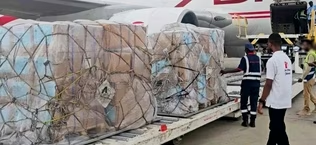
Then, the work of the dismantled US Agency for International Development goes on, thanks to two laid off federal employees and the story behind the first ever descent of Mount Everest's treacherous north face on skis.
MAN: In history, only five souls have ever made it up this route through a number of attempts from a whole bunch of expeditions and we got 12 people to the summit together.
And then I put my skis on and skied back down.
(BREAK) JOHN YANG: Good evening.
I'm John Yang.
On his first international trip as pontiff, Pope Leo is carrying a message of unity and peace to the Middle East.
Today he arrived in Lebanon, where he challenged political leaders to be true peacemakers and set aside their differences.
It's a precarious time in Lebanon.
In addition to the deep domestic political divisions, Israel regularly strikes south Lebanon, straining a fragile truce with Lebanese militias.
Special correspondent Simona Foltyn traveled through Lebanon and has this report.
SIMONA FOLTYN (voice-over): Tucked away in the mountains of northern Lebanon lies Saint Charbel, one of the country's holiest pilgrimage sites.
Millions come to the monastery each year to visit the tomb of the Maronite monk and priest praying for miracles.
Thousands of healings, physical and spiritual, have been attributed to the saint.
One miracle, though, has remained peace.
George Karout hopes the Pope's visit can steer the country on the right course.
GEORGE KAROUT, Pilgrim (through translator): I have great hope, God willing, that this visit will have an impact, because we are exhausted and if it doesn't change anything, we will go towards a very difficult place.
SIMONA FOLTYN (voice-over): A ceasefire signed a year ago was supposed to end the war between Israel and Hezbollah, but Israeli bombardment never stopped and is even intensifying.
George believes that the solution is to disarm Hezbollah.
GEORGE KAROUT (through translator): What is required in the first place is that there is a state and that the weapons are united in the hands of the state.
There is international pressure that we must do this, and this isn't just international pressure.
It's in our interest as Lebanese.
There is no economy, no money, there's nothing.
No country, Arab or Western, will give us any support if these weapons remain.
SIMONA FOLTYN (voice-over): And the clock is ticking.
Israeli and American pressure to dismantle the paramilitary group before the end of the year has once again deepened rifts between Hezbollah's Shia constituents and Christians.
During the Lebanese civil war, some Christian factions were allied with Israel, which remains a sensitive topic.
Father Boutrus Ziadi hopes the Pope can defuse tensions.
FATHER BOUTRUS ZIADI, Priest, Saint Charbel (through translator): We, the Lebanese Christians and Muslims, agree with one another despite the meddling of some people and some outsiders.
They are trying to divide the Shia, the Sunnis, the Maronites, but it hasn't caused a big crisis between us.
People continue to reconcile.
SIMONA FOLTYN (voice-over): Lebanon has 18 officially recognized religious groups, 12 of which are Christian.
While Christian populations elsewhere in the Middle East have steadily declined, Christians still account for roughly a third of Lebanon's 5 million people, the largest percentage in the region.
The Pope's visit has drawn visitors from Nina and Far.
Nina Bouhasin came with her grandchildren from St.
Louis, Missouri.
NINA BOUHASIN, Lebanese-American pilgrim: Well, I was born in Lebanon, educated in Lebanon, and then I met my husband in Lebanon, and then he and I came to the United States 56 years ago.
SIMONA FOLTYN (voice-over): Decades later, wars and economic hardships still push Lebanese to leave.
NINA BOUHASIN: Lebanon is losing the prime youth that are educated.
Then they go everywhere and establish themselves and excel in whatever field they choose.
And they live so well, and yet they're deprived to live in their own country.
SIMONA FOLTYN (voice-over): A country reeling from conflict.
Once more, we leave the Christian heartland in the north and drive south.
SIMONA FOLTYN: We're headed to Lebanon's border with Israel to meet a Christian community there.
This is a part of the country that has been heavily affected by the war and that the Pope will not be visiting.
SIMONA FOLTYN (voice-over): 90 miles further south, we arrive in the ruins of Yaroun, a mixed Christian and Muslim village.
In the heart of the historic center, I met Father Charles Nadav.
He showed me what's left of the Catholic Church.
It has weathered Lebanon's many wars, none as devastating as this one.
FATHER CHARLES NADDAF (through translator): In the 2006 war, the church was also hit.
But in 2023, the damage, as you see, was much greater.
SIMONA FOLTYN (voice-over): The church was built 200 years ago and was renovated in 1923.
CHARLES NADDAF (through translator): The church was very beautiful.
We organized a jubilee to commemorate the renovation of the church.
SIMONA FOLTYN (voice-over): And then this latest war began when Hezbollah fired a rocket in a symbolic show of support to its ally Hamas.
Israel responded with a punishing bombing campaign and ground invasion that left more than 4,000 Lebanese dead and many villages in ruins.
The church was hit several times as the fighting raged on.
But the biggest blow came after the ceasefire went into effect.
CHARLES NADDAF (through translator): When the war ended, the Israelis destroyed the wall with an explosion as they were blowing up the houses.
SIMONA FOLTYN: How has this conflict affected the Christian community here?
CHARLES NADDAF (through translator): The Christians in this village have been greatly affected.
They've been displaced from their homes.
SIMONA FOLTYN (voice-over): In total, 560 houses in Yaroun were destroyed, many in controlled detonations before the IDF withdrew from the village.
SIMONA FOLTYN: Yaroun used to be one of the most beautiful villages in the south, with old stone houses dating back hundreds of years, of the 55 Christian families that used to live here, now only 16 remain.
SIMONA FOLTYN (voice-over): Ronnie Hourani belongs to one of those 16 families.
His home was only partly damaged.
He still has with the municipality, which has given him the means to renovate.
His neighbors are not so lucky.
RONNIE KHORANI, Resident of Yaroun (through translator): Some people are afraid that if they renovate their homes, they'll be hit again and others don't have the money.
SIMONA FOLTYN (voice-over): Israel has violated the ceasefire around 10,000 times, according to the U.N.
peacekeeping mission.
While only a couple of dozen violations have been recorded on the Lebanese side.
The ongoing strikes are likely a reason the pope is staying away.
RONNIE KHORANI (through translator): He should have come here to Yaroun because the church was destroyed.
He should have come to see how we are doing.
The people of the south and especially the Christians really needed him.
SIMONA FOLTYN (voice-over): And so the community sent a stone from the demolished church to Beirut to be blessed by the pope.
Few believe this symbolic gesture will change their lives.
For PBS News weekend, I'm Simona Foltyn in Lebanon.
JOHN YANG: In tonight's other headlines, Israeli Prime Minister Benjamin Netanyahu is seeking a preemptive pardon in the midst of his years long corruption trial.
Netanyahu said a pardon would heal divisions in Israeli society, but initial public reaction suggested otherwise.
The appeal was made to Israeli President Isaac Herzog.
His office called the request extraordinary and said it would be considered responsibly and sincerely.
Homeland Security Secretary Kristi Noem said that the Afghan national accused of shooting two National Guard members in Washington, D.C.
killing one of them, appears to have adopted radical ideas while in the United States.
She spoke on NBC's Meet the Press.
KRISTI NOEM, Secretary of Homeland Security: We believe he was radicalized since he's been here in this country.
We do believe it was through connections in his home, community and state.
And we're going to continue to talk to those who interacted with him.
JOHN YANG: The Associated Press reports that a community advocate said the suspect had been unraveling for years, unable to hold a job and isolating himself for long stretches.
Severe weather is interrupting millions of Americans plans for getting home.
FlightAware said that by late this afternoon, nearly 7,800 flights had been delayed and about 660 canceled as a winter storm dumped heavy snow from the Midwest through the Great Lakes.
In the Chicago area, an estimated half foot of snow fell, while in Milwaukee, utility crews worked to restore power to thousands.
Another system is forecast to bring winter weather on Tuesday from New England to the Mid Atlantic.
Still to come on PBS News Weekend, two laid off federal employees who are keeping the work of USAID alive and the man who climbed Mount Everest and became the first person to ski down its most challenging route.
(BREAK) JOHN YANG: When the U.S.
Agency for International Development shut down, more than 80% of its programs were cancelled.
In an attempt to keep the most cost effective and life-saving projects up and running, two laid off agency employees created a website called Project Research Optimization.
It matches donors with threatened programs.
So far, they've helped keep nearly 80 projects running in 30 countries.
Ali Rogan sat down with the founders, Caitlin Tulloch and Rob Rosenbaum.
ALI ROGIN: Thank you both so much for joining us.
Caitlin, first to you.
What was it like when you realized that USAID was going to be essentially shutting down?
And what were you the most worried about happening after that?
CAITLIN TULLOCH, Founder, Project Resource Optimization: Thanks, Allie.
It really was a tumultuous time earlier this year.
I think initially were trying to figure out what the impact of the executive orders was going to be in terms of future programming.
And there was a belief that there would be future programming, USAID would continue in some way.
But after not too long, I think you could really read the tea leaves and understand that the agency as a whole was going to be shutting down.
And I think the scariest part of that, the part that really a lot of us had to spend a lot of time sitting with and processing, was that when you knew what USAID had been doing and the importance of some of these programs for global health, for survival in crises around the world, the thought of that just blinking out was really scary.
ALI ROGIN: And Rob, as somebody inside, as this all was happening, we heard many advocates for USAID saying this is going to lead to instability, hunger, deaths.
But as people who are watching this very closely, what have you seen in terms of the impacts on the ground?
ROB ROSENBAUM, Founder, Project Resource Optimization: Unfortunately, that is starting to really bear out.
And unfortunately, I don't think that we have seen the sort of full effects of this.
Many of the outcomes that the programs at USAID were set up to support take a long time to actually come to the fruition.
Immunizations that are not being met, those have lifetime consequences for children.
But where we are seeing kind of the most immediate impact of this is in humanitarian settings where health and nutrition services are not reaching children who desperately need them.
ALI ROGIN: So, Caitlin, tell me a little bit more about that.
What sort of programs are you connecting funding with?
And what is your criteria for basically picking which programs you're going to seek to connect to new sources of funding?
CAITLIN TULLOCH: As we understood that actually everything was at risk, I think that forced us to do a really terrible triage and focus on programs that we knew to be life-saving.
And that meant mostly programs from USAID's humanitarian portfolio and its global health portfolio.
I think the kinds of programming that we're looking at, as Rob mentioned, it's immunization for children under five, helping keep kind of global infectious disease burdens low.
And we saw in four or five countries, programs where the vaccines had already been procured.
The technical assistance to help strengthen the government's outreach and delivery of these vaccines was planned.
And then overnight the plug was pulled.
The other one that weighs heavily on my mind, I spent a couple of years working on treating children who are facing acute malnutrition.
This is, you know, at risk of starvation.
That usually happens in humanitarian settings, places like Sudan.
And so you saw the supply chain for things like this, ready to use food that helps keep children alive, all of a sudden being shut down, things being locked in warehouses.
ALI ROGIN: Rob, now you have funding through your platform flowing back into projects across 30 countries.
What does that look like?
And was it difficult to get some of these programs back up and running once funding had been paused?
ROB ROSENBAUM: Our approach has really been to try to figure out, in a really rapid triage kind of an approach, what are the programs that are delivering the most impact per dollar spent.
We call this cost effectiveness in terms of saving lives.
And we are able to do that because there's a huge amount of evidence out there of research that's been done to understand what are the interventions and the ways that programs are delivered that can lead to these types of outcomes.
And so went out searching for the programs that we understood were going to be delivering the most impact per dollar spent to reach out to those programs to really understand what they were doing, and then to use that information to try to crowd in private capital and private philanthropy to pick up some of those pieces.
We had a few donors at the beginning who kind of helped us build some momentum and get this thing going.
And as time has gone over the last eight to nine months, we've seen more and more people kind of come up and step forward and say, hey, this is something I really care about and this is a really important thing to do.
ALI ROGIN: You've used the word Rob, sticking with you a few times triage, which indicates an emergency situation.
Is there a point at which this no longer becomes an emergency operation and it becomes something that is a little longer term?
Are there plans for that at this point?
What does the future of this look like?
ROB ROSENBAUM: The bottom has not fully fallen out on this in terms of the like, long term consequences and the impact of what's happening.
And unfortunately, I do not think a lot of the funding that currently been cut is coming back in the next year or two.
So we've been working really hard over the last year again to triage these projects and to find those that we think are kind of most in most need of urgent funding.
We are continuing to do that from now through the beginning of next year.
We are kind of doing a last mad dash to say, are there any projects that should have met, that have met our criteria that we may have missed and rapidly kind of assessing them and getting them onto our platform to bring more funding in.
And then as we move into the new year, I think we're really moving into a new phase of this thing where we are focusing on what is the design of programs that really can lead to the most impact per dollar spent and how do we continue to work with the partners who are delivering this work, who have been delivering this work for many years now to help them streamline their programming, continue to do it at the highest possible level, and then continue to bring more and more private philanthropy in to help fill some of these gaps.
ALI ROGIN: Caitlin Tulloch and Rob Rosenbaum with Project Resource Optimization, thank you both so much.
ROB ROSENBAUM: Thank you so much, Ali.
CAITLIN TULLOCH: Thank you.
JOHN YANG: When adventurers talk about Mount Everest, most often it's about climbing the world's highest peak.
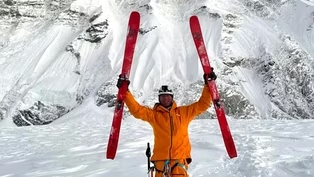
In October, Jim Morrison went the other way, becoming the first person to ski down Everest's most dangerous route.
It was chronicled by Jimmy Chin, a mountaineer and an Academy Award winning filmmaker for an upcoming National Geographic documentary.
Jim Morrison joins us now.
Jim, where did the idea for this come from?
JIM MORRISON, Mountaineer: This is a lifetime of skiing in big mountains all over the world.
And my partner Hilaree and Elsa and I have been working towards this endeavor for a long time.
JOHN YANG: Hilaree, we should note, died tragically in an avalanche on another Himalayan mountain in 2022.
You had planned to do this together?
JIM MORRISON: We had.
We dreamed this up.
Shortly after we had skied a neighboring mountain, the fourth highest mountain in the world, lhotse, right next to Everest, and been working towards getting there and achieving this goal together.
JOHN YANG: How long have you been doing this sort of thing?
JIM MORRISON: Really, my whole life.
I've been trying to make a turn on the side of the ski run as a little kid and in the steepest, hardest, firmest snow I could find and see what I could and couldn't do on my skis.
And it's been my life's passion to climb interesting mountains all over the planet.
JOHN YANG: Climb interesting mountains?
In order to ski down, you've got to get to the peak.
Talk about the climb up.
JIM MORRISON: The mountaineering side of climbing mountains has always fascinated me, but I've consistently looked at it with an eye of how can I climb that route but then ski back down.
Because walking down is not nearly as fun as skiing.
This particular mountain, we climbed a route called the Super Direct on the North Face.
And in history, only five souls have ever made it up this route.
Through a number of attempts, from a whole bunch of expeditions.
And we got 12 people to the summit together.
And then I put my skis on and skied back down.
JOHN YANG: Some of the pictures I've seen, you had a very narrow margin for error.
You were skiing in areas where if you slipped, if you lost an edge, you'd sort of have a precipitous fall.
How did you manage that?
JIM MORRISON: It was hard.
First of all, I was very nervous leading up to this expedition.
I visualized the whole thing.
I trained for it.
And once I was on the summit, I just got very focused and paid attention to what was right in front of me, didn't pay attention to what was below me or the exposure and just made very calculated, careful turns, skied within my ability where I knew I could stay on my feet and not make a mistake.
And turn by turn, I made my way down 29,000 feet down to 20,000 feet.
JOHN YANG: I have no idea what the snow is like up there.
Was that a challenge, what the snow was like, or did it actually help you, or did it make no difference?
JIM MORRISON: The snow was very challenging.
We had a really significant windstorm just before went up the mountain that stripped most of the soft, fresh snow down to what was virtually ice.
So navigating the different terrain of the snowpack, the ups and downs, and the ice that was in certain areas was a real challenge of the descent.
At the same time, there was very little avalanche risk, which made it safe for us to climb and safe for me to descend.
In that regard.
JOHN YANG: You say skiing down, you had to sort of pay attention, make sure you're skiing within your abilities.
Was there a point at which you felt, okay, I can exhale now.
I think I've got this?
JIM MORRISON: Yeah, that point was at the very bottom when I crossed what's called the Bergschrund, which is the crack in the glacier at the bottom of the mountain.
Until that point, it was very intense, and every turn mattered, and I didn't have an opportunity to really let my guard down.
But once I got onto the flat part of the glacier at the bottom of the mountain, I had a true exhale of physical calming down physically and a real emotional release.
JOHN YANG: Talk about that.
What it felt like to actually do this when you know you had done this.
JIM MORRISON: Yeah, you know, this is something that we have been working on for so many years.
We were there three different expeditions trying to get up the mountain, and I had a huge team supporting me, a lot of people around the world pulling for me and helping me achieve this goal.
And to get to the bottom, to have pulled off climbing this direct north face of Everest and then skiing all the way back down was a dream come true and something I felt really connected to Hilaree and sort of honoring her legacy and our life together.
I was just exuberant and ecstatic and really had a hard time understanding how I was going to move forward.
I just felt like I was about to have a physical breakdown of emotion and thrill.
JOHN YANG: Now, you had major knee surgery just in April.
Was there any point this summer when you thought, well, maybe we'll do this next year?
JIM MORRISON: I was pretty committed to going this summer, but having surgery on April 23rd and going to Everest in the end of August was a real challenge.
I worked with a great team of doctors and physical therapists to get me ready and checked all the boxes along the way.
Felt really good coming into the latter part of the summer, and, man, it was quite a first run on a new knee.
JOHN YANG: Talk about checking boxes.
You've done this.
What's next?
JIM MORRISON: Well, there's all kinds of nexts in my life.
For now, I'm going to try to celebrate this achievement and share my story and start thinking about what other mountains there are to ski and what other places there are to explore.
JOHN YANG: Remarkable achievement.
Jim Morrison, thank you very much.
JIM MORRISON: Thank you.
JOHN YANG: And that is PBS News Weekend for this Sunday.
I'm John Yang.
For all of my colleagues, thanks for joining us.
Have a good week.
Former USAID employees keep agency’s life-saving work afloat
Video has Closed Captions
Clip: 11/30/2025 | 6m 19s | Former USAID employees keep dismantled agency’s life-saving work afloat (6m 19s)

Lebanese Christians share their feelings about pope’s visit
Video has Closed Captions
Clip: 11/30/2025 | 6m 52s | Peace remains elusive for Lebanese Christians as Pope Leo visits war-torn country (6m 52s)
The story behind one man’s historic Everest descent on skis
Video has Closed Captions
Clip: 11/30/2025 | 6m | The story behind one man’s historic descent of Mount Everest on skis (6m)
Providing Support for PBS.org
Learn Moreabout PBS online sponsorship
- News and Public Affairs

FRONTLINE is investigative journalism that questions, explains and changes our world.

- News and Public Affairs

Amanpour and Company features conversations with leaders and decision makers.
One Question with Becky Ferguson











Support for PBS provided by:
Major corporate funding for the PBS News Hour is provided by BDO, BNSF, Consumer Cellular, American Cruise Lines, and Raymond James. Funding for the PBS NewsHour Weekend is provided by...