
October 16, 2026
10/16/2026 | 55m 52sVideo has Closed Captions
Kerry Kennedy; Liani Greaves; David Greaves
Kerry Kennedy, daughter of AG and Senator Robert Kennedy, who was assassinated in 1968, discusses her new biography of her mother, Ethel Kennedy. Nick Paton Walsh reports on the violence in Haiti. In 1972, William Greaves recorded the last known gathering of Harlem Renaissance luminaries. His son and granddaughter, Liani and David Greaves, have now brought that footage to light in a new film.
Problems playing video? | Closed Captioning Feedback
Problems playing video? | Closed Captioning Feedback
October 16, 2026
10/16/2026 | 55m 52sVideo has Closed Captions
Kerry Kennedy, daughter of AG and Senator Robert Kennedy, who was assassinated in 1968, discusses her new biography of her mother, Ethel Kennedy. Nick Paton Walsh reports on the violence in Haiti. In 1972, William Greaves recorded the last known gathering of Harlem Renaissance luminaries. His son and granddaughter, Liani and David Greaves, have now brought that footage to light in a new film.
Problems playing video? | Closed Captioning Feedback
Where to Watch Amanpour and Company
Amanpour and Company is available to stream on pbs.org and the PBS app.
Watch Amanpour and Company on PBS
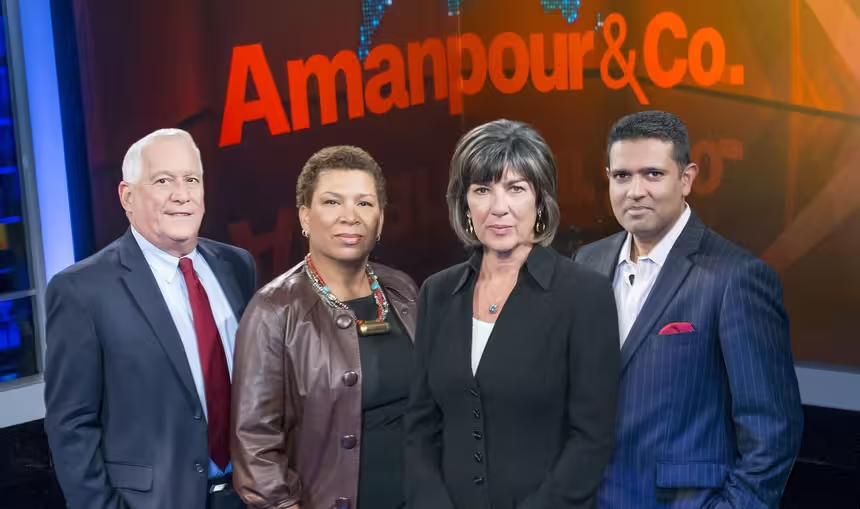
PBS and WNET, in collaboration with CNN, launched Amanpour and Company in September 2018. The series features wide-ranging, in-depth conversations with global thought leaders and cultural influencers on issues impacting the world each day, from politics, business, technology and arts, to science and sports.Providing Support for PBS.org
Learn Moreabout PBS online sponsorship[MUSIC] Hello everyone and welcome to Amanpour & Company.
Here's what's coming up.
As Trump's Washington makeover bulldozes parts of American history, a rare look at one of the families who helped shape it.
I speak to Kerry Kennedy about her new biography, her parents Robert and Ethel, and her MAGA brother, RFK Jr.
The fight to save Haiti's streets from armed gangs.
Nick Payton Walsh goes inside with the forces trying to restore order in a country on the brink of collapse.
Also ahead... The Renaissance period was a period through which I lived.
One night, four cameras and a cocktail party full of artists from the Harlem Renaissance.
Filmmakers David and Liane Greaves take audiences back to a fateful gathering in 1972 in their new documentary, Once Upon a Time in Harlem.
Amanpour and Company is made possible by the Anderson Family Endowment, Jim Attwood and Leslie Williams, Candace King Weir, Charles Rosenblum, Monique Schoen-Warsaw, the Sylvia A. and Simon B. Poyta Programming Endowment to Fight Antisemitism, the Strauss Family Foundation, the Peter G. Peterson and Joan Gantz Cooney Fund, Koo and Patricia Ewen, committed to bridging cultural differences in our communities.
Barbara Hope Zuckerberg.
And by contributions to your PBS station from viewers like you.
Thank you.
- Welcome to the program, everyone.
I'm Christiane Amanpour in London.
The Oval Office adorned in gold, the Rose Garden paved over, and the East Wing reduced to rubble.
While presidents have come and gone, the White House has endured as a symbol of American history and tradition.
Well, not anymore.
President Trump's new vision for Washington now includes threatening to take a wrecking ball also to the Kennedy Center, a memorial to the slain JFK.
My first guest, Kerry Kennedy, is doing what she can to preserve the family legacy.
She is JFK's niece, and she's the daughter of Robert Kennedy, Attorney General, Senator, civil rights partner to Martin Luther King, and a presidential candidate himself when he was also assassinated in 1968, a few short months after Dr.
King.
At his side throughout, his wife Ethel.
Now, Kerry chronicles her mother's life and her work in a new biography, "Ethel Kennedy."
I spoke to Kerry about all this, rich history, and much more, when she joined me from New York.
Kerry Kennedy, welcome to the program.
- Great to be with you, as always.
- You've written this amazing book on your mother, and I'm going to, you know, say the actual title, "It's the Extraordinary Life and Bold Legacy of Ethel Kennedy."
Now, obviously, you're a woman who loves her mother, but what is it that you want the world to know about your mother's role and what she did for America and for the world?
>> You know, I think this is an amazing story.
It's a story of rags to riches.
It's this incredibly beautiful love story with my father, and it's the story of a woman who was, had 10 children, was pregnant with her 11th, was standing next to her husband when a madman came out and shot five people and killed my father and killed her husband in her arms.
And what do you do with that trauma?
She got up the next day and she went to work and she raised her 11 children, her 11 traumatized children, on her own.
She became one of the most empowered women of her generation.
And then she became this extraordinary human rights activist.
And I think her survival was really through her faith and her service.
And I think that that's the lesson, that we need to find our own sense of spirituality and faith if we can find it.
And also we need to serve one another, especially in this time when our country is in so much trouble.
>> Well, you know, you mentioned that, and I'm going to ask you a little bit about the trouble you find your country in at the moment.
But first, let me ask you about the trauma.
I mean, obviously, it was absolutely the most awful thing anybody can live through, and for you children, as well.
And your mom, as you said, was pregnant.
She later delivered your youngest sister, Rory.
And I just cannot imagine how that must have been for you.
Do you remember the trauma afterwards?
- Yeah, I mean, the way I found out that my father was killed is I had gone to, I was eight years old.
I was with him that day.
And I went back to my hotel room, went to sleep, woke up the next morning to watch "Bugs Bunny," sat on the floor cross-legged, and turned on my TV, and then the newsflash came across.
You know, I was alone in a hotel room watching that.
It was really, really hard.
And then the flood of attention and the seeing the scene again and again and again, never able to watch TV without that maybe coming up was really hard.
And I think all of us experienced and continue to experience PTSD.
Of course, that wasn't a word at the time, but it carries with us to this day.
I mean, in a lot of ways, I think it made us as a family more attached to one another, more sensitive to one another, but also really damaged in profound ways that are still with us.
- Yes, and just listening to you, I mean, in full disclosure, I have known you since college.
I know many members of your family.
I was very close to President Kennedy's children, John and Caroline, and so I've watched how you all handle this over the decades.
And I wanted you to put in your words or your mother's words, what service to the country meant, how you kept doing that and kept basically the faith with both Robert F. Kennedy and John F. Kennedy's incredible examples and legacy.
Well, you know, both of those men believed that one person could make a difference and that each of us should try.
And they challenged the next generation to be involved in service and in government.
And that's what my mother spent our childhood doing and the rest of her life doing.
She had that voice in her head that all of us have that says, you're not smart enough, you don't have the right degree, you don't, you've never been elected to an office, you can't do this.
But she ignored that voice.
And that's what we all have to do now.
She went and she'd call me up and say, "Kerry, there's a protest at the Chinese embassy, want to go?"
And she'd come to my house and we'd take my twins and put them in the back of the car and off we'd go to the Chinese embassy, or to the U.S.
Capitol on behalf of child laborers in India, or wherever it was.
So that's who she was through and through.
If there was a way that she could make a difference, she was all in.
- Well, listen, I knew her as a pretty fierce lady too, so this is all resonating.
But let me ask you, I want to ask you, because many of your siblings and of your cousins have actually run for office, believing in the Kennedy mantra of service to the nation.
Your mom had a pretty difficult relationship, particularly in light of what you say, the trauma, clearly, after your father was assassinated.
Apparently, she had a difficult relationship with your brother, Robert Kennedy Jr., your older brother.
Can you describe a little bit about how that dialogue went on between you and your mother, or your mother and your siblings, about her fears and concerns?
She did not agree with Bobby on vaccine.
She was vaccinated herself.
She vaccinated all of her children.
She got vaccinated during COVID.
And she was explicit with Bobby about that.
And then when Bobby announced that he was running for president, she talked to Bobby about it.
And she called President Biden and said, there are 33 Kennedys in that generation, and they're all for you, and I'm for you and endorsing you.
And we love you, Mr.
President.
So I think that she had a comfort level with being able to say, I love you, I disagree with you.
And that's the way she went through life.
- And was she aware that Bobby endorsed Trump?
And what would she have said?
And what do you think about that?
- You know, well, I think that Bobby's endorsement of Trump is anathema to everything that we've ever been taught as a family about how to conduct oneself in public life.
I think that this is the most corrupt administration in history, and I think that it's been extremely painful to the American people.
We've pulled out of the commitments we've made around the world from the United Nations programs and human rights programs, the International Criminal Court.
And he has been terrible, especially to the press, and undermining democracy.
So I could go on and on about the Trump administration and the pain that he's caused to the American people and to the people around the world.
I don't understand how Bobby said to himself that this is okay to do.
I don't understand that, frankly, but that's the path he's on.
And I think for so many families, Christiane, in the United States, they're in this position of having a split of people going one way or the other politically, and we need to continue to see the dignity in one another, and to find in our hearts a way to love people with whom we disagree.
I want to revert to the human rights work and the civil rights work that that your father did, and that really laid the the ground for the creation of the Robert and Ethel Kennedy Human Rights Foundation.
And there was an historic moment during the campaign that I think everybody who was alive at the time and anybody who's read about it remembers.
When RFK, your father, landed in Indianapolis in 1968, I guess he was on the campaign trail, he was informed that Martin Luther King Jr.
had been shot in Memphis.
And your father chose to go out and address the city's largest black neighborhood that very night, despite having been urged and warned by city officials that it was too dangerous, that he'd be in harm's way.
I think your mother was there with him when he did that.
And I find that one of the most extraordinary pieces of public peacemaking and conciliation in recent history.
And I wonder what it took to defy all those warnings on that incredible dangerous night to go out there and try to talk to people who were so desperately aggrieved.
- Yes, you know, the mayor at the time, Richard Lugar, said, "You can't go there, and I won't even allow my police "to go with you if you do go, 'cause it's too dangerous."
But that's not how my father felt.
My father had worked with black communities across the country.
Richard Lugar had literally never even been to the largest black neighborhood in his city.
Daddy knew that he had a trusting relationship with the people there, who after all had been waiting for hours to hear him speak.
And that rally was organized by Congressman John Lewis, the great civil rights leader.
And so Daddy went and he said, what we need in the United States is not division.
What we need in the United States is not violence and lawlessness, but love and compassion and understanding those who suffer in our country, whether they be white or they be black.
And I think, Chris John, this is also the lesson for the book.
Our country is in flames today.
Don't just turn off the TV because it's too emotional to watch.
Don't turn it off or don't watch it and say, "What am I going to do?"
Get out there and do something.
Join a protest.
Go and vote.
Get all your friends to vote.
Take action.
You are not a victim.
You're a hero.
We need you to help us bring back our democracy and bring back our country.
- Very powerful, Kerry.
I want to just also ask you about some very important things in your family's legacy.
First of all, the Kennedy Center.
And let's just remind everybody that the Kennedy Center was not built by John F. Kennedy.
He and his predecessor, President Eisenhower -- or President Eisenhower was in office at the time -- started this fundraising effort to bring a place for the performing arts in Washington.
Later, after the assassination, it was named for President Kennedy.
But this is what he said about the importance of arts to any democracy.
Take a listen.
>> What freedom alone can bring is the liberation of the human mind and spirit, which finds its greatest flowering in the free society.
Thus, in our fulfillment of these responsibilities towards the art lie our unique achievement as a free society.
-So extolling obvious virtues of freedom and art at the height of the Soviet Union in the Cold War confrontation.
So when you see this bipartisan effort, now kind of under attack by the current president of the United States, complete with putting his own name on it, what do you think?
What do you think is the future of the Kennedy Center?
- Well, first of all, I think, you know, this is the memorial created by the United States Congress to a slain president.
So putting Trump's name on it would be like renaming the Washington Monument to the Trump Washington Monument or the Trump Lincoln Memorial or the Trump Tomb of the Unknown Soldier.
So President Trump, do your job.
Focus on the people's pain and the work that you're supposed to do in the Oval Office and not on the Kennedy Center.
That's not your job.
How do you think that would have played out if this was happening when Ethel Kennedy was still alive?
The destruction of all this history?
You know, I think she'd be there with the pitbacks at the Kennedy Center taking his name off the wall.
[ Laughs ] She was a woman of action, and that's the way she wrote.
-It's a really, really great read, and it's really good to talk to you.
Thank you so much, Kerry, for your conversation and this book about your mother, Ethel Kennedy.
-Thank you, Christiane.
And then let me just also say thank you for your service, for your friendship, but also your service as a journalist and to all journalists at these very, very difficult times.
I appreciate it.
-Thank you.
We appreciate that.
On behalf of all the journalists, I can just say we appreciate it because it's very difficult times.
Thank you, Kerry.
Every year, the violence and crises in Haiti are only getting worse.
More than 5,700 people have been killed or injured so far this year, as armed gangs tighten their grip on the country, and now the first elections in a decade have been postponed indefinitely.
Nick Payton Walsh joins some of the operations which are trying to curb the unrest, including a controversial force led by Eric Prince and his private security company.
The following video does contain material that some people may find disturbing.
[Music] Haiti's spiraled downwards, so brutal and stifling.
Any fix will do.
[Gunfire] To curb the gang's power, born of rape, murder, even mutilation.
Haiti's government has turned to new technology and skills with a checkered past.
Private security tycoon Eric Prince.
They are just flat-out evil criminals, and the best place for them is in the ground.
The decline so rapid, the descent to hell here so dizzying.
The success is both hard to measure and reach.
The gangs now control so much of the capital, Port-au-Prince, the fight against them has spread to the city's outskirts.
This is rural hillside Kenskoff, into which the gang swept months ago.
The gangs were pushed out but stormed back in again, killing and kidnapping dozens of locals in revenge.
The police are clearing them out again.
We join police during a day's long advance to reclaim tiny remote villages some faces blurred for their security.
The mist sweeps in and in seconds everything feels much closer.
As we move in with the police, the gangs use the fog and hills to keep shooting.
You can see that debris barrier there, I mean another way the gangs slowed the police down.
Being here about seven or eight shots have kind of flown over us, we've heard the crack.
It's a sign that the gangs are still really close by and don't want the police to ever feel comfortable down here.
There's another one.
More barricades lie ahead, locals eager on the road to get back to homes they've not seen for two years.
The barricades dismantled and burned so the gangs can't return and remake them.
There's an extraordinary scene of locals to reclaim their own streets after the gangs have been pushed out.
A ritual praising the heavens... ..overshadowed by ruin.
And soon, police tell the locals it is time to leave again in case the gang comes back to wreak vengeance on them.
Each room, each muddy road, must be slowly cleared.
And as they push on up the hill, their new foreign-donated armour is not the only outside help they're getting.
Hours earlier, two helicopters use the pause in the rain to land a police SWAT team in the hilltops.
The helicopters are part of Erik Prince's operation here, bringing new capabilities and the experience of foreign ex-special forces, but not for free.
And these are the first pictures of Prince's private security fighters in Haiti, who led the push with specialised Haitian police in what's called the task force.
I hear a lot of things about you.
See up here?
This is a good security position.
You can see everything.
Nobody has seen their operations in Haiti before, and this drone footage shows gang members fleeing.
There's still a fight here as the police settle in to try and hold the area.
Drones watching over them... And striking targets around.
Eric Prince made his name and millions in Iraq with Blackwater, sullied and reprimanded over civilian casualties there.
His ties to Blackwater long severed, he is now selling a new idea - that private security, mercenaries to their detractors, can tackle security or gang problems for failing states that can't.
Yeah, that's the bad part right there.
He was first sent to Haiti as a Navy SEAL 32 years ago.
And now he gave CNN his first interview and access to his operation here.
When we started, a police truck like the one we rode in here on, pretty much one of those was lost every week.
Attacked, ambushed, burned, the occupants slaughtered, butchered.
That's done now because there's much better response, quicker air support, drones, whatever, that prevents the police from being overmatched.
That's really why we're here.
Over 2,000 drone strikes on varied targets in the past year, a task force source said.
Here on what they said was a gang Molotov cocktail factory.
Prince wouldn't reveal his annual fee of likely tens of millions of dollars.
But on top of that, he gets a tenth of any new customs revenue generated if his leaner operation ends smuggling a dozen of illegal border crossings.
Did you put a number on what your contract is worth in terms of what the Haitian government pay you?
The previous UN force is that our cost is one sixth of what their annual camp cost was.
So it's a fraction of a fraction of a fraction.
He had aimed to free up key roads within a year here, but hasn't.
Although the UN has said this year has seen the gang spread in the capital halted, even reversed.
And how do you just answer critics who say that you're operating outside of what people might describe as international norms?
How do you respond to that?
I would welcome all those critics to come and walk through the rough neighbourhoods of Port-au-Prince for a week or a day and see how long they last and maybe their academic assumptions will be renewed.
You haven't killed any major gang leaders yet.
Have there been challenges in some of the operations you're doing?
Is not killing top leaders part of your strategy?
Look, insurgencies are not defeated by taking out just leadership.
I know there's been an obsession of that in the United States, but wars are won by taking significant numbers of enemy manpower off the battlefield.
We are in the process of doing that and enabling sovereignty to resume.
Our goals for success are that people can leave from their home, go to their place of work and not be murdered, raped, robbed, extorted by gang members at multiple steps of the way.
Because that's how it is now.
To grasp the enormity of the collapse and daily trauma, we head to the once vibrant downtown of the capital.
So long gang held, the swathes of it are now overgrown, as though nature is tired of the violence and wants to take back control.
We patrol at dawn, but the new UN-mandated gang suppression force hear soldiers from Chad, very far from home and still very far from suppressing the gangs, whose territory is marked with these ribbons and barricades.
First light, when those who live under the gangs make their daily break for it, to head out to the rest of the world.
On foot, through rivers of sewage and trash, to reach work or food.
A body lies abandoned in the road, likely dumped there overnight.
We go back with them at dusk to see it all happen again for the home trip.
We'll talk about how desperate life must be here.
To attempt this in the daylight... ..must simply be terrifying.
It's eerie being here inside an armoured personnel carrier, but they're risking it out... ..on the street here in the dark.
Many of them carry, it looks like, food for their homes, things back into gang-held areas.
Some of them barefoot.
The Chadians are often limited in what they can do, as their force is so far only a third of the size it's meant to be.
They are the 15th international mission to try and solve Haiti's problems.
Even the city's port is surrounded by gangs who tax every truck that goes in or out.
This UN-backed force, Prince and the police, urgently want to break the gang's stranglehold on here, as well as Haiti's key arterial roads, and this, the airport.
Stunning, really.
This was just the lifeblood of Haiti, its main airport, and utterly deserted, barely used, basically because the gangs are about 25 metres on the other side of its northern wall.
They can shoot at anything that tries to land.
The hills, the roads and downtown, all gang-ridden, we come here to see how the space for life is shrinking.
1.5 million displaced from their homes into sweltering catacombs like this.
But here was already pretty dense, pretty hard to live in really, before the violence around Kenskoff, send people into the city centre just to find anywhere they could try and get shelter.
They fled Kenskoff carrying nothing but stories of horror.
My father was killed.
He was shot.
He was shot.
We were all in the same boat.
We were all in the same boat.
I was with my father, he was with some of them.
He was with my father, he was with my father's consulate.
Oh, shit.
To see how life in a gang-held area means not only dread and isolation, but also hunger and even drones, We join a UNWFP food distribution convoy permitted by the gangs who have to let people eat.
It is a lifeline in a place where life is always on the line.
But even the gangs try to curb the chaos and anger.
We are all here to fight.
Hunger and grief, common currency.
I have no money, I have no money.
I have no money, I have no money.
I have no money, I have no money.
I have no money, I have no money.
I have no money.
I have no money.
I have no money.
The local gang leader Julio turns up with a message for Eric Prince.
The biggest threat is Eric Prince.
The solution is to help him.
He has a country, he has a country.
He has a country, he has to work, he has to earn money, he has to work, he has to earn money, he has to earn money.
But it is clear, the gangs are not men of peace.
We meet two children who worked for other gangs who made them murder and mutilate atrocities that are well documented.
They would make us kill people for them.
They kidnapped people who they brought to me to kill.
I did not take any pleasure because it was a bad thing.
I would tell them that I don't want to.
They would force me.
I killed three people.
I feel guilt.
Every time I think about it, I cry.
These people could have been my family.
I did not want to do it.
But if I did not, I would be killed in their places.
When they would hack the person, they would grab the heart and eat it.
As the conflict intensifies, over half of the 5,700 dead or injured this year have been hit during anti-gang operations, says the UN.
Drone strikes often seem targeted, like this one aiming for gang leader Vittel Homme.
But rights workers say civilians are often hit by the blasts.
And although data is patchy, the UN have reported over 80 dead so far.
No gang leader has been hit, at least from what we know, by kamikaze drones.
None.
The collateral damage was huge.
Well, you know, for the mercenaries, in reality, well, first of all, we don't know them.
That's the first thing.
We don't see them.
We don't know what they're doing.
We know they're very budgetary, because it's our taxes that pay them, and we don't see the results.
So we think, at least until now, that they're useless.
One horrific incident in September last year missed a gang leader, but killed eight children, including this woman's six-year-old daughter.
[speaking in foreign language] [speaking in foreign language] [speaking in foreign language] [speaking in foreign language] - Another January drone strike killed this man's son.
- [speaking foreign language] Most we spoke to blamed the gangs for bringing the strikes upon them.
Prince declined to comment on specific cases.
We run dozens of hours of surveillance in an area before we do anything there.
And a patrol, a raid or certainly a drone strike.
So it's not impossible that we have an accident, but we do very, very, very difficult diligence on making sure that doesn't happen.
The contrasts are painful.
The endless beauty here, swamped in relentless suffering.
Extreme gang violence, born of poverty and terror, now confronted by the means and mercilessness of the private sector, promising a quick fix at a price that's still out of reach.
Let's now go back in time to one night in 1972, when a pioneering documentarian invited artists and intellectuals to a dinner party.
The aim was to film their reflections on the cultural movement that they had created half a century earlier, known as the Harlem Renaissance.
It was when an influx of African-Americans in the New York neighborhood prompted an explosion of art, music, and literature celebrating their heritage.
William Greaves' project was never finished, and the footage was largely unseen until now.
Following his death, his son David and granddaughter Liani made it their mission to bring it to the big screen.
The result is Once Upon a Time in Harlem, and it premiered earlier this year at the Sundance Film Festival.
Here's part of the trailer.
Harlem became known as the Mecca of the new Negro.
And it was a sort of standing question.
What will it be tonight?
Will it be straight socialism or Negroology?
For the first time we were aware of so many creative people who were black.
And all of them were aiming at the same thing.
>> The struggle of the Negro, the rise of the Negro.
>> I'm not angry!
>> I'm not angry!
>> They wrote it up.
>> Hughie Blake never shakes hands with a white man.
>> Which is a lie!
I never offer my hand first!
>> David and Liany Greaves speak to Michelle Martin about why America must remember the luminaries of Black history now more than ever.
Thanks, Christiane.
Liany Greaves, David Greaves, thank you both so much for joining us.
Thank you for having us.
David Greaves, I'm going to start with you.
Before we get into that extraordinary afternoon in 1972, would you just tell us about your father, William Greaves, what brought him to film and what gave him the idea to make this film?
Well, what brought him to film was wanting to tell the African-American experience through African-American eyes, if you will.
And that he found that he couldn't do that working in front of the camera, so he wanted to do that from behind the camera.
So that brought him to the whole filmmaking experience, wanting to tell that story.
And then what brought him to this particular film is his growing up in the Harlem Renaissance and the shadow of these luminaries.
He had known them.
He had taken in their creativity, if you will.
And he wanted to make sure that the people of the future, that is now, would see those folks and see as close as possible that experience of the Harlem Renaissance.
And wanted it to, wanted those folks in that era not, not to be forgotten and to be presented from primary sources.
And who could give a real telling of the Harlem Renaissance story.
And Zora had a little apartment on 66th Street.
And it was a beautiful thing to go down to Zora's place and sort of expound your literary ideas.
You know, they can be very important to you when they're yours.
So Liani, I'm going to go to you.
You are William Greaves' granddaughter.
Did you know about this project or what did you know?
Yes, I did know about the project.
I mean, I learned about the project probably in my teens.
I'd always it always been this sort of almost a lore in our family that there was this very important footage that my grandfather had of the Harlem Renaissance and the important people that were in the at this party.
So this had always been a thing that I knew.
And then of course, my grandfather came back to the film throughout the 80s and the 90s and the early 2000s.
And so I certainly saw him working on the film during the 2000s, for example.
What did you know about the Harlem Renaissance?
I knew about the Harlem Renaissance and its influence on him.
My grandfather was sort of the quintessential, I guess, a Renaissance man.
He was a writer and a poet and before an actor, before he became a filmmaker, a dancer.
So, all of that was very alive in in me in terms of our our our history.
I kind of knew, you know, that the names that we do know, right?
Like the Zora Neale Hurston and Langston Hughes.
I I knew those names.
Aaron Douglas.
Um I knew Romare Bearden's name but several of the people in the film I didn't I wasn't aware of and also the importance of their roles.
So, Mr.
Greaves, you were you were behind the camera.
Yes.
In Duke Ellington's townhouse that day.
I mean, I can't even wrap my head around that guest list.
It's I mean, it's almost like a mythical experience that all these people were in one room.
I mean, you're talking about musicians UB Blake and Noble Sissy, photographer James Van Der Zee.
And there are stories told about what the factors were that led Harlem to be the place where this happened.
Everyone brought something.
Africa brought something.
The islands, West Indian islands brought something.
The Western, those of us who came from the West brought something.
Many of our successful people came from the West Indies.
Many of them came already well educated and became our doctors, our lawyers, our drugists, our creative writer.
As a result of the economic development and the political development, there was a ferment which finally brought us the artistic development.
A number of people started to come to Harlem because Harlem became known as the Mecca of the New Negro.
Did you have a sense of that there in the room?
Did that feel very present there then?
Or did it feel even then that it was something in the past?
- Actually, at that point, it was something that was happening then.
It was not something that I was thinking of in terms of, gee, these folks had come together.
It was only after looking at the footage that you realize that all of this, that these folks with their intellectual energy and their, you know, they were seekers of themselves and of intellectual development.
So they all came to this Mecca, if you will, as it's called, the Mecca of the quote, "New Negro."
And being seekers, as they were, they came to the library.
And that's where they began to interact, or at least some of them, a number of them began to interact, circling around the librarians who are the kind of unsung heroes of history, particularly Regina Andrews.
I mean, she's a beautiful young lady behind the desk at the library, and they are, she and her assistant are just very much into the literary world.
And so that when these seekers, if you will, these writers would come in and they would meet her and she was fascinated by them and their work.
So she would invite them to her apartment where she was part, the roommates with Ethel Ray who worked at the Crisis Magazine.
And so they formed sort of a nucleus that all this creative energy could circulate around.
And then they, and in that circulation, they collaborated and produced as Richard Moore says in the film, this concentration produced this glow of light and learning.
And these folks who generally are not thought about were critical to this activity.
They created the space for the artist to be in.
So they were creating these rooms at their, whether it was their private homes, at parties and that kind of thing, at their apartments, but also in the library.
Regina Andrews says in the film that if there was ever, if any of the poets or the writers needed a place to be in order to write, they would give them, make sure they had the quiet space.
I think that role is so important.
These are the people that are creating the space for the artists to work, and introducing them to each other.
And she tells a story about the young writers gathering at her apartment, and one New Year's Eve they were concerned that she never had enough serveware to feed everybody.
It was just the joy of living and creating together.
There were so many of the evenings when these creative writers would share the very first moment of their success with us.
You can see how these nights were many.
And they made for many happy evenings for me.
One New Year's Eve, we decided we would go out and have something to eat.
And we started on a tour of Chinese restaurants and went to about five.
And I found out later that the boys were so concerned over the fact that we never had dishes enough in our apartment to serve all of them at one time, that in each place they acquired a few Chinese plates or bowls or cups and saucers.
And now I own this acquired cutlery and dishes, and I treasure the pieces very highly.
You know, we often think sometimes of artists as being in competition with each other, or, you know, the creatives being sort of... But they were all... it was almost like they were all realized that they were part of something bigger than themselves, if that makes sense.
Yeah, you know, it's just dawned on me quite recently that they were practicing freedom for the first time in a generation, really, a lot of them, you know, they were there.
There's in this generation, a lot, many of their parents were slaves, UB Blake talks about that.
And so freedom was this new, wonderful practice.
And so was this, you know, artistic freedom.
And they were just, you know, they were young and they were happy to be with each other.
And Mr.
Greaves, the gathering, as we said, captures some surprisingly sharp disagreements.
I'm calling him a Negro artist.
I'm calling him an artist, period.
If you want, if he boosts your ego to say Negro, fine.
If it boosts it to say black, fine.
But before anything, he is an artist.
Negro boosts no ego.
Negro is a debasing, degrading term.
That is your opinion.
And Aaron Douglas is an Afro-American artist.
Well, you know, there were sharp disagreements, but there were civil disagreements.
And what was interesting was that how those disagreements that they were having, whether it was about straight socialism or negrology, if it was about how do we call ourselves black, white, negro, etc.
They were also, so those disagreements and those conversations are happening now.
And so that was, that was very interesting.
And that also, you take Lee Whipper, who, his mother was a doctor and his father was a lawyer.
That's about as middle class as you could get in the black community.
They came down from, from, from, from the North and did that, if you will, sort of challenging of the establishment down, down in the South.
So the film shows that there was, this was not a monolith of folks.
They had different thoughts, they had different backgrounds and yet they were able to come, come together.
And as Mr.
Hardy from the UNIA, the United Negro Improvement Association, as he says at the end of the film, they were traveling on different roads, but they all were going to the same goal.
And I think that's what kept it as a very civil relationship, even though they could disagree, but they were all moving in the same direction.
Then you see, you know, I think it was maybe Richard Bruce Nugent, who is an artist, "Wait, wait, wait, hold on here."
And then also seeing some of the women then speak up and say, "Excuse me, what we're not talking about here are the contributions of many of the women."
And that was like, wow, you know, even then they were having those conversations.
So Leigh Ann, how did you all finally bring this film to fruition so that we can all experience it?
Well, my grandmother had gotten a grant to restore the footage.
So her, initially, Louise Archambault Greaves, my grandmother, was sort of working to restore all six, there were 60,000 feet of film that were, that was in storage.
And she was working to have that restored and then make it available on the public archive, a public facing archive that people could study from and learn from.
So that was initially what she was working towards.
And then she passed away in 2023.
We sort of, you know, we got everything right, the legacy kind of fell here.
And, and as we were looking at it, we kept thinking that, you know, we should be making a film.
We should make this film, make this into a film first.
And we still, you know, part of our important part of our mandate is to create that public facing archive.
So that's still happening right now.
That's we're working on that.
But we decided to make the film and so we started working on that in 2023.
The actual the actual film.
I was just wondering what it was like for you though all these years knowing that there was gold in those storage facilities.
Keep in mind my grandfather was when we say he was working on this so he worked on it he shot it in 72 but he was working on this film like actively in the 80s in the 90s in the early 2000s and he died in 2014 but before he passed away in the early 2000s he was working on this film so it had been something that it was the last thing that he was working on and we always knew and that it was you know my grandfather had made over 79 documentaries throughout his career he touched over 200 documentaries that he worked on in some capacity he considered this footage from 1972 to be the most important thing that he'd ever filmed the most important event that he'd ever filmed so when you have that and my grandmother Louise Greaves who worked up until her last breath it was literally until her last breath that she was ensuring that this was going to reach the public.
When we understood how important that was, there wasn't a way that we would not, and when you meet the people, when you meet the character, the personalities in the film and you hear their stories, there's not a way that you don't know how important it is and how important it is to share it.
And so we had not, we did not, there was never a thought to put it back on a shelf.
It just would never have happened.
So before we let you go, you know, this film arrives at a moment when there is actually, you know, political discourse around black history.
I mean, it's this whole notion of what should be taught, what should be preserved.
I mean, you know, this administration, the Trump administration, tried to remove certain information from historical markers in some places that has been recently added.
They're trying to add, you know, disclaimers at some sort of historical sites.
And as we said, some of these folks had parents who were born into slavery, and they've seen, and they also, some of them were living in a time when there was racial violence that was commonplace.
I mean, commonplace.
So I'm wondering what each of you hopes this film will do in the world.
Liani, do you want to start?
I think the film is so historically important in the world right now.
I think it's also, you know, it's also very useful in the world right now.
And my hope is that people will see it, going to see this film.
We wanted for people to be in community, going to see the film in theaters, and that people will see that as a sign of resistance to this kind of oppression that we're experiencing around history and who we are as a nation also.
And I think that it's useful, particularly now because of the themes around it, because of the community and empathy that's exhibited in the film.
I think it's useful for us to remember who we are as a nation, what we're capable of, you know?
And I think it can be very instructive in that way.
So yeah, it feels like an act of service to the nation to be offering this in the world right now.
- I think showing this bill now as opposed to say in '72 or '73, the times now make this bill and seeing it an act of resistance to what is happening is that these are primary sources of folks talking about the Black experience, talking about the American experience, and hearing it unvarnished, if you will, and just straight from the folks who were as close to that time as we're ever going to come.
There is a rich history behind America, behind African Americans in America, that has been lost, but here we are, and we are determined that it will be seen now, and it will be seen in the future, and folks will look at it and say, "Yeah, I have to see this film.
I have to know about this at this time."
And it will not be erased.
David Greaves, Liane Greaves, thank you both so much for talking with me.
Thank you so much for having us.
We appreciate you.
Absolutely.
Thank you.
- "Once Upon a Time in Harlem" is out today in theaters across the United States.
That's it for our program tonight.
If you want to find out what's coming up every night, sign up for our newsletter at pbs.org/amanpour.
Thank you for watching and goodbye from London.
- "Amanpour & Company" is made possible by the Anderson Family Endowment, Jim Attwood and Leslie Williams, Candace King Weir, Charles Rosenblum, Monique Schoen-Warsaw, the Sylvia A. and Simon B. Poyta Programming Endowment to Fight Antisemitism, the Straus Family Foundation, the Peter G. Peterson and Joan Gantz Cooney Fund, Koo and Patricia Ewan, Committed to Bridging Cultural Differences in Our Communities, Barbara Hope Zuckerberg, and by contributions to your PBS station from viewers like you.
Thank you.
>> You're watching PBS.
♪ ♪
 New
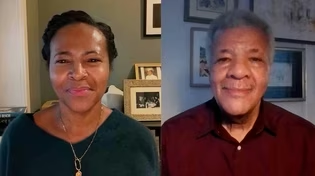
NewNever-Before-Seen Footage: The Last Gathering of the Harlem Renaissance
Video has Closed Captions
David and Liani Greaves discuss their film "Once Upon a Time in Harlem.” (19m 36s)
Providing Support for PBS.org
Learn Moreabout PBS online sponsorship New Episode
- News and Public Affairs

Top journalists deliver compelling original analysis of the hour's headlines.

- News and Public Affairs

Today's top journalists discuss Washington's current political events and public affairs.

 New Episode
 New Episode
 New Episode


 New Episode


 New Episode
Support for PBS provided by: