
Space Wars
Season 53 Episode 12 | 53m 54sVideo has Audio Description
Inside the escalating military struggle to control space and the satellites we rely on.
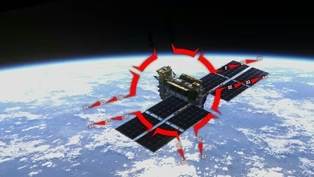
An arms race is escalating above us, as military powers vie for control of space. Discover how satellites we rely on are vulnerable to attack, how debris is filling increasingly crowded orbits, and what can be done to protect them.
See all videos with Audio DescriptionADProblems playing video? | Closed Captioning Feedback
Problems playing video? | Closed Captioning Feedback
National Corporate funding for NOVA is provided by Carlisle Companies. Major funding for NOVA is provided by the NOVA Science Trust and PBS viewers.
Support provided by:


Space Wars
Season 53 Episode 12 | 53m 54sVideo has Audio Description
An arms race is escalating above us, as military powers vie for control of space. Discover how satellites we rely on are vulnerable to attack, how debris is filling increasingly crowded orbits, and what can be done to protect them.
See all videos with Audio DescriptionADProblems playing video? | Closed Captioning Feedback
Where to Watch NOVA
NOVA is available to stream on pbs.org and the PBS app.
Buy Now

NOVA Labs
NOVA Labs is a free digital platform that engages teens and lifelong learners in games and interactives that foster authentic scientific exploration. Participants take part in real-world investigations by visualizing, analyzing, and playing with the same data that scientists use.Providing Support for PBS.org
Learn Moreabout PBS online sponsorship♪ ♪ NARRATOR: Space.
Long a peaceful frontier, it's becoming more militarized by the day.
JOHN SHAW: A fight in space could be decisive to a war on Earth.
DAVID BURBACH: In the near future, we may need to exchange blows in space.
NARRATOR: New technologies... PATRICK BINNING: It's like something out of "Star Wars."
Inconceivable even ten years ago.
NARRATOR: ...are raising new questions.
JONATHAN MCDOWELL: What would a war in space actually look like?
NARRATOR: Some answers are chilling.
A nuclear-capable weapon in space that could threaten... SHAW: Such a weapon is a doomsday weapon.
NARRATOR: Others surprising.
Then it grabbed this other satellite.
First time we've seen that.
NARRATOR: What's clear: space is vital not only to daily life... Nearly every single person on this planet uses space every day.
NARRATOR: ...but to the future of warfare.
KEVIN CHILTON: There has not been a domain that human beings have not figured out a way to fight in.
Why is space any different?
NARRATOR: "Space Wars," right now, on "NOVA."
♪ ♪ ♪ ♪ NARRATOR: February 5, 2022.
500 miles north of Moscow, a Russian rocket lifts off, carrying a satellite named Cosmos 2553.
The U.S.
military detects something highly unusual.
SHAW: Cosmos 2553 was deployed into a 2,000-kilometer orbit.
That's actually kind of high.
There's not a lot of satellites out there.
NARRATOR: The altitude raises concerns.
BINNING: It went to a very unique place in space, deep into the radiation belt, where spacecraft generally do not want to operate.
NARRATOR: Congressman Mike Turner, chairman of the House Intelligence Committee, issues a cryptic message.
News outlets immediately pick up the story.
CBS News has learned the U.S.
has informed Congress... ...we have a "serious national security threat"... ...on Russia's efforts to deploy a nuclear anti-satellite system in space.
They suspected that the Russians were actually testing the development of a nuclear bomb in orbit that they would be able to detonate at any time that they desired.
NARRATOR: A nuclear explosion in space could devastate the massive networks of satellites that underpin the technology of modern life.
BURBACH: Everybody in the United States makes use of space every day, whether they realize it or not.
It's now become part of everything that we do.
NARRATOR: Altogether, more than 12,000 active satellites are orbiting the Earth, from 100 to 22,000 miles above our heads.
GPS satellites-- our phones use them to pinpoint our location almost anywhere on Earth.
Weather satellites-- without them, killer storms could strike without warning.
Communication satellites-- essential for keeping us connected and informed.
And eyes in the sky-- peering down, gathering data, monitoring everything from crop growth to the global supply chain.
And peering up, telescopes, helping us understand the story of our universe.
Pretty much there's no part of your life that is not touched by space.
SHAW: Our society is more reliant on space today than it was yesterday, and it will be more reliant tomorrow than it is today.
And that curve's been moving upward, really, since we entered the space domain as humans.
BURBACH: Space has also become fundamental to how the American military operates.
NARRATOR: Satellites are essential for battlefield communication and targeting.
Without them, commanders are blind.
The more sophisticated these space-based systems, the greater edge they provide and the more valuable targets they become.
So, in 2019, the U.S.
created the Space Force, America's first new branch of the military in more than 70 years.
At the Combined Space Operations Center in California, service members known as "guardians" prepare for potential conflicts.
Former deputy commander of U.S.
Space Command Lieutenant General John Shaw directed many Space Force missions.
SHAW: The reason that we have a Space Force is, you need to be able to develop, organize, train, and equip for a potential fight in space, which could ultimately be decisive to a war on Earth.
NARRATOR: Roughly 100 countries have satellites of all kinds in space, but the U.S.
remains the dominant military player, far outspending its nearest competitor, China.
♪ ♪ And with more satellites launched in the past five years than in the last six decades combined, scientists and engineers are being recruited into the battle to dominate space.
♪ ♪ Humans have always looked to the sky, wondering what lies beyond.
But today, there are eyes looking back, and increasingly, they are military eyes.
Intelligence analysts for the U.S.
government are alert to the shift.
Chirag Parikh served in the White House on the National Space Council, where he prepared for possible space war scenarios.
PARIKH: Imagine an extreme scenario.
Two nations are in conflict.
One decides to detonate a nuclear weapon in space.
Because space has no atmosphere, there is no mushroom cloud or heat blast, but there is an electromagnetic pulse, or E.M.P., that fries the electronics of satellites within its line of sight.
On the ground, cell towers, emergency services, the electrical grid all fail.
Crisis ensues.
SHAW: Such a weapon is a kind of a doomsday weapon.
It's so indiscriminate.
If Russia were to detonate a nuclear weapon in space, it would destroy Russia's own satellites, our satellites, Chinese satellites, commercial satellites.
It would endanger the International Space Station and the Chinese space station.
NARRATOR: In the 80 years since the first atomic bombs were dropped on Hiroshima and Nagasaki, Japan, the world has been building nuclear weapons of all shapes and sizes.
These bombs either split or join atoms to release huge amounts of energy.
(explosion roars) And while, on Earth, nuclear explosions unleash destructive blast waves, along with heat, blinding light, and radiation, in space, they do something different.
In the late 1950s and early '60s, the U.S.
and Soviet Union conducted eight nuclear tests in space.
The largest was called Starfish Prime.
In 1962, the U.S.
launched a 1.4-megaton hydrogen bomb and detonated it 250 miles above the South Pacific.
This footage shows a high-altitude explosion.
♪ ♪ BURBACH: When you set off a nuclear weapon in space, there'll be a flash of X-rays and gamma rays that travels out, and when those high-energy particles hit satellites, even thousands of miles away, they can cause severe damage.
NARRATOR: The detonation unexpectedly destroyed about a third of the 24 satellites orbiting the world at the time.
It took out, like, for example, the U.K.
's first satellite.
Gone.
NARRATOR: And it didn't stop there.
The electromagnetic pulse was so severe that it impacted the electrical grid and knocked out streetlights in Honolulu.
NARRATOR: Dangerous high-energy particles released in the explosion were trapped by Earth's magnetic field, continuing to damage satellites for months.
It was a sobering lesson that led to an international ban on nuclear weapons in space, but it underscored an unavoidable reality.
There is this idea that, "Hey, we don't want to weaponize space.
"We don't want to militarize space.
We want space to be peaceful."
And yet, the uncomfortable fact is, it's really been militarized from the very beginning.
Even in the early 1960s, most of the satellites we were putting up were for military purposes.
NARRATOR: But that militarization was conducted largely out of sight, while public attention focused on NASA's peaceful exploration.
MAN (on radio): Burn looks good.
BURBACH: For many years, the United States did not like to talk about offensive space capability, because the last thing we wanted to encourage anyone to do was to think about shooting down satellites.
When we sent the astronauts to space in the 1960s, the intelligence community would've liked for the astronauts to not take any pictures looking back at the Earth, because they were afraid that would remind people about spy satellites.
NASA said no-- like, you couldn't come back and say, "Oh, we forgot to look at the Earth."
There was a deep sense of, "We need to keep space secret."
So it is a real change of mindset, bringing space into the realm of open discussion as just a regular part of warfare.
There's been a real shift, I would say just over the past ten years, in how comfortable the United States is in talking about its interest in and need for military capabilities in space.
We are ready to repel all challengers, and any attempt to defeat the U.S.
in space will fail.
MAN: Thank you, General.
NARRATOR: The White House later clarified that the Russian satellite, Cosmos 2553, which initially caused so much alarm, was in fact not carrying a live nuclear bomb, but they suspect it was a part of a program to eventually deploy one.
What's clear is that the militarization of space is only accelerating.
BURBACH: We have always used space for military purposes.
And we are now starting to think about it as a domain where, you know, we, we may need to, you know, exchange blows.
NARRATOR: But exchanging blows in space turns out to be more complicated than military leaders-- and even some science fiction writers-- have imagined.
BINNING: You know, as an engineer in aerospace, I love science fiction movies, but little of what you see, for example, in "Star Wars," is actually physically possible.
(weapons firing, engines whining) In a single scene of "Rogue One," there are at least five things going on that challenge our understanding of physics.
First, most of these spacecraft that are around this Earth-like planet are hovering.
We know you're not going to hover in low-Earth orbit.
If you're in low-Earth orbit, like the International Space Station is, it's like you're on railroad tracks and you're going 17,000 miles an hour.
The second thing is, you're seeing people flying spacecraft, like TIE fighters and X-wings, that are flying and diving as though it's a dogfight.
That's not how things work in space.
NARRATOR: On Earth, fighter planes turn by pushing against the air.
But in the vacuum of space, there's no air to push against, so spacecraft can't actually turn on a dime or perform tight maneuvers.
CHILTON: The only way to maneuver is with your rocket engines.
And because you're going so fast, to change your direction like you see in a "Star Wars" movie would take so much energy, you couldn't carry enough fuel to do that.
BINNING: The third thing is, they're dropping bombs as though there's gravity.
That's not how it works.
When you let go of something, it's just going to fly along with you.
(engines whining, weapons firing) The fourth issue is, space is a vacuum.
So, there's no sound.
(film audio stops) There is no medium for sound to travel through.
(film audio silent) So no explosions.
And, oh, by the way, those explosions are unrealistic.
It's in a vacuum.
And that explosion will be gone in milliseconds.
(film audio resumes) So "Star Wars" is great science fiction, but it's not based in reality.
NARRATOR: So what is the reality?
The rules of physics make movement in space very predictable, so objects can be easy to track.
But with more than 12,000 human-made satellites now orbiting the planet, the U.S.
military partners with private companies, like COMSPOC in Pennsylvania, to monitor what's actually happening up there.
Paul Graziani is the company's founder and C.E.O.
A satellite is anything that's orbiting around another body.
So, for instance, the moon is a satellite of the Earth and the Earth is a satellite of the sun.
So the term "satellite" can mean an active satellite or it can mean a very tiny piece of space debris.
There are a lot of objects up there.
Right now, we're tracking around 49,000, is what the U.S.
government tracks.
And of those 49,000, roughly 12,000 of them are operational satellites.
The rest of them are spacecraft that are no longer operational or space debris.
NARRATOR: Satellites travel around the Earth in predictable paths.
To stay in orbit, a satellite has to move forward fast enough to counteract the gravity pulling it downward.
Because the Earth is curved, if a satellite moves at the right speed, it can keep falling but never reach the ground.
This way, it moves in a continuous loop-- an orbit.
So, you need enough speed to keep going in your constant direction.
But orbits of satellites have all sorts of variables.
GRAZIANI: We developed software that takes inputs from telescopes and radars and antennas, and from those inputs, we figure out where those objects in space are at any moment and where they're going to be going.
The term used by the military or national security side is "space domain awareness."
What is that object and what might it be able to do?
♪ ♪ MCDOWELL: Back in the Apollo days, there were maybe a few dozen satellites operating in space.
A decade ago, it had gotten up to 1,200 satellites.
Today, we have over 12,000, and we're looking at maybe another factor-ten increase, to more than 100,000 satellites, a decade from now.
NARRATOR: Almost all satellites operate in one of three orbital realms.
BINNING: The three main orbital regimes are low-Earth orbit, medium-Earth orbit, and geosynchronous orbit.
And you can think of low-Earth orbit as being between 250 and 1,200 miles above the Earth.
JOE CALLARO: What we're looking at here are the low-Earth orbit satellites that we are tracking currently.
NARRATOR: Joe Callaro is COMSPOC's director of operations.
In LEO, the accuracy of the data in our system is between 25 and 50 meters.
NARRATOR: Low-Earth orbit, or LEO, is the easiest to get to.
It also allows the fastest communication with the ground, so today, nearly 90% of all satellites operate there, including the International Space Station and the growing number of commercial satellite networks, like the SpaceX Starlink system.
CALLARO: There's a lot of satellites, there's a lot of debris, but space is a huge volume.
And so, while it looks relatively dense with satellites, there's way more space between these objects than it appears.
NARRATOR: The vastness of space is hard to comprehend.
Even the relatively small area where satellites normally operate is about 75 trillion cubic miles, roughly 300 times larger than the volume of Earth itself.
I've shrunk the Earth down to 16 inches across.
This means that every inch is about 500 miles.
Um, most things are actually happening within arm's reach of the planet, so to speak.
We talked about three orbital regimes: low-Earth orbit, within about 1,000 kilometers of the Earth's surface; medium-Earth orbit, so about two feet away from this 16-inch globe; and geosynchronous orbit, which gets a little bit of an arm stretch, but about four feet away from the Earth.
So what we're looking at here is the geosynchronous belt.
It is the furthest orbit regime that we typically use for satellites.
NARRATOR: In geosynchronous orbit, around 22,000 miles up, a satellite moves in perfect sync with the Earth's rotation, so it can stay over a fixed point, putting it in a perfect position for telecommunications, weather forecasting, or spying.
SHAW: It was Arthur C. Clarke, a science fiction writer, who started to formulate this idea that satellites that are in orbit in that belt are actually moving around the Earth at the same rate the Earth is rotating.
And so they're always in that same spot in the sky.
NARRATOR: But some of the most important satellites sit between LEO and GEO, in a relatively quiet realm called medium-Earth orbit.
So, this is medium-Earth orbit, or MEO, and this is where we have put our GPS satellites.
NARRATOR: It's not hard to imagine the disaster if these suddenly stopped working.
♪ ♪ PARIKH: A Navy warship is patrolling the ocean.
The ship is guided by GPS satellites.
Suddenly, the GPS signals go out.
They can't navigate, they have decision uncertainty, operations grind to a halt.
The ship is a massive sitting duck in the middle of the ocean.
NARRATOR: In recent years, the U.S.
Navy has been preparing for just such a scenario.
♪ ♪ CHILTON: Sailors used to be taught celestial navigation to determine where their ship was.
Well, they stopped doing that when they got GPS.
Why waste their time doing that?
But there's a danger in becoming too dependent on a utility that's vulnerable to attack from an adversary.
The Navy realized there's a non-zero chance that the Global Positioning System might not be operating to our satisfaction.
Well, celestial navigation was taught for nearly 200 years at the Naval Academy, so they have reintroduced the use of sextants.
CHILTON: They want to have a backup for a really bad day, should our adversaries take out the GPS constellation.
NARRATOR: The Global Positioning System is a group of more than 30 satellites in medium-Earth orbit, about 12,000 miles above the planet.
SHAW: GPS was developed to solve a targeting problem.
If you're a ballistic missile submarine, and you surface and you're, or come near the surface, and you're ready to launch your missiles, how do you know where you are?
Well, a really nice way to do it would be to get precise signals from satellites in space.
NARRATOR: Each satellite broadcasts a radio signal providing its location and precise time from an on-board atomic clock accurate to within a billionth of a second.
CHILTON: GPS satellites are all synchronized on the same clock.
And they rely on communicating that timing signal back down to the surface of the Earth.
And then our receiver figures out the difference of when we receive those signals from different satellites to calculate where we are and how fast we're moving.
NARRATOR: The 1990s Gulf War was the first major conflict that used GPS widely, and it was a game changer.
It allowed a precision of weaponry that we had never seen before.
In World War II, it took 1,000 bombs to destroy a factory that you were going after.
Whereas, in the early 1990s, one airplane could actually hit targets with precision with just a few bombs that are GPS-guided.
So, that revolutionized warfare.
CHILTON: Because it came out of the military, GPS was classified and held as a top-secret capability.
But eventually, the U.S.
government said, "No, this is a utility that should be provided to the world."
NARRATOR: At first, the accuracy of the signal made available to the public was intentionally degraded.
BINNING: In the 1990s, with the civilian version of the signal, 300 feet was as accurate as you could be.
In 2000, President Clinton removed that limitation for the civilian population.
And that opened up all sorts of uses.
NARRATOR: Today, anyone with a GPS receiver knows exactly where they are nearly anywhere on Earth.
They also have access to the satellites' atomic clocks.
Modern banking relies on these clocks to precisely timestamp every digital transaction, from stock trades to ATM withdrawals.
GPS is crucial for both the modern economy and modern warfare.
SHAW: I had the privilege of having the Global Positioning System under my command out at Schriever Space Force Base in Colorado Springs.
And the center of GPS is an operations floor with eight people that operate that entire constellation for both military and civilian applications.
The U.S.
is not alone in having a global navigation system.
The European Union, the Chinese, and the Russians all have independent constellations of satellites.
In fact, your phone is tracking satellites from all four of those constellations.
NARRATOR: But these openly available signals leave a crucial technology vulnerable to attack.
SHAW: An adversary could want to eliminate those GPS satellites.
Right now, though, we've seen adversaries, when they want to counter a navigation system from space, do localized jamming on the ground.
NARRATOR: The radio signals that GPS satellites send are weak by the time they reach the ground, so local jammers broadcasting on the same frequency can easily drown them out.
SHAW: It's actually happening all over the world, and it's affected civilian air traffic.
A plane carrying the E.U.
Commission president, Ursula von der Leyen, was targeted by GPS jamming while trying to land in Bulgaria.
NARRATOR: Russia regularly jams over Europe, and recently, the U.S.
has done the same in the Caribbean and Middle East.
But intentional interference has extended beyond just GPS.
Good afternoon.
Russia launched cyberattacks in late February against commercial satellite communications networks in an effort to disrupt Ukrainian command and control during the invasion.
NARRATOR: In the hours before Russia invaded Ukraine in February 2022, Russia launched a cyberattack that knocked out satellite-based communications and internet systems across Ukraine.
Ukraine turned to Elon Musk, the head of SpaceX and owner of a satellite constellation called Starlink, for help.
SAMSON: There were people in the Ukrainian military tweeting at Elon Musk directly, saying, "Can you please help us out?
", you know.
So, Elon was able to snap his fingers and get it into the country very quickly.
NARRATOR: Starlink provides satellite-based internet using a novel approach.
Instead of covering the whole Earth with a few large satellites in geosynchronous orbit, it uses a constellations of small satellites in low-Earth orbit.
So instead of sending a signal all the way to geosynchronous and bouncing it back down, you just send it up a few hundred miles and back down.
BINNING: These satellites are communicating with their nearest neighbor, and their nearest neighbor is communicating with their next-nearest neighbor.
That makes this network happen.
NARRATOR: Starlink brought Ukraine back online and helped level the battlefield.
BURBACH: The Russians were not happy.
And the head of the Russian Space Agency even hinted that Elon Musk personally might be a legitimate military target.
(laughs) NARRATOR: As the war continued, SpaceX appeared to be limiting the service for certain regions and uses.
There were a lot of people that said, "Look," you know, "it's kind of scary that you can have "this capability you depend upon for your military, "and it can just be turned off "not because a government has thought about it "or a military has said, 'Okay, this meets our needs,' but a private citizen."
It is concerning that one person has so much control.
BINNING: In 2025, there were over 12,000 operating satellites on orbit.
About 70% of those are from one U.S.
company, SpaceX, and their Starlink constellation.
BURBACH: SpaceX has been responsible for probably around two-thirds of national security launches in recent years.
They're now putting up 50 satellites at least once a week.
So, Elon Musk owns something like three-quarters of all the satellites that the human race has operating.
NARRATOR: SpaceX recently began providing the U.S.
military with a customized version of Starlink called Starshield.
It's one of several military satellite constellations being developed for communications, spying, missile defense, and GPS.
BURBACH: It's really an entirely new paradigm, having large numbers of relatively disposable satellites operating at a low altitude.
NARRATOR: But even these satellites might be vulnerable to another kind of weapon that people have long imagined-- lasers.
♪ ♪ PARIKH: Imagine this.
A series of high-powered lasers conduct a coordinated attack.
Ground based and space-based weapons hit our intelligence satellites.
They destroy optics and fry electronics.
Suddenly, we can no longer see behind enemy lines.
Our military and intelligence services are rendered blind.
NARRATOR: General Atomics is one of the world's largest privately owned defense companies.
In their lab in San Diego, California, Robert Peterkin demonstrates how laser technologies can be used for military purposes.
Since the day the laser was invented, in 1960, people have been imagining ways to weaponize lasers.
NARRATOR: Lasers work by amplifying and aligning light particles so all of the energy is focused into a single, concentrated beam.
One type of laser technology has been deployed as a weapon for years.
It's called "dazzling."
PETERKIN: So this is the small laser we're going to use to demonstrate laser dazzling.
We're ready to go, so let's turn off the laboratory lights.
I'm going to switch the laser on and intercept the camera located a couple of meters across the room.
The green laser is about to hit the aperture of the camera.
And on the camera, you should start to see some green laser light.
NARRATOR: Many satellites rely on optical sensors, like those in digital cameras.
But these sensors can be vulnerable.
PETERKIN: As I continue to slightly move the laser beam... ...I can obliterate the image.
The laser intensity is overwhelming the electronics in that camera, but it causes no damage.
So when I move the laser beam away, the image reappears.
If my laser was powerful enough, I could, in principle, dazzle a satellite from the ground.
BURBACH: Both the Russians and the Chinese have a truck-mounted laser dazzling system that is deployable-- they've, they've displayed them.
CHILTON: It's a weapon-- it's a weapon system.
It's a kind of optical jamming, if you will.
And we're seeing our adversaries fielding this because we see the attempted interruptions in our satellite systems.
NARRATOR: The U.S., China, and Russia are all known to have laser dazzling systems, though none have acknowledged using them against adversaries' satellites.
The U.S.
has claimed that both Russia and China have used lasers to try and dazzle American spy satellites, possibly American commercial imaging satellites.
Nobody wants to give many details, and they also don't, you know, they don't want to... You know, they don't want to let the Russians know, was the dazzling effective or not.
NARRATOR: And higher-powered lasers can not only dazzle, but destroy, though the details of the weapon used for this test remain restricted.
PETERKIN: If the power is sufficiently high and I'm able to keep the beam on the drone for sufficiently long, I can defeat the drone, and this drone will then fall to the ground and will no longer be able to bother me.
NARRATOR: At close range, a 30-kilowatt laser, the equivalent of 30 million laser pointers concentrated into one beam, can burn through solid steel.
PETERKIN: This hole was made here, in this laboratory, with a laser of several tens of kilowatts, but the details of how weapons-class lasers work are held at a higher classification level.
NARRATOR: Laser weapons have been used on land and at sea, but putting them in space is a challenge.
Lasers are large consumers of power, so you need large battery banks, you need large solar arrays.
NARRATOR: To date, no nation has acknowledged putting a laser weapon in space.
But because it can operate over large distances, and it's not attenuated by an atmosphere, directed energy will be the weapon of choice in future space combat.
NARRATOR: But for now, many military satellites are potentially vulnerable to large-scale attack from a more conventional weapon.
♪ ♪ PARIKH: Our spy satellites detect a ballistic missile launch.
But this isn't going to the other side of the Earth.
This is going into space.
These weapon systems, known as direct-ascent anti-satellite weapons, attack missile-warning satellites, communication satellites, intelligence satellites.
Within minutes, these satellites are destroyed.
Our military and intelligence services go dark.
NARRATOR: At a Space Force base in Colorado, missile defense units use satellites to scan for infrared heat signatures of enemy missile launches and coordinate intercepts.
CHILTON: With a handful of these satellites in orbit, we can surveil the whole world and see any rocket launch anywhere on the planet.
NARRATOR: An attack on these satellites could open the door for undetected missile launches.
SHAW: There's been five anti-satellite missile operations done so far.
And the first was actually conducted by the United States.
NARRATOR: In 1985, the U.S.
launched an anti-satellite rocket from an F-15 fighter and blew one of its old satellites into hundreds of pieces.
At the time, the Soviet Union had a good number of satellites operating in low-Earth orbit that they were going to use in a potential conflict with the United States.
And we were motivated at the time to say, "How do we deprive them of that capability?"
NARRATOR: The test served as a cautionary tale, not only for the Soviet Union, but for anyone with hardware in space.
It's relatively easy to blow up a satellite, but that generates tons of debris.
And that makes space unusable for everyone.
NARRATOR: Despite the risks, in 2007, China used a missile to destroy one of their own defunct satellites.
JAMES CLAPPER: There are countries who are pursuing very aggressive, very impressive counter-space capabilities, which I cannot go into here because of classification restrictions.
♪ ♪ CHILTON: People talk about hitting a bullet with a bullet.
The satellite you're shooting at is probably traveling at about 17,000 miles an hour.
And if you're coming at it from the opposite direction at 5,000 miles an hour, you, that's a, that's an incredibly high closure rate.
And kinetic energy is equal to one-half mass times velocity squared.
That's a big velocity squared.
So you produce a tremendous amount of kinetic energy at impact that just totally obliterates the satellite and creates this large field of debris.
NARRATOR: The Chinese satellite strike created thousands of pieces of orbiting debris.
And the farther an object is from Earth, the less gravity and atmospheric drag it encounters, so the longer it stays in orbit.
Now, that altitude was 500 miles.
And debris at that altitude is going to persist for tens of years, if not a century or longer.
NARRATOR: Just a year later, the U.S.
announced that a disabled American satellite around 130 miles up carrying highly toxic rocket fuel was in danger of falling to Earth.
And so the U.S.
said, "You know what?
"We have this satellite that's not working.
"It's filled with this chemical.
"We don't know where it's going to crash.
"It'd be bad for people's health.
We better shoot it down."
NARRATOR: Officials were concerned that the satellite's hydrazine fuel tank might survive reentry and crash in a populated area.
A mission was given to U.S.
Strategic Command, where I was at the time.
And this was truly a mission to protect humans.
JAMES CARTWRIGHT: You'll see the intercept, you'll see the hit of the mass.
There you go.
And what we're watching right now is this cloud that's forming right here.
SAMSON: The U.S.
will swear up and down it was a safety hazard.
I've always said, "Well, clearly they were doing this operation in response to the Chinese."
I can tell you that was not the intent of the mission at all.
But if I was putting myself in a pair of Chinese shoes, I would, I would assume that that was, there was a demonstration there.
NARRATOR: Some questioned whether the shoot down was necessary, but because the satellite was relatively low, the debris quickly reentered the atmosphere and burned up.
Then, in 2019, India shot down a test satellite with a missile, and, in 2021, just three months before invading Ukraine, Russia made a move.
SHAW: I was actually on the operations floor at United States Space Command in November of 2021.
And I was dismayed as we saw the launch happen.
♪ ♪ BINNING: The Russians kinetically intercepted Cosmos 1408, which was a defunct intelligence satellite.
SHAW: And we started to see that we no longer had one target satellite, but a field of debris.
My assessment is that they conducted an actual intercept just to prove they could do it and say that, that no one could keep them from doing it.
NARRATOR: Russia defended the test and accused the U.S.
of accelerating the militarization of space.
They did it at an altitude of 250 miles, which happened to be the same altitude as the International Space Station.
MAN (over radio): Hey, Mark, good morning.
Sorry for the early call.
We were recently informed of a satellite breakup and need to have you guys start reviewing the safe-haven procedure.
BINNING: NASA required the astronauts to shelter in their emergency spacecraft and they had to begin maneuvering the International Space Station to avoid this debris.
NARRATOR: The astronauts were unscathed, but for months, the space station had to maneuver to stay clear of the fragments.
SHAW: Much of that debris has fallen out of orbit already, but a lot remains.
We're still tracking hundreds of pieces of debris from that particular event.
NARRATOR: So far, nations have only shot and hit their own satellites.
But given the danger posed by a single tiny fragment of debris, the prospect of a full-scale, anti-satellite missile battle in space is daunting.
♪ ♪ PARIKH: A massive barrage of anti-satellite missiles creates tens of thousands of pieces of debris.
This is when the nightmare scenario begins.
Known as the Kessler Syndrome, this debris cascades and intersects with other satellites, causing them to be destroyed, causing more debris.
And in a self-perpetuating chain reaction, thousands of satellites get destroyed.
NARRATOR: Chain reaction or not, space junk is already a problem.
BINNING: Just because you're up there moving 17,000 miles an hour doesn't mean everything is moving in the same direction as you.
In fact, very little is moving in the same direction as you.
Orbits all have different orientations.
So it's not about the pieces that are in your orbit, it's about the pieces that are at your altitude but have different orbital paths.
And the biggest risk is the piece coming at you from a perpendicular direction that's going to hit you at 17,000 miles an hour.
NARRATOR: Space junk comes in all sizes, from spent rocket stages, to defunct satellites, to lost astronaut gloves, to errant screws.
GRAZIANI: Recently, a small untracked piece of debris hit the Chinese space station.
It hit their evacuation module that they were planning to go back home on.
There was no loss of life, but it could have been much worse.
A massive collision between two satellites happened in 2009.
A U.S.
communications satellite inadvertently hit a defunct Russian satellite and it created an enormous debris field.
NARRATOR: It's not clear how close we are to reaching a Kessler threshold that could start a chain reaction and render orbits unusable.
Or if we'll ever get there.
BINNING: Space is enormously vast.
Even though there are more than 12,000 satellites and tens of thousands of more pieces of debris, stuff is not constantly bumping into each other.
NARRATOR: Others believe the chain reaction is already underway, even if it looks different than in the movies.
MCDOWELL: In the movie "Gravity," everything got shredded in about half-an-hour.
But really, this happens over decades.
Like most environmental disasters, it's a very slow-moving car crash.
I think the Kessler chain reaction is already happening.
Certainly, in some orbital regimes, there's enough debris that it's not the problem of just waiting to see if things hit each other and statistically calculating the probability, it's, how good are your dodge maneuver schemes and, and how, how well can you control the flow of traffic.
NARRATOR: Most satellites rely on solar panels to power their onboard electronics.
But they also carry small amounts of fuel to enable maneuvering with thrusters.
BINNING: In 2025, SpaceX had to do 300,000 maneuvers to make sure their spacecraft did not impact either a piece of debris or another satellite.
MCDOWELL: So this is really getting, I think, to the edge of being tenable.
I really worry, if we go from 10,000 satellites to 100,000 satellites, it may no longer be possible to successfully do all the dodging that's needed.
I think we're going to learn the hard way.
NARRATOR: Most new satellites are equipped with thrusters, but the same technology that can help satellites maneuver can also enable another kind of attack.
♪ ♪ PARIKH: Imagine a number of small, agile satellites approaching some of our key national security assets.
Suddenly, we start losing communications.
GPS starts getting jammed.
Other satellites are being moved out of their orbits.
It's hard to know exactly what's happening, but it's clear these attacks are something new.
NARRATOR: Governments rarely talk openly about military operations in space, but in Southern California, one private company has glimpsed some of the cutting-edge technologies that are driving space warfare.
ExoAnalytic runs a network of small optical telescopes that track objects in geosynchronous orbit, more than 22,000 miles up.
MJ Jeffries oversees the network.
So here at ExoAnalytic, we operate a global network of telescopes.
On the map right here, you're seeing all of our observatories.
We're in South Africa, Morocco, Spain, France, Greece.
We have them smattered across Australia, the United States and Hawaii.
We're also down here in both Argentina and Chile.
The telescope network is a series of 40 observatories, all around the world, about 400 telescopes total.
So right now I'm going to click into telescope 1818.
If you look at the map, in the lower left-hand corner, it shows you that we have a target symbol around Western Australia, and that's where this observatory is.
And I can go in and zoom in on the night sky in real time.
Now, as I zoom in, we're seeing a live picture coming in from the telescope.
I can jump over to a telescope in Morocco, come over here to France-- any of them are at our disposal.
NARRATOR: ExoAnalytic can detect the light reflected by even small objects from 22,000 miles away.
With one telescope and one picture, we can see something about this size, but using ten telescopes co-located, and putting all those frames together, we can track something down about this size.
All of the observations that we take with a part of our telescope network are what's called "not classified," because it's just a passive collection of the night sky.
So right now, that's about 700 active objects.
Now, of those 700 objects, 30 of them are not in the public catalogue.
NARRATOR: These 30 objects include classified reconnaissance and military satellites that the Space Force doesn't publicly discuss.
But because it's hard to hide in space, even the infrared detection satellites that anchor the U.S.
missile defense system, called SBIRS, are visible.
JEFFRIES: Currently, we're tracking SBIRS GEO-4, parked up at GEO.
And we can see that it's positioned above the African continent.
Since it's a geostationary satellite, it always maintains this same position.
It doesn't move to the left or move to the right.
NARRATOR: And sometimes, ExoAnalytic finds surprises.
In 2021, China launched a satellite into geosynchronous orbit.
The stated purpose of Shijian, or SJ-21, was debris removal.
JEFFRIES: So this gets launched up, it arrived at GEO, and it does a maneuver to go and rendezvous around another Chinese satellite called Compass G2.
And then it goes and actually captures Compass G2.
MCDOWELL: So you've got these two objects, right, that are orbiting the Earth at thousands of miles an hour, and you've got to move them close to one another with imperfect knowledge, right, about what their orbits are so that when they touch, they don't hit each other at, like, 100 miles an hour, right?
That would be bad.
JEFFRIES: So you can see right now, you have SJ-21 and you have Compass G2 next to it that's spinning.
In a moment here, you're going to see, instead of that square spinning, it's going to be stuck.
Now it's stuck.
NARRATOR: SJ-21 may have grabbed onto the other satellite with an arm, a maneuver ExoAnalytic had never seen before.
JEFFRIES: That was a pretty big deal.
So now we have to ask ourselves, what are they going to do?
NARRATOR: Suddenly, after weeks of orbiting together, both satellites disappeared.
JEFFRIES: In January 2022, I went to go see the location of SJ-21 and there was nothing there.
So it was a pretty big effort for our team to go and refind the satellite, but once we did, we saw that SJ-21 was moving very quickly east to west.
BINNING: Like a tow truck, SJ-21 grabbed another satellite and moved it 2,000 miles, stopped, released it, and then SJ-21 returned 2,000 miles back to the geosynchronous belt.
MCDOWELL: China is doing some very cutting-edge things in space and demonstrating capabilities that I think the U.S.
in general, and the D.o.D.
in particular, wishes it had.
And so that's causing some, some concerns.
NARRATOR: China insists they disposed of a defunct satellite as part of a debris removal test.
But many instead saw a public demonstration of a tool easy to repurpose for offense in the event of a conflict.
Yeah, it, it's worrisome.
Of course, they, they'll tell you it's for peaceful purposes.
SHAW: The United States has not done anything like that.
And that alone would've been remarkable for the career of SJ-21.
NARRATOR: But then, in January 2025, China launched another satellite, SJ-25, to rendezvous with SJ-21.
JEFFRIES: And then sure enough, right around July of 2025, we saw them dock.
The publicly available information states that SJ-25 is some sort of a refueling satellite.
SHAW: There was a fuel transfer from SJ-25 to SJ-21 that replenished its tanks.
BINNING: Remember, in space, if you want to get somewhere fast, you have to spend a lot of fuel.
Fuel is the most important expendable resource that you have.
Fuel determines how often you can maneuver, how fast you can maneuver.
And you can imagine, if you no longer had fuel as a limiter, what you could do.
SHAW: My response to seeing SJ-21 do the towing operation and then do the refueling operation was kind of some respect.
And it was a realization to never underestimate your adversary.
NARRATOR: Grabbing a satellite in orbit isn't the only way to mess with it.
In 2019, observers tracked the launch of a Russian satellite and noticed something odd.
The single dot showing the satellite soon split into two, and then into three.
GRAZIANI: Russia is unique in using a technique of deploying spacecraft from other spacecraft.
You can see as many as three of these nesting dolls, or matryoshka dolls, where one satellite will release another, and that'll release a third.
That object could be anything.
It could be a kinetic weapon that's intended to impact.
It could be a weapon that's intended to jam.
You just don't know.
NARRATOR: Russia claims these "nesting doll" satellites are intended to inspect other satellites for damage.
But COMSPOC has observed them following classified U.S.
satellites, at times coming within 50 miles.
There's no other reason to come up close to one of our very sensitive and important satellites than for bad intent.
What they're trying to do is intimidate us and let us know that if we got into a conflict, that those satellites would cease to exist.
NARRATOR: Small, mobile satellites that can attack in a variety of ways might be the future of space warfare.
♪ ♪ PARIKH: With little warning, hundreds of satellites deploy on-orbit weapons against our national security space assets: jamming, lasing, kinetic effects, cyber intrusions.
Billions of dollars of national security satellites are rendered useless, leaving our military back on Earth crippled.
NARRATOR: Even Rogers is a founder of satellite maker True Anomaly.
He's racing to build small, agile satellites that might be key to this new style of warfare.
Spacecraft subsystems have become less expensive and they've become smaller.
Which allows you to deploy more satellites at a single launch than you would previously, where a single launch was dedicated to a single billion-dollar spacecraft.
So we build them smaller, build them cheaper.
NARRATOR: This new spacecraft is called Jackal.
ROGERS: Jackal's a multi-role space superiority platform.
It's designed to track and follow highly agile targets.
As our adversaries have built more and more highly maneuverable systems, we've needed to adapt to that.
NARRATOR: Jackal has extra fuel tanks and highly efficient thrusters that give it more maneuverability and range than most traditional satellites.
ROGERS: So these are the tiny little rocket engines that allow the Jackal spacecraft to move from point A to point B within an orbit.
SARAH WALTER: Cleanliness is really important, because if you get dirt or particulates inside those thrusters, it can cause jamming and leakage of fuel.
ROGERS: So these have a lot of thrust that allow us to really quickly maneuver and get into position to go perform whatever mission it is that we need to go do.
NARRATOR: It's designed to get close to a target, for now carrying a camera, but ultimately, perhaps, a jammer, or even a laser weapon.
There's no technological barrier to deploying a laser on Jackal.
The question is, how far away do you need the target to be to engage it.
If it's very close, that technology exists.
If it's very far away, that's a pretty significant technological hurdle.
But for most engagements, you know, a handful of kilometers, a space-to-space laser is totally achievable.
NARRATOR: Carrying even simple weapons, maneuverable, cheap satellites can potentially take out billion-dollar behemoths.
They can lie dormant in space for months or years and be hard to identify as weapons.
BURBACH: This ability to have lots of satellites that can interact with each other, that, that is going to be a very different sort of future than what we've been used to in Earth orbit.
NARRATOR: International agreements are few and far between when it comes to the militarization of space.
Nothing governs how close one satellite can get to another, or most of what companies and governments do up there.
All of those things from the Wild West era, right, are going to happen in space if we don't prepare for them.
NARRATOR: The main international agreement, the Outer Space Treaty of 1967, prohibits nuclear weapons, but says nothing about conventional weapons in space.
And while the U.S., Russia, and China are all party to the treaty, there have been no major new agreements since.
SAMSON: Space is a shared domain, and actions by one actor can affect everyone's ability to utilize space.
There's a lot of work being done in diplomatic circles on space issues.
But at the United Nations, they've been going in circles, frankly, for decades now.
I think the likelihood of any arms control for space in the near term is pretty low.
I'm actually pretty pessimistic.
I'm afraid we are headed towards a higher level of militarization and weaponization of space.
NARRATOR: In 2025, the White House mandated the development of a new space-based missile defense system called "Golden Dome."
The Golden Dome will be capable of intercepting missiles even if they are launched from other sides of the world and even if they are launched from space.
NARRATOR: The program is supposed to include a constellation of satellites that can actively shoot down missiles.
Critics have pointed out that, besides the many technical challenges involved, Golden Dome would be a major escalation.
Satellites that can shoot down missiles can easily be aimed at other satellites.
SHAW: We have not yet seen satellite-to-satellite attacks.
I think those will happen in the future.
CHILTON: What if I had a satellite that had a mechanical arm and it could grab another satellite?
Would that be a weapon?
Well, I used to fly that weapon.
It's called the space shuttle.
But it wasn't built to be a weapon.
So we don't even have a good definition of what is a weapon and what is not a weapon in space.
We're now, in my mind, thinking about space warfare as we thought about air warfare in the 1920s.
We are so early in the testing and training that it's not even quite clear how this whole thing will play itself out.
NARRATOR: As technology progresses, it's up to humankind to decide how to use it.
But what's increasingly clear is that it's no longer possible to ignore what's happening above our heads.
There has not been a domain that human beings have not figured out a way to fight in: underwater, on top of the water, on land, in the air.
Why is space any different?
♪ ♪ ♪ ♪ ♪ ♪ ♪ ♪ ♪ ♪
Video has Closed Captions
Preview: S53 Ep12 | 30s | Inside the escalating military struggle to control space and the satellites we rely on. (30s)
Providing Support for PBS.org
Learn Moreabout PBS online sponsorship















Support for PBS provided by:
National Corporate funding for NOVA is provided by Carlisle Companies. Major funding for NOVA is provided by the NOVA Science Trust and PBS viewers.