Teaching for Tomorrow
Teaching for Tomorrow Town Hall
Special | 28m 17sVideo has Closed Captions
A Basin PBS town hall continues the conversation on education’s impact and future.
Following Episode 1 of Teaching for Tomorrow, Basin PBS convened a town hall to continue the conversation around public education. Community leaders, educators, and stakeholders gathered to reflect on the history of local schools and discuss the challenges and opportunities ahead, reinforcing the role of education in shaping a stronger, more connected future.
Problems playing video? | Closed Captioning Feedback
Problems playing video? | Closed Captioning Feedback
Teaching for Tomorrow is a local public television program presented by Basin PBS
Teaching for Tomorrow
Teaching for Tomorrow Town Hall
Special | 28m 17sVideo has Closed Captions
Following Episode 1 of Teaching for Tomorrow, Basin PBS convened a town hall to continue the conversation around public education. Community leaders, educators, and stakeholders gathered to reflect on the history of local schools and discuss the challenges and opportunities ahead, reinforcing the role of education in shaping a stronger, more connected future.
Problems playing video? | Closed Captioning Feedback
Where to Watch Teaching for Tomorrow
Teaching for Tomorrow is available to stream on pbs.org and the PBS app.
More from This Collection
Education shapes tomorrow. Teaching for Tomorrow is a four-part Basin PBS series exploring the voices, perspectives, and opportunities shaping public education today. Through stories from educators, students, and community leaders, the series highlights the impact of learning, the strength of communities, and the role education plays in building a stronger future for all.
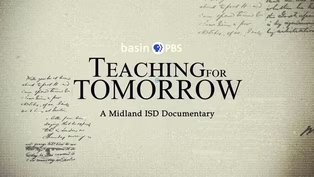
Teaching for Tomorrow Episode 1
Video has Closed Captions
Education builds community. Explore Midland ISD’s history and growth in Teaching for Tomorrow. (29m)
Providing Support for PBS.org
Learn Moreabout PBS online sponsorship[intro music] >>Announcer>> This program is made possible with the support from Midland Education Foundation, Community National Bank, Diamondback Energy ConocoPhillips and Lissa Noel Wagner.
>>Jay>> Good evening, and thanks for joining us.
I'm Jay Hendricks.
Midland has seen a lot of growth, as you heard John Moeshe telling you in the story you just saw in the story we saw from a one room schoolhouse in 1885 for 64 students at 40 campuses and over 29,000 students representing around 50 different languages.
And the growing hasn't stopped Midland ISD.
Now employees get ready for this.
Over 3300 staff that work tirelessly not only for our community, but for our students as well.
And not only do they teach, but they truly get to know their students, teachers, staff, not only teach for today, but they also prepare for tomorrow.
Very important.
I'm Jay Hendricks, coming to you from the Basin PBS Anwar Family Studio.
And thank you for joining us.
Tonight we are going to continue this discussion.
We're going to talk about schools.
We're going to talk about why education is important and how it helps to shape and form our communities.
We'd also like to thank our sponsors.
Bear with me as I read all of those.
Lissa Wagner, Diamondback Energy, we want to thank the Midland Education Foundation, companies like ConocoPhillips Community National Bank for generously supporting tonight's program.
Joining me here in the Basin PBS Anwar family studio.
Is this this group right here.
We're going to start first with Stan Van Hoozer, former principal of Lee High School.
Welcome.
>>Stan>> Thank you.
- Next, we are going to continue with our, introductions.
And right after him, we are going to go now with Tina Or Ortez.
She is a former teacher and a bond committee member.
Thank you.
<<Tina>> Thank you.
Next to her is Wes Torres, the Executive Director of Athletics for Midland ISD.
He's been a coach.
Some of you probably know him.
West, welcome.
<<Wes>> Thank you.
Right next to Wes is the troublemaker.
I've heard this all night.
Beau Garcia, the Executive Director of Fine Arts for Midland.
Beau, you know I'm joking with you.
[laughter] Uh, we're going to talk with him about, of course, fine arts as well throughout this evening.
And of course, our superintendent, Doctor Stephanie Howard, superintendent for Midland ISD.
Uh, she is going to join us as well.
And I want to thank all of you for joining us here.
Uh we're just going to have a little conversation, and we want to thank all of you uh to talk about the importance of public education.
And we saw in the video kind of how we grew to where we are now and every, I think, community probably has the same story, how they started, and uh got going.
A lot of you have dedicated your careers to education.
So right off the bat, I want to ask you what what led you to become uh an educator?
I'm going to start with you, Dr.
Howard.
>>Stephanie>> Sure.
So I'll go first, um, I kind of alluded to that earlier.
I actually grew up in a family of educate ed educators.
Dad taught and coach.
Mom worked at the schools, drove a bus, uh worked in the cafeteria, was a custodian.
So at 17, I was determined not to go into education because growing up in a small town, that's what everyone thinks you'll do, is be a teacher, uh.
So, uh went to college, uh second year in school.
You know, I had a great English professor and thought maybe I want to be a teacher.
So changed my major.
And then, you know, this is now you're 31 that I'm finishing.
Uh, wouldn't trade it for the world.
Started out teaching, teaching and coaching, um and then moved in, you know, to administration and, and here today as a superintendent.
What keeps me in that profession?
I love the work that we do.
Uh, you you heard stories tonight.
I want to thank our team that's here tonight.
Uh, the people we work with every day.
Uh, the support we have from the community and most importantly, the students that we get to serve.
And looking back at that history of oh how some of our students years ago were educated.
Um, I think the common theme there was educators that make a difference.
Someone made a difference in their lives.
Almost everyone you heard tonight.
Uh so the opportunity to do that, the opportunity to advocate for our students and stand up for them, and most importantly, make sure they're getting what they need in the classroom.
- Stan, I think I'd ask you the same thing as a administrator.
Um.
Tell me about what led you to get into that role.
I think you did some coaching, too.
Is that right?
- No.
I I never coach.
- You never coached?
I thought you did.
- I, uh I didn't want to be a teacher either.
[mic scratch] - Oh you didn't, ok [laughter] - My older brother and his wife, they were both teachers, and I didn't want to be like them.
I got an accounting degree.
I spent 17 years in the business world, but in the early 90s, there were layoffs going on, and I had finally matured a little bit in life, uh, and I saw how how well they were doing and how much they enjoyed what they were doing.
School.
I wasn't a great student at school.
I was a C student at best.
I never dreamed I would get into education, but in 92, I went back to school to, get a post-baccalaureate in history so I could teach history.
I was already I could have taught business because with my accounting degree.
But accounting was boring.
That's why I got out.
[laughter] And so I got into teaching and found I had a gift for that.
And I really enjoyed being around.
I was always in high schools.
Now, the high school kids, I always had a great time, uh teaching them I could make up stuff and they would believe it, uh.
[laughter] And but I had, uh Principal Dan Green at, uhLee freshman or at first started teaching.
He encouraged me because at that, I didn't start teaching until I was 40.
And he encouraged me to get into administration.
And so I got into administration and spent six years here in Midland teaching, and then moved to the Dallas area, where I was in the Dallas area for 15 years.
And I spent, uh 11 of those as a, administrator and assistant principal principal and the Dallas ISD, and then moved back to Midland to be principal in Midland Lee, which a lot of people would have lost money on that.
[laughter] To think that I would have been the one that have come back and to be a principal at Lee.
But it was the most rewarding thing that I did in my life.
Uh was being an educator, and I'm proud of that.
And, take up for educators all the time.
It's a hard job.
Yeah, it's not as easy as people think.
And, uh I loved my time in education.
- Tina, you've been a teacher.
Do you agree with him?
Is it harder now than it ever was?
- Oh, I think it's harder now.
Um, I remember when he started.
I was at Lee Freshman teaching at Lee Freshman, um and I always wanted to be a teacher.
[laughter] I just, I just knew for, like, third grade, I knew I'm going to be a teacher when I grew up.
And um, I had amazing teachers.
I did an and Mr.
Rand, who was a great teacher, I mean, kids loved him, um I coached and I loved coaching.
My dad was my teacher that taught me how to do all the stuff, coaching.
And, um so, yeah, I just, I loved it.
I knew I was going to.
That's what I wanted to do when I got when I graduated, I graduated with a degree in English.
Uh, I got married and moved to College Station with my husband, and he finished school.
It was a bust.
There was.
He was an engineer, petroleum engineer.
We moved back and there was no nothing.
I was like, I'm getting a job.
And I went in and Mr.
Cooper hired me and he said, we need a Spanish teacher.
Do you think you can teach Spanish?
I said, I can do that.
[laughter] So, I went to school at night, got my my educate my uh certification for Spanish and loved it.
So I teach in English and Spanish, [laughter] and I loved it.
So, um and I coached and taught dance, which I had never in my life had a dance class.
But I was the back in the day when MTV was on and with our [laughter] so we would call up Dualby Dancing We taught our dance.
We had great time and coaching.
It was it was amazing.
I just had so much fun and may, may even today see kids that they're already 50.
I'm like, oh my God, y'all are getting old.
Um, but yeah, I still see him today and have good, good rapport with him.
Still.
- You may have started a craze with the dancing to the videos.
[laughter] Now they're all popular.
We're going to kind of transfer here and talk about, uh how the number of community partners MISD has a lot of philanthropy in our community that helps out.
And it's astounding, I'm sure.
And let's talk about how those partners support MISD a whole.
And I'm going to start with with the actually both of you.
But let's start first with, Beau let's talk about the importance of these, uh uh donors that help us out, because especially for you, we're talking equipments, were talking uniform.
There's a lot that we have to get.
- Sure.
Yeah.
Uh one of the great things about our community is we're kind of a we're a little small, a small, big town, I guess you could say.
And we have people that span the whole gamut of, you know, family members knowing this person, knowing this person.
And so it's those connections that we create.
Uh one of the beautiful things about, um our music community is that a lot of us play in the symphony, um.
A lot of us are out in the communities in Midland, Odessa, and we're we're trying to just share what we love.
But I love how, um our donors see that, and they want to give back to us.
One of the really wonderful things, um that's happened to us most recently is, uh we've been in a time of, of Midland where, you know, there are some instruments that possibly need a little more love, um.
Maybe a little less duct tape and, uh we've been using those instruments, and our students have been out on those marching fields in the, uh concert halls an and doing great things.
But we've needed a change.
And so, um the Education Foundation, along with FMH um partnered and helped us, and we got $1 million grant, um to get all new band orchestra instruments for our students.
And you'll see some of those sousaphone is out on the marching field, [laughter] uh real shiny and pretty.
And, uh we are so fortunate to have those relationships, but I think it's it's really giving back to the future.
You know, when when I was a kid, I just dreamed of seeing some great things on the stage.
And now in this setting, you get to see it on the field, on the stage, you can see in small groups and big groups.
But, you know, our people are very generous here in Midland.
- And those sousaphones I, we call them tuba.
And that's what I played.
- Yes.
- They always had dents.
They never shut, you know, it was just it's what you had.
- Absolutely.
It's a tuba player.
- Yeah - Yeah.
- Let's talk about athletics.
uh Wes if you will, please.
Because a lot of that funding is obviously very important so that you can continue the season, uh.
This is every sport.
- Yeah.
And so we are blessed.
And Midland, you know, I tell folks when, you know, I moved here, one thing that was different for me was just the community involvement, you know, coming from Amarillo and a couple of other small towns, you just don't you have involvement.
But here there's involvement in their support financially as well.
I think the community really, um wants to see our program succeed.
We're blessed to uh have, you know, sound budgets where we able to take care of our student athletes.
And we look good.
We play well, um but our parents and our booster clubs, they they want to help.
And they're always looking for ways to supplement, you know?
And so we always like to think of our booster club as the, you know, icing on the cake, right?
We provide what they need and they want to they want to go above and beyond.
Um we have a lot of major productions, you know, Friday Night Football, you know, those of you that have been those games, I mean, thats um, I didn't understand as a high school basketball coach of 21 years what it took to to put on a Friday Night Football game.
You know, you have over 100 workers and just everybody that's involved that you've got to prepare to make sure that everything goes right on Friday night and that that takes a lot of financial support.
We've got we're blessed with several partners in our community.
Uh, Rogers Ford has been one of the, you know, Dawson, his group have been great.
And so we're blessed to have those guys that want to step up and help.
And you know, I think when when the community sees that you put out a good product, um they come out, uh-uh we got in several emails over the last year and a half of, you know, what can we do?
We want to help.
And little did I know, when I got an education and into the athletic administration role that marketing and in and you know, that was going to be part of the job.
I would I never guessed that even, you know, working on a master's degree that wasn't that wasn't part of the training, I promise you that.
[chuckle] But, you know, that's that's it's where we are.
But Midland makes it easier.
- It's in there.
It's good to have, the folks that we do have here, let's talk about school in general.
You mentioned being a C student.
- Yes.
- Math was not my specialty.
I wish someone had taken the time to teach me how to do algebra.
[laughter] They didn't teach me how to do.
If somebody would just said, this is how it works, I might have been better.
So I was always in intro classes.
I'm sure we all probably had our challenges here, uh.
As a teacher, how do you get to those students who you know are struggling and how do we get them to, to to learn that they can do this?
- First, you have to you have to realize you have to look at them.
You have to figure out who needs help.
Like when I taught Spanish, when I first started it wasnt required.
So I had the top kids, kids that wanted to go to college and it was required to go to college.
So I'd have amazing kids.
Then it was required two years of a foreign language.
So I'd had the number one kid in the class and the number 800 kid - Heh.
- in the class.
And so I would be like, oh my gosh, because this kid was like this, like, Ms.
Yarbrough, this is boring.
[laughter] And then I finally had I figured out how to group them together a little bit of every but, you know, smart, not so smart, not smart at all, [laughter] put them all together.
- Right in the same classroom.
- Well, and and then groups - Yup - and then the guy that knew it would help the other and then they would just [snap fingers] pick up.
So you you have to know your kids.
You have to learn who is the smartest pencil in there and who's the dullest, and put them together and work.
And it's it's work.
But but you can do it.
I mean, it's possible.
And and you bring them all up together.
- Yeah.
I wish.
I wish she'd have been there to teach me math, but.
- No, you don't.
Not math.
[laughter] - Oh, God.
No math.
- Well, the one thing she said that's the most important is you've got to know your kids.
- Yeah.
- And I was just like you.
I was good with numbers when they started putting X's and Y's in there, I had no clue.
[laughter] - Right.
- Right.
I couldn't teach a kid algebra if I had to, but I would always tell my teachers, and Tina and Beau were teachers for me at, uh, Lee that I had a math teacher that let me sit in the back of the room and do nothing.
You know, and at the time, that was great.
But because of that, I still don't know algebra.
And I didn't want our teachers to allow a kid to do that.
I mean, that's kid kids will do that if you let them.
But we're not doing those kids any favor if we let.
And that's one of the biggest changes that I think in education is that involving kids, making sure, checking for understanding, making sure that all kids are following along and know and have a chance to show you that they understand.
And and that all comes from knowing your students.
- Okay, you mentioned that.
And we're in a transition now because times have changed.
Okay.
Gone are the erasers and chalkboards.
We now have smart boards and computers.
We have handheld devices.
How is this change affected the way we teach and interact with the students, and how have we embraced this technology has got to be a challenge.
Also, when you're hiring teachers, you must have to find those that know how to deal - Right - with these devices.
- So, you know, I think back, um during my time as an assistant principal principals, when technology was really coming on board, we might have been a little slower getting technology in Midland back then.
Um, but one of the things that was evident from the beginning is just adding technology into the classroom did not improve instruction.
And so, uh, we worked really hard back then, and we continue to work on it now.
The technology enhances education.
And so, um thinking about, you know, you can put all the devices in the world in a classroom, but without an effective teacher, it doesn't matter.
And so and then how does that effective teacher utilize technology, what technology does for us, is um, it, um, allows us to assess students.
So it allows us to take them on a personalized learning plan, uh because Tina talked about, you know, you have students of all different, um preparedness levels in your classroom, and it's very difficult for any one teacher to take 30 students in a classroom.
Some are here, some are here, and make sure they're all getting what they need.
And so, um utilizing technology in that way, not as a replacement for instruction, but when we're reinforcing the learning, can be very effective and so just like with anything, whether that chalkboard back in the day, you know, just having a chalkboard in the class didn't make, um instruction good either.
The technology has to be utilized in, in an appropriate way and in a way that increases engagement and enhances learning.
- The good news is you don't have to clean them, uh [laughter] you - Now, everyone's allergic.
- Everybody is allergic to chalk [laughter] for coaching.
Let's talk about, uh you know, you you would have to have somebody shoot your game film.
I would come back to you, shoot game, film, all this kind of stuff.
Now it's technology.
So much different.
So how has that changed it?
- It is.
It's funny, when I first started coaching this year, I guess 27, for me, I was the youngest on staff and the youngest on staff.
Always in football season.
You loaded up on Saturday morning, got in the school suburban and you met someone typically being from the Panhandle area, you met a Dairy Queen [laughter] and uh you exchange film.
The problem with that is you better hope that what you received them to, what you were taking back to your head coach, there was something on there, because if you didn't, then you were in charge.
And that happened to me once.
- Mmhmm - And there was not a way to prove that.
But, you know, I think that often joked with our coaches that I think that technology has saved marriages, relationships and coaching simply because it's been able to the coaches have been able to utilize their time a little more efficiently.
You know, I think back to when Huddle, what we use for a video technology that that changed the landscape of the number of hours you spent at the office, you know, I was able to come home, have dinner with the family, help get put the kids to bed, wife goes to bed.
I stay up and go to work at that point because I was able to do that from from home on a computer, uh, on the cell phone.
Kids now they have access to the game's over.
They have access to their the game field.
They just played it within, you know, 15, 20 minutes after they're done, they can get on their phone and see how they played, uh communication, being coaches and and our student athletes has improved just because of technology.
And and so on Friday nights UIL just approved with, this past season of just the use of in-game technology, which, you know, years ago, that would have never been allowed and so it has, um made coaches, just have the ability to just be more efficient with their work.
- You want to add something?
- Mmm I always move my hair.
- Oh, you move your hair.
[laughter] I thought you wanted to add something.
So, um let's talk now about the growth in this community, the schools.
We're going to talk about the bonds a little bit here now, new schools being built.
That's got to be exciting.
We've seen that transition in the video that we saw earlier about how we've grown already and now where we're going, uh, what are you most excited about and what tell us what this means in your eyes for the city of Midland.
- Yeah.
So the bond 2023 was, um something that was a long time coming.
Um, Tina and Stan had a big part in that and did a great job helping us get that passed in the community in general.
Um for me, having been in this, um community for so many years and having been at the freshman school and the senior high school, the junior highs, I believe great reconfiguration is the single most important thing.
The facilities.
Absolutely.
But the facilities are what allow us to to reconfigure our grades.
It's going to allow us to move our sixth graders up to our middle schools, uh.
We'll have six middle schools instead of four, uh beginning band.
You know, we don't have beginning band right now.
So a sixth grader moves to Midland from somewhere else in the state, and they're coming from a middle school, and we put them back in elementary school, and they have no electives.
And and that's something that, um is a big barrier to getting students ready for that secondary experience.
Um then in ninth grade, you know, they're at the freshman school.
And while our freshman schools do a great job, there's a bit of disconnect.
And that true high school experience.
And so even though a couple of years ago we started really changing the way we approach that, if you're a ninth grader, you're still eligible for everything that happens at the high school, um We're having the bus back and forth every morning, every afternoon.
And so that grade reconfiguration that allows us to be more efficient as well, uh we have a lot of resources and people tied up back and forth between the freshman schools and the senior high schools right now.
We have, fine arts teachers that try to go to 24 elementary schools to work with sixth graders versus having, you know, fine arts teachers at middle schools.
Uh.
The facilities are going to be game changing for us.
The two new high schools, if you drive by, you see those coming along, um, I believe that from a recruitment and retention perspective, you know, if I'm moving into the area and I drive around, you know, within a 50 mile radius, I'm going to notice those two new high schools and I'm going to want to teach at those.
- Sure.
You guys both worked on it?
- Yes, uh, and I think one of the most important things on the bond, when we were trying to get people out to vote was that we really targeted the younger demographics in Midland, because traditionally in Midland, I was born and raised in Midland, but bonds don't pass.
Uh.
Everybody has an agenda, and it's the older demographics.
They usually go out and vote.
So we really concentrated and it was a concentrated effort.
And it was due to, uh our support from Pioneer, from ProPetro, from Diamondback, from community, from companies like that that had a lot of employees in the in the area that were younger, that had school kids.
We really targeted those people, uh Sam Sledge, ProPetro was uh he is one of the larger employees or employers here, even though he might have kids that go to a private school, most of his employers or most of his employees, kids go to, uh public school.
And he knows the value of having good schools and schools for those kids to go to.
And we couldn't have done it without those companies really giving us the support that they did and really helping us reach that younger demographic, that 30 to 45 year old, those parents that have kids in school and it's going to be exciting.
I know it was exciting when our elementary schools opened up, when those kids that have been going to the current schools get to walk into those new buildings, they can't help but be excited.
There's going to be so many new little things there.
It's like moving into a new house.
When you've lived in an old house, your whole life.
And it's just the updates that have happened in 70 years with all the appliances and everything's and I think it's going to be an exciting time for for Midland, for the kids in Midland, uh, the athletics, the fine arts that it's going to offer, uh, it's And I'm proud that we had that opportunity.
- And some of those donors, by the way, are here with us - Yes - and watching right now.
Thank you, uh.
Did you want to add something too?
Just that, that that age group, that 30 to 40 and probably 25 and up, they really supported us, and and it was it was them that went out to vote.
And they, they, they were the ones who wanted this to pass because they've seen what their kids are going to want.
- I want to add to that because in ConocoPhillips, Chevron, they're here.
They also are big supporters, uh But one thing that we were all at the high schools, all of us um were at the high schools at some point here.
And when our families would get to the high schools, they would say, we need new high schools.
It's too late then.
And so to their point, we talked to the families that had kids that would be in the high schools when these schools would be built.
Um, by the time we got our kids in high schools, everybody agreed we have to have better facilities.
You know, we're sharing Midland High as a gym and a half for 25, 2700 students and, uh you know, sharing classrooms.
And so, um there was never a problem convincing the ones who had kids in high school at the time, it was, convincing people early enough to get those high schools built.
- More work for you.
Is that okay?
- Uh, bring it on.
Yeah.
You know, it's it's great to to be able to say, like, hey, we have 360 kids in band now.
And so we we need to have this many instruments.
But, you know, we'll never say no to children.
- Okay?
Everybody's ready for the growth now.
Everybody's ready I we're running short on time.
But is everybody ready?
- Absolutely.
- Yes?
- Yes.
- Wes?
- I think it's going to be great for Midland.
- Okay.
All right.
We are running short on time.
I want to thank all of you.
First off, for sharing your insight again.
You can watch this, uh if you will, there be four other episodes that, that or three other episodes that we will air as well.
That concludes tonight's town hall on Teaching a for Tomorrow for Midland ISD.
As we said, it is a four part documentary.
Tonight you saw the first one.
I'd like to thank our sponsors once again.
They include Lissa Wagner.
We want to thank Diamondback Energy.
We want to thank the Midland Education Foundation the audience.
You all can applaud for those folks.
If you'd like to.
[applause] ConocoPhillips, Community National Bank.
And uh certainly we want to thank our guest, Dr.
Stephanie Howard.
Thank you so much.
Wes Torres, we want to thank you as well.
Beau Garza, thank you so much.
Tina Ortiz, thank you so much for your insight, Stan.
Thank you so much as well.
And I'd also like to thank our folks here and our, that, that put this on because a they're having to make sure that we all get on but also put up with me and I thank you [laughter] all for doing that.
We also want to thank our Basin PBS viewers and members.
And if you're not a member, let me remind you if you'd like to become one, it is very easy.
That's how you do it.
Visit basinpbs.org for more information.
You can also check your local listings for dates and times of the next episode of Teaching For Tomorrow.
That is a Midland ISD documentary, so we hope you've enjoyed what we brought you tonight, uh thank you all for your insight.
Uh, I am Jay Hendricks with First Alert seven.
On behalf of the Basin PBS board, our staff and crew back there, they deserve a round of applause.
By the way, thanks [applause] for joining us.
I want to say thank you.
And good night to you all.
[applause] [music]
 New Episode
 New Episode
- Drama

Lesley Manville and Tim McMullan return in the final installment of the Susan Ryeland mysteries.
 From My Station
 New Episode



 New Episode


 New Season

Support for PBS provided by:
Teaching for Tomorrow is a local public television program presented by Basin PBS