
The Story: LEGACY
Episode 9 | 24m 36sVideo has Closed Captions
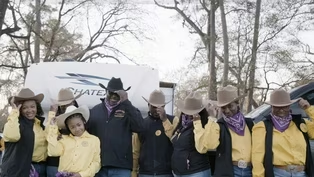
It's three stories of tradition, the preservation of black cowboy culture, and legacy.
Legacy exists in all of our lives, but for some, it is an integral part of their livelihood and identity. In these three stories, we see a cultural tradition continued across borders and generations, the preservation of black cowboy culture, and a pitmaster who maintains the legacy of the family members she’s lost.
Problems playing video? | Closed Captioning Feedback
Problems playing video? | Closed Captioning Feedback
Production Support Provided By: H-E-B and Texas Parks & Wildlife Foundation
The Story: LEGACY
Episode 9 | 24m 36sVideo has Closed Captions
Legacy exists in all of our lives, but for some, it is an integral part of their livelihood and identity. In these three stories, we see a cultural tradition continued across borders and generations, the preservation of black cowboy culture, and a pitmaster who maintains the legacy of the family members she’s lost.
Problems playing video? | Closed Captioning Feedback
Where to Watch Texas Monthly Presents: The Story
Texas Monthly Presents: The Story is available to stream on pbs.org and the PBS app.
Providing Support for PBS.org
Learn Moreabout PBS online sponsorship(dramatic music) - [Julianna] There are so many traditions that just were sort of left to die out.
(audience cheering) - She is picking up the mantle and continuing on.
That's barbecue legacy right there.
- When I think about legacy, it's hard to know where you're going without knowing where you came from.
- [Cowboy] We do this to kind of keep that tradition alive.
- I feel really proud to record stories like that and just make them known to the public.
(pensive curious music) (pensive curious music fades) (keyboard clacking) (dramatic music) - There is just something so unique and special about Texas to me.
Richardson and Plano, all of those suburbs are pretty heavily Asian and I think being able to access restaurants like Jeng Chi where you have these like gourmet mooncakes and homestyle authentic Chinese restaurants is really special.
My name is Juliana Chen and I wrote "The Mooncake King and Queen of Dallas," for Texas Monthly.
So I wanted to write the story because I'm Chinese and I don't like mooncakes and honestly no one I know who's Chinese likes mooncakes at all.
They're not like a tasty food but I had stumbled across Jeng Chi.
I was clicking on the website and I saw that they had like a standalone website for ordering mooncakes and I was kind of thinking to myself like, "If I don't like these and no one else likes these, like these have to be really, really good."
Mooncakes in their most popular form today, they're like this big and they're kind of hard and they're printed with like a patterned stamp on top and then they're filled with some sort of paste, like a lotus seed paste or a red bean paste.
Jeng Chi is a restaurant in Richardson just outside of Dallas that serves authentic dishes from Taiwan and mainland China.
Jeng Chi is busy year round, but they are definitely busiest during lunar New Year and mid autumn Festival.
Mooncakes are traditionally only really enjoyed during Mid-Autumn Festival, which typically occurs in mid to late September.
It's similar to a harvest festival in the sense that you're eating a lot of fall foods and just celebrating autumn abundance.
Growing up, my family would get mooncakes every year for the mid-autumn festival.
You usually like exchange boxes of them within your family or your friends or you, you know, just go purchase them from an Asian grocery.
But yeah, I mean I never liked them.
They weren't my thing originally until I tried Jeng Chi's, which I actually really like.
The process that it takes to make mooncakes and the dedication that requires are part of what makes them such an integral part of the restaurant.
A lot of mooncakes are made with a lot of preservatives, but they kept telling me like, we make everything by hand.
We source all of our ingredients ourselves and I think they take a lot of pride in still doing everything the hard way.
(light whimsical music) When I interviewed Yuan, he told me he still insists on getting up at three in the morning.
(light whimsical music) Yuan and Mei Teng are the couple that founded Jeng Chi.
They were both born on the mainland of China and moved to Taiwan and their story is just so interesting to me because at one point they moved their operations to Brazil and they were making mooncakes even there, as well.
Their son, Francisco, was raised in Brazil, too, and he just shared with me stories about growing up and speaking Portuguese with his parents and learning you know, how to be in the bakery.
- [Francisco] We still keep up with the tradition.
Making it by hand, it takes quite a lot of effort by a lot of people.
- Then they moved their operations to Dallas in 1990.
(light bright music) The process is really what separates Jeng Chi from all the other mooncakes.
The fact that everything is handmade, it makes for a quality difference that you can definitely tell.
The process begins with measuring out the dough.
Then press it flat so you have a good base for the filling and then make a little ball from there that then goes into the paddle.
The knocker is sort of like a wooden paddle.
It has a handle and then a large rectangular portion with a little mold inside of it and this is what you put the raw dough and filling inside and then you kind of like bang it on the table to set the shape and then the fully formed mooncake falls out and it always has a pattern stamped on the top and then they're ready to be baked.
(cart wheels clattering) I have so much respect and admiration for what he's able to do and what he insists on doing every day.
When I talked to Yuan and I asked him what does it mean to be making these mooncakes, you know, from scratch, and like why is it so important that you make them from hand and like for me to be asking why is this important to you was like baffling because it's like asking why do you breathe or like why do you do, you know, something necessary to function?
Like it seems like it was just ingrained maybe in him from birth that like these traditions and these, you know, ways of respecting that the food that you make are so important, for him that that is the only way and that's the right way.
(gentle music) (whimsical music) It does make you think what compels someone to like dedicate much of their life to this and I think part of their dedication to the craft so to speak is also a dedication to like preservation of family tradition.
- I'm a first generation immigrant, right, and there is something precious about the cohesion of family and to be able to bring that family tradition together.
(Yuan speaking in Korean) (Yuan continues speaking in Korean) (whimsical music) (Yuan continues speaking in Korean) (family continues speaking in Korean) (Yuan continues speaking in Korean) (gentle music) - Leaving a legacy and then choosing like actively to carry that legacy on, it's maybe not something that everyone does.
There are probably like so many traditions or legacies that could have been that just were sort of left to die out because someone didn't care enough to continue it.
As they're approaching old age and as it just becomes more and more important for people to have sort of a written or oral record of you know, their ancestors or their elders, I feel really proud to be part of or among the people who get to record traditions like this and just make them known to the public.
(gentle music) (wind blowing) (paper shifting) - This is a tragic success story, is really what it is.
Family disagreements, tumultuous situations, lots of tragedy along the way and the relatively short history of this restaurant, but continued success throughout all of it.
(pensive music) I'm Daniel Vaughn, the barbecue editor at Texas Monthly and I've written so many stories about La Barbecue.
La Barbecue had been owned by LeAnn Miller, but I knew Ali really before I knew LeAnn.
(reflective country music) Ali worked at the JMueller Barbecue food truck and it was so good.
- I'm not a real rule type of gal around here.
I always say if there's rules in barbecue, I break 'em.
Just get the job done.
Make it consistent.
Make the best brisket you can.
So we have set the bark on these beautiful briskets, they look so good right now.
As you can see there's like a really nice flex to it, so a nice tenderness and that's really what we're looking for before you wrap.
Hot and fast is about a six and a half max, seven hour brisket.
John Miller taught me that style in all his glory.
- There was nobody to like John Miller when it came to barbecue and when I say that, that comes with the good and the bad.
They cooked all the barbecue, made all the sides, but he ran the business poorly, usually.
We called him the Dark Prince of Barbecue in an article in Texas monthly.
Something that he might have taken offense to but he really embraced and he kinda liked that persona.
He always wore a black hat and sometimes sunglasses and really sort of stepped into that role.
But he was unfinanceable you know, it was hard to find somebody who was willing to give John Miller any money in hopes of ever seeing it again.
With Jay Miller Barbecue, it was his sister LeAnn who was backing him financially.
LeAnn Miller came from a famous barbecue family, but she wasn't really all that into barbecue.
John and LeAnn's dad was Bobby Miller.
He ran Louie Miller Barbecue.
Louie is Bobby's dad who founded the restaurant in Taylor, Texas, which is still operating today, one of the hallowed grounds of Texas barbecue.
But LeAnn really made her name as a photographer in Texas and California.
With John and LeAnn, the partnership ended pretty spectacularly.
Right around Halloween, John had texted me and said that LeAnn fired him.
She changed the name to La Barbecue and at the time Ali Clem was working with John.
So when it became La Barbecue, Ali stayed on as the cook.
LeAnn and Ali met and certainly formed a relationship and eventually got married.
When La Barbecue came to be, it was kind of a surprise that LeAnn from the storied barbecue family of Louie Miller Barbecue was jumping into the business and really being, you know, part of the face of the business, part of the identity of this new La Barbecue business.
And I think La Barbecue has always wanted to be one of the best barbecue joints in Texas.
(gentle country music) La Barbecue has always been that mix of old school barbecue rooted in that Louie Miller Taylor Texas style, simplicity of seasonings and smoke.
You know, they've been in our top 50 barbecue list since they opened and certainly demands return visits.
(people chattering) - It's hard running business with family, you know, so there was some ups and downs of course, but in the end, you know, he came to me and said how proud he was.
He said, "I've taught you everything from beginning to end.
You will be my legacy."
And I said, "John, do not curse me like that."
And then he sent this like little witch emoji and it was like, "I curse you."
(laughing) (somber music) - John died in December of 2021.
John Miller's death was not such a shock just because he was in poor health and he was in poor health for many, many months.
And you know, LeAnn and I had a bit of a contentious relationship.
She would call and yell at me about stories, but when John died, I got a phone call from LeAnn who said, "I want to talk to you about it and I want you to write about John passing.
You know, I haven't told anybody yet."
It was surprising that she reached out to me, that she wanted me to tell that story about John's life.
I just never would've imagined that it would be so shortly after that LeAnn herself would pass away too.
(somber music) LeAnn passed away suddenly in the summer of 2023.
She was in her fifties, really young.
It was a shock to everybody and it was certainly a shock to Ali.
The way Ali tells it, there were really no signs that she was in poor health.
So it was sudden and it was shocking.
- Unfortunately, John has passed, LeAnn who I was married to, LeAnn Miller, which is John's sister has passed and now it's just me making barbecue and trying to carry on that family legacy and you know, make their family lineage proud.
(bright pensive music) It's important to me to keep doing this for many reasons.
I really do it for not only myself but my crew.
(pensive music) - The fact that it remains one of Austin's great barbecue joints so many years after opening, I think is a credit to LeAnn and to Ali now.
They were one of four barbecue joints in Texas to receive a Michelin star.
You know, the fact that she went from, you know, basically being just a helper on that truck and in that pit to being the owner of one of the only Michelin star barbecue joints in Texas.
- [Ali] Show 'em your Michelin star tattoo.
- [Daniel] That's a pretty astounding run.
- LeAnn probably would have, I don't know, I know she would've cried.
She would've been so proud to have this knowing that we've been recognized for all of our hard work.
- This is a legacy story.
It starts with John Miller coming from Louie Miller Barbecue, continuing that legacy on, working with his sister, his sister taking over the business and continuing that legacy and her passing on but her wife picking up the mantle and continuing on.
I mean that's barbecue legacy right there.
(reflective music) (wind blowing) (paper shifting) (horses clopping) (people chattering) - I wanted to write a story that kind of explored a different side of the cowboys that were in popular culture.
(upbeat western music) And that opened my eyes to a whole other world of cowboy history that I hadn't known.
And this family who is very committed to keeping this part of their history alive and passing on these traditions to the younger generation so that it keeps going and it keeps thriving and not only does it survive, but it grows.
My name is Cat Cardenas and I wrote a story about "Myrtis Dightman Jr.
and the Prairie View Trail Riders" for Texas Monthly.
When most people think about cowboys, I'm sure that the images that pop up are usually like John Wayne era white guys.
(tense bright music) The reality is different than that.
(soulful country music) The truth is that cowboys were a pretty diverse group of people.
During like the peak of the trail riding era, one in five cowboys were Native American, Black or Mexican.
A lot of Black cowboys had become known for their bronco busting skills and a lot of Mexican vaqueros had been known for their rope tricks and rope skills.
Then that laid the foundations for what we now know as the rodeo.
But once the cattle driving era ended, you started to see like a lot of Old West shows popping up, making entertainment out of this culture that a lot of Americans had come to know of, at least like tangentially.
The popularization of the Old West whitewashed most of cowboy history.
(tense western music) I think because I grew up going to my grandpa's ranch as a kid, I had a very different understanding of cowboys than a lot of people did growing up in Texas.
The cowboys in my life were Mexican so I knew that there was a whole different story out there to pursue in terms of learning cowboy history.
- Father, we thank you for this day of goodness.
- When I started doing some research, I learned about the Prairie View Trail Riders.
- We'll give your name, the glory, the praise, in Jesus name we pray, amen.
- Amen.
(person calling) - This is the Prairie View Trail Ride 2025, always imitated but never duplicated, trust and believe that.
- The Prairie View Trail Riders, it's 250 to 300 people and they're traveling on horses with wagons in tow and mules in tow.
- We do this to try and keep the tradition of what our old ancestors used to go through and try to keep that tradition alive.
- Every year they go on an 88 mile trek from Hempstead to Houston riding through the Houston Rodeo.
(audience cheering) All these different trail riding groups meet up together at the end at the Houston Rodeo, (audience cheering) culminating in this big opening parade which signals the start of the whole thing.
(exciting music) As you can imagine, anyone that knows Houston, there's a lot of highways and construction to get around so they have to adjust their routes for that, but they're traveling like it's the Old West in a lot of ways.
- Seems like every time we get to a railroad track, we have problems.
We don't do too many going across these railroad tracks, but that's with trail riding.
Nothing is scheduled.
You just never know what's gonna happen and so hopefully what we do, make sure that we have no incidents.
- [Cat] The group's trail boss is Myrtis Dightman Jr., who comes from a rich history himself.
(people chattering) - [Cat] His dad, Myrtis Dightman Sr., was known as the Jackie Robinson of rodeo.
He broke the color barrier in the rodeo.
And so Myrtis Jr.
grew up around horses and that was his whole world.
- My dad, he started out as a bull fighter, so a clown.
In other words, he would protect them bull riders from getting hurt and then at the end of the night, he was riding bulls.
(audience cheering) - Myrtis was a huge deal.
At the time when the rodeo was segregated, he couldn't compete in a lot of events and as with a lot of cases where someone had to break through and make history, they had to do it the hard way and so he got notoriety by busting the toughest Broncos, riding the toughest bulls.
- There weren't any Blacks doing stuff like that.
And I just wanted to come out and see could I do it.
They didn't believe me because they never seen a Black guy ride bulls and I just wanted to prove to 'em that it could be done.
(people chattering) (horses clopping) - 1957 was the inaugural ride for the Prairie View Trail Riders.
They were the first African American group to make the trek to the Houston Rodeo, but their small group wasn't really treated very well.
(pensive blues music) They were forced to kind of ride behind the white cowboy groups that were ahead of them and through his persistence and their continued involvement in going to the Houston Rodeo and building up this tradition and getting a bigger and bigger group each year, other groups followed suit.
It's because of him that there are other groups like the vaqueros groups that travel from the Rio Grande Valley all the way up to the Houston Rodeo.
They wouldn't have had that same opportunity were it not for the Prairie View Trail Riders group kind of opening that door and paving that path for other groups.
- Mr.
Dightman is seen as a light.
He lets us know that what we're doing, we're doing it for a reason, which is just learning, growing and hopefully just inspiring other people that look like us to just keep on going.
And to be able to help carry on part of that, it's just touching.
So well, you take care of yourself.
- Yes ma'am.
You too.
You be good, ya hear?
- Yes, sir.
- Yes, ma'am.
You can come any time you want.
(gentle music) - [Cat] Myrtis Jr.
wants to like help carry on his dad's legacy and help pass on those things and it's through him that that culture and that passion is still alive and is gonna be carried on by Myrtis Jr's kids and their kids after them.
- [Interviewer] Are you gonna be the trail boss?
- Yeah, yeah, he gonna be- (Myrtis III laughing) - In a couple of years.
- Hey now.
They want me to train and do it so I guess I have to, man.
I guess it's in the blood.
- Keep it going and he got a son, his son is named Myrtis.
- Uh-huh.
- We gonna keep the Myrtis' here.
(person laughing) (gentle bright music) (people chattering) - What I'm trying to continue is the cowboy heritage.
Now, not what they see on TV 'cause they don't see us on TV.
(laughing) - [Cat] For Myrtis Jr., carrying on his dad's legacy has meant making sure that these traditions don't just peter out.
(serious reflective music) That new younger generations of Black kids like get to grow up knowing that this is part of their culture and that it's an option for them if they want to like tap into that.
(person calling) The whole stereotype that everything's bigger in Texas, the Houston rodeo is a big part of that.
I mean it's a massive spectacle.
(audience cheering) Having all these groups come together, it's just a better representation and a better picture of what cowboy culture is like.
For Black Texans, a lot of their history is incredibly integral to huge milestones and huge cultural touch points that they don't always get the credit for.
Because I had felt some of those feelings of not being represented in our state's culture, our state's history, I felt really passionate about reporting on a story that would connect people and would make people feel more represented in terms of feeling that connection to their history in the state.
(gentle music) What's that saying that's like you can't know where you're going without knowing where you've been.
When I think about legacy, that's kind of what I think about.
It's hard to know where you're going and have that sense of direction without knowing where you came from.
- When I think of Yuan's dedication to this legacy of food, there is nothing I really care about as much as he cares about that.
So I think it's a cultural question, for sure.
Like in your ethnic community or religious community, like are you committed to keep these traditions moving forward so they don't die out?
- We don't know when these things are gonna end.
We thought John Miller and LeAnn would both be cooking barbecue now in their fifties and into their sixties, but they're not.
So the longer we can continue on and keep the legacy alive keeps their memory alive, as well.
- [Cat] I think it's really admirable to make sure that where you come from that that stays alive and that those people are always remembered.
(group clapping) (gentle music)
Video has Closed Captions
Preview: Ep9 | 30s | It's three stories of tradition, the preservation of black cowboy culture, and legacy. (30s)
Providing Support for PBS.org
Learn Moreabout PBS online sponsorship












Support for PBS provided by:
Production Support Provided By: H-E-B and Texas Parks & Wildlife Foundation