
April 2, 2026 - PBS News Hour full episode
4/2/2026 | 57m 46sVideo has Closed Captions
April 2, 2026 - PBS News Hour full episode
Thursday on the News Hour, President Trump fires Attorney General Pam Bondi following her turbulent tenure at the Justice Department. Republicans announce a plan to end the partial government shutdown and fund most of Homeland Security, but the political battles continue. Plus, Russian soldiers face torture and extortion from their own superiors as the invasion of Ukraine grinds on.
Problems playing video? | Closed Captioning Feedback
Problems playing video? | Closed Captioning Feedback
Major corporate funding for the PBS News Hour is provided by BDO, BNSF, Consumer Cellular, American Cruise Lines, and Raymond James. Funding for the PBS NewsHour Weekend is provided by...
Support provided by:

April 2, 2026 - PBS News Hour full episode
4/2/2026 | 57m 46sVideo has Closed Captions
Thursday on the News Hour, President Trump fires Attorney General Pam Bondi following her turbulent tenure at the Justice Department. Republicans announce a plan to end the partial government shutdown and fund most of Homeland Security, but the political battles continue. Plus, Russian soldiers face torture and extortion from their own superiors as the invasion of Ukraine grinds on.
Problems playing video? | Closed Captioning Feedback
How to Watch PBS News Hour
PBS News Hour is available to stream on pbs.org and the free PBS App, available on iPhone, Apple TV, Android TV, Android smartphones, Amazon Fire TV, Amazon Fire Tablet, Roku, Samsung Smart TV, and Vizio.
Providing Support for PBS.org
Learn Moreabout PBS online sponsorshipAMNA NAWAZ: Good evening.
I'm Amna Nawaz.
Geoff Bennett is away.
On the "NewsHour" tonight: President Trump fires Attorney General Pam Bondi,following her turbulent tenure at the Justice Department, including her handling of the Epstein files.
Congressional Republicans announce a plan to end the partial government shutdown and fund most of Homeland Security, but the political battles continue.
And Russian soldiers face torture and extortion from their own superiors as the invasion of Ukraine grinds on.
ALEXANDRA ARKHIPOVA, Wilson Center: The people are saying that literally we paid everything to have our father, brother, husband not to be killed.
(BREAK) AMNA NAWAZ: Welcome to the "News Hour."
President Donald Trump has ousted the second member of his Cabinet in less than a month.
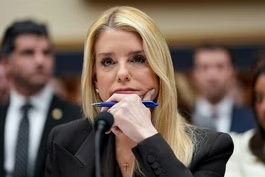
Attorney General Pam Bondi will be leaving her role after just 14 months on the job.
In a post on his social media platform, the president said Bondi would be -- quote -- "transitioning to a much needed and important new job in the private sector."
He did not specify the reason for her dismissal.
Our justice correspondent, Ali Rogin, has more on Bondi's firing and what comes next for the Department of Justice.
ALI ROGIN: Amna, after the announcement, Bondi called her time as A.G.
the honor of a lifetime and said it was easily the most consequential first year of the Department of Justice in American history.
During her tenure, Bondi has faced bipartisan criticism for her handling of the department's investigation into late convicted sex offender Jeffrey Epstein, and the president himself has expressed frustration over her lack of prosecutions of his perceived political enemies.
But Bondi was also a vocal ally of President Trump who frequently attacked members of Congress on his behalf, including at a combative hearing in February.
PAM BONDI, Former U.S.
Attorney General: I find it interesting that she keeps going after President Trump, the greatest president in American history.
ALI ROGIN: Deputy Attorney General Todd Blanche, who previously served as President Trump's personal attorney, will lead the department until the president names a new nominee for the role.
For more on what this means for the DOJ, I'm joined by Mary McCord.
She's a former acting assistant attorney general for national security and longtime federal prosecutor.
She's now executive director of the Institute for Constitutional Advocacy and Protection at Georgetown Law.
Mary, thank you so much for being here.
MARY MCCORD, Former Justice Department Official: Thanks for having me.
ALI ROGIN: Fourteen months in, what is Pam Bondi's legacy going to be as attorney general?
MARY MCCORD: Well, I think probably the things that people will remember her for the most probably is the debacle of the Epstein investigation.
I mean, way back early in Donald Trump's tenure, she really promised that the client files were on her desk.
That had to have just been made up, because it was only months later that she said, we don't have anything here.
I've investigated this along with the FBI director.
There's no criminal cases coming out.
There is no client list.
And then, of course, we've seen what has happened since then.
There are so many other things that she did that I feel like she should be remembered for.
And these are mostly not good things at all, completely undermining the independence of the Department of Justice from the White House, saying famously in the Great Hall the first time she addressed the men and women of the department that she was so pleased to be working under the direction of the president of the United States.
And that's really complete anathema to the prosecutors who, in order to show the American people that justice is not being used for political purposes, want to keep that distance.
ALI ROGIN: Why do you think this is happening and why now?
MARY MCCORD: I have actually thought for some time that this was going to happen.
And it's getting in -- Donald Trump's minds about when he -- mind about when he decides to do something is difficult to do.
It's usually tied to a news cycle or to try to distract from news, I think.
And so, today, it's not clear.
He had a bad day in the Supreme Court yesterday with the birthright citizenship argument, which had really nothing to do with Pam Bondi, but still perhaps he wants a distraction.
Now, whether this is the kind of distraction he wants, I don't know.
The Epstein matter, this all -- what this really will do is bring that back into the fore of discussion, even while people were starting to discuss other things, because, again, I think that's really one of the things she's most known for.
ALI ROGIN: We also know that President Trump was frustrated with her failure to successfully prosecute some of his political adversaries, James Comey, Tish James, to name a few.
Some of the top names being circulated to replace her include current EPA Administrator Lee Zeldin, U.S.
attorney for Washington, D.C.
Jeanine Pirro.
Would any of these names have any more success in those prosecutions of political adversaries than Bondi did?
MARY MCCORD: You know, her lack of success there is because the evidence didn't support the charges.
And that's what we have seen with -- when grand juries like we have heard already under Jeanine Pirro's watch in Washington, D.C., a grand jury rejected efforts to indict the members of Congress who had put out the truth in a statement, saying that members of the military owe an oath to the Constitution and not to obey unlawful orders.
That was just a true statement.
And the grand jury refused to indict.
We have seen vindictive and selective prosecution motions filed in the cases of James and Jim Comey.
Now, the court didn't have to actually reach the final merits of those because they kicked those cases out on the grounds that Lindsey Halligan was unlawfully in that office.
But they were powerful motions that, even though Lindsey Halligan had managed to get indictments there, those motions and some other statements by the judges in those cases suggested she might have done so by failing -- by saying things to the grand jurors that she wasn't supposed to say.
So, the long and the short answer to your question is, a different person doesn't change whether there is a lack of evidence.
And some of the suggested prosecutions are just really straining to find something to prosecute.
ALI ROGIN: Todd Blanche, who's currently the deputy attorney general, will serve in the acting capacity as the leader until someone is named.
He was President Trump's former lawyer.
He interviewed Ghislaine Maxwell last year.
Epstein survivors who have criticized the DOJ's handling of this say it's not about Pam Bondi; it's about a system that has failed them repeatedly.
So is Todd Blanche going to provide continuity here in terms of how the DOJ has handled it thus far?
MARY MCCORD: I mean, with respect to that case, I think he really made a mess of things when he did do that interview with Ghislaine Maxwell, because he suggested that this was going to come to some sort of conclusions.
But what we have seen when you read the transcript of those interviews, as a former prosecutor, there's nothing about that interview that tracks with what prosecutors would normally do when they're interviewing somebody who is complicit in the crimes, right?
And he was a former prosecutor or was a prosecutor.
He is a former prosecutor.
So he does know better.
I don't think he's -- he has definitely been as involved in this matter as Pam Bondi was.
And I think that now I think he's maybe benefited from so much criticism being levied against her.
And that focus may turn more to him now, because she's not going to be there.
ALI ROGIN: Mary McCord with Georgetown Law, thank you so much for your insights.
MARY MCCORD: My pleasure.
AMNA NAWAZ: Any nominee the president selects to replace Pam Bondi will have to face confirmation in the U.S.
Senate.
For more on how that could play out, as well as a Republican deal to fund the Department of Homeland Security, I'm joined by Andrew Desiderio.
He's senior congressional reporter for Punchbowl News.
Good to see you again.
ANDREW DESIDERIO, Punchbowl News: Great to see you.
AMNA NAWAZ: So let's pick up here on who could replace Pam Bondi.
The president has not yet said who his pick would be, but how do you see that confirmation process playing out and could it move as quickly as we saw Markwayne Mullin's, who became the new DHS secretary in a matter of weeks?
ANDREW DESIDERIO: Well, there's a lot that the Senate has to do when it comes back from recess on April 13.
But, on top of that, I think this move has the potential to backfire on the president, in the sense that it will reignite the Epstein files conversation, right?
One of the reasons it's been reported why the president fired her was because he was uncomfortable with how she handled the whole matter.
And this will be another opportunity for senators to question whoever the nominee is in a confirmation hearing about that very issue, which is something that we know gets under the president's skin, and that's going to be broadcast for everyone to hear.
In terms of the prospects for confirmation of the new individual, I don't -- I mean, unless there's someone really out there like Matt Gaetz, for example, which I don't think it will be, I think Senate Republicans will be able to get behind the ultimate nominee.
AMNA NAWAZ: All right, let's turn now to this partial government shutdown, nearly 50 days in now.
Senator Thune, Speaker Johnson announced a plan to fund most of DHS.
They're punting on funding ICE and CBP to a later deal.
How did this deal that they are talking about now, how did this become the deal?
ANDREW DESIDERIO: Well, the Senate passed it by unanimous consent at 2:30 in the morning last week.
I was there in the Senate chamber watching it.
But it's interesting because, the very next day, the House speaker, Mike Johnson, rejected it, said -- he called it a crap sandwich.
House Republican leadership was just like, no, we're not doing this.
This is a complete joke, right?
And Leader Thune thought he had the buy-in from the House and from the White House on this.
And then we were out of stalemate.
Both chambers left for recess.
It was, OK, the DHS shutdown is going to drag on now.
Fast-forward just five days later, and the speaker and Leader Thune have now come to an agreement that the House is just going to pass what the Senate passed.
So, early this morning, at 7:00 a.m.
during a pro forma session of the Senate, Leader Thune went to the floor and effectively sent that bill back to the House, so that they can vote on it.
Now, House Republicans had a call earlier today in which Speaker Johnson got a lot of pushback for his agreement with Leader Thune on proceeding with this deal, because it leaves out ICE and CBP funding.
So that's going to be a big point of contention for Republicans.
AMNA NAWAZ: So, look ahead for us now.
What could be the House timeline on this if they vote on it, and will it pass if it does move forward?
ANDREW DESIDERIO: Well, it's a recess week next week, and it sounds like it's very unlikely that the speaker will bring the House back to vote on this legislation.
Again, it would pass overwhelmingly, right?
That's not the issue.
The issue is, for Mike Johnson, he cannot put something on the floor that doesn't get a healthy number of Republicans supporting it.
So if you have got less than half of the conference, for example, that's not going to vote for this, but then you get every Democrat voting for it, that's really bad for Mike Johnson's standing in terms of either continuing to be speaker or to be House minority leader if Republicans lose control of the chamber later this year.
So that's something he's got to consider.
And it means that this shutdown is just going to drag on unnecessarily, I would say, for an extra two weeks here because the speaker did not just try to pass the bill that the Senate originally passed, which they sent back to them now.
It's like this game of ping-pong right now.
AMNA NAWAZ: So walk us through what this Republican plan could look like to fund CBP and ICE later.
What's that process?
ANDREW DESIDERIO: So they're going to use a process called budget reconciliation, which is a process that allows them to pass something with only Republican votes.
They can evade the filibuster.
They don't have to worry about Democrats.
The catch is that it has to deal with things that are budgetary in nature.
So ICE and CBP funding obviously qualify there.
But it has to have offsets too.
It has to be deficit-neutral.
So we're talking about, what are the Republicans going to try to cut?
There have been reports that they would look at health care-related cuts again, like they did last year in the One Big Beautiful Bill Act.
So that's going to be a politically fraught process for them.
And the president has said he wants that bill on his desk by June 1.
It's essentially two months from now, pretty quick timeline for a process as complicated as this.
AMNA NAWAZ: Andrew Desiderio of Punchbowl News, always great to have you here.
ANDREW DESIDERIO: Thank you.
AMNA NAWAZ: Today, in New York and London, leaders from European and Middle Eastern countries worked to develop a plan to try and reopen the Strait of Hormuz, which has been largely closed since the war in Iran began.
And after President Trump's speech last night predicting two to three more weeks of war, the U.S.
and Israel continued to bomb Iran today, and Iran continued its strikes on Gulf countries and Israel.
Here's Nick Schifrin.
(SIRENS BLARING) NICK SCHIFRIN: Outside Tel Aviv tonight, the threat is constant.
Iranian missile evaded Israeli air defense, shattering car windshields and puncturing this water pipeline.
It shows how, despite one month of war across Israel and the Gulf, Iran still can project power and display defiance.
Spokesman Elias Hazrati: ELIAS HAZRATI, Spokesperson, Iranian President (through translator): Our missile capabilities are growing stronger day by day.
Moreover, the Strait of Hormuz is in the hands of Iran's powerful forces.
NICK SCHIFRIN: Iran's assault on oil vessels and other energy targets in and along the strait has led to a staggering decline of traffic in what was one of the world's most important oil and natural gas choke points.
Before the war, the number of cargo ships going through the Strait of Hormuz in either direction averaged more than 100 per day.
One month ago, at the start of the war, that number dropped off a cliff and only handfuls of boats that Iran chooses are now transiting.
YVETTE COOPER, British Foreign Minister: We have seen Iran hijack an international shipping route to hold the global economy hostage.
NICK SCHIFRIN: Today, a group of more than 40 countries led by British Foreign Minister Yvette Cooper coordinated plans to reopen the strait after the war ends, this mostly European and Arab coalition, born from behind-the-scenes diplomacy with the U.S., but also because European leaders realized a program to sell American weapons for Ukraine was at threat if Europe didn't respond to President Trump's demand to help open the strait.
YVETTE COOPER: We are focusing on the effective coordination that we need across the world to enable a safe and sustained opening of the strait.
ANTONIO GUTERRES, United Nations Secretary-General: Conflicts do not end on their own.
They end when leaders choose dialogue over destruction.
NICK SCHIFRIN: In New York at the United Nations, diplomats met at the Security Council to debate a draft resolution aimed at authorizing a military mission to protect commercial shipping in and around the Strait of Hormuz from Iranian attacks.
A final vote is expected tomorrow, but a senior official from a country on the Security Council tells "PBS News Hour" Russia could issue a veto.
ABDULLATIF BIN RASHID AL ZAYANI, Bahraini Foreign Minister (through translator): We are confident that this draft resolution is consistent with international law, contrary to what Iran is doing today.
NICK SCHIFRIN: But some European leaders are skeptical of that plan and frustrated with President Trump.
Today, French President Emmanuel Macron accused President Trump of weakening NATO -- quote -- "If you create doubt every day about your commitment, you hollow it out.
And when we're serious, we don't say the opposite of what we said the day before."
DONALD TRUMP, President of the United States: When this conflict is over, the strait will open up naturally.
It'll just open up naturally.
NICK SCHIFRIN: Last night, President Trump argued that Iran's desire to sell oil will mean the problem of the Strait of Hormuz will solve itself.
But President Trump also expressed a desire to escalate, today, posting this video of a U.S.
strike on a bridge that a U.S.
official tells "PBS News Hour" was a planned Iranian resupply route, the view from a nearby family picnicking during the attack terrifying.
And Iran's Foreign Ministry also posted these photos today of what it said was an attack on the century-old Pasteur Medical Research Institute in Tehran.
A U.S.
official denies this was an American attack.
DONALD TRUMP: We're going to hit them extremely hard over the next two to three weeks.
We're going to bring them back to the Stone Ages, where they belong.
In the meantime, discussions are ongoing.
Yet, if during this period of time, no deal is made, we have our eyes on key targets.
If there is no deal, we are going to hit each and every one of their electric-generating plants very hard and probably simultaneously.
NICK SCHIFRIN: The markets did not like that message, opening down, and Brent crude prices spiked, traders apparently disappointed that the president did not signal the end of the war.
And the war continues to reverberate, massive U.S.
airstrikes in Central Iran, in Isfahan province, a critical hub for its nuclear program clouded in apocalyptic smoke, as the U.S.
targets ammunition depots.
The president vows to continue the war for another two to three weeks.
For the "PBS News Hour," I'm Nick Schifrin.
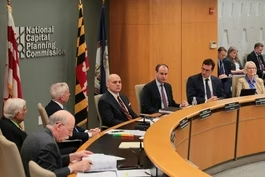
AMNA NAWAZ: In the day's other headlines: President Trump's White House ballroom project got final approval today from the agency overseeing all construction on federal property in Washington, D.C.
The 12-member National Capital Planning Commission, which is led by Trump appointees, voted overwhelmingly to allow the project to proceed.
STUART LEVENBACH, Vice Chairman, National Capital Planning Commission: It addresses a real operational need, while contributing a building that is dignified, harmonious with its surroundings, and worthy of the White House campus and the American people.
And for those reasons, I support moving forward with it.
AMNA NAWAZ: Despite today's approval, the plan still faces legal hurdles.
A judge earlier this week ordered construction to stop, but allowed two weeks for the administration to appeal.
That ruling said President Trump is -- quote -- "steward and not owner" of the White House, and that Congress must also approve the project.
The president argues none of that should be necessary.
The Army's chief of staff, General Randy George, is stepping down effective immediately.
The "News Hour" has confirmed that Defense Secretary Pete Hegseth asked that he agree to take early retirement.
George's ouster is just the latest of more than a dozen high-level dismissals of top generals and admirals by Hegseth since he took over the Pentagon last year.
George will be replaced on an acting basis by General Christopher LaNeve, who until February was Hegseth's senior military adviser.
Democratic Party leaders are suing to block President Trump's executive order targeting mail-in voting.
The lawsuit was filed by Senate Minority Leader Chuck Schumer and House Minority Leader Hakeem Jeffries, along with other party groups.
It argues that -- quote -- "President Trump possesses no such authority to order such a sweeping change to American elections."
Trump's order calls for the creation of a federal list of those eligible to vote by mail.
It also threatens to withhold federal funds from states that don't comply.
Responding to the lawsuit, a White House spokesperson criticized Democrats for being -- quote -- "upset about lawful efforts to secure American elections."
In Colorado, an appeals court today ordered former county clerk and election denier Tina Peters to be resentenced.
She's been serving a nine-year prison term related to her efforts to find fraud in the 2020 election, which Joe Biden won.
The judges today said that her continued promotion of election conspiracies should not have been a factor in her sentencing in 2024, saying it violated her free speech.
But they also rejected President Trump's attempt to pardon Peters, since she remains convicted of state crimes.
In Northern California, a 4.6-magnitude earthquake struck early this morning, rattling millions as they slept.
The quake struck near the small mountain town of Boulder Creek, but was felt up to 100 miles away, including around San Francisco.
There have been no reports of serious damage.
In the meantime, a more serious quake struck clear across the globe today in Indonesia.
WOMAN (through translator): The kids were shouting: "Mom, mom, come down quick."
So we went downstairs, found the emergency stairwell, and hid in the storage room.
AMNA NAWAZ: The 7.4-magnitude quake sent this hospital patient and her family scrambling for safety.
Many more fled their homes and public spaces, as dozens of aftershocks followed.
The quake toppled parts of buildings into streets and caved in roofs and ceilings.
At least one person was killed.
The earthquake originated underwater, generating a small tsunami, but authorities say that danger has now passed.
The Trump administration said today it will impose a 100 percent tariff on some imported pharmaceuticals.
But companies can avoid the new levies by agreeing to lower prices or by establishing new factories to serve the U.S.
market.
That's one of two executive orders signed by President Trump today, with the other focusing on metals.
The U.S.
is revamping the way it assesses tariffs on foreign steel, copper, and aluminum, with the stated aim of simplifying the system for U.S.
companies.
Today's steps for the administration's first such moves since the Supreme Court ruled in February that the president's sweeping global tariffs were illegal.
They also come exactly one year to the day since President Trump rolled out those worldwide tariffs on what he called liberation day.
That included tariffs on many of America's closest trading partners.
Despite largely being struck down, their broader economic and political impacts are still playing out.
In the meantime, on Wall Street today, it was Iran, not tariffs, that was top of mind for investors.
The Dow Jones industrial average slipped about 60 points on the day.
The Nasdaq shook off early losses to post a modest gain of nearly 40 points.
The S&P 500 also closed a touch higher.
And the world's oldest land animal, Jonathan the tortoise, is alive and well after reports of his death spread on social media yesterday.
Officials from his home island of Saint Helena in the South Atlantic posted a proof of life photo with images of today's headlines in the background.
Condolences had poured in yesterday after an X post claiming to be from Jonathan's veterinarian announced he had died.
It was viewed more than two million times.
His real vet later clarified that it was a hoax aimed at soliciting crypto donations.
Jonathan is believed to be 193 years old.
This photo is from the 1880s.
That means he was born about five years before Queen Victoria's coronation and nearly five decades before the invention of the lightbulb.
Still to come on the "News Hour": Iran continues attacks across the region, despite the president's claims that the war is winding down; astronauts progress on their voyage around the moon and deeper into space than any human has gone; and Judy Woodruff explores how the No Kings protests fit into America's history of protest.
We return to the war now in the Middle East, the blocking of the Strait of Hormuz, and reaction to President Trump's announcement that the attacks will go on two to three weeks more.
For that, we turn to Robin Niblett, a distinguished fellow and former director at Chatham House.
That's a global policy think tank.
And Firas Maksad is managing director of the Middle East and North Africa practice at the Eurasia Group.
It's an international consulting firm.
Welcome to you both.
And, Firas, I will begin with you, because clearly all nations are not viewing the war in Iran and its impacts the same.
So let's begin with the regional countries in the Gulf.
How are they looking at the U.S.
and Israeli war in Iran?
And what do they want to see happen now?
FIRAS MAKSAD, Eurasia Group: Well, Amna, it's not a uniform view across the Arabian Gulf.
These countries have different interests.
They have different positions from Israel.
And they have been also impacted in different ways as a result of this war.
I think it's important to point out that most of these countries prefer diplomacy, rather than war, at a time when it was actually Israel that was very much lobbying the president of the United States to conduct this military operation.
That view, however, began to change as Iran very much attacked these countries, Saudi Arabia, the UAE, Qatar, Kuwait, Bahrain, and others.
And the private message to the president increasingly became, go on.
We're already taking the hit, finish the job, don't leave us with an Iran that's standing 10 feet tall, having taken on the United States and Israel, survived the regime decapitation and continues to fire ballistic missiles.
As of late, however, that message is again changing, these countries now increasingly worried that, as President Trump in the two weeks ahead sends more forces to the region, promises and threatens escalation, they, their critical infrastructure, the energy, the power plants, and the desalination plants might very be very much in the bullseye.
So they're very concerned at this point.
AMNA NAWAZ: Robin Niblett, meanwhile, we know the European allies never wanted the U.S.
to withdraw from that raw nuclear deal in the first place, never wanted this war to begin.
And you just heard President Trump last night call upon them, as nations that depend on the oil and liquefied natural gas that goes through the Strait of Hormuz, to act, to, in his words, grab it and to cherish it.
How is that message going down with European allies today?
ROBIN NIBLETT, Chatham House: Not well, like the whole war itself.
I think there's a view expressed by just about every European leader that this was a war that was not well-planned, doesn't have clear objectives, a war in which the Europeans were not consulted, but to the extent that even the British weren't prepared at the beginning to be able to allow bases to be used for the initial assault, something that President Trump has called out very harshly, as you know.
You got to remember this comes on the back of the Europeans, the Greenland shock threats to sovereignty in Europe, which is quite a shocking element for them to be coping with as well, a trade war, unpredictable positions on Ukraine.
I think, for most European leaders, they have realized that, while they have been sort of buying time on Ukraine, trying to sort of buy time and simply try to jolly President Trump along, on Iran, it is the wrong approach to take.
So you have seen some really clear language from all the top leaders in Europe, from Keir Starmer, from Macron, even from Germany's Chancellor Merz recently, saying that this is -- this war is not being thought through, we're not going to be involved.
Even Giorgia Meloni in Italy, she has also been critical recently of a badly thought through war that's against international law.
So how's it seen?
Not well, and also a sense that we're going to take the hit economically.
As you know, we don't get much oil from the Gulf anymore.
We do get some important liquefied natural gas and our gas prices are already high because of the war against Ukraine by Russia.
So we know we're going to take more of the hit.
So then, for President Trump to kind of do the, we broke it, you own it, as people have described it, is seen as galling, to put it mildly.
AMNA NAWAZ: Firas, this focus by the president on reopening the strait and the push for other nations to take control and act to do it, how are Gulf nations looking at that effort?
FIRAS MAKSAD: Well, Amna, that is a point of grave concern for them.
There are some nations in the Gulf that are entirely dependent on exporting through that narrow body of water.
Now, there are others that don't, that have work-arounds.
Saudi Arabia has an east-west pipeline that allows it to channel quite a bit of its oil to the Red Sea.
The UAE also has a work-around that channels oil, 1.4 million barrels a day.
But for most of these countries, the strait is the lifeline.
And the idea that Iran might control it after all this is said and done or that Iran might even charge some kind of a toll system, a toll regime is something that's very concerning.
I think it's very important for us to also remember that the Red Sea, the Bab-el-Mandeb strait, that -- where Yemen and the Houthis are, can also become contested if the Houthis choose to attack the Saudi pipeline or to fire at ships there.
So it's an overall picture that is very much clouded.
And the United States and its president essentially devolving responsibilities to other is not what these countries want to hear right now.
AMNA NAWAZ: Robin, in the minute or so we have left, you have mentioned Mr.
Trump's repeated threats to leave NATO.
And after European allies rebuffed his efforts to help reopen the strait last month, he threatened to stop sending weapons to Ukraine.
How are those threats, are those threats influencing how European leaders are viewing this moment and what they might do?
ROBIN NIBLETT: Well, I think, obviously, it's a deep source of concern.
Mark Rutte, the secretary-general of NATO, convened a private call with some of the main European leaders, saying, look, this is serious.
And it's serious especially for military support to Ukraine.
Europeans now pay for that military support for Ukraine, but we need to be able to buy a lot of it from America.
We don't have the equipment ourselves.
So you saw a lot of these moves to say that we will provide some type of maritime reassurance force after there's a cease-fire.
That followed a request from Mark Rutte to try to tone it down over NATO.
I think, in the long term, however, Europeans believe they just need to get through the next three years.
They reckon that NATO will survive if we can get beyond the Donald Trump presidency.
And that's what they're focused on right now is surviving these next three years.
AMNA NAWAZ: All right, that is Robin Niblett and Firas Maksad joining us tonight.
Gentlemen, thank you both for your time and insights.
Appreciate it.
FIRAS MAKSAD: Thank you.
ROBIN NIBLETT: Thank you.
AMNA NAWAZ: New research estimates Russian forces have suffered more than one million casualties in its war against Ukraine.
At the same time, its territorial gains have been some of the slowest in modern history.
Tonight, we get a rare look at the Kremlin's war machine.
Special correspondent Simon Ostrovsky reveals the brutality and the corruption eating away at the Russian military from the inside.
And a warning: Viewers may find some scenes in this report disturbing.
SIMON OSTROVSKY: In Russia's military, men learn quickly to fear their commanders more than their foe.
This is the treatment awaiting those who refuse to hand over their pay.
Hundreds of videos circulating on Russian social media reveal horrific punishments by superiors extorting money from their men.
Soldiers report being locked in cages, electrocuted and sexually assaulted.
Those wounded, but lucky enough to survive, must pay thousands more to be declared unfit for service, or they're force to literally limp into battle.
MAN (through translator): Russian warriors, this is how we go to the front.
SIMON OSTROVSKY: Corruption dictating who lives and who dies.
In Russia, military cemeteries are running out of space to bury the dead, while the authorities are trying to keep the scale of their losses secret by blurring them on maps.
New research published by the Center for Strategic and International Studies in Washington, D.C., shows the extraordinary price Russia is paying as its war in Ukraine grinds on into its fifth year.
Between the start of the full-scale invasion in 2022 and the end of last year, Russian forces have suffered 1.2 million casualties, which include the dead, wounded and missing.
Out of that staggering number, as many as 325,000 are believed to be dead.
One of the report's authors is Seth Jones, a former senior official in the Department of Defense.
He said many Russians are dying because they're unable to pay bribes and are being sent to the front lines to be killed.
SETH JONES, Center for Strategic and International Studies: They're being used as bait, so they draw fire.
And when there's artillery that goes off, Russian artillery or Russian drones are able to, say, spot where Ukrainian locations are.
SIMON OSTROVSKY: One of the things I have been struck by as I have looked at the video footage that's come out of this war is that you often see soldiers who are totally unfit for duty.
I'm talking about people who are on crutches, people who are missing limbs.
You have to ask yourself, why is this happening?
What kind of a strategy is that?
SETH JONES: I think this is where the Russians believe this is the least worst strategy, because they have an advantage in numbers.
The problem, of course, is that it leads to historical numbers of casualties.
It is unprecedented since World War II.
SIMON OSTROVSKY: Another way of looking at it is by comparison to America's deadliest war since World War II, the Vietnam War.
Here in Washington, D.C., at the Vietnam War Memorial, the names of service men and women who died and went missing in Vietnam are commemorated on these walls.
In total it's about 58,000 names.
Russia's war dead in just four years are more than five times that number.
And the multiple is even higher if you consider the missing in action.
After nearly two decades, the widely unpopular Vietnam War ended with an embarrassing withdrawal of American troops and the fall of South Vietnam.
With Ukraine, the Kremlin has managed to project strength both at home to its citizens and abroad when it comes to negotiating for land.
Last year, President Donald Trump even told his aides the Russian army looked invincible after seeing footage from this military parade in Moscow.
Yet, on the actual battlefield, Russia's forces have advanced at a slower pace than any major offensive campaign in any war in the last century.
SETH JONES: We're seeing average rates of advance around 15 meters per day and in some cases up to 70 meters per day.
The... SIMON OSTROVSKY: The advances are being measured in meters.
SETH JONES: Meters, right.
SIMON OSTROVSKY: That sounds like World War I. SETH JONES: It's even slower than World War I. So this is slower than some of the slowest and most casualty-accepting campaigns we have seen in any war in the last century.
SIMON OSTROVSKY: In Russia, promises of generous sign-up bonuses and a steady paycheck have managed to feed enlistment drives, with recruitment targeted at the country's poorest regions.
For now, that's helped compensate for the high battlefield casualty rates.
WOMAN (through translator): Heartbreaking.
Our boys are once again being sent to the special military operations zone.
SIMON OSTROVSKY: Leaked messages sent to this government Web site show mounting desperation among Russian soldiers and their families.
Obtained by the independent Russian outlet Radio Echo, nearly 12,000 complaints filed over six months last year accused commanders of corruption and violence towards their own men.
In this 2025 video, military police in the Siberian region of Tuva beat and electrocute wounded soldiers to force them back to the front.
Alexandra Arkhipova is a Russian researcher who's spent weeks sifting through these letters to verify their authenticity and catalog the brutality that the Russian military is inflicting on its own men.
ALEXANDRA ARKHIPOVA, Wilson Center: In many cases, in many letters, the people are saying that literally we paid everything to have our father, brother, husband not to be killed.
In many cases, superiors, they use tortures to take money from the soldiers.
MAN (through translator): How the (EXPLETIVE DELETED) did you end up here?
MAN (through translator): I refused to go on the mission.
MAN (through translator): Why the (EXPLETIVE DELETED) did you think you could do that?
MAN (through translator): I'm wounded.
SIMON OSTROVSKY: And this is the Russian army doing this to its own soldiers?
ALEXANDRA ARKHIPOVA: Yes, correct.
SIMON OSTROVSKY: She told PBS News the army shifts the cost of the war in Ukraine onto the soldiers themselves through extortion.
Soldiers report handing over up to 80 percent of their salary just to stay alive.
MAN (through translator): What did he do to you?
MAN (through translator): He shoved a (EXPLETIVE DELETED).
MAN (through translator): Why?
What for?
MAN (through translator): Because I didn't give him money.
MAN (through translator): How much was he demanding?
MAN (through translator): Thirty nine hundred dollars.
SIMON OSTROVSKY: Price lists dictate new rules of engagement, $2,000 to be assigned to a post as a drone operator away from the front line, $6,000 to serve in the rear, a staggering $12,000 for a forged discharge on medical grounds.
The picture you describe is hellish.
If the entire military is functioning like this, it couldn't really perpetuate the war for much longer.
ALEXANDRA ARKHIPOVA: The situation in Russia, from the economical point of view, is very bad.
Poor people, they became poor, so they go to the war.
Taxes are going up.
And it's a big problem now what to buy for dinner.
And this is the price of the war.
SIMON OSTROVSKY: With Russian oil and gas revenues down 24 percent last year, the price of war is no longer just the 35,000 Russian casualties a month.
It's also new taxes the government has been forced to levy, coupled with skyrocketing prices for consumer goods.
In the fifth year of what was meant to be a three-day war, the outlook for Russia has never been so grim.
For the "PBS News Hour," I'm Simon Ostrovsky in Washington, D.C.
AMNA NAWAZ: A day after liftoff, Artemis II is now well on its way, four astronauts on a 10-day voyage around the moon and back, traveling deeper into space than any human ever before.
For what's happening now and what comes next, I'm joined by our science correspondent.
That is Miles O'Brien, who is just back from witnessing that historic launch yesterday.
Miles, it's great to see you.
So give us an update.
In those first 24 hours since liftoff, what have the astronauts been up to and how's everything going so far?
MILES O'BRIEN: The mission is going smoothly, Amna.
I don't want to hex it or anything, but things are going well.
It is a test flight.
And one of the things that was high on the list of things they wanted to understand was, how well does the Orion capsule maneuver when it is manually controlled in space?
So they separated from the second stage of the rocket, which is no longer needed for them, pulled back and attempted to get close to it as if it was docking, although they did not dock.
There was a docking target as if there had been a docking mechanism on it.
And it gave the crew an opportunity to fly the Orion, see what it's like as it got closer to that other object, obviously to tell them a little bit about how it handles for future docking.
I was watching as the navy test pilot and astronaut Victor Glover handled this situation.
And why don't you listen in?
I think you will agree he's got the right stuff.
VICTOR GLOVER, Artemis II Pilot, NASA: And now I see ICPS in the docking camera field of view.
OK, waiting for 550.
I'm on the THZ (ph).
There's 550.
It's got a little rough like we're driving on a rocky road, but it's much quieter than in the sim eight.
I can see the side docking target.
That is a good-looking American flag.
Happy -- going off, Fox.
Great flying with you, Houston.
Nice vehicle.
WOMAN: Great job, Victor, and to the entire crew, and we enjoyed your excitement at seeing ICPS out the window.
MILES O'BRIEN: Smooth flying by a steady hand and someone who knows a lot about flying, but this time in space on a brand-new vehicle, Amna.
AMNA NAWAZ: That is so very cool to hear.
So, Miles, not because I want specific details, but because it got attention, there was a report about some issues with the onboard toilet after launch.
Is everything OK now?
MILES O'BRIEN: Well, I guess you could say it's a number one problem as well.
But, yes, the toilet did fail initially.
This was a big deal, because the Apollo capsules had no toilet.
They had to use bags, and this was a big deal.
They had to do a reboot on the system because a fan wasn't operating.
The urine collection capacity was out of commission.
But they got it rebooted, and everybody's fine and dandy on that priority.
AMNA NAWAZ: Good to hear.
So, walk us through what the next big hurdle is for these astronauts.
What are they preparing for?
What comes next?
MILES O'BRIEN: It's a historic moment, Amna, and it's going to happen potentially in about an hour or so.
It's called the translunar injection burn.
This is when they will fire the rocket motors enough to increase the speed of the spacecraft by about 800 miles an hour.
And that will be enough to pull the Orion capsule away from the gravitational pull of Earth and more toward the moon.
Once this burn is done, they're pretty much on their way to the moon, and they will get their honor about Sunday for this ride around the moon.
AMNA NAWAZ: So if they expect to get there on or around Sunday, tell us a little bit about how much the rest of us down here on Earth will be able to witness and able to see of this historic journey.
MILES O'BRIEN: Well, the new administrative NASA, Jared Isaacman, had made it possible for them to bring their iPhones.
They had been banned for astronauts by NASA because they were concerned about them being flammable.
He said, that's crazy.
Bring your iPhones.
So we're going to get some great selfies for sure.
But I will tell you this.
If you go back to 1968, Apollo 8, perhaps the most audacious Apollo mission of them all, the world was just completely gobsmacked by the image captured by Bill Anders, one of the crew members on that Apollo mission.
As they orbited the moon, they saw this blue orb arise and it was Earth.
It was an Earthrise shot.
And it took everybody back.
It helped really in many ways start the environmental movement here on Earth.
And I have talked to several Apollo astronauts, and almost all of them to a person say, they went to the moon.
What they ended up being more fascinated about and more appreciative of was Earth itself.
It will be interesting to see if this crew has the same experience.
AMNA NAWAZ: Miles O'Brien, always great to talk to you.
Please come back soon, update us on the mission.
Thank you.
MILES O'BRIEN: You're welcome, Amna.
AMNA NAWAZ: Organizers said some eight million people showed up to the third nationwide No Kings protest over the weekend.
Demonstrators at thousands of events rallied against the war in Iran, immigration enforcement, and what they see as executive overreach by the Trump administration.
Judy Woodruff went to the protest in Minnesota to explore how No Kings fits into America's long history of protest.
It's for her series America at a Crossroads.
JUDY WOODRUFF: It was a rally with big names and an even bigger crowd.
Some 100,000 people marched to the state capitol in St.
Paul on Saturday dressed like kings and founding fathers, carrying signs and speaking against an administration they called tyrannical.
MAN: He's a dictator.
He's an authoritarian.
What else can I say?
WOMAN: They're destroying our democracy and choosing to do whatever they want without any repercussions.
JUDY WOODRUFF: Organizers picked Minnesota as the flagship No Kings protest following the Trump administration's sweeping immigration crackdown here.
For months, federal agents repeatedly clashed with residents, made thousands of arrests and killed two U.S.
citizens; 34-year-old Miguel Hernandez, whose parents are from Mexico, served as a marshal during the protest.
MIGUEL HERNANDEZ, Owner, Lito's Burritos: A lot of people are coming together, spreading all these ideas that we -- yes, we should stand up against tyrants, but we should make better communities.
JUDY WOODRUFF: Hernandez and his family own two restaurants in the Twin Cities.
And even though Operation Metro Surge has technically ended, he says both residents and businesses continue to struggle.
MIGUEL HERNANDEZ: Some of these restaurants last 80 percent of their clientele for four months.
Some of their staff members aren't coming back too.
To see that bloodshed on the streets that I call home, the streets that I drive past every day that's a great trauma a lot of us felt here.
JUDY WOODRUFF: But Hernandez says No Kings is about more than what's happened in Minnesota.
MIGUEL HERNANDEZ: I'd love for more folks to say, in the face of authoritarianism, yes, you might risk something, but, at the end of the day, you will be helping someone.
Step out of your comfort level and push back on something that will ultimately get worse if we do not.
COREY BRETTSCHNEIDER, Brown University: What these moments call for are citizen action.
That's the thing that works, not the traditional story of the three branches of government, one branch checking another.
JUDY WOODRUFF: Corey Brettschneider is a political scientist at Brown University.
His 2024 book, "The Presidents and the People," tells the story of five presidents who pushed the boundaries of executive power and the citizens who pushed back.
COREY BRETTSCHNEIDER: The sort of myth that we often tell that all the framers were believers in democracy is not true.
There really was an authoritarian current, an understanding of the Constitution from very early on.
JUDY WOODRUFF: His first example is John Adams, who used the Sedition Act of 1798 to prosecute members of the press who criticized him.
COREY BRETTSCHNEIDER: Adams thought the word republic was compatible actually with monarchy.
The newspaper editors who fight back against Adams really use that moment in order to turn the election of 1800 into at least in part a referendum on the idea of, is there a right to dissent?
JUDY WOODRUFF: Adams lost that election to Thomas Jefferson.
Over the years, many presidents have been depicted as kings, including Abraham Lincoln, who during the Civil War suspended habeas corpus, a person's right to challenge their own detention.
Franklin Delano Roosevelt was also labeled a king for, among other things, serving four terms as president and attempting to pack the Supreme Court.
But Brettschneider says authoritarian only accurately applies to a much smaller group.
COREY BRETTSCHNEIDER: Even if numerically, it's far from a majority, you really only need one to succeed.
In those instances, we largely did fight back.
We did recover.
But that's not a guarantee of the future.
There's no law of political science that says citizens defending the Constitution from an authoritarian president will win out.
ADAM KASIM, Protester: I better be out to fight for what I believe and what the founders of America stood for, for over 200 years.
SEN.
BERNIE SANDERS (I-VT): I have been thinking a lot about the men and women in 1776 who announced to the world that they would no longer be ruled by the king of England.
Today in 2026, our message is exactly the same, no more kings.
(CHEERING) JUDY WOODRUFF: Do you think of it in that vein or no?
JOHN HINDERAKER, President, Center of the American Experiment: I really don't.
I think that the Democratic Party has a platform that consists almost exclusively of hating Donald Trump.
JUDY WOODRUFF: John Hinderaker leads the Center of the American Experiment, a conservative think tank in the Twin Cities.
JOHN HINDERAKER: These people are election deniers.
They have never accepted the fact that Donald Trump won the 2024 election.
He was selected by the American people to be the president.
He's entitled to act as the president.
Every single thing he does, they automatically oppose.
And they -- the resistance movement started before he was even inaugurated.
They really know Trump is not a dictator.
Trump is not a king.
It's perfectly safe to go out there and call Trump all the horrible names you want to call him, because he is not, in fact, a dictator.
JUDY WOODRUFF: Cally Proctor is a mom and writer in Minneapolis.
She voted for President Trump in 2024.
CALLY PROCTOR, Minneapolis Resident: We have a president who still is held accountable by things like elections, by things like courts, by things like other branches of the government and systems that are still working and operating.
JUDY WOODRUFF: Proctor says she saw government overreach while President Biden was in office, especially around COVID restrictions.
Do you think what happened during the Biden administration is equivalent to what we're seeing now?
CALLY PROCTOR: I do.
And I know a lot of people - - I know that a lot of people do as well, but it just -- I think that if you talk to people who are at the No Kings rally, they say, why are you here, I think that it would be ironically very similar to my own concerns.
JUDY WOODRUFF: Cara Schulz is a libertarian who serves on the city council in the Twin Cities suburb of Burnsville.
Around 2009, Schulz attended Tea Party protests against government spending and President Obama's health care policies.
And this year, she was on the front lines as Minnesotans confronted federal agents.
CARA SCHULZ, Burnsville, Minnesota, City Council: We had armed masked men coming into our neighborhoods and lobbing tear gas.
But that is what government power looks like.
It's just how in your face it's going to be or not.
We have seen this over and over and over through our country's history, but most of the time most of us are able to turn away.
And we're at a point where it is so pervasive in our communities that we can't turn away.
JUDY WOODRUFF: Still, Schulz has not participated in No Kings protests.
CARA SCHULZ: A lot of the messaging is very Trump-specific, as if he is only the problem, and if he's replaced with someone else the problem goes away.
JUDY WOODRUFF: She says her biggest concern is that authoritarianism has become normalized.
According to preliminary results from a 2025 survey, about a third of U.S.
adults believe having a strong leader for America is more important than having a democracy.
But during Saturday's protests at least, that idea was nowhere to be found.
It's a No Kings rally.
What does that say to you?
KATELYN THOMAS, Protester: Democracy.
I mean, that's what this country was founded on.
And I love this country.
I don't want to see that go away.
MIGUEL HERNANDEZ: There's been a lot of people who've done this in the past and it's kept America from tilting too far in the direction of authoritarian government.
And I think it should always be that way.
And we should always -- our government should listen to the people.
MAN: Thank you, Minnesota!
JUDY WOODRUFF: For the "PBS News Hour," I'm Judy Woodruff in St.
Paul, Minnesota.
AMNA NAWAZ: And that is the "News Hour" for tonight.
I'm Amna Nawaz.
On behalf of the entire "News Hour" team, thank you for joining us.
 New
NewArtemis II astronauts embark on voyage around the moon
Video has Closed Captions
Artemis II astronauts embark on voyage around the moon (5m 2s)
 New
NewGulf nations, European allies respond to Trump's Iran speech
Video has Closed Captions
How Gulf nations and European allies are responding to Trump's Iran address (7m)
 New
NewHow 'No Kings' events fit into America's history of protest
Video has Closed Captions
How 'No Kings' rallies fit into America's history of protest (8m 49s)
 New
NewNews Wrap: Planning commission approves ballroom project
Video has Closed Captions
News Wrap: National Capital Planning Commission approves Trump's ballroom project (6m 9s)
 New
NewRepublicans in Congress announce plan to end DHS shutdown
Video has Closed Captions
Republicans in Congress announce plan to end DHS shutdown, but political battle continues (4m 30s)
 New
NewRussian corruption fuels massive casualties in Ukraine
Video has Closed Captions
Russian corruption fuels massive casualties in Ukraine (8m 17s)
 New
NewWhat's next for the Justice Department after Bondi's firing
Video has Closed Captions
What's next for the Justice Department after Bondi's firing (7m 3s)
 New
NewWorld leaders work to ease markets as Trump signals more war
Video has Closed Captions
Global leaders work to ease oil price surge as Trump signals more weeks of Iran war (4m 53s)
Providing Support for PBS.org
Learn Moreabout PBS online sponsorship
- News and Public Affairs

FRONTLINE is investigative journalism that questions, explains and changes our world.

- News and Public Affairs

Amanpour and Company features conversations with leaders and decision makers.
One Question with Becky Ferguson











Support for PBS provided by:
Major corporate funding for the PBS News Hour is provided by BDO, BNSF, Consumer Cellular, American Cruise Lines, and Raymond James. Funding for the PBS NewsHour Weekend is provided by...