
April 8, 2026 - PBS News Hour full episode
4/8/2026 | 57m 46sVideo has Closed Captions
April 8, 2026 - PBS News Hour full episode
Wednesday on the News Hour, confusion and tension are growing around the Strait of Hormuz hours into a fragile ceasefire between the U.S. and Iran. We speak to the partner of a man detained by immigration authorities on his way to see his prematurely born baby in the hospital. Plus, Portland's first-of-its-kind climate fund faces growing debate over how the money should be spent.
Problems playing video? | Closed Captioning Feedback
Problems playing video? | Closed Captioning Feedback
Major corporate funding for the PBS News Hour is provided by BDO, BNSF, Consumer Cellular, American Cruise Lines, and Raymond James. Funding for the PBS NewsHour Weekend is provided by...
April 8, 2026 - PBS News Hour full episode
4/8/2026 | 57m 46sVideo has Closed Captions
Wednesday on the News Hour, confusion and tension are growing around the Strait of Hormuz hours into a fragile ceasefire between the U.S. and Iran. We speak to the partner of a man detained by immigration authorities on his way to see his prematurely born baby in the hospital. Plus, Portland's first-of-its-kind climate fund faces growing debate over how the money should be spent.
Problems playing video? | Closed Captioning Feedback
How to Watch PBS News Hour
PBS News Hour is available to stream on pbs.org and the free PBS App, available on iPhone, Apple TV, Android TV, Android smartphones, Amazon Fire TV, Amazon Fire Tablet, Roku, Samsung Smart TV, and Vizio.
Providing Support for PBS.org
Learn Moreabout PBS online sponsorshipGEOFF BENNETT: Good evening.
I'm Geoff Bennett.
Amna is on assignment.
On the "News Hour" tonight: Confusion and tension are growing around the Strait of Hormuz hours into a fragile cease-fire between the U.S.
and Iran, a truce complicated by Israel's ongoing strikes in Lebanon.
We speak with the partner of a man detained by immigration authorities on his way to see his premature baby in the hospital.
And Portland, Oregon's first-of-its-kind climate fund faces growing debate over how the money should be spent.
SAM BARASO, Program Manager, Portland Clean Energy Fund: Our frontline communities, those that face the greatest and worst impacts of climate change, should be at the center of creating those solutions.
(BREAK) GEOFF BENNETT: Welcome to the "News Hour."
For the first time in more than five weeks, the U.S.
did not launch widespread attacks on Iran today and Iran did not strike U.S.
targets.
Even as the cease-fire between the two nations largely held, it's being tested by what appears to be Iran's ongoing choke hold of the Strait of Hormuz, as well as Israel's war in Lebanon.
Nick Schifrin reports on the many factors that could determine if the temporary truce can become a long-term peace.
NICK SCHIFRIN: Today, in two capitals, two declarations of victory.
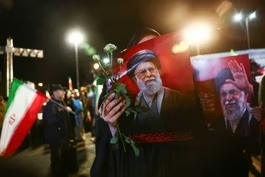
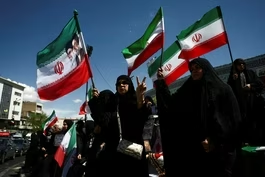
In Tehran, immediately after the cease-fire, government supporters filled the streets, desecrating what the regime has for decades called the big and little Satan.
Meanwhile, at the White House... KAROLINE LEAVITT, White House Press Secretary: This is a victory for the United States of America.
NICK SCHIFRIN: ... and the Pentagon... PETE HEGSETH, U.S.
Defense Secretary: Operation Epic Fury was a historic and overwhelming victory on the battlefield, a capital-V military victory.
NICK SCHIFRIN: ... the U.S.
declared its own goals met.
But this is what the vice president admitted was a fragile truce.
In the hours after the cease-fire, Iran attacked Israel, intercepted by air defense, and Iran reported an attack on an oil refinery in the Strait of Hormuz.
And it's that energy choke point through which 20 percent of the world's oil and natural gas usually flows that became one of the cease-fire deal's linchpins.
Today, Iranian state media announced it was closed because of ongoing Israeli attacks on Lebanon.
KAROLINE LEAVITT: This is a case of what they're saying publicly is different privately.
We have seen an uptick of traffic in the strait today.
NICK SCHIFRIN: But at the White House today, spokesperson Karoline Leavitt insisted the strait was open.
KAROLINE LEAVITT: I will reiterate the president's expectation and demand that the Strait of Hormuz is reopened immediately, quickly and safely.
That is his expectation.
It has been relayed to him privately that that is what's taking place and these reports publicly are false.
MAN: Transiting in the Strait of Hormuz is closed.
NICK SCHIFRIN: In the Persian Gulf, Iran's navy tells a different story, broadcasting this audio message today.
MAN: If any vessel tries to transit without permission will be destroyed.
Out.
NICK SCHIFRIN: And maritime intelligence organizations tell "PBS News Hour" that Iran only allowed five ships through the strait today, the same number as the day before the cease-fire.
Iranian Foreign Minister Abbas Araghchi warned - - quote -- "The cease-fire terms are clear and explicit.
The U.S.
must choose, cease-fire or continued war via Israel.
It cannot have both.
The world sees the massacres in Lebanon.
The ball is in the U.S.
court."
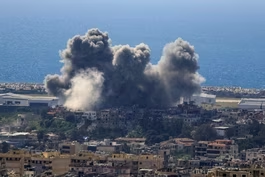
Israel today hit Lebanon with what it called the largest coordinated wave of strikes since the war in Iran began, pounding Beirut, attacking more than 100 targets within 10 minutes, and targeting Southern Lebanon, where Israeli troops recently invaded and pushed out most of the population.
Israeli Prime Minister Benjamin Netanyahu said today, this part of the war will not end.
BENJAMIN NETANYAHU, Israeli Prime Minister (through translator): I insisted that the temporary cease-fire with Iran would not include Hezbollah, and we continue to strike it hard.
J.D.
VANCE, Vice President of the United States: I think this comes from a legitimate misunderstanding.
I think the Iranians thought that the cease-fire included Lebanon, and it just didn't.
NICK SCHIFRIN: But Vice President Vance today, at the end of a trip to Budapest, Hungary, said Israel never promised to cease-fire in Lebanon, but might be willing now.
J.D.
VANCE: The Israelis, as I understand it -- again, I'm supposed to get a fuller report when I get on the plane -- have actually offered to be -- frankly, to check themselves a little bit in Lebanon because they want to make sure that our negotiation is successful.
NICK SCHIFRIN: Vance will lead negotiations with Iran beginning this weekend in Pakistan, alongside Steve Witkoff and Jared Kushner, dispatched by President Trump.
J.D.
VANCE: He's told us to come to the negotiating table.
But if the Iranians don't do the exact same thing, they're going to find out that the president of the United States is not one to mess around.
He's impatient.
He's impatient to make progress.
He has told us to negotiate in good faith.
NICK SCHIFRIN: Last night, Iran's supreme National Security Council released its negotiating demands, including -- quote - - "the establishment of a secure transit protocol in the Strait of Hormuz in such a manner as to guarantee Iran's dominion, withdraw of U.S.
forces from the Middle East, and U.S.-Israeli reparations."
The U.S.
has long rejected those demands.
Iran is also demanding the lifting of all sanctions, which President Trump acknowledged today was on the table.
But, in turn, Iran has rejected the U.S.'
longstanding demands, including no domestic uranium enrichment, end of support for proxies, and limits on missile inventory and range.
And, today, the U.S.
added a new demand and threat.
Iran must hand over its nearly 1,000 pounds of highly enriched uranium, believed buried under the rubble of last summer's U.S.
strikes, or the U.S.
will launch a raid to seize it.
PETE HEGSETH: They will either give it to us, which the president the president is laid out.
They will give it to us voluntarily.
We will get it.
We will take it.
We will take it out.
NICK SCHIFRIN: But back in Tehran, there is cautious relief and, for some, a clear enemy.
MAN (through translator): Everyone likes peace and calm, but, unfortunately, someone is talking to us who is not trustworthy at all.
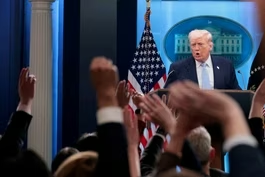
DONALD TRUMP, President of the United States: Every bridge in Iran will be decimated by 12:00 tomorrow night.
NICK SCHIFRIN: Even for President Trump, it has been a volatile 48 hours.
He whipsawed between threatening to destroy Iran's civilization unless there was a deal to an 11th hour deal, declaring the cease-fire and claiming "Almost all of our various points of past contention have been agreed to."
For European allies confronting an unpredictable president, for the U.S.'
Gulf allies facing persistent new Iranian threats, and for energy infrastructure that will take months or years to rebuild, the war will have consequences long beyond any cease-fire.
Tonight, a U.S.
official acknowledges to me that the Strait of Hormuz is basically a pressure valve that Iran can turn on and off.
But the official argues the war has shifted Iran's demands, including its willingness to accept this temporary cease-fire.
The challenge now is this weekend's negotiations, which Iran enters with a leverage over the strait, Geoff, that it did not have before the war.
GEOFF BENNETT: Nick Schifrin, our thanks to you.
Let's turn now to our White House correspondent, Liz Landers, who spoke with President Trump on the phone earlier today.
So, Liz, what did the president say about Iran in your phone call?
LIZ LANDERS: I called him around 8:45 this morning right after that Pentagon briefing had ended.
And I wanted to ask him about what Nick's report included, about the strikes that were still happening from the Israeli military on Lebanon that was ongoing this morning.
I asked the president if he had seen that there were still military strikes happening.
He said yes.
They, Lebanon, were not included in the deal.
And I said, why not and if Lebanon should have been included as part of this cease-fire deal.
And he said: "Because of Hezbollah, they were not included in the deal.
That will get taken care of too.
It's all right."
I went on to ask him if he was OK with the Israeli military continuing to bomb Lebanon.
He reiterated: "It's part of the deal.
Everyone knows that."
And he said that that's a separate skirmish.
Geoff, I tried to get him to answer another question about the post that he posted yesterday on TRUTH Social about wiping out Iranian civilization, but he hung up before I was able to get an answer.
GEOFF BENNETT: The White House press secretary, Karoline Leavitt, was also asked about the different understandings of Lebanon during her White House press briefing this afternoon, the understandings over how Lebanon would be included in this deal or not.
What did she say?
LIZ LANDERS: Iran seems to think that stopping the Israeli attacks on Lebanon was part of the cease-fire deal.
The president, though, and both -- and also Israel have made it clear that that was not the case from their point of view.
Karoline Leavitt was asked about this in today's briefing.
Here's what she told reporters: KAROLINE LEAVITT, White House Press Secretary: Lebanon is not part of the cease-fire.
That has been relayed to all parties involved in the cease-fire.
As you know, Prime Minister Netanyahu put out a statement last night in support of the cease-fire, in support of the United States' efforts, and he's also assured the president they will continue to be a helpful partner throughout the course of the next two weeks.
LIZ LANDERS: Karoline was also asked in a follow-up question if the president may want to see Lebanon included in future conversations, and she said that this will continue to be discussed between President Trump and Prime Minister Netanyahu, but again reiterated it's not part of the current conversation.
GEOFF BENNETT: And the president in a separate phone call with a journalist from ABC News talked about a revenue proposal with Iran over the Strait of Hormuz.
Tell us about that.
LIZ LANDERS: That was earlier this morning.
And ABC News' Jon Karl spoke with him briefly as well and asked the president about whether he was OK with the Iranians charging a toll on all ships that are moving through the Strait of Hormuz.
The president described the potential for this revenue sharing mechanism, telling him -- quote -- "We're thinking of doing it as a joint venture.
It's a way of securing it, also securing it from lots of other people."
And the president added: "It's a beautiful thing."
Geoff, a reminder that the Strait of Hormuz was open to free flow of goods and ships before this conflict started.
So this is another complicating factor, of course, that Nick laid out in his full report.
GEOFF BENNETT: Liz Landers, terrific reporting, as always.
Thank you.
LIZ LANDERS: Of course.
GEOFF BENNETT: And we're joined now by "News Hour" special correspondents Reza Sayah in Tehran and Simona Foltyn in Beirut.
Reza, we will start with you.
We're seeing reports of air defense systems going off in Tehran tonight.
And Iran says it may reenter the conflict following Israeli strikes in Lebanon.
What are you hearing on the ground right now?
REZA SAYAH: Yes, this cease-fire agreement is not even 24 hours old and there's signs that it's falling apart.
Iranian state media reporting that Tehran is prepared to exit the cease-fire agreement if Israel continues its bombing, its airstrikes targeting locations in Lebanon.
And, seemingly, Tehran has taken a couple of steps in doing that.
They're once again shutting down the Strait of Hormuz and, according to state media, the Revolutionary Guard launching a number of missiles targeting locations in the Gulf.
Mohammad Bagher Ghalibaf, he's the speaker of Iran's Parliament.
He accused Washington's partner Israel of violating the cease-fire agreement by attacking locations in Israel and launching drones into Iranian airspace.
Around 8:00 p.m.
local time here in Tehran, once again, Tehran's air defense system activated.
We heard that familiar volley of anti-aircraft fire in the skies, usually an indication that the drone is up above.
Abbas Araghchi, the foreign minister here in Iran, with a message to Washington, saying the United States is a choice, to either abide by the agreement or choose to continue this war through Israel.
GEOFF BENNETT: And, Reza, there also appears to be a major gap on the nuclear issue.
President Trump says there will be no uranium enrichment.
Iran, Iranian officials insist they have that right.
How wide is the divide between the two sides at this point in this fragile cease-fire?
REZA SAYAH: Yes, many gaps.
These two sides haven't even sat down to begin negotiations, and there's indications that there's lots of confusion.
You look at the idea of uranium enrichment, the White House explicitly saying that Iran cannot enrich uranium.
That's one of Tehran's conditions.
They believe that a peaceful nuclear program is their right.
And you look at the Strait of Hormuz, Iran is demanding a new protocol to ensure safe passage, saying they want to charge fees for ships and tankers.
No indication that Washington is going to accept that.
And you look at Washington's other demands for Iran to cut ties with proxies, to curtail its ballistic missile program, Tehran's demands for the U.S.
to get rid of its troops from the region, end sanctions, lots of demands, no indication of any compromise.
GEOFF BENNETT: And, Simona, based on your reporting, what more do we know about the Israeli strikes in Lebanon today and their impact?
SIMONA FOLTYN: Well, this was a massive attack by Israel on Lebanon, unlike anything we have really seen over the past month or during the previous war back in 2024.
There was no prior warning given by the IDF, which means that civilians didn't have the chance to get to safety, which is why we are seeing this high and still rising in death toll with more than 200 people killed, hundreds injured, and this sweeping bombardment of densely populated urban areas, not just here in the capital, Beirut, but also in the south and east of the country.
The IDF says it was targeting Hezbollah infrastructure and fighters, which it said had moved outside of Hezbollah's typical areas of control.
But what we have really seen are horrific scenes of people, including children, being pulled from the rubble of a residential building, grocery stores, shops, pharmacies and bakeries.
So what this escalation has really done is inflict a very heavy civilian toll and sow panic and chaos among a traumatized population on a day when many had hoped that a cease-fire was on the horizon.
GEOFF BENNETT: And, Simona, the president told our Liz Landers on the phone this morning that Lebanon is not part of the cease-fire agreement.
What does that mean for the situation there?
SIMONA FOLTYN: Well, Israel has said that it will continue to strike Lebanon as long as Hezbollah remains a threat in what increasingly sounds like an open-ended war.
Let's remember that the IDF has never been able to defeat Hezbollah militarily in the previous wars and occupations.
Now, on top of that, the IDF appears to have broadened its targets to include Hezbollah's political, financial, as well as media institutions, institutions that are considered legal here in Lebanon and the attacks on which international rights groups have called war crimes.
The IDF also said that it wants to clear Southern Lebanon of all Hezbollah supporters, who still constitute a significant share of Shia Muslims here in Lebanon.
So, all of this really raises the question, at which point would the IDF consider Hezbollah defeated?
Because, clearly, it's no longer just about the weapons, but also about the organization and its constituents and the ideology.
GEOFF BENNETT: Simona Foltyn in Beirut and Reza Sayah in Tehran for us tonight, our thanks to you both.
And now for additional perspective on the cease-fire and today's developments, we get two views.
Barbara Leaf was U.S.
ambassador to the United Arab Emirates and was the assistant secretary of state for Near Eastern affairs during the Biden administration.
She's now a distinguished diplomatic fellow at the Middle East Institute.
That's a think tank in Washington, D.C.
And Michael Doran was senior director for the Middle East on the National Security Council during the George W. Bush administration and is now a senior fellow at the D.C.-based Hudson Institute.
With a welcome to you both, Barbara, we will start with you.
How confident are you that this cease-fire, such as it is, this fragile truce, can hold?
BARBARA LEAF, Former U.S.
Assistant Secretary of State: I'm very worried.
I think a lot of people are worried, above all, the folks in the Gulf.
I spoke to several senior Gulf officials today.
They all termed the arrangements as fragile.
One said it was less a cease-fire than it was a fragile truce, but that the prospect of escalation was clearly there.
It did give time, which was good.
But another official worried about the fact that this dispute over whether Lebanon was in or out of the agreement was clearly a point of volatility.
GEOFF BENNETT: What about that, Michael?
The fact that the U.S.
and Iran, the negotiations are so far apart, what are the prospects that they can come together?
MICHAEL DORAN, Former National Security Council Staffer: It really depends on how much the Iranians are hurting and how badly they want this deal, I think.
And it's really, really hard to know.
They're clearly trying to pull Lebanon into the deal.
And perhaps that's one of the reasons why they aren't letting ships travel freely through the strait.
Maybe it's part of the reason why they continued to hit the Gulf states today.
We're going to have to see how it goes.
It might just be that this is the messy end to this part of the conflict.
I mean, cease-fires are often messy, but we're going to have to wait and see.
GEOFF BENNETT: The president, Barbara, suggested that Iran has capitulated.
Do you see any evidence of that?
BARBARA LEAF: Not so far.
Not so far.
I think they are getting ready to see what they can get at the table, but they clearly believe they have two really profoundly important pieces of leverage, one, the capacity, still resilient capacity, and will to impose really huge costs on the Gulf in terms of the energy infrastructure and critical infrastructure.
But, more importantly, they have a hold on the global economy's throat through the Strait of Hormuz.
So that is a huge piece of leverage.
GEOFF BENNETT: How do you see it?
MICHAEL DORAN: I think they do have those points of leverage, for sure.
We didn't destroy their - - all of their missiles and drones, and they have this muscle that they can use, but they're hurting very, very badly.
They have -- you have seen their senior leadership has been destroyed.
Some of their repressive apparatus has been destroyed.
Their defense industrial base has been set back.
And think about the situation they were in just before the war began.
Their economy is a completely -- complete basket case.
Their currency is worth nothing.
They're in really horrible shape.
GEOFF BENNETT: Let's talk a bit more about the strait, because President Trump today proposed this idea of a joint venture between the U.S.
and Iran that would charge ships passing through this key trade corridor.
What do you make of the suggestion that the U.S.
and Iran could somehow jointly manage the Strait of Hormuz?
BARBARA LEAF: Well, I was gobsmacked.
I didn't know what to make of it.
And I hardly think that was a reassuring proposition to, again, the Gulf countries or to others who -- around the globe who really depend on that to be an open waterway for the free flow of commerce.
So that is not status quo ante.
And that would suggest something that will be even harder, if anything, to arrange.
GEOFF BENNETT: This idea that Iran is weakened but still dangerous, what does that mean for stability in the months ahead?
MICHAEL DORAN: It's going to be very, very fragile, the whole situation.
But it really does come down to what the new leadership in Iran wants.
There's clearly a current of opinion -- you heard it in the statements of President Pezeshkian -- to go a different way, less support for proxies, some kind of agreement with the United States over the nuclear program.
But the guys who are in control of the missiles don't have that point of view.
We have to see once the dust settles here a little bit if that other opinion that we're hearing through President Pezeshkian can actually have some opinion -- some influence on the IRGC.
GEOFF BENNETT: Yes.
What's your assessment?
BARBARA LEAF: Well, I think the sad truth is that there has not been regime change as such.
There has been a transition in the regime, but it has meant that the IRGC has captured the heights of power, of every element of power.
The supreme leader is visible only through statements.
But in any case, doubtful that he will be less hard-line than his father.
He won't be as powerful as his father was at the end of his life.
And so, as Mike said, it's a very -- it's an opaque system.
It's very difficult to measure where it's going to come out.
I, frankly, believe though, that the true test that will test the regime is not so much what the U.S.
and the Israeli militaries are doing, as brutal a campaign as it's been for the regime, but rather, when the guns fall silent and they have to face their own people and they have to face a shattered economy.
And that's where getting the Strait of Hormuz out of their hands again is so critical, because, otherwise, they have a huge volume of money coming in to fill their coffers.
GEOFF BENNETT: Stepping back, in your view, is the U.S.
better off today after striking Iran?
MICHAEL DORAN: Absolutely.
They were -- the administration faced and the Israelis faced an Iran that was building up a massive stockpile of missiles.
And that was going to protect their nuclear program.
And we can see how serious this -- these weapons are.
They have hit some of our most important radar systems in the Middle East.
They have wreaked havoc with our allies.
It's not easy to eradicate it.
And if we sat back and let them build up a bigger and bigger stockpile, we'd be in a much worse situation than we are now.
GEOFF BENNETT: How do you see it?
BARBARA LEAF: So it really fundamentally depends on what we're able to get for these post-conflict arrangements.
The damage that Mike laid out is truly epic, but it is transient.
What has been destroyed can be rebuilt, especially if they have revenues coming in from their oil and the Strait of Hormuz.
So that all depends.
Whether we're better off or not is really fundamentally driven by what we can arrange at the negotiating table.
And that will take also something that the administration is not fond of doing, but really creating a multilateral coalition, not so much for securing the strait, although there may be a role for that, but rather for the collaborative political pressure on the regime.
GEOFF BENNETT: Barbara Leaf, Michael Doran, thank you so much for your insights.
BARBARA LEAF: Thank you.
GEOFF BENNETT: Deeply appreciate it.
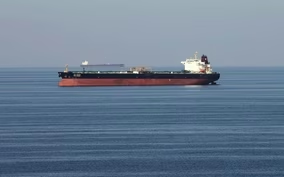
Well, even with this shaky cease-fire, some more in the energy infrastructure in the Middle East will take months to recover and prices may not drop as much as hoped.
Our William Brangham has more on this part of the story -- William.
WILLIAM BRANGHAM: That's right, Geoff.
As we mentioned, it is unclear if the strait is really open, and even, if so, there is still great hesitation about sending multimillion-dollar vessels through it.
Separately, there were additional attacks earlier today on energy infrastructure.
One thing that is clear, consumers are feeling the pain at the pump.
Gas prices are over $4 a gallon nationally.
So, for more on what this all means, we are joined by Jason Bordoff.
He's the founding director of the Center on Global Energy Policy at Columbia University.
Jason, thank you so much for joining us.
Does this... JASON BORDOFF, Founding Director, Center on Global Energy Policy, Columbia University: Thank you.
WILLIAM BRANGHAM: ... alleged cease-fire, as much as we can call it that, give you any sense about what happens going forward with regards to energy prices?
JASON BORDOFF: Well, as you have been talking about with your correspondents, the only thing lacking from this cease-fire is for people to cease firing.
And we have seen Iran today strike many of its neighbors, Israel strike Lebanon.
And as long as that's the case, that does not give confidence to the oil tankers sitting in the Gulf trying to get out to deliver oil to the market to go through.
We saw maybe three or four -- reports differ -- a couple of tankers moved through today.
But until oil starts flowing again, and it is not yet, and this cease-fire as you said, is very tenuous, the market is still short.
And we saw the sort of traded price of oil come down, but the physical price that people were willing to pay is still quite high, and it's going to keep going higher unless the oil starts to flow again.
WILLIAM BRANGHAM: If Iran maintains control over the strait, which, we should say, it did not have before this war began, is it your sense that it is just too financially scary for shippers to go through there?
Is it an insurance issue?
What is it in particular?
JASON BORDOFF: I think, first and foremost, it's just confidence.
Certainly, you need insurance.
You need signals from Iran that tankers will be allowed to pass, that their military is not going to arbitrarily stop some and not others.
I don't think anyone in the oil industry -- I saw a quote today from someone in the industry who said, we didn't have to pay a few million in fees before, and I thought we won this conflict, meaning the United States.
So no one's going to be happy about paying a toll.
If it was just a toll, the cargo is valuable enough that people would do it.
But, right now, there's just no confidence that you can move tankers through the strait.
And that's just to clear the oil that's sitting there in tankers for the last 40 days waiting to get to market.
If you want to start producing again in the region, you need the rest of the world's tankers to be willing to go to the wrong side of the strait back into the Gulf and load up.
And they don't want to get stuck if this thing falls apart again in a couple of days or a week or two.
WILLIAM BRANGHAM: And separate from that, a lot of energy infrastructure was targeted.
I believe it's at least nine countries saw facilities targeted successfully by Iran.
How long does that take to both rebuild and then restart a legitimate supply of energy?
JASON BORDOFF: You know, we have seen an escalation there, and even today, with a reported attack by a drone on the major Saudi pipeline to the Red Sea, the East-West Pipeline.
As far as we know, most of the oil-related infrastructure damage is still modest.
There's a bit of a mutually assured destruction dynamic where I think Iran knows that if they really target things in a serious way, they will be targeted as well.
So we're still at a point where, within weeks, maybe a month or two, you can probably get the infrastructure back up and running.
That could change if this escalates in a tit-for-tat way and we start to see more significant damage.
And, then again, you -- no one's going to start restarting production.
We have nearly 10 million barrels a day that is shut in.
People stopped producing.
That is costly and it can do damage to the wells to restart.
No one's going to do that until they have long-term confidence they can get the oil to market.
WILLIAM BRANGHAM: Crude oil prices, we saw, did start to come back down.
I believe it was a 13 percent drop today.
But U.S.
gas prices, as I mentioned, still remain high.
How long should consumers be expecting here in the U.S.
to be bracing for those kinds of spikes?
JASON BORDOFF: Well, it is a well-known phenomenon that, when oil prices rise, gasoline prices rise quickly, and, when oil prices fall, gasoline prices fall much more slowly, maybe two weeks or so.
And so that would be the time frame, if the oil starts flowing and that sharp reduction in price we saw today is matched by the physical reality of the oil market.
But that's still to be seen if the cease-fire holds, if tankers are willing to go through.
If none of that happens, again, the price people have physically been willing to pay for oil has been quite a bit higher than that oil price you just mentioned that fell about 10 percent or 15 percent today.
That price will rise again if we don't see the oil start to flow quickly.
WILLIAM BRANGHAM: And the same thing we saw with jet fuel prices, and a lot of consumers reporting today that airlines were now tacking on all sorts of new fees.
Again, is that just what consumers should be expecting going forward?
JASON BORDOFF: I think jet fuel, the same as gasoline, the same as diesel.
And it's even worse in some other parts of the world.
Asia, you're seeing physical shortages.
You're seeing not just airlines raise prices, but some airlines canceling flights to Asia because they're not sure they can refuel.
And so that's only going to change once we start to see millions of barrels a day of oil transiting through the strait again.
And until that happens, people should still be ready for higher gasoline prices and airline prices and all the other ways oil prices trickle through the economy.
WILLIAM BRANGHAM: And are there any other -- lastly, just any other downstream consequences we ought to be looking out for, fertilizer, food prices?
JASON BORDOFF: Well, the Strait of Hormuz is just one of the most critical transit -- maritime transit places in the world.
So we have seen it with oil.
We have seen it with natural gas, and there has been real physical damage to the Qatari LNG plant.
So natural gas prices have been rising, particularly in Europe and in Asia.
And then, as you said, petrochemicals, aluminum, fertilizer, which could have really significant impacts as we enter harvesting season in particularly low- and middle-income countries, all of that is going to get much more painful if that strait is not reopened quickly.
WILLIAM BRANGHAM: Jason Bordoff, thank you so much for being here.
Really appreciate it.
JASON BORDOFF: Thank you.
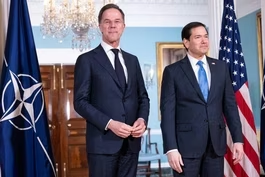
GEOFF BENNETT: In the day's other headlines: NATO Chief Mark Rutte met with President Trump behind closed doors at the White House today in a bid to ease tensions between the U.S.
and the military alliance.
Before the meeting, White House Press Secretary Karoline Leavitt shared what she called a direct quote from the president about NATO's actions during the Iran war, saying -- quote -- "They were tested and they failed."
Mr.
Trump has repeatedly criticized the bloc for not backing his war and has threatened to withdraw the U.S.
from the 32-member alliance.
Earlier in the day, Rutte also met with Secretary of State Marco Rubio, who has said the U.S.
will have to reexamine its relationship with NATO.
Southwest Airlines is the latest us carrier to say it's raising baggage fees as airlines grapple with higher energy costs brought on by the Iran war.
Starting tomorrow, passengers will pay $45 for their first checked bag and $55 for a second.
Southwest, of course, allowed free bags for years.
Those prices match the new fees by Delta, which took effect today, but a third checked bag on that airline jumps sharply to $200.
United Airlines and JetBlue also announced price hikes just last week.
In most cases, bags will still be free for customers in premium cabins, plus active-duty military personnel and those with certain membership status.
In Georgia, Trump-act Republican Clay Fuller will be sworn into Congress as early as next Tuesday after he won a special election to replace former Congresswoman Marjorie Taylor Greene.
Fuller thanked supporters at an election watch party last night.
CLAY FULLER (R), Georgia Representative-Elect: The Democrat Party poured millions of dollars into this campaign, but they can't beat Donald Trump and they never will.
And I will be on Capitol Hill as a warrior to have his back each and every day.
GEOFF BENNETT: He will served out the remainder of Greene's term, which ends in January.
But for Democrats, there was a silver lining.
Candidate Shawn Harris performed better than expected in the deep red district that Greene won by nearly 30 points.
Harris said as much to his supporters.
SHAWN HARRIS (D), Georgia Congressional Candidate: The reality of it is, we came a little short, but we did not lose, because nobody ever thought that a Democrat would actually have a performance like this.
GEOFF BENNETT: Meantime, in Wisconsin, appeals court Judge Chris Taylor beat back a conservative challenger to expand that state's Supreme Court's liberal majority 5-2.
Federal weather officials say last month was by far the warmest March on record for the continental U.S.
Data out today showed the average temperature was 50.9 degrees Fahrenheit.
That's more than nine degrees higher than the 20th century average, which officials use as a benchmark to measure present-day temperatures.
And experts say nearly 20,000 daily records were shattered across the country in March.
The sweltering heat was inescapable for millions of Americans, from summerlike conditions on the West Coast to record low snowpack in the Rockies and Sierra Nevada.
And forecasters expect that trend to continue.
Turning overseas now, Greece is the latest nation to say it intends to ban social media access for children under the age of 15.
The country's prime minister said the move is aimed at protecting children's mental health.
KYRIAKOS MITSOTAKIS, Greek Prime Minister (through translator): The science is clear.
When a child spends hours in front of a screen, the mind does not rest.
That's why we have decided to move forward with something difficult, but necessary.
GEOFF BENNETT: He went on to say that the Greek Parliament will introduce the ban this summer, and, if passed, it will come into force in January.
Last year, Australia became the world's first country to enforce a social media ban for children.
Since then, other countries like Malaysia, France, Denmark and the U.K.
have drawn up their own social media restrictions for young people.
The crew of the Artemis II mission is set to return home following their voyage around the far side of the moon.
Last night, NASA released this photo of the Milky Way galaxy taken on board their Orion spacecraft.
It's the latest glimpse from their journey, which has included extraordinary views of the lunar surface, providing new insights into the moon's topography.
The Orion capsule is expected to splash down in the Pacific Ocean on Friday evening.
On Wall Street today, stocks surged as cease-fire hopes in Iran sent oil prices tumbling.
The Dow Jones industrial average jumped more than 1,300 points on the day.
The Nasdaq added more than 600 points, or nearly 3 percent.
The S&P 500 also ended sharply higher.
And Jim Whittaker, the first American to reach the top of Mount Everest, has died.
His achievement back in 1963 made him an instant celebrity.
Whittaker developed an early reverence for mountains and a clear understanding of the risks they carry, once reflecting in a 1981 interview, "When you live on the edge, you can see a little farther."
Jim Whittaker was 97 years old.
Still to come on the NewsHour: we speak with the partner of a DACA recipient detained by immigration authorities; Portland, Oregon, debates how a first-of-its-kind climate fund should be spent; and comedian Lyric Lewis gives her Brief But Spectacular take on finding your authentic voice.
During this Trump administration, ICE has detained more than 260 people protected under DACA, also known as the Deferred Action for Childhood Arrivals.
More than 80 of them have been deported.
The Obama era program created back in 2012 shields undocumented immigrants brought to the U.S.
as children from deportation and allows them to work legally.
While DACA recipients can be removed for reasons such as criminal convictions, advocates say some with no criminal record are also being swept up in the broader crackdown.
Our Lisa Desjardins has one of their stories.
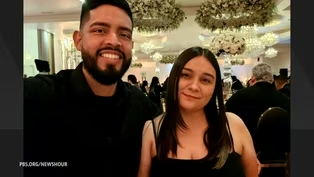
LISA DESJARDINS: Juan Chavez Velasco was detained on his way to the hospital NICU taking breast milk to his infant daughter, who was born almost six weeks premature.
Brought to the United States from Colombia when he was 8 years old, Juan is 35 years old now and a longtime part of the DACA program.
He renewed his DACA status every two years, became a college graduate, works in a lab in Texas doing blood and other medical tests.
His wife and kids are all citizens and he has no criminal history.
Juan has been held at a detention center in Texas for the past seven weeks.
His wife, Stephanie Villarreal, joins me now to talk about this.
Tell us what happened in February, the day that your husband was detained.
STEPHANIE VILLARREAL, Wife of Juan Chavez Velasco: Yes.
So I had had my youngest daughter on February the 6th, and, 12 days later, he was driving to the NICU to go take her some of my breast milk that I had been pumping.
And as he was driving out of the neighborhood, he saw a car parked on the side of the road.
And he pulled over.
And there was some ICE agents that approached him.
And, basically, they questioned him.
And he tried to let them know that he had DACA and a work authorization.
And he was detained as of that day on February 18.
LISA DESJARDINS: At that point, when it happened, as you say, he had DACA status right then.
How concerned before that were you or he that he could be detained?
STEPHANIE VILLARREAL: I believe that we were just more under the impression that the administration had mentioned nothing would happen to DACA recipients.
We had started hearing rumors about DACA recipients being detained, and we just started to get really nervous about everything.
But, again, we just didn't think that it would hit home.
LISA DESJARDINS: I want to talk a little bit about that, because he had a DACA status when he was detained, but that status expired while he was in detention.
And he had applied for renewal last fall.
The Trump administration's under court order.
They're supposed to renew this status.
But your husband's hasn't been.
What do you think's happening here?
STEPHANIE VILLARREAL: I feel like it's intentionally being delayed, but it is affecting the livelihood of many DACA recipients, and just like my husband.
He was picked up when it was active.
And, yes, it did expire while he was in detention.
LISA DESJARDINS: We did ask DHS for a statement about Juan's case.
And this is what a spokesman said -- quote -- "He is an illegal alien from Colombia and was issued a final order of removal in 2005.
He received full due process.
DACA does not confer any form of legal status in this country."
How do you respond to that?
STEPHANIE VILLARREAL: I just believe that they use that term so often about illegal aliens.
My husband is more than just that.
He's a father.
He's a husband.
He's done everything right.
He's come here.
And he's built his education.
He's built his family.
And the term illegal alien just has a very negative attachment to it.
LISA DESJARDINS: I know you speak with him daily.
How is he doing?
STEPHANIE VILLARREAL: He's holding up.
He's having some medical concerns.
He just did some labs, and he came out with having kidney stones.
So he's dealing with that.
He doesn't have the healthiest of foods or the best drinking water.
So it's definitely heightened the pain that he has coming from that.
LISA DESJARDINS: This debate that you all kind of landed in the middle of right now, in many ways, it's about who Americans should be, who the Trump administration feels should be allowed to enter or stay in this country.
And I wonder how you see yourself and how your husband sees himself as Americans.
STEPHANIE VILLARREAL: He feels American at heart.
He hasn't stepped foot in Colombia since he was 8 years old.
We love this country.
It's the country that provided him all of his opportunities, especially being on the DACA program.
He was -- like I mentioned, graduated with two bachelor's degrees, that he was able to work and provide and be able to accomplish that at the same time.
So he definitely is very thankful being here.
And he does feel like he's truly an American.
LISA DESJARDINS: You know, the argument from the Trump administration is that, even if he's done no wrong, his family shouldn't have brought him here and they shouldn't have entered illegally when he was a child.
How do you respond to that?
STEPHANIE VILLARREAL: I feel like, as loving parents, you will do whatever it takes for your children.
And, sometimes, that comes with sacrifices.
I truly believe that that's what my mother and my father-in-law did for my husband.
They provided him an opportunity to live a better life.
LISA DESJARDINS: Have you thought about what you would do if he is deported?
STEPHANIE VILLARREAL: Unfortunately, it would require us to possibly move to a different country just to be together as a family, just because my kids are so young and he deserves to be a part of their life and they deserve to be with their dad.
LISA DESJARDINS: What's the hardest part about that?
STEPHANIE VILLARREAL: It's just uprooting everything that we thought we were going to do with our children.
We just bought -- we just purchased our home last year, and things were feeling perfect.
We just started building our family.
And we were ready to just build our lives.
We didn't think that anything like this could have ever happened.
LISA DESJARDINS: Given that, I think my last question is, do you look at America differently now because of this experience or no?
STEPHANIE VILLARREAL: We do.
Unfortunately, there's so much hatred in this world right now.
And at one point, when we were growing up, we were always told that the United States of America was the best place for everyone to be.
And, right now, there's just so much hate, that I look at my children and try to teach them that we cannot normalize what's going on right now.
LISA DESJARDINS: Stephanie Villarreal, thank you so much for talking with us.
STEPHANIE VILLARREAL: Thank you.
Thank you for having me.
GEOFF BENNETT: In 2018, voters in Portland, Oregon, approved a first-of-its-kind climate and justice fund aimed at investing in projects in historically marginalized communities.
Since then, the fund has grown and so has the debate over how that money should be spent.
Stephanie Sy reports as part of our series Tipping Point.
WOMAN: Our community members die 10 years younger than everywhere else because of the lack of clean air.
STEPHANIE SY: At a city council hearing last month in Portland, Oregon... WOMAN: And making sure that we make more progress on decarbonization of our transportation sector.
STEPHANIE SY: ... climate change and environmental justice were on the agenda.
WOMAN: This is going to cause an issue.
This is going to cause a delay in some of these programs.
Tell the truth.
STEPHANIE SY: The debate on this day, how to spend about $15 million from a roughly $1.6 billion pool of money, known as the Portland Clean Energy Fund, or PCEF.
MONICA SAMAYOA, Oregon Public Broadcasting: There is no other fund like this in the nation.
STEPHANIE SY: Monica Samayoa is a climate and environment reporter for Oregon Public Broadcasting.
MONICA SAMAYOA: So, the Portland Clean Energy Fund is a 1 percent tax that is imposed on large retailers in the city.
The purpose of the fund is to address social, racial and climate justice, as well as to reduce greenhouse gas emissions.
STEPHANIE SY: When Portland voters created this fund eight years ago, Samayoa says it was expected to generate about $60 million annually.
But when the pandemic hit and more people turned to large retailers online, the fund had an unexpected windfall.
MONICA SAMAYOA: It's actually generating $200 million a year.
And that threw off everyone, because they were thinking, what are we going to do with these large amounts of money?
STEPHANIE SY: The money, earmarked for both large and small climate-related projects in underserved communities... KARI ROWE, Portland, Oregon, Resident: Can I have a piece?
STEPHANIE SY: ... has been a crucial lifeline for families like 40-year-old Kari Rowe and her two young children.
Rowe, a photographer, bought her first home two years ago.
KARI ROWE: Yes, we moved in and the house was awesome, cute, small, and then a few days later, a 14-day ice storm hit.
And in that moment, I realized like, oh, my gosh, my walls are not insulated because there was ice.
It was cold to the touch on every single wall.
STEPHANIE SY: After qualifying for a program that helps Native Americans make energy-efficient upgrades to their homes: KARI ROWE: They insulated every wall that would adjoin a living space.
STEPHANIE SY: Rowe was able to use more than $20,000 in PCEF funds to insulate her walls, weatherize her doors, and air-seal her attic.
KARI ROWE: They insulated all the space between the house and the foundation.
STEPHANIE SY: She says her total energy usage has dropped by half since this work was completed, saving her about $80 a month in utilities.
KARI ROWE: We'd still be freezing in the winter and sweating all summer long, so I'm beyond grateful.
STEPHANIE SY: But for the last few years, reporter Monica Samayoa has been tracking efforts to use PCEF dollars outside of climate-related projects.
MAN: Now, at 5:00, a controversial ballot measure that would divert climate tax dollars to fund police staffing in Portland.
STEPHANIE SY: That includes a proposed ballot measure to divert 25 percent of the fund's annual revenue to hire 400 additional police officers.
Voters here will likely vote on the measure in November.
MONICA SAMAYOA: Supporters say, well, we need more police officers on our streets.
There's not enough.
A second proposal that has got a lot of attention right now is coming from Portland Mayor Keith Wilson.
He has floated around this idea that PCEF would provide at least $75 million to renovate the Moda Center.
And that is our sports arena where the Portland Trail Blazers play.
KEITH WILSON, Mayor of Portland, Oregon: The Portland Trail Blazers are a part of our DNA.
That's so important to keep in Portland.
STEPHANIE SY: Mayor Keith Wilson says upgrades to the Moda Center are needed, not only to keep the Trail Blazers in Portland, but also to make the stadium more sustainable environmentally and economically.
KEITH WILSON: It's going to hit the three key pillars of PCEF.
It's going to reduce emissions,it's going to reduce energy usage, and it's going to provide a benefit to community in need.
STEPHANIE SY: How is it serving underserved communities to put $75 million from PCEF into these renovations?
KEITH WILSON: The Moda Center is right in the middle of what we call our Albina District.
It is a district that has been underserved for decades.
We built a freeway right through this vibrant community and displaced whole communities.
And what we're doing is, we're partnering with the Albina District to rebuild that neighborhood, and the Moda is going to be the center point of that.
JESSICA CARMONA, Bonneville Environmental Foundation: When you're talking about renovating a sports center, I don't think that's the -- like, how can you tie that to climate action and community services?
You're essentially saying anyone can take money from PCEF with no purpose.
STEPHANIE SY: Jessica Carmona is a senior program manager for the Bonneville Environmental Foundation, a nonprofit that manages more than 2,000 solar panels near Portland's airport.
Funded from a $4 million PCEF grant, Carmona believes this is how the money should be spent.
JESSICA CARMONA: There's unlimited need and opportunity for climate action projects in many different ways that benefit the community.
STEPHANIE SY: The solar panels have been up and running since September and now provide about 150 low-income residents with so-called energy credits.
Carmona says they will help lower utility bills up to 40 percent over the next two decades.
JESSICA CARMONA: You make it accessible for people who move around a lot because they don't have stable housing sometimes.
So they can subscribe and they can take the subscription with them.
They don't have to own their home.
STEPHANIE SY: Just across the street, PCEF funding also financed rooftop solar panels inside this community of roughly 60 formerly homeless people who live nearby.
SAM BARASO, Program Manager, Portland Clean Energy Fund: Our frontline communities, those that face the greatest and worst impacts of climate change, should be at the center of creating those solutions.
This is a competitive grant-making program.
STEPHANIE SY: Sam Baraso is the program manager for the Portland Clean Energy Fund.
He says the projects that PCEF is funding will be transformative for the city.
SAM BARASO: I mean, we have retrofit hundreds of homes that now see bill savings of $1,000-plus per year.
We have planted countless trees across the community, invested in getting folks on the e-bikes and so forth.
And we have distributed almost well over 20,000 portable heat pump cooling units.
STEPHANIE SY: But Baraso admits, like many cities, Portland is facing a challenging moment when it comes to local government revenues.
SAM BARASO: There's always been competing priorities and desires to spend the resources in other ways.
So I think there are these trade-offs that are always there, and we try to balance those trade-offs in a way to get at ultimately, how do we make sure that this fund addresses our climate, creates real tangible benefits for the folks that are here?
STEPHANIE SY: Trade-offs now being weighed by Portland City Council and ones that Monica Samayoa says carry enormous consequences for America's first-of-its-kind billion-dollar climate fund.
MONICA SAMAYOA: That money's allocated.
So Mayor Wilson's proposal is going to be interesting if it moves forward, because the city's going to have to decide, do you remove money from the city bureaus that are needing this money or from the community that also needs this money?
So that's a tough decision that's going to have to be made.
STEPHANIE SY: Decisions that will become only more difficult in the years ahead.
For the "PBS News Hour," I'm Stephanie Sy in Portland, Oregon.
GEOFF BENNETT: Actor and comedian Lyric Lewis says she discovered her love of performance through improv.
In tonight's Brief But Spectacular, she reflects on finding her authentic voice in comedy.
LYRIC LEWIS, Actor and Comedian: My favorite thing about improv is, oh, it feels like playing as an adult.
The instant gratification of audience laughter, there's truly nothing like it.
It's just a launching point to really take off and have fun.
So I'm originally from New Orleans, Louisiana.
My mom's side is from the Lower Ninth.
My dad's side is from the 17th Ward.
As a kid, they called me Motormouth because I literally would never stop talking.
The basic rules of improv, for anybody, but especially for a beginner, it's really to yes/and.
And it's to try not to be funny.
I think the worst thing that can happen during an improv performance is becoming self-aware.
Improv, like acting, is just reacting.
When I was coming up, especially in, like, junior high, high school, and college, I have seen these women's career, Maya Rudolph, Jennifer Coolidge, Cheri Oteri, even Will Ferrell.
They all had The Groundlings in common.
I'm like, I want to go where these people who I idolize, where they got sharp.
Coming from a theatrical background and the drama department at Syracuse, it isn't, like, super, super diverse.
I was kind of used to at that point being one of in a classroom setting, but still, at The Groundlings, it was very interesting that at first I was just doing the classes and I was just getting my training on.
And it wasn't until I got into writing lab.
My teacher was Karen Maruyama.
I was writing monologues and I had this thing where I was like, I will not be a stereotype.
And Karen was so great and delicate about being like, look on the wall and how many people on that wall that are in the main company look like you.
So I went and looked and it was none at that time.
And she was like, why, when you have a chance to write for yourself, and to give a voice not only to yourself, but she was like, to your cousin, to your aunts, to your family, why not give them a seat at the table by writing from every pocket or perspective that you have?
So when I got voted into the main company, there had not been a Black person in the main company for 16 years.
I was like students need to see a representation of everything on the stage and every student needs to see it.
The oddest reaction, this was the summer of 2019.
So this is when at Disney first announced that they were doing the live action "Little Mermaid," but that it was going to be Halle Bailey.
And the outrage that people had on social media, because they were like, how, how can a mermaid be of color?
And so I did a sketch where I was literally a mermaid.
The whole sketch, I'm like, my name is Alcorella (ph).
I'm from the like the NAACP sector of the mermaids under the sea.
And I literally am like, who's mad?
And I had one woman once that was like in the second row, she went, I'm mad.
She was like, well, what -- I don't know what to do now with the dolls.
Ain't nowhere in nobody's song that she say, kiss the little white mermaid that has red hair.
It's just kiss the girl, girl.
My name is Lyric Lewis.
And this is my Brief But Spectacular take on how life is play, because it is.
GEOFF BENNETT: Well, you can watch more Brief But Spectacular videos online at PBS.org/NewsHour/Brief.
And that is the "News Hour" for tonight.
I'm Geoff Bennett.
For all of us here at the "PBS News Hour," thanks for spending part of your evening with us.
 New
NewA Brief But Spectacular take on how life is a play
Video has Closed Captions
A Brief But Spectacular take on how life is a play (3m 14s)
 New
NewFormer U.S. officials on chances Iran ceasefire can hold
Video has Closed Captions
Former U.S. officials analyze chances fragile Iran ceasefire can hold (7m 29s)
 New
NewICE detains DACA recipient delivering milk to premature baby
Video has Closed Captions
DACA recipient detained by ICE while delivering milk to premature daughter in NICU (7m 10s)
 New
NewIsrael strikes Lebanon without warning, more than 200 dead
Video has Closed Captions
Israel strikes Lebanon without warning, hours after Iran ceasefire announced (4m 54s)
 New
NewNews Wrap: NATO chief meets with Trump amid tensions
Video has Closed Captions
News Wrap: NATO chief meets with Trump in bid to ease tensions (5m 26s)
 New
NewOil infrastructure recovery will take months, expert warns
Video has Closed Captions
Expert warns Middle East energy infrastructure will take months to recover (6m 41s)
 New
NewPortland's $1.6B climate fund sparks spending debate
Video has Closed Captions
America’s first billion-dollar climate fund sparks spending debate in Portland (8m)
 New
NewTrump says Israeli strikes on Lebanon a 'separate skirmish'
Video has Closed Captions
Trump says Israeli strikes on Lebanon a 'separate skirmish' not part of Iran ceasefire (2m 58s)
 New
NewU.S.-Iran ceasefire tested by Strait of Hormuz chokehold
Video has Closed Captions
U.S.-Iran ceasefire tested by Strait of Hormuz tension and Israel’s war in Lebanon (6m 23s)
Providing Support for PBS.org
Learn Moreabout PBS online sponsorship
- News and Public Affairs

FRONTLINE is investigative journalism that questions, explains and changes our world.

- News and Public Affairs

Amanpour and Company features conversations with leaders and decision makers.
One Question with Becky Ferguson











Support for PBS provided by:
Major corporate funding for the PBS News Hour is provided by BDO, BNSF, Consumer Cellular, American Cruise Lines, and Raymond James. Funding for the PBS NewsHour Weekend is provided by...