
December 22, 2025 - PBS News Hour full episode
12/22/2025 | 57m 46sVideo has Closed Captions
December 22, 2025 - PBS News Hour full episode
Monday on the News Hour, the Trump administration halts offshore wind projects off the East Coast in its latest move against the industry. The new head of CBS News sparks controversy by pulling a "60 Minutes" story about the alleged torture of men deported by the Trump administration to El Salvador. Plus, the hurdles that parents of kids with disabilities face when trying to find care.
Problems playing video? | Closed Captioning Feedback
Problems playing video? | Closed Captioning Feedback
Major corporate funding for the PBS News Hour is provided by BDO, BNSF, Consumer Cellular, American Cruise Lines, and Raymond James. Funding for the PBS NewsHour Weekend is provided by...
December 22, 2025 - PBS News Hour full episode
12/22/2025 | 57m 46sVideo has Closed Captions
Monday on the News Hour, the Trump administration halts offshore wind projects off the East Coast in its latest move against the industry. The new head of CBS News sparks controversy by pulling a "60 Minutes" story about the alleged torture of men deported by the Trump administration to El Salvador. Plus, the hurdles that parents of kids with disabilities face when trying to find care.
Problems playing video? | Closed Captioning Feedback
How to Watch PBS News Hour
PBS News Hour is available to stream on pbs.org and the free PBS App, available on iPhone, Apple TV, Android TV, Android smartphones, Amazon Fire TV, Amazon Fire Tablet, Roku, Samsung Smart TV, and Vizio.
Providing Support for PBS.org
Learn Moreabout PBS online sponsorshipWILLIAM BRANGHAM: Good evening.
I'm William Brangham.
Amna Nawaz and Geoff Bennett are away.
On the "News Hour" tonight: The Trump administration halts offshore wind projects off the East Coast.
It's the latest move against this burgeoning industry.
The new head of CBS News sparks controversy by pulling a "60 Minutes" story about the alleged torture of men deported by the Trump administration to El Salvador.
And the hurdles that parents of kids with disabilities face when trying to find appropriate care.
JASMINE WATKINS, Mother of Caine Harris: I want him to be a kind, loving person that's thriving.
And to be able to do that, he needs extra help.
And that's OK.
(BREAK) WILLIAM BRANGHAM: Welcome to the "News Hour."
The Trump administration today announced an immediate pause on the leases for five large-scale offshore wind farms off the East Coast, citing concerns about national security.
The Interior Department provided few details, but said the Pentagon believed the turbines could obscure and confuse radar signals.
This is just the latest move by the White House taking aim at wind power.
At least one of the projects halted today was already partially operating.
Our science correspondent, Miles O'Brien, has been reporting on these projects and joins us now with the details.
Miles, what is the reaction you have been hearing from the states, from the companies about this move today?
MILES O'BRIEN: William, it's a little bit of a Groundhog Day effect, one more time, sort of the same arguments, and there's a sense of resignation and, frankly, quite a bit of sadness.
There's a huge amount of money that's being lost, even as we speak.
And this idea of putting wind offshore to feed the cities, the population centers along the East Coast first took root about 25 years ago, really began going in earnest about 10 years ago, went through layer after layer of approval and permitting process, which included the Federal Aviation Administration and the Department of Defense to determine if, in fact, these turbines might pose a threat to radar and the ability for radar to track aircraft.
Ultimately, it passed all of those tests, the permits were granted, and now billions have been spent to put these turbines in the water and, in many cases, already connect them to the grid.
And so the idea that, after all that, it might come to naught leads to a lot of resignation and sadness.
And many of the people we spoke with almost felt like they had received yet another body blow on a long-term effort that they thought they had come close to realizing.
WILLIAM BRANGHAM: As I mentioned, the Interior Department said that the Pentagon had discovered new issues with regards to radar that you were just describing.
This is how Interior Secretary Doug Burgum put it on FOX News earlier today.
DOUG BURGUM, U.S.
Interior Secretary: The Department of War has come back conclusively that the issues related to these large offshore wind programs have -- create radar interference that creates a genuine risk for the U.S., particularly related to the -- where they are in proximity to our East Coast population centers.
WILLIAM BRANGHAM: Miles, I know you have talked with a lot of people who have looked at this issue.
What do they say about these concerns?
Are they legitimate?
MILES O'BRIEN: Well, first, radar do see these turbines.
They are as tall as the Eiffel Tower, on or about 1,000 feet.
So, of course, they're going to see them.
There's no question they create an interference pattern.
But a couple of things here.
First of all, having flown through these turbines myself in a small aircraft, the FAA is well aware of the obstacles, where they are.
It's not like they're moving anywhere.
And they're able to identify these problems for traffic that might run afoul of it.
As for a threat coming in, there are all kinds of ways to mitigate against that problem by either improving the radar coverage, adding additional radar that can sort of peek through the turbines, reducing the radar reflectivity of the turbine blades, any number of ways.
And I should point out, while the turbines do make more radar noise, if you will, while they're spinning, if the projects are shut down, as the Trump administration wants to do, those turbines are still sitting in the water.
Those obstacles are still there.
So it's hard to see how this remedies that particular problem if you would accept for a moment that it is, given the fact that the Pentagon has looked at this dozens of times over the years.
WILLIAM BRANGHAM: Taken together, all of these projects were going to power I believe it's 2.5 million homes and businesses along the East Coast.
I mean, these are massive clean energy projects.
What happens now?
Is there an alternative to supplying that power?
What's next?
MILES O'BRIEN: In the Northeast, they have doubled down on offshore wind.
We talked to the grid operator in New England, ISO New England, and they have approximately 37 gigawatts of power in the interconnection queue, as they call it; 45 percent of that is offshore wind, 45 percent of that battery, and 10 percent of that is solar.
So there really aren't any viable options right now on the near-term horizon for the Northeast.
If you wanted to think about alternatives, building fossil fuel plants, it takes five, six, seven years just to get a gas turbine delivered.
Certainly, nuclear is an even longer time frame.
And the country is facing an unprecedented, near-unprecedented increase in demand for energy driven by the electrification of the economy and the rise of these A.I.
data centers.
And if you really want to look at a national security issue, an unstable grid that is unable to support that growth in the need of energy, that is a true security threat.
WILLIAM BRANGHAM: Miles, as we have reported repeatedly and we have talked about quite a bit, this is just the latest in the Trump administration's efforts to undo renewable energy and to double down on fossil fuels.
What are the long-term ramifications of that?
MILES O'BRIEN: It's an inopportune moment.
William, 70 years of flat demand for electricity in the U.S., now there's a huge uptick thanks to the electrification of the economy and A.I.
data centers.
Every expert I have spoken to says every possible option needs to be on the table in order to meet this demand.
WILLIAM BRANGHAM: Miles O'Brien, always great to talk to you.
Thank you so much.
MILES O'BRIEN: You're welcome.
WILLIAM BRANGHAM: In the day's other headlines: The leaders of Greenland and Denmark are pushing back against the latest U.S.
moves over Greenland after President Trump tapped Louisiana Governor Jeff Landry to be his special envoy to the semiautonomous territory.
Writing on social media, Governor Landry thanked Trump for the post, writing -- quote -- "It's an honor to serve you in this volunteer position to make Greenland a part of the U.S."
Greenland's prime minister and his Danish counterpart released their own statement, saying -- quote -- "Greenland belongs to the Greenlanders."
And Denmark's foreign minister says he will summon the U.S.
ambassador.
LARS LOKKE RASMUSSEN, Danish Foreign Minister (through translator): Out of nowhere, there is now a special U.S.
presidential representative who, according to himself, is tasked with taking over Greenland.
This is, of course, completely unacceptable.
WILLIAM BRANGHAM: Trump has repeatedly called for the U.S.
to take control of the mineral-rich Arctic island and earlier this year did not rule out using military force to do so.
President Trump announced plans today for what's being called a new Trump class of warships.
DONALD TRUMP, President of the United States: These are the best in the world.
They will be the fastest, the biggest, and by far 100 times more powerful than any battleship ever built.
WILLIAM BRANGHAM: He made the announcement from Mar-a-Lago, alongside his defense secretary, Navy secretary, and secretary of state, though he provided few further details on the ships themselves.
Trump has long been critical of the Navy's current ships.
This comes as the administration is increasing its military pressure on Venezuela.
U.S.
forces have already seized two oil tankers in the region, and the Coast Guard tried to intercept a third one this past weekend.
Russian investigators say a car bomb that killed a senior Russian general in Moscow today may have been orchestrated by Ukraine.
Fanil Sarvarov was in charge of training Russian troops for the country's war in Ukraine.
His death is just the latest involving a senior military official inside Russia itself.
Authorities in Kyiv have yet to comment.
And the killing comes after us envoy Steve Witkoff described talks this weekend between Russians and the U.S.
officials as -- quote -- "productive and constructive," though there's been no clear breakthrough on a path to ending the war.
Back in this country, Jim Beam is pausing production at its main distillery in Kentucky for all of next year.
The country's largest bourbon maker says it will use the time to -- quote -- "invest in site enhancements" at its Clermont facility.
The pause comes as the whiskey industry copes with tariff-related uncertainty, plus a declining rate of alcohol consumption across the United States.
Jim Beam, which is owned by Japan's Suntory Holdings, says its bottling and warehouse facilities at Clermont will stay open, as will another distillery nearby.
The online grocery shopping platform Instacart is ending its use of pricing based on artificial intelligence after reports that some consumers were being charged different prices for the very same goods.
A recent study by Consumer Reports and two nonprofits found that some shoppers were charged as much as 23 percent more than others for identical items from the same store.
Overall, prices in a basket of Instacart goods varied by an average of 7 percent.
The company argued those prices were offered randomly and were not based on personal information about the customers or demand.
On Wall Street today, stocks posted decent gains to start the shortened holiday week.
The Dow Jones industrial average gained more than 220 points.
The Nasdaq added more than 120 points.
The S&P 500 ended just below its all-time high.
And the nation's oldest national park ranger, Betty Reid Soskin, has died.
She joined the service in her 80s and went on to help create a California park dedicated to the World War II icon Rosie the Riveter and the work of other women on the home front.
BETTY REID SOSKIN, Park Ranger: And this is why, at 85, I became a Park Ranger, because you guys have forgotten all that good stuff.
WILLIAM BRANGHAM: Soskin also shared from her own experience the untold stories of women of color during that era, often wearing her uniform even when not on duty.
She only retired at the age of 100.
In 2023, Soskin spoke to the "News Hour" about her life not just as a Park Ranger, but as a government worker, a businesswoman and a mother of four.
BETTY REID SOSKIN: I never really dreamed that there were so many parts to me.
I don't think I will be remembered as a Park Ranger.
I want to be remembered as Betty.
WILLIAM BRANGHAM: In a statement, Soskin's family said she -- quote -- "led a fully packed life and was ready to leave."
Betty Reid Soskin was 104 years old.
Still to come on the "News Hour": a major Netflix deal prompts concerns among Hollywood's creative community; Tamara Keith and Amy Walter break down the latest political headlines; and how Israelis celebrated Hanukkah in this fraught time.
CBS News abruptly pulled an investigative report on "60 Minutes" just a day before it was set to air.
WOMAN: It began as soon as the planes landed.
WILLIAM BRANGHAM: It promised an inside look at allegations of abuse and torture suffered by men deported by the Trump administration and sent to a notorious prison in El Salvador.
The new editor in chief of CBS News, Bari Weiss, said the segment would eventually run, but it needed comment from a Trump administration official.
But "60 Minutes" correspondent Sharyn Alfonsi condemned that decision, writing in an internal e-mail that they did reach out to the administration and heard nothing back.
Alfonsi wrote -- quote -- "If the administration's refusal to participate becomes a valid reason to spike a story, we have effectively handed them a kill switch for any reporting they find inconvenient."
We are joined now by Brian Stelter.
He's the chief media analyst for CNN.
Brian, thank you so much for being here.
For those who don't know the internal workings of an organization like "60 Minutes," how unusual is it for them to pull a story at the last minute like this?
BRIAN STELTER, CNN Chief Media Correspondent: This is virtually unheard of.
I have been covering TV news 20 years.
I can't think of a case quite like this.
It's unique because the segment was screened ahead of time many times.
It was approved by the editors and the lawyers and the vetters.
And then it was publicly announced on Friday afternoon.
CBS likes to promote the "60 Minutes" lineup ahead of time to encourage people to tune in on Sunday night.
So it was promoted.
But then, on Saturday morning, new editor in chief Bari Weiss objected to the piece, expressed concerns about it, and that's why it was shelved.
Bari Weiss had to have known that the segment had been promoted ahead of time.
She had to have known it had been publicized, but she decided to intervene anyway.
Now, that is her prerogative.
She is the editor in chief of CBS News, but it's astonishing that she has done so.
And it's created a lot of consternation inside CBS.
WILLIAM BRANGHAM: Alfonsi, Sharyn Alfonsi, the correspondent on this, argued that this wasn't about editorial differences, that this was about politics, implying that this was going to be a very tough piece about the Trump administration, and someone in CBS wanted that dialed back.
Bari Weiss pushed back against this, saying, stories are -- that are not ready for error are routinely held back by news organizations and there's nothing to see here.
I understand that you have now seen a copy that inadvertently was posted in Canada... that does seem to be the actual broadcast that was intended to run.
In your view, as a media analyst and critic, does it feel like a lopsided piece of journalism or does it feel like it lives up to "60 Minutes"' normal standards?
BRIAN STELTER: I think, if this segment had aired one or two or three years ago, people would have said it's a normal "60 Minutes" segment.
It is in line with CBS standards.
There's nothing particularly unusual about the segment.
However, we now live in this very politically heated time, where Paramount is under tremendous pressure from the Trump administration and Paramount is trying to cozy up to the Trump administration because of various deals that are in the works.
So you now have a situation where "60 Minutes" is under the microscope, and this story, yes, would have been under that political microscope as a result.
But let's step back and just assess what you just said.
It is stunning that this broadcast, which was held by the editor in chief of CBS in the United States, still aired in Canada.
And that did happen.
It streamed online.
And in the last couple of hours, Americans have been watching the segment and been sharing it on sites like Reddit and Bluesky.
So, imagine, right?
You're the editor of CBS News.
You are trying to shelve the segment, but it's now out there in the world anyway.
Now people are watching it.
And the point of the segment is to feature the voices of some of these men who were deported, who say they were tortured in the custody of the El Salvadorian government.
That's the point of the story.
Now, Weiss says she wants comment from Trump administration officials.
She wanted someone like Stephen Miller on camera.
And that would be great.
And that would make for a different story.
But the bottom line is that Sharyn Alfonsi and her team, they wanted to tell the story of some of the men who were deported.
And they succeeded in doing so.
And now it's being seen in Canada and now on the Internet all over the world.
WILLIAM BRANGHAM: Someone who was privy to some of these internal conversations at CBS spoke to one of my colleagues and said this, that: "Bari Weiss is not a journalist, and she has just confirmed that for all the world to see."
She herself has, again, defended this decision and said the piece will run when it feels appropriate.
This is -- she is the editor in chief.
What have you been hearing from within CBS about the fallout from this move?
BRIAN STELTER: Many CBS staffers say this is the moment they have feared all year long, with corporate meddling and political pressure tainting the journalism at CBS.
They fear it's a blow to the network's credibility.
But now that this segment has been shared online, because it aired in Canada, because the video has been captured and posted on YouTube and other sites, now, in some ways, this situation has reversed itself.
And now the segment has been shown, even though CBS has not officially released it.
So it changes the dynamics somewhat both for Weiss and for CBS.
The broader concern, though, will remain.
The broader concern among CBS staffers will remain.
And that is that the company is vulnerable to political pressure.
Every few days, President Trump complains about "60 Minutes."
He did it again on Friday night.
He complains about the owners of Paramount.
Is there a firewall in place between the corporation and the newsroom?
That remains the giant question.
WILLIAM BRANGHAM: And, lastly, none of the previous controversies that have come out of "60 Minutes," whether it was them settling a lawsuit against the Trump administration that many people argued CBS would have handily won in court.
Where do you think this ends?
Does this continue to be a cancer inside CBS, or will this too blow over?
BRIAN STELTER: The journalism will continue to speak for itself, and the reporting will continue to get out, as we have seen today, in spite of some attempts to stop it or to pause it.
Now, Bari Weiss has questions to answer.
I'm sure she will in the future.
She says she's trying to protect the integrity of CBS, but that's what the journalists and the producers do as well, say they're trying to do as well.
So it's a tug-of-war of sorts inside this newsroom.
It reflects the broader tensions of our time.
And this is something that is part of a broader free speech and First Amendment test that we're living through in the U.S.
We're at the end of the first year of Trump 2.0.
And I would say the media is largely winning, largely succeeding, largely passing that stress test.
But the test is real, and we see that test under way right now at CBS.
WILLIAM BRANGHAM: That is Brian Stelter, CNN's chief media critic.
Thank you so much.
Always good to talk to you.
BRIAN STELTER: Thanks.
WILLIAM BRANGHAM: As we just heard, Paramount's recent merger with Skydance is fueling major concerns about editorial control at CBS.
At the same time, Paramount is engaged in a battle with Netflix to buy Warner Bros.
Discovery.
Paramount's most recent bid was rejected in part over financing.
But, today, Larry Ellison, the father of Paramount CEO David Ellison, personally guaranteed $40 billion as part of an effort to revive that bid.
But Netflix's proposed $83 billion offer is still considered the favorite for now.
Talk of this deal has triggered widespread fears in Hollywood about what this could mean for the creative industry.
Our senior arts correspondent, Jeffrey Brown, gets some perspective from one of the leading unions.
It's part of our arts and culture series, Canvas.
JEFFREY BROWN: One key opponent to the deal is the Writers Guild of America, whose members have a lot at stake.
Joining me now is president of the WGA West, Michele Mulroney.
And thanks so much for joining us.
Now, you have come out strongly opposed to this deal.
What's your chief concern?
MICHELE MULRONEY, President, Writers Guild of America West: Our members are very concerned about this merger because we have seen in the past that mergers always promise benefits, but they inevitably lead to fewer jobs for industry workers, mass layoffs and diminished competition in the marketplace.
JEFFREY BROWN: What have you seen in the past that causes that?
MICHELE MULRONEY: We only have to look a few years back to the Disney and FOX merger, where there were a lot of promises that this merger would mean more production, more programming.
But, in fact, the opposite has happened.
In 2016, pre-merger, these two entities were putting out about 25 movies a year.
And last year, they only put out 14.
So that's just an example of the way that unfortunately these mergers and acquisitions often cause contraction in the marketplace.
JEFFREY BROWN: So how would that play out, do you think, or how do you fear it might play out in this specific case?
Would HBO go away?
Would there be fewer theatrical releases?
What's the worst fear here?
MICHELE MULRONEY: Yes, there are several fears.
Obviously, Netflix is in a pole position here, it seems, for this potential merger.
And they're the biggest streamer out there with 300 million subscribers.
And for them to absorb HBO Max and HBO, we just don't know if the HBO that we have all come to know and love would survive a merger like this.
Any time there's an increasingly small number of creative gatekeepers getting to decide which projects our writers write, which stories get told and what consumers get to watch on TV, streaming or in theaters, that's of concern.
We anticipate potentially less variety.
And, certainly, we're concerned about the theatrical exhibition business, which has been, as you know, struggling since the pandemic to find its footing again and what this acquisition might mean for them.
JEFFREY BROWN: Could it not be argued that Netflix, of course, has a lot of money, that it certainly has created all kinds of programming?
Could there not be more opportunities, not less, with its resources?
MICHELE MULRONEY: It's hard to say, but, again, based on mergers we have seen before, that's rarely the case.
There's often a lot of talk of one plus one equals three, but, in our experience, it's more like one plus one equals 1.5.
Yes, they have a lot of resources, and now potentially getting into the theatrical business.
We have to see how that plays out.
We know that their core business, which has been very successful, of course, has relied on all of us staying at home on our couches watching the scripted programming.
Are they suddenly going to want us all out in movie theaters?
How are they going to handle theatrical windows, that time frame between when a movie is in a theater and when it appears on a streaming platform?
If those windows are short, as they have been for Netflix, around 17 days, that doesn't give a movie a chance to perform and find an audience.
So we're very concerned about the long-term effect on theatrical exhibition of this potential merger.
JEFFREY BROWN: But those long-term economics of the industry that you're talking about, those have been happening and those continue either way, don't they, the shorter theatrical releases, the move more towards streaming?
MICHELE MULRONEY: They don't necessarily have to.
I mean, there was a time when the movie business, the theatrical business was doing better because we had more robust theatrical windows of 45 days, 90 days.
This trend doesn't have to continue this way.
I mean, we don't even think that it's inevitable that Warner Bros.
has to be sold.
I mean, this is a situation where Wall Street prefers that companies give their money to shareholders, rather than investing back in their businesses and trying to compete.
We don't believe that mergers are the only way forward.
We don't necessarily believe that Warner needs to be swallowed by another major competitor, who would then control an alarming amount of market share.
JEFFREY BROWN: You know, just for larger context, I mean, the last time the world was focused on your members, it was a couple of years ago during the strike.
What's been the aftermath of that for your members?
Of course, there was the pandemic as well.
Where do things stand right now?
MICHELE MULRONEY: It's been a very complicated time for our industry.
Of course, we made really, really important gains and wins in that five-month strike.
But since the strike, not because of the strike, but since the strike, we have seen a real pullback in spending in this industry, where less is being produced.
We have seen almost a 40 percent decline in jobs in episodic television, for example.
And so it's been a very challenging time for our members.
So, at a time when there's already more - - this contraction in our business, I think we can ill afford the risks of a merger and what might come from that.
JEFFREY BROWN: Paramount may still come back with a new hostile takeover attempt.
Do you have the same concerns over that potential deal?
MICHELE MULRONEY: Yes, our concerns aren't buyer-specific.
Our feeling is that, whoever wins here, writers stand to lose.
So each merger brings its own concerns, but, overall, just an anticompetitive environment, an anticompetitive creative marketplace is something that should be of great concern.
And, of course, we hope that there will be a robust regulatory process looking at this.
JEFFREY BROWN: So how does this end?
Warner does want a deal to go through.
You want regulators to block it altogether?
MICHELE MULRONEY: In an ideal world, that's what we're pushing for.
We're meeting with congressional committees and attorneys general to really ask them to do what they're supposed to do, ask the hard questions, go through the antitrust process, and look at the downsides of, as I said, any single entity controlling this much market share.
I mean, the Kroger's merger in the supermarket world was blocked, and the -- in the publishing world, the Penguin merger was blocked as well.
So it's kind of -- it's not like they can't do this.
They have done this in the past.
And so we're very concerned that the proper attention needs to be paid on the regulatory level for this.
JEFFREY BROWN: Michele Mulroney of the Writers Guild of America West, thank you very much.
MICHELE MULRONEY: Thank you so much for your time.
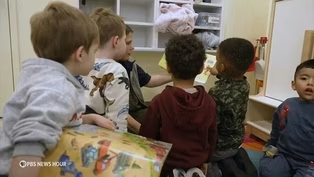
WILLIAM BRANGHAM: More than a quarter of all parents of children with disabilities say they struggle to find appropriate childcare for their kids.
And even for those who do, many say their kids routinely encounter discrimination, like being excluded from field trips and some classes.
Judy Woodruff reports for our series Disability Reframed.
JUDY WOODRUFF: In many ways, Caine Harris is a typical young boy.
He loves Curious George and watching videos on his mom's iPad.
So tell me about this young man that we're sitting here talking with.
He's 4 years old.
Is that right?
And... JASMINE WATKINS, Mother of Caine Harris: Yes, that's my 4-year-old son, Caine.
JUDY WOODRUFF: And he is a bundle of energy.
JASMINE WATKINS: Yes, he's very hyper.
(LAUGHTER) JUDY WOODRUFF: But Jasmine Watkins says, when her son was around 18 months old, he began falling behind some of his peers.
JASMINE WATKINS: I recently, within these last three weeks, have gotten him diagnosed with autism.
But that's, like, a very new diagnosis.
Prior to that, I would say he has a speech delay, a cognitive delay.
JUDY WOODRUFF: On top of that, Caine is not potty trained, common for children his age with autism.
All this has made it incredibly difficult for Watkins, a single working mom in Silver Spring, Maryland, to find childcare.
JASMINE WATKINS: They ask you about your child's personality.
They ask if there's any diagnosis.
And they will ask you that.
And if you're like, oh, my child, he doesn't talk or he's still in diapers, these are things that they're putting into perspective when they're trying to enroll you in a program.
JUDY WOODRUFF: She says, earlier this year, after looking at several childcare centers in the area that couldn't meet Caine's needs, a spot opened up at Easterseals, a national nonprofit that provides day care to all children, including those with special needs.
CHYRLETTE CRUMP, Easterseals: We get calls every day with families looking for space for their child with special needs.
And, sometimes, the families don't want to share that information over the phone because they're afraid that they're going to hear that answer no.
JUDY WOODRUFF: Chyrlette Crump is the director of the child development center at this Easterseals, which serves about 60 kids ages 5 or younger.
The organization relies on both public and private funding, including grants and donations, to offer these services.
Parents pay based upon their income.
Caine is one of about 12 children here with special needs.
CHYRLETTE CRUMP: I think what sets us apart is, we're not afraid to work with children with disabilities.
Sometimes, for educators or programs, it's fear of the unknown.
We're not afraid.
We need to meet children exactly where they are, so if there is ability or disability, we can help support them.
JUDY WOODRUFF: But finding that support isn't easy.
ELIZABETH CURDA, U.S.
Government Accountability Office: Our analysis showed there's over 2.2 million children in the United States with disabilities who are aged 5 or younger.
And their parents are having a very difficult time finding childcare for them.
JUDY WOODRUFF: Elizabeth Curda is a director at the U.S.
Government Accountability Office, which released a report last year.
It showed many childcare centers often put up barriers for children with special needs, including requirements for potty training by the age of 3.
Their parents can face yearslong wait-lists and sometimes even be forced to move to access childcare.
ELIZABETH CURDA: And what we heard from providers is, they need training, they need additional staff and funding for accommodations and for making the physical environment accessible.
NAKISHA URBINA, Teacher, Easterseals: They learn the routine.
They learn the consistency.
JUDY WOODRUFF: At Easterseals, teachers like Nakisha Urbina do receive extra training and instruction on how to interact with students like Caine Harris.
NAKISHA URBINA: Just having an open mind that not to take the behavior personal, because sometimes they're not going to be in compliance.
JUDY WOODRUFF: She says this training has been crucial and that she now enjoys having special needs children in her classroom.
NAKISHA URBINA: It helps me teach the other children that everyone is learning differently.
So, it helps me create the lesson plan that includes Caine and the other children.
So it's not challenging.
It just helps me become better at what I'm doing and how I'm teaching both children with special needs and children that do not have special needs.
JUDY WOODRUFF: Some staff here are also trained on even more medically complex needs, like how to properly feed 1-year-old Miracle Wynn.
ROBERT WYNN, Grandfather of Miracle Wynn: I have never seen a baby like this, so independent.
She's a fighter.
JUDY WOODRUFF: Grandfather Robert Wynn raises Miracle, who's relied on this tube attached to her stomach to be fed ever since surviving open-heart surgery at birth.
ROBERT WYNN: I could show you pictures where she had tubes all over.
I cried every day because I didn't know if she was going to make it, but God is good.
Right here.
Right here.
JUDY WOODRUFF: While some parents pay up to $2,500 a month for childcare at Easterseals, Wynn received a grant from Montgomery County in Maryland that allows him to send Miracle here for free.
What would it be for you, what would it mean for you if this place didn't exist?
ROBERT WYNN: I have no idea.
I would be lost.
I'm going to be honest with you.
I would be lost.
They allow me to go to work.
I hadn't worked in almost a year.
They allow me to go to work.
I mean, boy, they do my baby's hair.
I'm dad.
I mean, I have got five girls, but I have not learned how to do hair.
JUDY WOODRUFF: You're not good with hair.
ROBERT WYNN: Not at all.
And they do it for me.
JUDY WOODRUFF: That level of care is what Jasmine Watkins says has made Easterseals a good fit for her son, who now also gets picked up five days a week for additional speech training at a local school.
JASMINE WATKINS: I just want Caine to be happy.
I want him to be able to articulate himself.
I want him to be a kind, loving person that's thriving.
And to be able to do that, he needs extra help.
And that's OK.
JUDY WOODRUFF: Extra help that still remains out of reach for so many parents across the country.
For the "PBS News Hour," I'm Judy Woodruff in Silver Spring, Maryland.
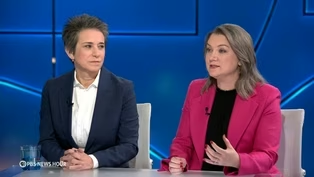
WILLIAM BRANGHAM: A fractured Republican Party on display and fallout from the partial release of the Epstein files.
There is no shortage of political news on this holiday week.
So, for analysis, we turn to our Politics Monday duo.
That's Amy Walter of The Cook Political Report With Amy Walter and Tamara Keith of NPR.
Welcome to you both.
Thank you so much for being here.
TAMARA KEITH, National Public Radio: Hello.
AMY WALTER, The Cook Political Report: Hello.
WILLIAM BRANGHAM: I want to talk about this Turning Point event that happened over the last few days.
This was the organization founded by the late Charlie Kirk.
His death had brought a fair amount of unity to the Republican Party, but multiple speakers at this multiple-day event seemed to chip away at that foundation.
Most notably, Ben Shapiro, the conservative reporter and spokesperson, said -- he basically accused right-wing influencers like Tucker Carlson of promoting antisemitism and conspiracy theories.
And he said that putting someone like Nick Fuentes, the avowed racist and neo-Nazi, on his broadcast was a problem.
Here's a bit of what Shapiro said.
BEN SHAPIRO, Conservative Political Commentator: There is a reason that Charlie Kirk despised Nick Fuentes and indeed even chided Dinesh D'Souza for debating him.
He knew that Nick Fuentes is an evil troll and that building him up is an act of moral imbecility.
And that is precisely what Tucker Carlson did.
He built Nick Fuentes up.
WILLIAM BRANGHAM: Also at this weekend event, Erika Kirk, the widow of Charlie Kirk, endorsed Vice President Vance for president in 2028.
Vance himself spoke Sunday and addressed some of these criticisms.
J.D.
VANCE, Vice President of the United States: I didn't bring a list of conservatives to denounce or to deplatform, and I don't really care if some people out there -- I'm sure we will have the fake news media denounce me after this speech.
President Trump did not build the greatest coalition in politics by running his supporters through endless self-defeating purity tests.
WILLIAM BRANGHAM: Tam, is this evidence of the GOP splintering in some way?
TAMARA KEITH: What Vance is saying is a statement about political math.
And his view is exactly what President Trump's view was, which was Trump never denounced anyone who supported him.
He would take all the voters that he could get.
I do think that there is a bit of a crack-up happening, some very heated debate about antisemitism.
You also see this at The Heritage Foundation, which was this think tank that has long roots in conservative policy, but now a lot of people are leaving The Heritage Foundation.
Some of them are even going to an organization that former Vice President Mike Pence started.
And they're leaving because they're upset about the platforming of Nick Fuentes.
So this is a really big fight that's happening.
And I think partially what it is, is that Charlie Kirk in death did unite them briefly, but also, when he was alive, he did a very good job of sort of keeping the movement in line.
WILLIAM BRANGHAM: Papering over the fissures.
TAMARA KEITH: Yes.
AMY WALTER: Yes.
It's a great example of what we know about another very powerful political figure, which is that that personality alone is something, when it is gone, is very difficult to reassemble, right?
So, a very... WILLIAM BRANGHAM: It's like questions about Trump too.
AMY WALTER: That's exactly right, yes, that when the person who has built the coalition, who has kept the coalition going is gone, there's a vacuum and there are a lot of folks trying to fill that vacuum.
Obviously, folks like Ben Shapiro saying, yes, we do need to fill the vacuum, but we need to avoid allowing people who say these things as being part of our movement.
It's going to undermine everything that we hoped it would.
WILLIAM BRANGHAM: Sticking with you, Amy, just for a second, we did see, as I mentioned, Erika Kirk saying, the vice president should be our nominee... AMY WALTER: Yes.
WILLIAM BRANGHAM: ... and that this might help us in advance of the midterms.
Is that a legitimate thing to be arguing at this point, or are we putting the cart so far in front of the horse here?
AMY WALTER: Right.
The idea, I think, was twofold.
The first is, Erika Kirk and Charlie Kirk were very good friends with J.D.
Vance.
This is a very personal relationship that I think transcends the politics.
And the second is, yes, this idea that young voters who united -- who the TPUSA united, in many ways, for Donald Trump, that was Charlie Kirk's real special sauce was engaging with those younger voters.
For those voters in 2026 to turn out, the movement needs to be unified.
There needs to be one voice.
There needs to be not this sort of fractiousness on display.
And so will that help by endorsing J.D.
Vance?
I don't think that J.D.
Vance has much to do with what's going on in 2026, but it's definitely putting a marker down.
And Tucker Carlson talked about this too at the event, putting a marker down basically is who we want to support, who this movement will support, whether we call it MAGA, whether we call it TPUSA, whether we call it conservatism.
We will only support people who allow all voices and we will denounce no one if they are an ally of ours.
WILLIAM BRANGHAM: Right.
Tam, do you think, I mean, when it comes to maintaining this coalition, does putting Vance's name forward as a potential standard-bearer help?
TAMARA KEITH: He's the vice president of a president who will not be running for office in '28, constitutionally not allowed to do that.
The president has already said he thinks that a Vance-Rubio ticket would be unstoppable.
Rubio has said, if Vance is running, he's not going to challenge him.
So there is a conversation happening, there is movement happening.
Like, in 2013, I was in Iowa covering Ted Cruz, Senator Ted Cruz, who was very clearly already running for president.
It's not too early.
And there is this idea of sort of clearing the field.
I don't know that Vance is going to be able to clear the field at all, but it puts a marker down.
WILLIAM BRANGHAM: I want to pivot quickly to the Epstein files, the continued rollout.
Friday was the deadline for the DOJ to drop all of these files.
They clearly have not done that.
Some have come out.
Some have been redacted.
Much of it's redacted.
Parts with Trump in them were put out and then retracted and then put out again.
Steve Bannon once predicted that the GOP's failure to adequately deal with Epstein would be electoral doom for the GOP.
Do you think that this will matter to voters at all?
AMY WALTER: I think it is not as relevant to voters as many of those feared.
But what I do think it really speaks to is the continuing challenge for both parties to deal with the fact that you have a public that is so cynical and so convinced that there are people in power who are pulling levers and getting away with all kinds of terrible stuff.
It is what is animating our politics right now, is this idea that to have to blow up the system or to reassess the system is the only way forward.
WILLIAM BRANGHAM: Do you think it'll matter?
TAMARA KEITH: I don't know that this specifically will matter.
I think what Amy is talking about with people feeling disenchanted with the establishment and people in power, that's not going away.
That traces back to a lot of things, including the financial crisis in 2008 and 2009, where somehow the banks did fine, but real people lost their homes and lost their shirts.
WILLIAM BRANGHAM: And nobody went to jail.
TAMARA KEITH: And nobody went to jail.
And this is a case with Epstein where one person -- two people went to jail, and one of them has now been moved to a cushy women's camp.
WILLIAM BRANGHAM: Right.
Tamara Keith, Amy Walter, so nice to see you.
Have a great holiday, both of you.
AMY WALTER: You too.
TAMARA KEITH: You too.
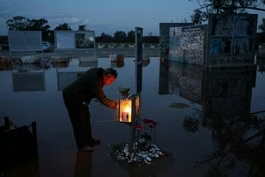
WILLIAM BRANGHAM: For millions of Jews around the world, Hanukkah ended this evening at nightfall.
It's a holiday centered on dedication and perseverance.
And the Festival of Lights is particularly special in Israel, especially for the survivors of October 7, their families, and the families of those who were lost.
The "News Hour"'s producer in Israel, Karl Bostic, sent this report from two kibbutzim shattered by terror, but now being revived.
KARL BOSTIC: Torchbearing children bringing light out of darkness, celebrating a Jewish victory in an ancient war.
But here on Kibbutz Nir Oz, barely two miles from the Gaza border, the sacrifices honored are much more familiar.
RON BAHAT, Security Manager, Nir Oz: It's light.
We need to cover light with all this darkness.
The place is -- start blooming.
And, of course, we had a very dark period after October 7.
And now you will see that we come back stronger, bigger and better.
KARL BOSTIC: Nir Oz was among the hardest-hit kibbutzim that terror-filled morning on October 7; 47 residents were killed; 76 were taken hostage.
Now it is slowly coming back to life.
The building and growing have begun anew and its people are returning.
EMI PALMOR, Former Director General, Israeli Ministry of Justice: There was a huge massacre here.
Hamas terrorists entered 97 percent of the homes and the complete community was evacuated.
One out of four was either kidnapped or murdered and the rest were evacuated.
So it's a very, very special year because we're going to see the revival.
And we have hostages who returned.
We have Gadi Moses, who is 81 years old, who was almost 500 days in captivity by himself.
And when he came out, he wrote a letter to his friends in the kibbutz.
He said: I'm back.
Let's get to work and let's push away the darkness.
KARL BOSTIC: During his captivity, Gadi Moses lost track of time.
He didn't know what day it was, but he never lost track of hope.
His lifeline was to hear the news from radio only when his captors let him listen, a signal, a light that helped him survive.
The interesting, amazing thing is, they allowed you to listen to the Israeli news.
What do you... GADI MOSES, Released Hostage: No, no, no, no, no.
They gave me five minutes a week.
I ask for radio, and I ask it again and again, months, two months, three months.
KARL BOSTIC: And for one of those five minutes, he heard Israel's defense minister speaking on the radio.
GADI MOSES: Today is the third candle.
KARL BOSTIC: He knew what day it was, the second day of Hanukkah.
What makes this Hanukkah so special for you?
GADI MOSES: The light.
The light.
We have a lot of light, and the light means hope.
We hope that next year it will be much better.
KARL BOSTIC: That hope will mean the building of new homes for returning families and space for new families.
Dozens of homes are expected to be built in the new year, but the community is still struggling with the shadow of October 7.
Though all hostages have been released except for one, these yellow flags remain as reminders of the horror.
This is the home of Oded and his wife, Yocheved Lifshitz.
More than two years ago, they were both taken hostage on October 7 into Gaza.
Afterwards, the home was set on fire.
And still, two years later, nothing has changed, including this piano, which is Oded's piano.
Now everyone's debating which homes to save and reserve or which ones to demolish.
(CHEERING) KARL BOSTIC: As sundown plunged the day into the night, the lighting of the fire began in Nir Oz for Hanukkah.
Yizhar Lifshitz, the son of Oded and Yocheved, watched the fire with his mother, now 87.
His father, Oded, at 82 was killed in the tunnels of Gaza.
But Yizhar is defiant and sees the rebuilding of Nir Oz as part of the fire.
YIZHAR LIFSHITZ, Son of Hostages: It's not because we are heroes, because we are in the corner.
What is the other option?
To cry and die?
No way.
KARL BOSTIC: The nearby kibbutz of Be'eri was also hit by the attacks of October 7, and is finding its own light to rebuilding.
This place's residents met at the local pub in Be'eri.
Despite their own personal tragedies, they are also defiant about returning.
For Yuda Simon, Hanukkah represents miracles.
YUDA SIMON, Be'eri Resident: Hanukkah is a story of miracles for the Jewish people.
And my family had a small miracle inside the hole, in the black hole that happened to us in our family.
KARL BOSTIC: His family left for holiday on October 6, but his brother Mordecai stayed behind, and he was killed that next day while trying to rescue his girlfriend.
YUDA SIMON: A lot of the kibbutz members, actually 30 of the kibbutz members were kidnapped and 102 were murdered.
KARL BOSTIC: Have you ever thought of leaving Be'eri?
YUDA SIMON: Well, all the time, I thought -- I wasn't sure it is my house, but now I'm completely sure, after October 7, this is my house.
KARL BOSTIC: Not only are residents displaced for more than two years choosing to return, but also new people have made the decision to move to places like Nir Oz and Be'eri, even though there is still a threat living next to Gaza.
Netta Asher is only 23, and she just moved here.
She also joined the local security force.
NETTA ASHER, Nir Oz Resident: So I have moved here four months ago, but I have known the people for years now, ever since I volunteered here a couple of years ago.
And I moved here because I'm surrounded by the strongest, most optimistic and uplifting people.
I think that it's very empowering to be here.
You're not really safe anywhere.
And once you let go and you accept, that's when serenity comes.
I think it's the best cure for anxiety in a very paradoxical way.
KARL BOSTIC: The Festival of Light that is Hanukkah began with the tale from ancient times, when all that was left to provide light during a war was a small canister of oil.
It was enough to last for eight nights.
For Jews in Israel today, those eight nights from an ancient war have now become two years of the same kind of sustaining light for another war in these modern times.
Karl Bostic, "PBS News Hour," Tel Aviv, Israel.
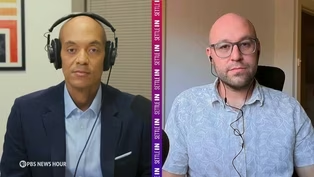
WILLIAM BRANGHAM: We return now to our video podcast "Settle In."
Geoffrey Bennett recently spoke to Gideon Meyerowitz-Katz.
He's an epidemiologist and writes the Health Nerd blog.
He has spent years helping people understand the data behind the news they see about their health.
They spoke about bad science, misconceptions around what we eat, and Health Secretary Robert F. Kennedy Jr.
's Make America Healthy Again campaign.
Here's a little bit of that conversation.
GEOFF BENNETT: When we talk about the health secretary, RFK Jr., Robert F. Kennedy Jr., what do you make of his personal crusade to reveal, to unearth the cause of autism?
GIDEON MEYEROWITZ-KATZ, Health Nerd: So, when we talk about autism, what we're discussing isn't necessarily the sole cause of autism.
What -- certainly, what RFK Jr., when he speaks, he's mostly discussing the increase in the rates of autism.
So if you look at the number of people who are autistic, if you look at the earliest studies of that, they were conducted in the '60s in the United States and also in the U.K.
And they estimated that around one in 2,000 children had autism, somewhere around five in 10,000 kids, give or take.
If you look at the most recent estimates, the number is now closer to one in 30.
So, somewhere -- it's just under 3 percent of children would be diagnosed as autistic today.
So that's about a 60-times increase between the 60s and 2025.
But if you look at the history of autism, it quickly becomes clear the main thing that's happened there.
So in the '60s, when we talk about autism, it was a term used to describe severely disabled or children with very significant developmental delay who were mostly nonverbal, who required a great deal of assistance in their lives.
And so it was a very specific disease.
And then, as the decades went on, when we talk about autism spectrum disorder, it is very, very broad compared to the 1960s definition of autism.
It includes children who are fully verbal, who are succeeding at school, who are very able to take care of themselves.
And these are all things that, in the 60s, would be considered to be exclusion.
So if you could do any of that, you wouldn't be diagnosed as autistic.
And so we know that a large portion of this increase that RFK Jr.
and co.
are attempting to explain is simply because we have changed the definition of what autism is.
And, I mean, the other big thing that's changed, I don't -- and, again, we're referencing the '90s.
Growing up in the '90s and the '80s, it was very hard to be diagnosed with autism.
And that's because there were very few providers who recognized the term, who were experienced and trained in recognizing autism.
And I remember, when I was a kid you had to go to a special psychiatrist who had monthslong wait to see -- to even get assessed for autism.
These days, you can be assessed online and it takes maybe two appointments to get a diagnosis if you believe that you have autism.
It's very quick.
And so the expansion of the diagnostic criteria and the substantial expansion in sort of the ability to get diagnosed explains the majority of the increase in autism.
And there are studies looking at this.
So there was one study in California that found that just replacing the term mental retardation, which fell out of favor in the '80s, with autism, which became the new diagnosis, explained 25 percent of the increase in rates of autism in California, which is 25 percent just for that one term being removed.
And there was a study in Denmark that found the overwhelming majority of the increase in autism is explained in that country by the change in diagnosis and the improved access to diagnosis.
WILLIAM BRANGHAM: And that is the "News Hour" for tonight.
I'm William Brangham.
On behalf of the entire "News Hour" team, thank you so much for joining us.

CBS News chief draws backlash by pulling '60 Minutes' story
Video has Closed Captions
Clip: 12/22/2025 | 7m 5s | New CBS News chief draws backlash by pulling '60 Minutes' story on El Salvador prison (7m 5s)
Gideon Meyerowitz-Katz joins Geoff Bennett on ‘Settle In’
Video has Closed Captions
Clip: 12/22/2025 | 4m 39s | Gideon Meyerowitz-Katz joins Geoff Bennett for our ‘Settle In’ podcast (4m 39s)
How communities scarred by Oct. 7 celebrated Hanukkah
Video has Closed Captions
Clip: 12/22/2025 | 6m 30s | How Israeli communities scarred by Oct. 7 celebrated Hanukkah (6m 30s)

News Wrap: Trump names special envoy to Greenland
Video has Closed Captions
Clip: 12/22/2025 | 5m 26s | News Wrap: Trump names Louisiana governor as his special envoy to Greenland (5m 26s)
Tamara Keith and Amy Walter on a fractured Republican Party
Video has Closed Captions
Clip: 12/22/2025 | 8m 27s | Tamara Keith and Amy Walter on a fractured Republican Party (8m 27s)

Trump halts East Coast projects in latest blow to wind power
Video has Closed Captions
Clip: 12/22/2025 | 6m 6s | Trump halts East Coast projects in latest blow against wind power (6m 6s)

Warner Bros. sale prompts concerns among creative community
Video has Closed Captions
Clip: 12/22/2025 | 7m 44s | Proposed Warner Bros. sale prompts concerns among Hollywood's creative community (7m 44s)
Why finding childcare for kids with disabilities is so hard
Video has Closed Captions
Clip: 12/22/2025 | 6m 54s | Why finding childcare for kids with disabilities is so difficult in the U.S. (6m 54s)
Providing Support for PBS.org
Learn Moreabout PBS online sponsorship
- News and Public Affairs

FRONTLINE is investigative journalism that questions, explains and changes our world.

- News and Public Affairs

Amanpour and Company features conversations with leaders and decision makers.
One Question with Becky Ferguson











Support for PBS provided by:
Major corporate funding for the PBS News Hour is provided by BDO, BNSF, Consumer Cellular, American Cruise Lines, and Raymond James. Funding for the PBS NewsHour Weekend is provided by...