
Here and Now
Dr. Ryan Westergaard on Measles Cases in Southwest Wisconsin
Clip: Season 2500 Episode 2508 | 5m 44sVideo has Closed Captions
Dr. Ryan Westergaard on a measles outbreak and falling childhood vaccination rates.
Wisconsin Department of Health Services state epidemiologist Dr. Ryan Westergaard describes a measles outbreak in southwest areas of the state and the impacts of falling childhood vaccination rates.
Problems playing video? | Closed Captioning Feedback
Problems playing video? | Closed Captioning Feedback
Here and Now is a local public television program presented by PBS Wisconsin
Here and Now
Dr. Ryan Westergaard on Measles Cases in Southwest Wisconsin
Clip: Season 2500 Episode 2508 | 5m 44sVideo has Closed Captions
Wisconsin Department of Health Services state epidemiologist Dr. Ryan Westergaard describes a measles outbreak in southwest areas of the state and the impacts of falling childhood vaccination rates.
Problems playing video? | Closed Captioning Feedback
Where to Watch Here and Now
Here and Now is available to stream on pbs.org and the PBS app.
Providing Support for PBS.org
Learn Moreabout PBS online sponsorship>> Wisconsin is experiencing one of the largest measles outbreaks in several years.
At last count, the Department of Health Services has identified 48 cases and one hospitalization, mostly in the southwest part of the state, and the case count has grown rapidly due to how highly contagious measles is among the unvaccinated.
With the latest, we're joined by Doctor Ryan Westergaard, chief medical officer with the Wisconsin DHS Bureau of Communicable Disease.
And doctor, thanks very much for being here.
>> Thank you for having me.
>> Describe how fast this has spread in this latest outbreak.
>> Well, unlike some previous outbreaks, we didn't catch this one at the very beginning.
We we identified cases that may have been associated with some families that had symptoms for a few weeks.
So it might even have been going on for a month.
When we did first detect it a couple of weeks ago, it's doubled about every 4 or 5 days.
So we started with just two cases confirmed.
Now we're up to 48.
So that number goes up when our investigators and local in the community, following up on people who report symptoms, identifying contacts, and when they find people with note with new symptoms, or they hear about a new test, that number goes up.
So this is often what we see with measles outbreaks.
>> How do public health officials get a handle on it?
>> Yeah, it's it's pretty painstaking.
And we give them so much, so much credit for their dedication out in the communities.
So measles is one of the reportable conditions.
So every positive lab test and every diagnosis made in a clinic we hear about in public health and here in Wisconsin, it's our local health departments, usually at the county or sometimes the city level that are the front line.
So where I work at the state health department, we we support, we aggregate the data, but the work that gets done in the community is involves every single person who is identified with measles gets an interview where an investigator, sometimes a public health nurse or a full time disease investigator will meet with them in person, face to face with.
With.
Personal protective equipment when.
When needed, and they'll confidentially try to understand places and people where they've been in contact.
And then we can then spread out and identify other people who have been exposed, give them the advice that they need about to double check their vaccination status or to get a post-exposure prophylaxis, meaning a vaccine.
And, and so that's, that's the work that's being done right now.
And we're probably going to see more cases as a result of those investigations.
>> With childhood vaccination rates, including for measles sitting at about 85% for incoming kindergartners in Wisconsin.
Was it just a matter of time before this outbreak happened?
>> I think the answer is yes to that.
We've we've been concerned about the level of childhood vaccinations being too low.
Measles, as you said, is probably our most contagious virus.
And the classical teaching in public health school is that you really need to have a community with 95% vaccine coverage or greater to prevent an outbreak.
If there is a case that comes into the community through travel, for example.
So we have many communities that are below 90 and below 85%.
And so for the past year and a half, where there have been measles outbreaks occurring in different places of the country, we've kind of been anticipating when is it going to come to Wisconsin.
The benefit of that is that we were ready and we're we're making the right resources available to our southwestern counties, and hopefully we'll take this what is now a medium sized outbreak and keep it that small and prevent it from getting to be a large one like we've seen in some other states.
get measles?
>> Measles is can be a pretty serious infection.
And it's a it's a good question to ask and to talk about, because there's been so little measles around in this country for so long that many physicians that are my generation or younger have never seen a case.
So measles can is a respiratory virus.
So it spreads through the air, which is what makes it so contagious.
The other side of the room, particles can remain suspended in the air and cause an infection.
But when it gets into the body, through the nose or mouth mouth, it causes a whole body.
A systemic infection causes high fever, sometimes as high as 105, a whole body rash that is, the characteristic dense red measles rash that starts on the head and then spreads to the whole body.
And so most anyone that gets measles will have those symptoms and feel pretty terrible.
But a subset of people with measles can get really severe illness, and it can cause pneumonia and cause encephalitis or swelling of the brain.
And sometimes, particularly in children, that brain inflammation can cause permanent disabilities like blindness or deafness.
So so it's a serious it's a serious infection, one that we want to prevent.
And our goal is to is to eliminate measles.
So there's actually not spreading in our communities at all.
And that's why the stakes are kind of high.
there was a measles vaccine?
>> Yeah.
The measles vaccine or version of the measles vaccine was released in 1963.
So a good long time ago and the decades before that, essentially everyone got measles during childhood.
Right.
And so that's why there's some misconception that this is a sort of a normal part of childhood.
But what we don't remember is that when 3 to 4 million children in the US get measles in a year like they did in the 50s and 60s, that means that several hundred children, young babies, will will die from the serious complications.
So in that decade before we had MMR vaccine, there were 3 to 400 deaths in children per year.
>> Doctor Ryan Westergaard, thanks very much for your update.
>> Yeah, thanks for being for having me.
>> Turning to this week's Inside Wisconsin politics.
 New
NewHere & Now opening for August 21, 2026
Video has Closed Captions
Clip: S2500 Ep2508 | 1m 22s | The introduction to the August 21, 2026 episode of Here & Now. (1m 22s)
 New
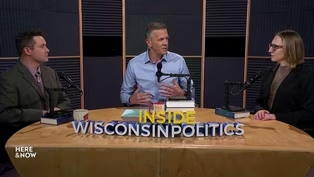
NewInside Wisconsin Politics: Data Centers in the Governor Race
Video has Closed Captions
Clip: S2500 Ep2508 | 5m 23s | Inside Wisconsin Politics on how data centers are a wedge issue in the governor's race. (5m 23s)
 New
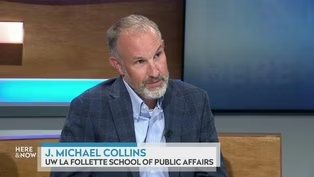
NewJ. Michael Collins on Student Loan Defaults and the Economy
Video has Closed Captions
Clip: S2500 Ep2508 | 5m 35s | J. Michael Collins on the rising number of student loan borrowers who are in default. (5m 35s)
 New
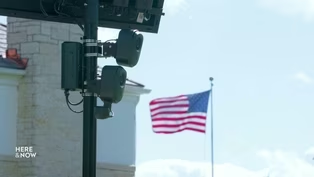
NewThe Rise of and Opposition to Flock Cameras in Wisconsin
Video has Closed Captions
Clip: S2500 Ep2508 | 2m 49s | Widespread automated license plate reader use has provoked a vocal surge of opposition. (2m 49s)
 New
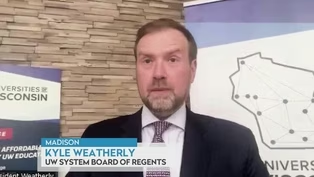
NewUW System Pushes for Tuition Freeze in Return for Investment
Video has Closed Captions
Clip: S2500 Ep2508 | 1m 29s | The UW Board of Regents plans to freeze tuition if the state invests in the system. (1m 29s)
Providing Support for PBS.org
Learn Moreabout PBS online sponsorship New Episode
- News and Public Affairs

Top journalists deliver compelling original analysis of the hour's headlines.
 New Episode
- News and Public Affairs

Today's top journalists discuss Washington's current political events and public affairs.


 New Episode
 New Episode
 New Episode
 New Episode
 New Episode
 New Episode
 New Episode
 New Episode
Support for PBS provided by:
Here and Now is a local public television program presented by PBS Wisconsin