
Here and Now
J. Michael Collins on Student Loan Defaults and the Economy
Clip: Season 2500 Episode 2508 | 5m 35sVideo has Closed Captions
J. Michael Collins on the rising number of student loan borrowers who are in default.
UW-Madison La Follette School of Public Affairs professor J. Michael Collins discusses the rising number of student loan borrowers who are in default and what it indicates about the overall economy.
Problems playing video? | Closed Captioning Feedback
Problems playing video? | Closed Captioning Feedback
Here and Now is a local public television program presented by PBS Wisconsin
Here and Now
J. Michael Collins on Student Loan Defaults and the Economy
Clip: Season 2500 Episode 2508 | 5m 35sVideo has Closed Captions
UW-Madison La Follette School of Public Affairs professor J. Michael Collins discusses the rising number of student loan borrowers who are in default and what it indicates about the overall economy.
Problems playing video? | Closed Captioning Feedback
Where to Watch Here and Now
Here and Now is available to stream on pbs.org and the PBS app.
Providing Support for PBS.org
Learn Moreabout PBS online sponsorshipUW-Madison.
Trying to make college more affordable could help the problem of student loan defaults.
Thousands of people across Wisconsin are not keeping up with repayment of student loans, according to Wisconsin Watch, more than 100,000, or 15% of borrowers in the state carry loans that are in default, having not made a payment in 360 days.
What kind of a bellwether is this for the overall economy, and what's the consequence?
We turn to Jay Michael Collins, a consumer finance expert and professor at the La Follette School of Public Affairs.
And thanks very much for being here.
>> Thanks for having me.
>> So what kind of a marker are student loan defaults for larger economic struggles?
>> I mean, it is a little bit of a canary in the coal mine because if you think about it, many people who have student loans also have credit card loans.
They might have mortgages, auto loans.
These are the loans that they probably have delayed on making payments on.
So once they get behind on these loans, there could be a cascade where they get fall behind on their credit card loans and other kinds of loans.
So it is it is something that's very concerning.
>> How predictable is it that people who hold potentially hefty student loans wouldn't be able to repay them once the Biden era help kind of phased out?
>> There's a lot of different things going on.
I mean, the Biden era help was also with the pandemic.
And so there was this long period where no payments were required, almost three years.
So now borrowers have to get back in the habit of making payments again.
Simultaneously, though, we change the rules, meaning the federal government changed the rules.
And so even a conscientious borrower is going to have a hard time when the payment plans are changing, when they're getting opted into plans, if they don't take an action.
So that's made it really hard, I think, for people to try to keep up with what the current rules and regulations are.
>> What's an example of how payments might have ballooned when these favorable repayment plans went away?
>> I mean, one of the examples is we had at one point in time, we had probably too many different repayment plans that people could opt into.
But the sort of standard plan today would result in borrowers who were in a repayment plan before seeing their payments go up at least $500 a month.
So that's a big, big shift, especially when they were maybe paying very little during the Covid period.
Other plans, you actually have to take action to step up and get to your servicer.
That means standing in, standing in a virtual line for the phone or otherwise trying to get reach them.
And it's been really hard.
There's a big backlog to try to get access to that help that you need.
for people who actually go into default on these loans?
>> The the big issue with student loans, unlike almost all other forms of debt, is these are unsecured loans and they don't go away in bankruptcy.
So you have to pay them back.
If you don't, your wages will be garnished.
Even your Social Security could be garnished as you get older.
So there really is no recourse but to pay these loans back.
Most of the new payment plans are actually stretching payments now over 30 years.
So that's quite a long time to have that burden of payments that you have to take care of.
>> Meanwhile, consumer spending ticked down this summer and job numbers were revised down.
How was the rate of inflation, the higher cost of things dragging down the economy amidst all of the rest of what.
>> We've talked?
I mean, the surveys of consumer sentiment that the University of Michigan and other places do are all ticking downwards.
People seem troubled.
I think, you know, if you look at the inflation numbers, it's not terrible outside of particularly oil.
But what people really feel like is that their wages aren't keeping up.
In other words, the the paycheck is not going up as much as prices for everything else.
And so in lots of surveys, people think that they will actually their budget will be worse off this year because their raises and their income won't match their cost of living.
And so that's really that squeeze that people are feeling and making it hard to keep up with everything, including student loans.
>> And meanwhile, you also say that September 4th is a day that people will be looking ahead to why.
>> Right now, the information that we have, the data we have is pretty mixed.
So consumer sentiment seems kind of weak.
You know, inflation numbers, like a lot of the numbers are just kind of very middling.
And so it's hard to look at the numbers and draw any conclusions.
But the last jobs report, as you mentioned, was pretty negative.
And so this next jobs report will really tell us if this is a trend, if we see another really weak jobs report that suggests that places aren't hiring, maybe places are even letting people go.
We worry about what this fall might look like in terms of higher unemployment as well.
>> Speaking of that, the economy polls as a key election issue, as it always does.
What is it like out there for the average voter in Wisconsin kind of heading into the midterms?
>> Yeah.
I mean, this anxiety that people feel, this worry, that people feel they take it out in lots of different ways.
And so one of those ways is the government isn't doing it for me.
And so I think this will particularly be hard for any incumbent, particularly anybody who's associated with the current administration, is going to have to sort of make an argument that they didn't contribute to the problems.
It's not clear that what any politician can do, in the light of the current economic, economic situation, but it certainly is making voters very anxious and perhaps a little bit rebellious in their votes this year.
>> And your crystal ball would suggest that potentially it won't get better before November.
>> The numbers have shown us, if anything, more negative signals than positive signals.
So maybe things won't be getting as worse as the worst case scenario, but it looks very unlikely it's going to get a lot better.
>> All right.
Well, thank you for your insights, J. Michael Collins.
Finally tonight, you've probably driven past one but may not
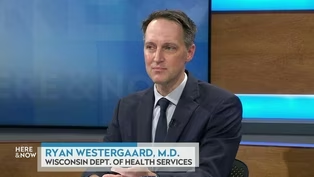 New
NewDr. Ryan Westergaard on Measles Cases in Southwest Wisconsin
Video has Closed Captions
Clip: S2500 Ep2508 | 5m 44s | Dr. Ryan Westergaard on a measles outbreak and falling childhood vaccination rates. (5m 44s)
 New
NewHere & Now opening for August 21, 2026
Video has Closed Captions
Clip: S2500 Ep2508 | 1m 22s | The introduction to the August 21, 2026 episode of Here & Now. (1m 22s)
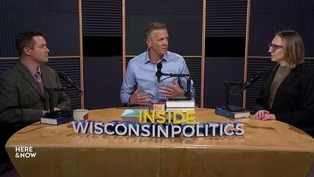 New
NewInside Wisconsin Politics: Data Centers in the Governor Race
Video has Closed Captions
Clip: S2500 Ep2508 | 5m 23s | Inside Wisconsin Politics on how data centers are a wedge issue in the governor's race. (5m 23s)
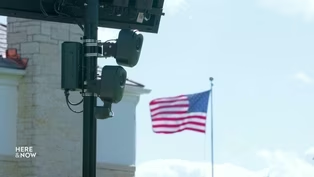 New
NewThe Rise of and Opposition to Flock Cameras in Wisconsin
Video has Closed Captions
Clip: S2500 Ep2508 | 2m 49s | Widespread automated license plate reader use has provoked a vocal surge of opposition. (2m 49s)
 New
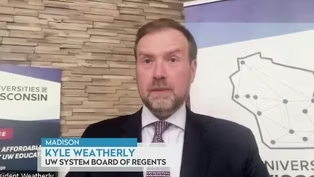
NewUW System Pushes for Tuition Freeze in Return for Investment
Video has Closed Captions
Clip: S2500 Ep2508 | 1m 29s | The UW Board of Regents plans to freeze tuition if the state invests in the system. (1m 29s)
Providing Support for PBS.org
Learn Moreabout PBS online sponsorship New Episode
- News and Public Affairs

Top journalists deliver compelling original analysis of the hour's headlines.
 New Episode
- News and Public Affairs

Today's top journalists discuss Washington's current political events and public affairs.

 New Episode
 New Episode
 New Episode
 New Episode
 New Episode
 New Episode
 New Episode
 New Episode
Support for PBS provided by:
Here and Now is a local public television program presented by PBS Wisconsin