
Health workers in Africa struggle to slow Ebola outbreak
Clip: 5/26/2026 | 4m 53sVideo has Closed Captions
Health workers in Africa struggle to slow Ebola outbreak
At least 220 people are believed to have died from the Ebola outbreak in Central Africa. The World Health Organization says that it is spreading so quickly that response efforts are struggling to keep pace. The epicenter remains in the Democratic Republic of Congo, where mistrust of health authorities is complicating efforts. Geoff Bennett discussed more with Dr. Celine Gounder of KFF Health News.
Problems playing video? | Closed Captioning Feedback
Problems playing video? | Closed Captioning Feedback
Major corporate funding for the PBS News Hour is provided by BDO, BNSF, Consumer Cellular, American Cruise Lines, and Raymond James. Funding for the PBS NewsHour Weekend is provided by...
Health workers in Africa struggle to slow Ebola outbreak
Clip: 5/26/2026 | 4m 53sVideo has Closed Captions
At least 220 people are believed to have died from the Ebola outbreak in Central Africa. The World Health Organization says that it is spreading so quickly that response efforts are struggling to keep pace. The epicenter remains in the Democratic Republic of Congo, where mistrust of health authorities is complicating efforts. Geoff Bennett discussed more with Dr. Celine Gounder of KFF Health News.
Problems playing video? | Closed Captioning Feedback
Where to Watch PBS News Hour
PBS News Hour is available to stream on pbs.org and the PBS app.
Providing Support for PBS.org
Learn Moreabout PBS online sponsorshipGEOFF BENNETT: At least 220 people are believed to have died from the Ebola outbreak in Central Africa, with suspected cases now nearing 1,000.
The director-general of the World Health Organization warned the outbreak is spreading so quickly that response efforts are struggling to keep pace.
The epicenter remains in the Democratic Republic of Congo, where deep mistrust of health authorities is complicating containment efforts.
Funerals organized by the Red Cross teams are now taking place under military and police escort after several health care facilities were attacked in recent days.
Here's how one Red Cross volunteer described the resistance she's encountered.
VANNY BIRUNGI, Red Cross Volunteer (through translator): We have come to tell the people of Bivo Kolomani (ph) that the disease is here.
Unfortunately, we're facing resistance.
And some people want to stone us, but we're not going to give up.
We're continuing to tell them that the disease is here.
Some accept it and others don't.
We fear that, because the resistance is strong, people will continue to die, but we're not giving up.
GEOFF BENNETT: For more on the outbreak and efforts to contain it, we're joined now by Dr.
Celine Gounder, editor at large for public health at KFF Health News.
Thanks for being with us.
DR.
CELINE GOUNDER, KFF Health News: My pleasure.
GEOFF BENNETT: You were on the ground back in 2014 during the Ebola outbreak in West Africa.
As you watch this outbreak unfold, what stands out to you most about the response?
DR.
CELINE GOUNDER: You have many of the same conditions that we saw during the 2014-to-2016 West African epidemic.
So, again, we have no vaccine, no specific treatment, which at the time was the case with that species of Ebola.
We're seeing delayed detection in part because of difficulties with contact tracing, a health care system that is dysfunctional, cross-border spread, in part by migrant workers.
On top of that, you have armed conflict.
You have these militants backed by the Rwandan government in much of the affected area.
You also have refugee camps in Southern Sudan.
And Kampala, where we have seen some of the cases in Uganda, is a major travel hub.
So you have all of the conditions ripe for a huge epidemic.
GEOFF BENNETT: And you have raised concerns about the cuts to USAID at a moment like this.
Walk us through the practical impact, the capabilities, the staffing, the response infrastructure that is potentially undermined by a lack of funding.
DR.
CELINE GOUNDER: So a key number here is one in five.
One in five contacts of Ebola cases or who've had high risk exposures, only one in five are currently undergoing contact tracing and follow-up, so once they're identified, having follow-up for three weeks to make sure they don't develop symptoms, if they develop symptoms, that they're isolated and they receive treatment.
And that's exactly the kind of work that the people who were funded by USAID were doing.
And so now you don't have local health care workers funded to do that contact tracing, to do the isolation, and then also, importantly, safe burials.
So a key part of Ebola control is, if somebody passes away from Ebola, that the body is handled safely so that other people don't get infected.
And that requires special safe burial teams that have the equipment to do this and also have a relationship with the community to do this safely.
GEOFF BENNETT: You mentioned the cross-border spread of Ebola.
What should people understand about the risk beyond the region?
DR.
CELINE GOUNDER: Well, I do think we're going to see a very large regional outbreak.
We may see some sporadic cases outside of the immediate region.
I don't think, for a whole host of reasons, that we're going to see sustained transmission outside of the region.
Our level of infection control in health care facilities is much higher in Western health facilities.
We also have better water, sanitation, and so forth.
So I don't think you're going to see that kind of explosive spread outside of the region, but we may see some sporadic cases.
GEOFF BENNETT: And researchers at the University of Oxford, as I understand it, are testing a next-generation Ebola vaccine using technology similar to what was used during the COVID pandemic.
How promising does that appear at the moment?
DR.
CELINE GOUNDER: This is still very early stage, and I'm not aware of anything that is ready for human clinical trials at this stage.
Ideally, you would have something that you could study in the middle of an outbreak.
That's the best way to actually get data on the vaccine quickly, but I don't think that we have anything that's ready for prime time yet.
GEOFF BENNETT: Dr.
Celine Gounder, thanks for your insights, as always.
We appreciate it.
Giving Iran control of strait a mistake, Bolton argues
Video has Closed Captions
Giving Iran control of Strait of Hormuz would be a mistake, Bolton argues (6m 44s)
How schools are using AI and VR to train nurses
Video has Closed Captions
How schools are using AI and VR to train the next generation of nurses (7m 20s)

Iran says U.S. acting in 'bad faith' after new strikes
Video has Closed Captions
Iran says U.S. acting in 'bad faith' after strikes during peace talks (4m 16s)

Jon Meacham joins Amna Nawaz on 'Settle In'
Video has Closed Captions
Jon Meacham and Amna Nawaz examine the state of our democracy on 'Settle In' (5m 53s)
News Wrap: South Carolina Senate rejects redistricting push
Video has Closed Captions
News Wrap: South Carolina Senate rejects redistricting push (5m 48s)
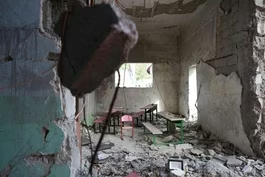
On the ground at the Iranian school devastated by airstrike
Video has Closed Captions
At Iranian school devastated by airstrike, grieving families say they will never forget (7m 33s)
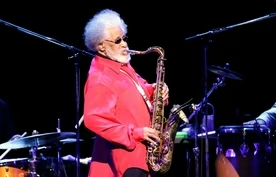
Remembering the remarkable life of jazz legend Sonny Rollins
Video has Closed Captions
Remembering the remarkable life of jazz legend Sonny Rollins (5m 36s)

Trump's 4th medical checkup renews scrutiny of his health
Video has Closed Captions
Trump's 4th medical checkup renews public scrutiny of his health (4m 24s)
Providing Support for PBS.org
Learn Moreabout PBS online sponsorship New Episode
- News and Public Affairs

Today's top journalists discuss Washington's current political events and public affairs.

- News and Public Affairs

FRONTLINE is investigative journalism that questions, explains and changes our world.
One Question with Becky Ferguson
 New Episode
 New Episode
 New Episode


 New Episode
 New Episode
 New Episode
 New Episode
Support for PBS provided by:
Major corporate funding for the PBS News Hour is provided by BDO, BNSF, Consumer Cellular, American Cruise Lines, and Raymond James. Funding for the PBS NewsHour Weekend is provided by...