
Multiple failures likely led to deadly LaGuardia collision
Clip: 3/24/2026 | 6m 14sVideo has Closed Captions
Investigators believe multiple failures led to deadly LaGuardia Airport collision
The National Transportation Safety Board said it was likely a series of failures that led to the accident at LaGuardia Airport when an Air Canada jet struck a fire truck on the runway. Geoff Bennett discussed the latest with science and aviation correspondent Miles O’Brien.
Problems playing video? | Closed Captioning Feedback
Problems playing video? | Closed Captioning Feedback
Major corporate funding for the PBS News Hour is provided by BDO, BNSF, Consumer Cellular, American Cruise Lines, and Raymond James. Funding for the PBS NewsHour Weekend is provided by...
Support provided by:

Multiple failures likely led to deadly LaGuardia collision
Clip: 3/24/2026 | 6m 14sVideo has Closed Captions
The National Transportation Safety Board said it was likely a series of failures that led to the accident at LaGuardia Airport when an Air Canada jet struck a fire truck on the runway. Geoff Bennett discussed the latest with science and aviation correspondent Miles O’Brien.
Problems playing video? | Closed Captioning Feedback
How to Watch PBS News Hour
PBS News Hour is available to stream on pbs.org and the free PBS App, available on iPhone, Apple TV, Android TV, Android smartphones, Amazon Fire TV, Amazon Fire Tablet, Roku, Samsung Smart TV, and Vizio.
Providing Support for PBS.org
Learn Moreabout PBS online sponsorshipGEOFF BENNETT: Now the latest on the collision at New York's LaGuardia Airport Sunday night that killed two pilots and injured dozens more.
The National Transportation Safety Board said today it was likely a series of failures that led to the accident when an Air Canada jet struck a fire truck responding to a possible emergency with another plane.
Many questions remain, but we learned today that a runway warning system failed to sound the alarm moments before the accident and that a fire truck was given permission to cross the runway less than 30 seconds before they collided.
Two controllers were on duty.
For more, we're joined now by our science and aviation correspondent, Miles O'Brien.
Miles, it's good to see you.
So what more did we learn today from the NTSB and the timeline presented today?
MILES O'BRIEN: Well, the timing itself, Geoff, is kind of breathtaking.
The controllers in the tower there, two of them, were dealing with an emergency on the field.
A 737 United Airlines had fumes in the cabin, flight attendants were feeling sick, and so the crew made the decision to evacuate the passengers off the aircraft.
And that's what precipitated the need to get emergency trucks on the way to this other aircraft.
The tower team continued pretty much normal operations, allowing the Air Canada aircraft to continue its approach and, only 20 seconds before it was to touch down, gave it clearance to cross the runway.
That is extremely tight, and the controller later said, quoting him now: "I messed up."
But it's not so much an individual's responsibility in this case when you look at the whole system and how it failed.
GEOFF BENNETT: Miles, we have spoken on this program in the past about the concerns over air traffic controller staffing.
And one of the questions that came up during the press conference today was the fact that the air controller in charge was doing the duties of two positions.
Here's what the NTSB chair, Jennifer Homendy, said: JENNIFER HOMENDY, Chair, National Transportation Safety Board: In this situation for the midnight shift, it is standard operating procedure that they only have to on duty, and those two perform the duties of other controllers.
That is our understanding right now.
However, we're going to further dig into that as part of our investigation.
Certainly, I can tell you that our air traffic control team has stated this is a problem, that this is a concern for them for years, that they have had this concern for quite a long time.
GEOFF BENNETT: So that's the SOP?
You have two controllers staffing one shift.
Is that even safe?
MILES O'BRIEN: Yes, safe is a hard thing to put in a line in the sand on, but they have been doing it for years with two people.
And it is on a standard operating night, a normal night, you can get away with it.
They have for years and years.
Is it safe?
Well, if something goes awry, maybe it isn't.
Maybe you need the two additional people that the NTSB would have recommended in this case to manage the emergency that was unfolding as that occurred.
And so clearly there is a staffing issue here.
And for the FAA to try to sidestep this is just not being fully honest with the situation.
We know air traffic control is way understaffed.
We know the difficulties the FAA has had in hiring people to become properly staffed.
Takes a long time to do it.
And we know that this has a factor to play in a lot of situations when people are stressed, mandatory overtime, working long hours.
Sometimes hard to quantify how that impacts safety, but it's always there.
GEOFF BENNETT: The other thing we learned today, Miles, is that the fire truck that was involved in this collision didn't have a transponder.
Why would that have mattered?
MILES O'BRIEN: Well, this is one of those layers of redundancy we have been talking about, Geoff, right?
You have got fewer people in the tower, and now we have got apparatus at LaGuardia, as busy a piece of concrete on the planet when it comes to aviation, running around without a transporter.
And a transporter basically turns sort of a blurry blip on a radar into a very specific piece of identification that would say, hey, that's fire truck number one.
I can see it over there, and would have given the controllers way more visibility than that blip, which ultimately was not enough to give them any level of alarm or concern.
So, yes, a simple device like a transponder in the apparatus that are running around airports is fundamental and should have been in it, for sure.
GEOFF BENNETT: And, Miles, as you said, we know that fire truck was responding to another aircraft, a United Airlines plane.
MILES O'BRIEN: Yes, this is the thing at the -- a foundational issue here, to me, is, you had an emergency on the field at LaGuardia.
The first thing that should have been done as a matter of rote procedure is stop all arrivals.
Air Canada, go around.
Discontinue your approach while I sort this problem out.
And I think there's a certain psychology problem here is that these controllers are in a high-pressure job where they're trying to maintain a certain tempo to allow the number of arrivals and departures at a place like LaGuardia, which is incredibly stressful, high-tempo.
And I think, frankly, they try to perform at that level no matter what.
As I said, so many times, controllers on a daily basis perform heroic acts in order to make this system safe.
We should not be relying on heroic acts.
And when those controllers are in that heroic mode, they may decide, well, maybe I can sneak one more departure in or arrival in, in this case, and then simultaneously handle that emergency.
It's a mind-set that needs to change.
GEOFF BENNETT: Science and aviation correspondent Miles O'Brien.
Miles, our thanks to you, as always.
MILES O'BRIEN: You're welcome, Geoff.
 New
NewChicago Fed president breaks down economic risks of Iran war
Video has Closed Captions
Chicago Fed president breaks down economic risks of Iran war (7m 5s)
 New
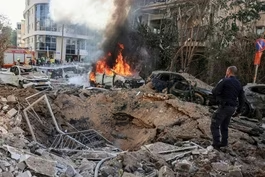
NewCivilians find no refuge from strikes as Mideast war widens
Video has Closed Captions
Civilians find no refuge from strikes as Middle East war widens (8m 57s)
 New
NewJakarta sinks as climate change and overdevelopment collide
Video has Closed Captions
Jakarta rapidly sinks as climate change and overdevelopment collide (7m 3s)
 New
NewNews Wrap: Mullin sworn in as Homeland Security secretary
Video has Closed Captions
News Wrap: Mullin sworn in as Homeland Security secretary (6m 5s)
 New
NewPentagon faces another legal challenge over new media rules
Video has Closed Captions
Pentagon faces another legal challenge over new media rules (7m 45s)
 New
NewTrump’s plans for D.C. draw backlash and court challenges
Video has Closed Captions
Trump’s vision for D.C. draws design backlash and court challenges (8m 58s)
Providing Support for PBS.org
Learn Moreabout PBS online sponsorship
- News and Public Affairs

FRONTLINE is investigative journalism that questions, explains and changes our world.

- News and Public Affairs

Amanpour and Company features conversations with leaders and decision makers.
One Question with Becky Ferguson











Support for PBS provided by:
Major corporate funding for the PBS News Hour is provided by BDO, BNSF, Consumer Cellular, American Cruise Lines, and Raymond James. Funding for the PBS NewsHour Weekend is provided by...