
Geoffrey Baer Explores Chicago's Rail System in New WTTW Special
Clip: 4/13/2026 | 8m 12sVideo has Closed Captions
The Windy City is also known as the rail capital of America.
Our very own train enthusiast Geoffrey Baer takes us through the evolution of rail travel and how it got Chicago's landscape and culture on track.
Problems playing video? | Closed Captioning Feedback
Problems playing video? | Closed Captioning Feedback
Chicago Tonight is a local public television program presented by WTTW
WTTW video streaming support provided by members and sponsors.
Geoffrey Baer Explores Chicago's Rail System in New WTTW Special
Clip: 4/13/2026 | 8m 12sVideo has Closed Captions
Our very own train enthusiast Geoffrey Baer takes us through the evolution of rail travel and how it got Chicago's landscape and culture on track.
Problems playing video? | Closed Captioning Feedback
How to Watch Chicago Tonight
Chicago Tonight is available to stream on pbs.org and the free PBS App, available on iPhone, Apple TV, Android TV, Android smartphones, Amazon Fire TV, Amazon Fire Tablet, Roku, Samsung Smart TV, and Vizio.

WTTW News Explains
In this Emmy Award-winning series, WTTW News tackles your questions — big and small — about life in the Chicago area. Our video animations guide you through local government, city history, public utilities and everything in between.Providing Support for PBS.org
Learn Moreabout PBS online sponsorship>> All roads lead to Chicago or all rails lead to Chicago.
I should say the Windy City is also known as the rail capital of America and its on full display in a new W t Tw special called Right Rails.
Our very own training busiest Jeffrey Bear takes us through the evolution of rail travel and how it got Chicago's landscape and culture on track.
Here's a sneak peek.
>> It's just no denying the magical appeal of trains when the Stones J the sheer power.
The thrill of the journey.
And there's no place that captures that magic more than America's railroad capital.
Chicago.
>> joining us now is our favor conductor, Jeffrey Bear.
Welcome back more acute food, OK?
So as mentioned, you're a train.
Enthusiast yourself.
Yes, I and throughout the documentary, you know, we see other rail fans.
I didn't know that they had a Yeah.
Bind over your shared interest.
What do you think it is about trains that peaks people's interest so much?
I ask everyone I interviewed in this show.
Why do we love train so much?
And they all said the same thing.
I don't It's like they're just so big and powerful.
All and cool.
yes, the others like some kind of magical appeal and I can't really put my We heard someone say there's, you know, there's something a little bit calming about it.
And there is right.
Just kind of the, you know, the sound of them, you know, marching down the track home.
Yeah, that's a rhythmic feeling.
This sort of rocking you a little bit like a baby as you go along there.
Exactly.
How did Chicago become the epicenter of the nation's realty?
Well, that word a location, location, location.
Actually.
My father-in-law in St.
Louis used to say that St.
Louis blew because they they declined to take the railroads back.
Unlike many teen, hundreds and Chicago was like, bring it on So and of course, they had a little Mississippi River that they had to get across, which was, you know, not easy to it.
It's a you know, >> it really has to do with our location at You know, the tip of Lake Michigan and then you read across the the right across the state.
You've got the Mississippi River and that waterway.
And you've got, you know, you get here from the east.
So we were already this sort of very much a transportation center by water even before the railroads.
And so I think it's kind of also just natural for the railroads to jump on board or the city's iconic trains stations show up in popular media quite a bit.
As mentioned in the special.
Here's a little bit of that.
>> The terminals might be gone, but they live on in the movies from high roller high jinx.
It worth that much to Yeah.
2 life-threatening mistaken identity.
>> 2 baby saving G men.
And including up Union station after this scene.
Fortunately, it was filmed on a sound stage.
>> Makes me want to watch a few we you know, we saw some some stations that are no longer standing what happened to all of the stations in the rails that are now defunct, right?
There were 6 great rail terminals in Chicago.
We in the program more than any other city in the country.
Partly this is because you could not go from the West Coast to the East Coast without stopping in Chicago, getting off the train and going to another station and be like today if you wanted to go from California, New York and have to fly into midway, go to O'Hare and then fly on to New York, which nobody wants know and and, you know, the taxi services made a lot of money with all transferring people from one station to another in Chicago.
you know, over time we with the crosscountry rail travel was a clip, spike cars and airplanes.
And so there were fewer and fewer trains coming in am track consolidate everything into union station so that that's the one historic station that's still there.
I mean, the that street station still there with the building was torn down.
Metro still use it.
South Shore line.
Metra Electric still uses that the railroad along the along the lakefront.
We Ogilvy for the the old Chicago, Northwestern Pacific.
But the only historic railroad station still there is Union Station Union station, OK special.
It also digs into how reels shape Chicago's identity.
For instance, of course.
>> Many black Chicagoans owner way via train during the first wave of the great migration to Chicago.
How to trains become sort of a symbol of liberation for African-American.
You know, we wonderful.
She's a poet and and a professor reviewing never heard over and And she take her over to 11th Street, which is Illinois Central Station was.
>> this is where.
You know, thousands of African Americans from the south came off the train with hope in their hearts.
You know, as we've said, its cause, it's kind like a sacred space.
And even so articulate about the way that this transformed Chicago, this influx.
We also talk about the Pullman porters.
We go out to the Illinois Railway Museum, drive a steam engine in the end of the show we talk with their it is the porters.
And you know, well, you have this luxurious train.
We also show where the Pullman porters corridors were essentially servant's quarters in the train.
thing, the size of a phone booth with the toilet because they couldn't use the toilet that the customers were using.
Passengers.
And, you know, we talk about the whole life of the Pullman porters as well in this show, right?
Our transit system.
It looks a lot different from the days of the Pullman porters, though, why did we moved away from that traditional mode of travel to you know what we see today else?
Buses, cars, of course.
>> cars >> really, you know, interstate highway system basically.
Was kind of a boondoggle put the real literally put the railroad passenger railroads out of business and air travel.
Now, in fact, you know, when I was a student in Europe, I spent a year abroad.
We rode trains everywhere, even in Europe.
Now, you know, kids are or who are doing.
There's there there's year abroad are flying not taking the trains as much but Amtrak, the actually this year apparently is having the best the biggest year they've they've had in a long, long time.
So people are coming back to the railroads, especially gasoline prices the way they are now.
And obviously, we're just looking at the L there.
We have one of the biggest transit systems in the country.
you know, we we're still, you know, people are still you know, a lot of challenges right now with the L specially since COVID.
you know, the L system is still there, still they're struggling.
Still depend on a quite a bit, OK?
So we don't have time to show the clip.
Folks are gonna have to Very jealous of the fact that you got to drive a steam locomotive.
>> How fun was that?
Oh, it was just like a bucket list thing, you know, and I have to say how these train crews survived like with how they lived past the age like 30, I don't know because the fumes and the heat in that cab were unbelievable.
I mean, our actually our cameraman, Tim Boyd got heatstroke.
Oh, deer in the cab.
I hope that ha 2010 is okay.
Great website to for the show.
Everyone just use the Web.
Sorry.
Well, I'm gonna talk about it right now.
Jeffrey Bear, Congrats again.
Another show.
Thank you so much for joining Salute course.
And you can watch riding the rails with Jeffrey Bear tonight at 7 right here on W T Tw.
>> You can also watch it online at W T Tw Dot com slash rails.
There you can find more
 New
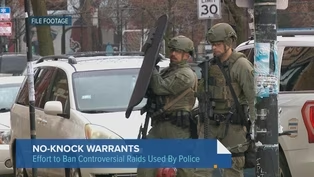
NewBill Would Ban No-Knock Warrants Across Illinois
Video has Closed Captions
The bill would ban no-knock warrants in all but “exigent circumstances.” (11m 42s)
Providing Support for PBS.org
Learn Moreabout PBS online sponsorship
- News and Public Affairs

Top journalists deliver compelling original analysis of the hour's headlines.

- News and Public Affairs

FRONTLINE is investigative journalism that questions, explains and changes our world.
One Question with Becky Ferguson











Support for PBS provided by:
Chicago Tonight is a local public television program presented by WTTW
WTTW video streaming support provided by members and sponsors.