
March 31, 2026
Season 4 Episode 354 | 26m 30sVideo has Closed Captions
The 2026 Kentucky General Assembly is up against a hard deadline.
State lawmakers advance a bill that attempts to cut costs and implement federal changes to Medicaid, a sweeping elections bill moves forward, an overhaul of Kentucky's child care center regulations passes the Senate, London Mayor Randall Weddle is indicted, and a judge says the impeachment of a Lexington judge is null and void.
Problems playing video? | Closed Captioning Feedback
Problems playing video? | Closed Captioning Feedback
Kentucky Edition is a local public television program presented by KET
March 31, 2026
Season 4 Episode 354 | 26m 30sVideo has Closed Captions
State lawmakers advance a bill that attempts to cut costs and implement federal changes to Medicaid, a sweeping elections bill moves forward, an overhaul of Kentucky's child care center regulations passes the Senate, London Mayor Randall Weddle is indicted, and a judge says the impeachment of a Lexington judge is null and void.
Problems playing video? | Closed Captioning Feedback
How to Watch Kentucky Edition
Kentucky Edition is available to stream on pbs.org and the free PBS App, available on iPhone, Apple TV, Android TV, Android smartphones, Amazon Fire TV, Amazon Fire Tablet, Roku, Samsung Smart TV, and Vizio.
Providing Support for PBS.org
Learn Moreabout PBS online sponsorshipmusic >> I think we have taken huge steps forward with this bill.
>> It's down to the wire this legislative session and reining in Kentucky's Medicaid costs is still being debated.
[MUSIC] Big news in a judge's impeachment case, another judge's decision about the House vote against Judge Julie Goodman.
[MUSIC] >> It's not a chain.
It's not generic.
You're not going to find what we have here anywhere else on the planet.
[MUSIC] >> Plus, a northern Kentucky city is bringing in the business.
We'll hear their secrets to success.
>> Production of Kentucky edition is made possible in part by the KET Millennium Fund.
[MUSIC] >> Good evening and welcome to Kentucky edition for this Tuesday, March the 31st.
I'm Renee Shaw coming to you from the KET Studios in the Frankfort Capitol Annex.
I'm so glad you're with us this evening.
The 2026 Lawmaking session of the Kentucky General Assembly is nearing its end.
This is day 56 of the 60 day session, and lawmakers are putting in some extra hours to pass a number of bills ahead of the ten day veto period that begins Thursday.
One of those bills, House Bill two, is Kentucky's attempt to cut costs and implement federal changes to Medicaid.
As our June Leffler reports, the Senate's version of an omnibus Medicaid bill has won over more health advocates and even Democrats than what was proposed in the House.
That begins tonight's legislative update.
[MUSIC] >> A Senate committee reduced the co-pays that the House proposed for Medicaid expansion recipients.
>> $5 for all health care services and $1 for prescription drugs.
>> Just $1.
A Northern Kentucky Republican asks.
>> Maybe a dollar in 1958 would have had meaning.
But why even a dollar?
Why not just let them?
What's a dollar mean now?
Nowadays.
>> You know, we're trying to change behavior.
So rather than go into the emergency room for your primary care, we want to try to have you find your primary care home outside of the emergency room.
So what we felt was more appropriate is to have all of those behavioral changes happen, but with a lower fee.
>> Reduced co-pays will lower the burden on patients and the medical providers who collect those payments.
This rural Republican says.
>> We learn very quickly that co-pays the same as no pay.
And even looking at, say, $20 co-pay, it's not just $20.
There's got to be an A collection expense involved with that administrative expense.
And you're really talking to the provider more like 40 or $50.
>> The Senate moderated House Bill two in other ways, extending the timeline for changes and easing some eligibility and paperwork requirements for patients.
House Republicans earlier took a more aggressive approach, going above and beyond in many ways, what Congress voted for last year.
>> Gallatin effort to try to just what needed to be addressed, but not go beyond any further than that.
>> I think we have taken huge steps forward with this bill.
>> Health advocates and Democrats still raise one concern frequent checks on a person's eligibility based on potentially inaccurate or out-of-date data.
This would apply to all Medicaid recipients, not just the expansion population.
>> Any data that can be verified without asking a household to do more paperwork is always the right approach, but the balance to that approach is to make sure that we're not letting one conflicting data source determine a person to be ineligible for Medicaid.
>> Apparently, when I'm being told it's 12, different databases don't align up automatically, and I'm worried about how many people are just going to get lost through no fault of anybody's other than the system.
>> The Senate Health Services Committee approved House Bill two unanimously.
It now heads to the Senate floor.
If passed, it would need concurrence in the House for Kentucky additions.
I'm June Leffler.
>> Thank you.
June.
The latest version of the state's two year budget plan includes $290 million in a special Medicaid fund that's being referred to as a lockbox.
We talked about how this lockbox would work on last night's Kentucky tonight, right here on KET.
>> There is no area of the state government where the costs are increasing nearly as quickly as they are in the Medicaid space, and we really need to bring some cost control into that space.
And so what we did is we put that $290 million there for the administration to be able to return to us and, you know, hopefully work on some cost containment measures.
But if they aren't able to fully contain them there, there is some available funds for them to come to us and to at the beginning of the 2027 session.
So just keep in mind, you know, right now there will only be six months into the fiscal year.
Ideally, they're able to find some savings.
And that really should be the challenge that this administration takes up is how do we make Medicaid a more affordable program in the Commonwealth.
And so there will be this fund there for them to come back to the General Assembly.
If they're not able to figure out how to to execute some savings and ask to get into it.
>> I think the lockbox is an interesting concept, and I'm glad to know that there are earmarked funds available.
Should we run into budget issues with Medicaid?
I don't think it's really a question, though, if we're going to run into those budget issues, the question is not so much if, but when.
And I hope, just as Senator McDaniels has said, that we'll be able to contain the cost of the Medicaid program.
But unfortunately, not to sound too radical here, as long as we have multiple Mcos and we are not moving toward a single payer system, the costs are just going to continue to increase.
The federal government's not doing us any favors either.
The cuts from the federal level through HR one are going to be felt in Kentucky.
And so I think we need to be really ready with that lockbox and have very clear standards by which it can be opened.
>> You can check out last night's full one hour discussion about where Kentucky State budget stands at this point, and what's in it.
That conversation is available online on demand at ket.org.
Johnny Nash KY.
Tonight, the list of alternate IDs that you can bring to the polls may be getting shorter, thanks to a sweeping elections bill that's almost to the finish line, and some lawmakers look to streamline the death penalty in Kentucky.
Our Mackenzie Spink continues our legislative update.
[MUSIC] >> House Bill 139 came back to its Chamber of Origin today, but with some changes from the Senate addressing voter identification.
Under current law, if you don't have a state ID to verify your identity at the polls, you can use your Social Security card or a public benefits card like EBT or Snap.
If House Bill 139 becomes law, that could change.
>> Yes, Mr.
Speaker, there were certain documents stricken from use, and that's EBT cards and Social Security cards.
The bill requires photo ID.
>> The bill also increases the limit for campaign contributions to the federal limit of $3,500.
One Lexington Democrat argues this measure encourages a pay to play system.
>> I personally believe that less money in politics would be good.
I don't think that a pay to play system that benefits wealthy people and corporations is what's good for Kentucky, and I believe that when we raise the campaign contribution limit, that's exactly what we're doing.
>> Senate Bill 251 heard opposition from both sides of the aisle today.
Currently, execution protocols for prisoners on death row are established through an administrative regulation process that supporters say unnecessarily prolongs justice from being served.
>> Justice delayed is justice denied.
And right now in Kentucky, justice is being delayed again and again, while families of murdered loved ones are left waiting, often for decades.
>> Several lawmakers were against speeding up the execution process and cited the recent impact of modern DNA testing in exonerating potentially innocent inmates.
>> Hundreds, if not thousands, of death row inmates have been exonerated by the new technology of DNA, where they have spent years and decades in prison, often on death row, for crimes they did not commit.
>> Several Republicans, including the head of the pro-life caucus for the House, spoke out against the bill, saying it doesn't align with pro-life values.
>> You know, we've had the opportunity to continue to be the most pro-life state, one of the most pro-life states in the Commonwealth, in the nation, one of the most pro-life states in the nation.
And yet here we are doing a pro-death bill.
And this pains me tremendously.
>> Representative Jason Nemes says that even though he is pro-life, his position as a legislator requires him to vote in favor of the bill.
>> I am pro-life, like many of you, I am adamantly opposed to the death penalty.
One day I hope I get to vote against it.
But all this does is follow the law that exists and allow the death penalty to be enforced.
And so while I don't like that, I am not the law.
>> Both House Bill 139 and Senate Bill 251 passed on the House floor, but only House Bill 139 will head to the governor's desk next.
Representative James Tipton successfully added a House floor amendment to Senate Bill 251, and so the Senate will have to agree to that before it's finally approved for Kentucky edition.
I'm Mackenzie Spink.
>> Thank you so much, Mackenzie.
Representative Tipton's floor amendment requires that all execution protocol policies be posted online for the public to see.
The Senate advanced House Bill 422 today.
That's also known as Logan's Law.
This legislation is named in honor of six year old Logan Tipton, who was stabbed to death in his family's Versailles home back in 2015.
Logan's killer, Ronald Exantus, was found not guilty by reason of insanity for the murder, but he was found guilty of attacking other members of the Tipton family.
M.santos was released under mandatory reentry supervision late last year after serving less than half of his sentence.
A Senate change to the bill also honors 23 year old Jordan Wells, who was fatally shot while walking in Louisville back in 2024.
Currently, House Bill 422 would prevent juries from splitting a not guilty by reason of insanity verdict for crimes that occurred at the same time, the legislation also mandates longer mandatory prison time for violent offenders and clarifies that certain felony offenders would not be eligible for early release under mandatory reentry supervision.
Senator Amanda Mays Bledsoe, who represents Woodford County, spoke on the bill today.
>> I would urge this body to consider the victims who deserve certainty that the gravest offenders will remain behind bars for an appropriate minimum period.
Consider the communities that deserve thoughtful, risk based reentry that reduces recidivism, and consider the integrity of our statutes.
So they work as lawmakers intended and most importantly, to consider Logan, the Wells family and families who deserve a system that gets this right.
>> Logan's law passed the Kentucky Senate today, unanimously.
It now goes back to the House for them to approve or reject an overhaul of Kentucky's child care center regulations passed the Senate today.
House Bill six came from a working group comprised of childcare stakeholders put together by the Kentucky Chamber of Commerce.
>> House Bill six isn't going to be enough for some, and it's going to be too much for others.
But House Bill six lays the foundation for building a stronger and more sustainable private childcare network, which includes 2000 small businesses, nonprofits and faith based organizations throughout our state, serving more than 100,000 young children.
Young children.
>> The child care measure is only getting bigger.
The Senate attached a kindergarten readiness provision that would give $2,000 to parents and child care centers, who equip their children with all the skills they need to start school, ready to learn.
That money is only available for selected pilot program participants.
That program would last four years and cost $1 million.
As the session comes to a hurried end, state lawmakers finalized a few other key measures earlier this afternoon.
Our Toby Gibbs has a rundown of some other high interest measures that's making their way to the governor's desk.
[MUSIC] >> It's been identified as the first step in child abuse, grooming, the practice of building a relationship with a child to gain their trust in order to sexually abuse or exploit them.
House Bill four defines it and sets criminal penalties.
Recent headlines have detailed such behavior by school personnel with student athletes.
The measure won unanimous approval in the House and now heads to the governor's desk.
Another child protective measure is on the same course.
This one seeks to keep kids safe as they get on and off the school bus.
House Bill seven lets school districts install cameras on school busses to capture motorists who cruise past busses with stop arms.
Extended drivers could face fines for that.
The bill's sponsor has said that such instances happen about 1300 times in a single day, putting kids in danger.
A bill to shield firearms makers and sellers from civil liability when guns are used in criminal activity is headed to the governor's desk.
House Bill 78 strengthens existing state and federal liability protections.
The measure carves out immunity exceptions for sellers who knowingly sell a firearm to someone they knew posed a danger and committed a crime.
Firearms manufacturers could still be sued when a defective gun caused injury when it was being used lawfully.
For Kentucky edition.
I'm Toby Gibbs.
>> The Senate overrode another one of Governor Andy Beshear vetoes today.
This measure was Senate Bill 199.
That's related to pesticides.
The bill would limit Kentuckians from suing pesticide companies for injury or cancer risk, unless the Environmental Protection Agency determines the manufacturer withheld information on the warning label.
Some Republicans sided with Democrats in opposing the measure when it first passed.
Today on the Senate floor, the body voted 23 to 12 to override the governor's veto.
A lot more still to come, and we're going to be here tomorrow to sort out all the happenings here in your state Capitol, and we'll be back in our Frankfort studio tomorrow evening to give you the very latest in the final days of the 2026 Kentucky General Assembly in regular session.
[MUSIC] In other news, a Laurel County grand jury has indicted London Mayor Randall Weddle.
The attorney general's office says Weddle was indicted on four counts of excessive campaign contributions.
The contributions were made to Governor Andy Beshear campaign and to the Kentucky Democratic Party.
All four counts are class D felonies.
Attorney General Russell Coleman discussed the indictment late this afternoon.
>> December of 2022.
Mr.
Well made more than 20 unlawful campaign donations to the Andy Beshear for governor campaign in the Kentucky Democratic Party.
Mr.
well used his personal credit card to make these excessive contributions and reported other individuals as the donors.
I'm certainly not here because Mr.
Weddle made contributions to a candidate of a different party.
For me.
I'm standing here today announcing this indictment for the people of London.
>> Kentucky Mayor Waddle's arraignment is scheduled for April the 15th.
Today, a Franklin Circuit Court judge ruled the impeachment of a Fayette County judge is null and void.
The Kentucky House overwhelmingly voted to impeach Fayette Circuit Court Judge Julie Goodman for abuse of office and misconduct earlier this month.
The impeachment petition was filed by a former state representative who's seeking reelection.
In his ruling, Judge Philip Sheppard said, quote, the impeachment petition filed by a Partizan political candidate seeking election to the Kentucky House of Representatives makes no allegation of criminal conduct, violation of any civil or penal statute or regulation, and it does not set forth any statutory or regulatory violation allegedly committed by Judge Goodman.
Judge Sheppard also noted that complaints against Judge Goodman were not referred to the Judicial Conduct Commission, which has the power to remove judges from the bench.
Judge Goodman has asked the Kentucky Supreme Court to intervene, alleging the legislature is violating the state constitution.
Today's ruling does not change that appeal.
The state Senate is also tasked with holding a trial to determine whether to convict Judge Goodman.
It's unclear when that trial could begin.
Now, turning to the United States Supreme Court, the highest court in the land, and an 8 to 1 ruling, the High court ruled against a law banning conversion therapy for LGBTQ plus kids in Colorado.
The majority sided with a Christian counselor who argued the law banning talk therapy violates the First Amendment.
Justice Neil Gorsuch, writing for the court, said the law, quote, censors speech based on viewpoint.
In a solo dissent, Justice Ketanji Brown Jackson wrote that states should be free to regulate health care, even if that means incidental restrictions on speech.
Colorado is one of about two dozen states that have banned conversion therapy.
Last year, state lawmakers in Kentucky passed a bill overturning Governor Andy Beshear s 2024 executive order banning conversion therapy for kids.
David Walls is executive director of the Family Foundation in Kentucky, a Christian public policy organization.
Reacting to today's ruling, he said, quote, Like Colorado's law, the governor's executive order allowed pro LGBTQ plus counseling while attempting to restrict counseling from a biblical perspective on marriage and sexuality.
On the other side of the debate is Rebecca Blankenship, a former executive director of Ban Conversion Therapy, Kentucky.
She called on the state legislature to, quote, make clear that whether you are gay or straight, you deserve protections against psychiatric abuse.
End quote, the National Democratic Democratic Party hopes to win new converts in Kentucky, and a coal company declares bankruptcy.
Our Toby Gibbs has the details in tonight's look at headlines around Kentucky.
>> The National Democratic Party is launching a voter drive in Kentucky.
According to the Kentucky Lantern, events in Kentucky include voter registration blitzes at the University of Kentucky and Morehead State University.
The plan encourages organizers to connect on a personal level with their neighbors to persuade them to become Democrats, National party Chair Ken Martin is quoted as saying, when you organize everywhere, you can win anywhere.
[MUSIC] A Pike County based coal company has filed for bankruptcy.
It's Clintwood j o d, based in Belcher, the News Express reports.
The company filed for chapter 11 protections on March 23rd.
The company has mines in the Phelps, Kemper Stopover and Fed's Creek areas.
County Judge Executive Ray Jones says he understands the company has furloughed its workers.
[MUSIC] W EKU radio reports that Warren and Madison counties were Kentucky's fastest growing counties from 2020 to 2025, according to census estimates.
Warren County's population went up by 11%, about 15,000 people, while Madison's increased by almost 10% or 9000.
[MUSIC] Madison County now has more than 100,000 people.
For the first time, some of Eastern Kentucky's coal counties, including Pike, Harlan and Perry, saw the biggest drops in population.
[MUSIC] Six more families now have habitat for humanity homes in the Durban Estates development in Bowling Green, according to the Daily News.
This is the last phase of a 50 home habitat development.
The six homes cost $1.2 million, with 400,000 from federal Disaster recovery block grants and the other 800,000 from other grants, donations and money from the habitat for Humanity Restore grant funding is contributing to an effort to fund 730 affordable homes throughout Bowling Green after destruction caused by the 2021 tornado.
[MUSIC] With headlines around Kentucky.
I'm Toby Gibbs.
[MUSIC] >> Thank you so much Toby Gibbs.
As we told you yesterday, the City of Covington hit a major economic milestone last year, earning more than $1 billion in payroll income.
Our Emily Sisk caught up with city leaders to learn how Covington is attracting new businesses and what's next to keep the growth going.
>> 2025 was $1 billion year for the city of Covington, as the River city broke a record for the most annual payroll income, which came in at $1.16 billion.
Mayor Ron Washington said Covington had this success because of its ability to attract businesses large and small.
>> When people come here, they say, mayor, I love going to small business.
I love shopping locally, I love shopping at my neighbor's store.
And, you know, our neighbors are our business owners.
They're living here.
They're sending their children to school here.
They're part of the fabric of Covington.
>> In the city is working to support small business growth through incentives like rent subsidies.
The city will provide up to $500 of rent relief during a small business first year.
>> If we can give them that little bit of a break for that first year, we've seen the in the numbers bear it out.
They tend to be a lot more successful and a lot longer term.
>> And according to Covington's 2025 impact report, that support is making a difference when it comes to the survival rate of small businesses.
>> The failure rate for a a business in the first year nationally is about 10% higher than it is in Covington.
>> The city is also focusing on retaining its historic businesses.
West said.
It's no surprise to come across many stores in Covington that have been operating for more than a century.
>> We say we embrace our grit and our glam, and those older businesses tend to give us that grit and that determination and kind of that reliability.
And it's all part of our identity now.
>> Mayor Washington also mentioned larger businesses making their home in Covington.
He referenced companies like Marfo FM, a French based operation that makes airline food, which decided to invest its first American plant in the River city.
>> They looked at the whole United States and they said, where do we want to put our plant?
Where do we want to put our factory?
And they picked right here, city of Covington.
>> And things aren't slowing down.
With construction underway on the new Covington Central riverfront, a 23 acre multi-use site.
>> They're single family housing there.
There's a it's a multi-use facility.
We're planning a hotel in that location parking garage, condos, townhomes.
It's coming to central riverfront.
>> West said.
Part of Covington's mission is to stay authentic, which means staying away from chain stores and restaurants.
He believes this helped the city earn national accolades last year, like being a top Small U.S.
city for food and drink.
>> We embrace that quirkiness and it's it makes us authentic and I think people appreciate today that authenticity.
It's not a chain.
It's not generic.
You're not going to find what we have here anywhere else on the planet.
>> Tom West said he wants Covington to continue with this trajectory of growth, but maintain its history and local culture in Covington for Kentucky edition.
I'm Emily Sisk.
>> Thank you so much, Emily.
According to Covington's 2025 impact report, the city brought in nearly 700 new jobs just last year.
Well, that'll do it for us for Kentucky edition tonight.
We hope to see you right back here again tomorrow night at 630 eastern, 530 central, where we inform, connect and inspire.
So much more news coming to you from Frankfort, which is where I'll be tomorrow night.
We hope you'll subscribe to our edition newsletter, newsletters, and all the ways you can keep in touch with what's happening with KET.
Thank you for so much for watching.
I'm Renee Shaw, reporting from our Frankfurt bureau here in the State Capitol Annex.
And I will see you again tomorrow night.
Take good care.
[MUSIC]
 New
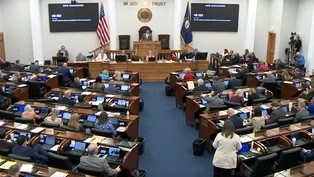
NewBill Criminalizing 'Grooming' Heads to Governor's Desk
Video has Closed Captions
Clip: S4 Ep354 | 2m 30s | Lawmakers pass bill that sets criminal penalties for child "grooming." (2m 30s)
 New
NewCity of Covington Hits Economic Milestone
Video has Closed Captions
Clip: S4 Ep354 | 3m 33s | Covington's mayor talks about the keys to the city's economic success. (3m 33s)
 New
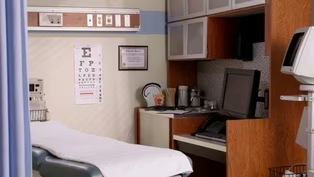
NewLawmakers Debate Reining in Kentucky's Medicaid Costs
Video has Closed Captions
Clip: S4 Ep354 | 5m 39s | Lawmakers debate how to cut costs and implement federal changes to Medicaid in Kentucky. (5m 39s)
 New
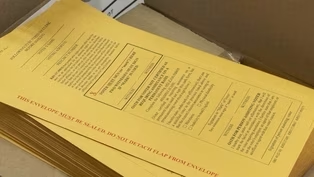
NewSweeping Elections Bill Moves Forward
Video has Closed Captions
Clip: S4 Ep354 | 3m 39s | Omnibus bill looks to cut down on number of alternate IDs for voters. (3m 39s)
Providing Support for PBS.org
Learn Moreabout PBS online sponsorship
- News and Public Affairs

Top journalists deliver compelling original analysis of the hour's headlines.

- News and Public Affairs

FRONTLINE is investigative journalism that questions, explains and changes our world.
One Question with Becky Ferguson











Support for PBS provided by:
Kentucky Edition is a local public television program presented by KET