
March 26, 2026 - PBS News Hour full episode
3/26/2026 | 57m 46sVideo has Closed Captions
March 26, 2026 - PBS News Hour full episode
Thursday on the News Hour, negotiations to end the war with Iran falter and more U.S. troops are preparing to deploy to the Middle East. With social media under scrutiny, Germany considers following Australia's lead and banning the platforms for most children. Plus, more states are legalizing the controversial practice of medical assistance for dying.
Problems playing video? | Closed Captioning Feedback
Problems playing video? | Closed Captioning Feedback
Major corporate funding for the PBS News Hour is provided by BDO, BNSF, Consumer Cellular, American Cruise Lines, and Raymond James. Funding for the PBS NewsHour Weekend is provided by...
Support provided by:

March 26, 2026 - PBS News Hour full episode
3/26/2026 | 57m 46sVideo has Closed Captions
Thursday on the News Hour, negotiations to end the war with Iran falter and more U.S. troops are preparing to deploy to the Middle East. With social media under scrutiny, Germany considers following Australia's lead and banning the platforms for most children. Plus, more states are legalizing the controversial practice of medical assistance for dying.
Problems playing video? | Closed Captioning Feedback
How to Watch PBS News Hour
PBS News Hour is available to stream on pbs.org and the free PBS App, available on iPhone, Apple TV, Android TV, Android smartphones, Amazon Fire TV, Amazon Fire Tablet, Roku, Samsung Smart TV, and Vizio.
Providing Support for PBS.org
Learn Moreabout PBS online sponsorshipJOHN YANG: Good evening.
I'm John Yang.# Geoff Bennett and Amna Nawaz are away.
On the "News Hour" tonight: Negotiations to end# the war with Iran falter and more U.S.
troops## are preparing to deploy to the Middle East.# A look at the United States' latest strategy.
With social media under scrutiny,## Germany considers following Australia's lead# and banning the platforms for most children.
And more states legalize a controversial# practice, medical assistance for dying.
DEL DELASHMUTT, Portland, Oregon,# Resident: I want to go as me,## the guy that can smile and laugh and joke a# little bit, rather than be a pile of pain.
(BREAK) JOHN YANG: Welcome to the "News Hour."
Late today, President Trump said on# social media that he's extending his## ban on bombing Iran's power plants by# 10 days until April 6.
Early this week,## he said tomorrow was the deadline for Iran to# open the Strait of Hormuz or face a resumption## of attacks on energy infrastructure, which# is illegal under the Geneva Convention.
Today's extension came after an# hours-long Cabinet meeting that## included an update on what U.S.
officials# say are ongoing negotiations with Iran.
Lisa Desjardins has our report.
LISA DESJARDINS: Today in the Middle East, still# more civilians paying the price of war.
Emergency## workers rushed to help an elderly woman in the# Arab-Israeli town of Kfar Qasim.
She had just## been spared from an Iranian missile fragment, its# impact in printing a crater and flipping cars.
That strike, part of the Tehran regime's# ballistic attack on Central Israel today,## engulfed cars in the town of Ganei Tikva in# flames.
Rescue workers putting out the fire## revealed charred husks of vehicles.# Iranian missiles also obliterated a## home nearby in Tel Aviv, a fragment# landing in a family's living room.
Israeli rescue services reported one death and 25# injuries from Iranian and Hezbollah attacks today,## as Israel last night killed the head# of Iran's navy, Alireza Tangsiri,## along with other senior naval commanders.
Israeli Defense Minister Israel Katz: ISRAEL KATZ, Israeli Defense Minister# (through translator): Last night, in a## precise and lethal operation, the IDF thwa.. Alireza Tangsiri, along with senior naval# command officials,the man who was directly## responsible for the terrorist operation of# mining and blocking the Strait of Hormuz,## and navigation was blown up and neutralized.
LISA DESJARDINS: This as the Strait# of Hormuz remains in Iran's grip,## causing hundreds of billions in# economic blowback and preventing## a fifth of the world's seaborne oil# and natural gas supply from transport.
The U.S.
today continued its bombing,# releasing video of strikes targeting## Iranian military capabilities.# At the White House, a rarity,## a public briefing by special envoy Steve Witkoff# during a Cabinet meeting with President Trump.
He said Iranian officials rejected key# demands, including about its nuclear stockpile.
STEVE WITKOFF, U.S.
Special Envoy to the Middle# East: Throughout our meetings with the Iranians,## we heard the following from them.
The Iranians# have the inalienable right to enrich.
Then we## heard they possessed enough 60 percent enriched# material, 460 kilograms, to make 11 atomic bombs.
LISA DESJARDINS: Even so, Witkoff# conveyed a belief that Iran may## be at a pivot point for a deal with Trump.
STEVE WITKOFF: Your indications that you# are willing to listen to peace proposals## have been well received.
We have delivered# that message, sir, along with the 15 points## for peace.
Finally, we have told Iran# one last day.
Don't miscalculate again.
LISA DESJARDINS: Trump told the room# that Iranians made a goodwill gesture.
DONALD TRUMP, President of the United States:# They said, to show you the fact that we're## real and solid, and we're there, we're# going to let you have eight boats of oil.,## eight big boats of oil.
This was two# days ago.
And they'll sail up tomorrow.
LISA DESJARDINS: And he conveyed# his sense of the state of play.
DONALD TRUMP: And they will tell you, we're not# negotiating.
We will not negotiate.
Of course,## they're negotiating.
They have# been obliterated.
Who wouldn't## negotiate?
They are begging to make a deal.# We will see if we can make the right deal.
LISA DESJARDINS: But, yesterday, Iran's foreign# minister publicly denied any direct negotiations.
ABBAS ARAGHCHI, Iranian Foreign Minister# (through translator): Over the past few days,## our American counterparts have begun# sending messages t.. other countries that are our friends.# If there are messages through others to## which we respond with our own position and# demands, that is not called conversation,## nor negotiation, or anything.
This is# simply sending messages through others.
LISA DESJARDINS: Pakistan has emerged# as a key mediator in this conflict.
TAHIR ANDRABI, Spokesperson, Pakistani# Ministry of Foreign Affairs: Pakistan has,## ladies and gentlemen, actively engaged with the# regional actors to de-escalate.. seize hostilities, and move# towards a peaceful settlement.
LISA DESJARDINS: But, for now, the# war, its issues and its grief continue.
For the "PBS News Hour," I'm Lisa Desjardins.
JOHN YANG: Now for the view from Tehran,## as airstrikes continue and the U.S.
claims# to be negotiating with the Islamic Re.. For that, we turn again to# special correspondent Reza Sayah.
Reza, what's the atmosphere# like in Tehran right now?
REZA SAYAH: John, more airstrikes# on this 27th day of this war,## starting at around 8:00 p.m.# local time here in the capital.
We heard the unnerving roar of jet# fighters above the skies in Tehran,## followed by several earth-shaking explosions.# State media reporting the airstrikes targeted## at least four locations in Tehran, including# some near Mehrabad Airport.
This is the## civilian airport in Tehran that has already been# targeted a couple of times in this conflict.
The Revolutionary Guard continues to# hit back.
State media reporting that,## over the past 24 hours, its forces,# Hezbollah forces, and Iraqi militia## groups launched 230 operations targeting U.S.# interests and Israeli positions in the region.
At this hour, things are quiet in Tehran,# with the exception of numerous major squares,## where Iranians have gathered every# night to show solidarity and support## for Iranian forces.
Throughout# this conflict, many have been## eager to see if or when anti-government# protesters will show up in the streets.
Four weeks into this conflict,## we have neither seen or heard any reports# of any anti-government protests happening.
JOHN YANG: What's the government there saying# about negotiations with the United States?
REZA SAYAH: Well, there's been so many conflicting# and confusing statements coming from the White## House regarding negotiations, Mr.# Trump saying talks are happening,## the Iranians are begging for an agreement.# This week, he said Iranians gave him a present.
So, sometimes, it's hard for# Iranian officials to make sense## of these statements.
Statements from# the Iranian officials here in Tehran## seem to be more consistent and easy to# figure out.
What Iran's foreign minister,## Abbas Araghchi, confirms is that messages# are being exchanged using intermediaries.
Pakistan is playing a key role.
He says# Tehran has seen Washington's 15-point## proposal.
Tehran has rejected the proposal# and put forth its own proposal, demanding a## guarantee for no more wars, reparations,# and authority over the Strait of Hormuz.
So, both sides are making lofty demands, and# it's not clear how they're going to bridge## their huge gas or if this exchange of messages# is going to continue.
What is clear is that,## as this war drags on, Iran seems# to be getting more confident and## believing that they have absorbed# and survived.
U.S.
and Israeli blows,## and they're at least projecting the# message that they're in the driver's seat.
But, obviously, Washington is# trying to do the same thing.
JOHN YANG: Are there any concerns there# about the possibility of a land invasion?
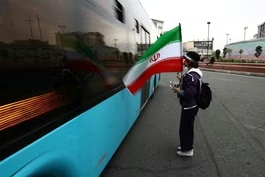
REZA SAYAH: Tehran says it's taking the# threat of a land invasion seriously.
State## media today quoted military officials# in saying that they have long known## that this was a possibility, and# they have been preparing for it.
And here's another sign that suggests Iran's# confidence has grown.
We're seeing bolder,## more daring statements from Tehran.
State media# reported today, if a ground invasion happens,## Iranian forces have a surprise# in store for American troops,## and the surprise won't be more missiles# and drones.
It'll be something else.
JOHN YANG: Special correspondent Reza# Sayah in Tehran, thank you very much.
REZA SAYAH: Thank you.
JOHN YANG: While President Trump talks about# trying to make a deal with Iran to end.. more U.S.
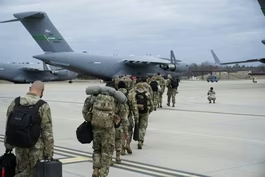
troops are headed to the region.# The 82nd Airborne Division's 1st Combat## Brigade Team has been ordered to deploy, and# the Marine amphibious warship the USS Tripoli## is expected to arrive in the Middle East in# the coming days, along with other assets.
So what new capabilities do these forces# bring, and how might they be used?
For that, we turn to two people# with extensive military experience.## Retired Army Colonel Joel Rayburn served# in the first Trump administration on the## national security staff with a focus on# Iran in the Middle East.
He's now at the## Hudson Institute.
And retired Lieutenant Colonel# Frederic Wehrey focused on the Middle East during## his two decades in the Air Force.
He's now at# the Carnegie Endowment for International Peace.
Jack Rayburn, let me start with you.
What new## capabilities will the United States# forces have with these new troops?
COL.
JOEL RAYBURN (RET.
), Former Trump National# Security Council Staff: Good to be with you.
Well, the troops of the 82nd Airborne# Division that are being deployed,## that's part of the Rapid Deployment Force# that can deploy anywhere in the world with## very short notice.
The 82nd Airborne# Division, the brigades and battalions## of that division are uniquely trained for# forcible entry into contested territory.
So they're the kind of troops that# do rapid insertion into, for example,## strategic infrastructure like an airfield.
If# you think about the war in Grenada back in the## Reagan administration, it was the 82nd Airborne# Division that seized the airfield on Grenada.
And they usually do that in order to pave# the way for, open the way for follow-on,## more robust, heavier forces to come in# after them.
So that's an insertion force.## The Marine forces that are coming,# there are two Marine expeditionary units## that are on their way as part# of amphibious ready groups.
Those are the kind of forces that are trained and# equipped to do amphibious assaults onto islands,## onto ports or to seize vessels.# So, two very similar forces,## move rapidly, be able to be able to# seize key infrastructure quickly.
JOHN YANG: Fred, anything you# don't want to add to that?
LT.
COL.
FREDERIC WEHREY (RET.
), U.S.
Air# Force: I agree.
These are remarkable forces.## They strike deep.
They strike hard.
They're# quick Response Forces.
As was mentioned,## they're designed to seize assets very# quickly so that other forces can flow## into a region as part of a larger assault force.
They're not designed for longer-duration# operations.
And they're also, I should add,## self-contained, especially the Marine# units.
They have their own air support,## their own armor, their own helicopters.# And that makes them able to really go## anywhere in the world and operate autonomously.
JOHN YANG: Jack, how would you# expect these troops to be used?
COL.
JOEL RAYBURN (RET.
): Yes, I think# clearly what's happening here is that## the president and Central Command are moving# these assets into the theater to signal that## they have the option, they have the capability of# seizing islands such as Kharg Island or seizing## potentially the islands that the Iranian regime# uses in order to threaten the Strait of Hormuz.
There are several islands closer to the Strait# of Hormuz from which they traditionally have## done that, or also to provide supporting kind# of seizure operations if there's a military## forcing of the strait.
So it really increases# the president and Central Command's options.
JOHN YANG: Kharg Island, of course,## is where 90 -- about 90 percent of# Iran's oil is .. COL.
JOEL RAYBURN (RET.
): Right.
JOHN YANG: Fred, are these things a# good idea?
Is it a.. LT.
COL.
FREDERIC WEHREY (RET.
): They're,# quite frankly, fraught with risk.
I mean, very -- obviously, these forces could## accomplish their tactical objectives.# They could seize the island.
They could## destroy coastal missile batteries.
They could# seize various sites along the Strait of Hormuz.
But then the question is, what# next?
And, really, the question is,## does that tactical advantage become# a strategic liability?
Because those## forces are now exposed.
We know that Iran# has trained for this sort of scenario.## There's a saying among military planners# that the enemy always gets a vote, right?
And so the Iranians may have multiple# retaliation options against these forces,## against staging areas, against the# supply lines.
The other big risk is## that it will not completely free the Strait# of Hormuz, right?
It will certainly degrade## Iran's ability to disrupt the traffic coming# in, but it won't solve the problem completely.
And then I should also add,# we have seen this before,## where there's an initial# force, and because it doesn't## achieve its strategic objectives, it# may achieve its tactical objectives,## those strategic objectives remain unobtained# or unfulfilled, that requires more forces.
You have to set up a buffer zone to# protect those forces.
And very quickly,## you're in a situation of mission creep.
JOHN YANG: Jack, what do you think of --# make of the fact that these forces were## not in the region when this war# began?
What does that tell you?
COL.
JOEL RAYBURN (RET.
): I think it# means these were an option.
I mean,## look, military planners plan everything to the# nth degree.
I used to be one.
I think Fred did## too.
You planned scenarios in branches# and sequels to all of your base plans.
I just think it just means this was an option# that they maybe hoped not to have to employ,## but also they adapted to the situation.# I think, look, as far as whether it's a## good idea, it's a high-risk tactical# operation, but the payoff is huge.
If there's a U.S.
seizure of Kharg Island,# if there's a U.S.
forcing of the strait,## militarily forcing of the strait, sort of game# over for Tehran at that point.
They're pretty## much -- they're out of strategic military# options.
They have been quite degraded.
We are the enemy that has gotten a# vote in their game plan.
They are## off their game plan.
I don't think their# command-and-control is coherent enough## to be able to adapt.
I think our forces# are inside their OODA loop, if you will.
So, as I say, tactical risk of# that kind of operation is high.## The payoff strategically would also be quite high.
JOHN YANG: And, Joel, I# apologize for calling you Jack.
Fred, are these troops, do you think that# they are leveraged for negotiations?
Or## are the -- is the United States looking# to change the trajectory of this war?
LT.
COL.
FREDERIC WEHREY (RET.
):# I think both could be at play.
And I agree with Joel that the military has# obviously thought through multiple scenarios,## but I'm just very concerned that the Iranians have## thought this through before.
And we# don't know their strategic calculus.
You seize a critical oil terminal like# Kharg, you could empower hard-liners.## You could really force the regime to dig# in even deeper.
I don't think it's game## over for them.
I think they have got# redundancy.
They have got resilience.## They could open conflict in another# theater.
They could engage proxies.
So we don't know their retaliation options.# I think they see this as a long game,## right?
I mean, you're talking about a# generation of leadership that weathered## the Iran-Iraq War.
This is very short term# for them, right?
And so simply seizing these## islands and these assets, I don't know# if it's -- I don't think it's going to## change their strategic calculus about# suddenly giving in to Trump's terms.
JOHN YANG: Fred, I want to stay with you for# a second.
There's been a lot of talk about## the rhetoric of the secretary of defense,# Pete Hegseth.
He talked about no quarter,## no mercy for our enemies.
He said there# would be no stupid rules of engagement.
Early this week, he prayed that every# round find its mark against the enemies## of righteousness.
What do you make of this?
LT.
COL.
FREDERIC WEHREY (RET.
): Well, it's,# quite frankly, shocking.
It's irresponsible,## strategically reckless, ethically# problematic on multiple fronts.
I mean, look, the Constitution specifies# a separation between religion and state,## between church and state.
And so# public officials are not supposed## to use their office to push a particular# religious vision.
And that's exactly## what the secretary is doing with this very# apocalyptic Christian nationalist vision.
The second issue is, the U.S.
armed forces# are very diverse.
You have men and women## of diverse faiths or no faiths at all.# And that's going to create frustration## or alienation.
It's not a good leadership# strategy.
You're not building inclusion.
I mean, the other problem with framing this... JOHN YANG: Fred, I'm going to interrupt# you, because w.. and I'd like to hear Joel's thoughts on this.
LT.
COL.
FREDERIC WEHREY (RET.
): Yes.
JOHN YANG: Sorry.
LT.
COL.
FREDERIC WEHREY.. COL.
JOEL RAYBURN (RET.
): Yes, and I think# Secretary Hegseth is the secretary at.. He's trying to explain to his forces who are# engaged while they're fighting.
And he's trying## to inspire them.
He's trying to -- he's trying# to get -- show them confidence in the campaign.
And I think he's also -- he's also a little bit# frustrated about the depiction of a campaign## which is a one-sided contest being --# as being something other than that.
JOHN YANG: Joel Rayburn and Fred# Wehrey, thank you both very much.
We start the day's other headlines in# the nation's capital, where pressure is## mounting on Congress to end the Homeland# Security funding fight.
Senate Majority## Leader John Thune says he's given Democrats# what he called a last and final offer.
SEN.
JOHN THUNE (R-SD): Enough is# enough.
Republicans have bent over## backward to negotiate with Democrats.# And now Democrats need to get serious## about funding the Department of Homeland Security.
JOHN YANG: A vote to advance a bill to fund# DHS was halted while senators discussed the## latest Republican offer behind closed# doors.
Democrats have said the proposals## so far don't do enough to put guardrails# on immigration enforcement officers.
Meantime, airport chaos continues across# the country as TSA agents are poised to## miss another paycheck tomorrow.
Nearly# 500 officers have quit the job altogether.## Officials said TSA lines at George Bush# Intercontinental Airport in Houston took## up to four hours and warned they could# only get worse as the weekend approaches.
Florida Democrat Sheila Cherfilus-McCormick,# who's been indicted for allegedly stealing## millions in taxpayer money, faced a# rare public Ethics Committee hearing## in Congress today.
The bipartisan panel,# which hasn't held a public hearing against## a sitting member of the House in more than# 15 years, began this investigation in 2023.
Members questioned why they should# delay their conclusion as she requests.
REP.
MARK DESAULNIER (D-CA): And the American# people are entitled to demand accountability of## all of us when they're -- if their elected# representatives are without integrity.
JOHN YANG: Cherfilus-McCormick's lawyer# joined the case less than three weeks ago.## The congresswoman has denied any wrongdoing# and has pleaded not guilty to the federal## charges against her.
The result of the ethics# process could bring political consequences,## including possibly getting# expelled from the House.
New York's LaGuardia Airport has reopened# the runway that was the scene of this week's## deadly collision of an Air Canada jet# and a fire truck.
Crews hauled away the## wreckage last night.
The mangled plane# was taken to a hangar for passengers to## reclaim their belongings.
The regional Port# Authority said clearing the runway will help## one of the nation's busiest airports# return to full operational capacity.
Most of the roughly 40 people who were injured in# the crash have been released from area hospitals.
A federal judge says he will not dismiss the case# against ousted Venezuelan President Nicolas Maduro## and his wife because of a dispute involving# their lawyer's legal fees.
Maduro's attorney## said the U.S.
government was violating his# client's constitutional rights by blocking## the Venezuelan government from paying those fees.# The judge said he will rule on the issue soon.
The deposed leader and his wife, Cilia Flores,## have pleaded not guilty to drug trafficking# and weapons charges.
President Trump said today## that the Justice Department will bring other# cases against Maduro, but did not elaborate.
The International Olympic Committee has banned# transgender women from competing beginning with## the 2028 Summer Olympics in Los Angeles.# This aligns the IOC with President Trump's## executive order barring transgender# athletes from women's college sports.
Athletes wanting to compete in women's events will# have to undergo a one-time genetic test.
Today,## only one openly transgender woman# has competed at the Olympics,## a weightlifter from New Zealand# in 2021, who did not medal.
On Wall Street today, stocks suffered their# biggest loss since the beginning of the war## with Iran.
The Dow Jones industrial leverage# fell by more than 450 points, or 1 percent.
The## Nasdaq plummeted by more than 2 percent and# the S&P 500 had its worst day since January.
And as the men's and women's NCAA basketball# tournaments continue tonight and tomorrow,## there is only one perfect bracket# left among the 40 million entries## tracked across all the major sites.
It# belongs to 14-year-old Otto Schellhammer,## an eighth grader from the Pittsburgh area.
In the ESPN women's March Madness Challenge,# he's correctly picked all of the 48 games## played so far.
There are no perfect men's# brackets.
What makes Otto's achievement## all the more remarkable is that he says he# knows basically nothing about basketball## and doesn't even watch the games.
But now his# mother says he will be watching very intently.
Still to come on the "News Hour": how# climate change has powered a heat wave## that blanketed the West Coast; Germany# debates whether to ban social media for## children; and the newest umpires# in Major League Baseball, robots.
A massive heat dome has been spreading# across much of the United States,## with temperatures reaching historic highs, but# it's not an isolated spike.
In recent weeks,## the country has grappled with a# series of extreme weather events.
Ali Rogin more for our# periodic series Tipping Point.
ALI ROGIN: John, this heat is not just notable for# nearly unprecedented early spring temperatures,## but also for the amount of ground it's# covering.
Temperatures have been 20 to## 40 degrees above normal in the Great# Plains, and it's been moving east.
Some cities are already seeing record-breaking# streaks, and the heat is expected to last into## early April.
That's because a high-pressure# system is acting like a lid, trapping hot air## underneath and allowing temperatures to rise day# by day.
The Southwest registered triple digits,## with temperatures reaching# 101 degrees in New Mexico.## Kansas also set a march record with# 102 degrees twice in four days.
For more on what we can expect in the coming days,## I'm joined by Bernadette Woods Placky,# chief meteorologist at Climate Central.
Bernadette, thank you so much for being here.
How unusual is it for us to see this type of# heat in March, and has this ever happened before?
BERNADETTE WOODS PLACKY, Climate# Central: This is wildly unusual.
And,## no, it has not happened to this level before.
I do think people are used to# seeing temperatures spike 100## degrees in Phoenix and Las Vegas, but that's# usually May, June, July.
It's not in March.
ALI ROGIN: And how far has this# heat spread in the country so far,## and what can we expect in the coming days?
BERNADETTE WOODS PLACKY: Sure, so there's a# lot of ways to put together these numbers, and,## any way you look at them, they are breaking# records like we have never seen before.
One is, we broke an all-time temperature# record for March for the country.
We also## have had multiple states break their# all-time March temperature record.
We## have seen hundreds of records a# day happen over this past week.
And when you break down the balance# of record highs to record lows,## we took it back all the way to the# beginning of the year, because,## remember, there were some cold stretches.
But# since the beginning of the year, 85 percent of## our records have been warm or hot records,# and only 15 percent have been cold records.
So there's a lot of coverage# in that early season cold.## It's nothing compared to what# we're experiencing right now.
ALI ROGIN: So you mentioned we're# seeing record heat, record cold,## but why is it that we are seeing# more record hot weather than cold?
BERNADETTE WOODS PLACKY: Well,# that's because of climate change.
Now, one is the weather pattern.
It's# extraordinary for this time of year.
It## looks more like a weather pattern we'd see# in July.
But that weather pattern alone,## combined with the additional fossil fuel# pollution we put into our atmosphere,## is why we're breaking records to this level.
And one way you can look at that, right,# is, we understand the greenhouse effect.## This is science that goes back to the# 1800s that really isn't challenged.
And## we can measure those greenhouse gases in the# atmosphere, and we know we're putting more of## those into our atmosphere from the burning# of fossil fuels like oil, coal, and gas.
So when you thicken that blanket around our# atmosphere, it traps more heat.
The most obvious## and direct way that we experience that extra# warming on our planet is through extra hot days.
ALI ROGIN: And, now, we have been# experiencing these heat domes.
For## the last 10 years, they have been on# the rise.
What makes them different,## though, from just other types# of early spring warm weather?
BERNADETTE WOODS PLACKY: Well, we have had## heat domes before.
We .. But what happens underneath those, when you add# those extra greenhouse gas in the atmosphere,## it allows our temperatures to go to levels# we have never experienced.
So that's the## big difference right now, is that every time# we're using the word unprecedented or record,## and it feels like it's getting# a little old to some people,## but it's happening that frequently right now# that we're pushing record highs to this level.
ALI ROGIN: This hot weather is also# having implications for things like## snowpack and water resources out West.# How is this going to affect communities## not just in the present,# but in the months to come?
BERNADETTE WOODS PLACKY: This is a really# important part of this conversation,## because the West as a whole has been# really low on its amount of snow this year.
And you got to remember that's water.
That's# water for the warmer months.
That's how we water## our plants and our crops.
That's also our water# resources.
So, on April 1, this is a really big## day out West, where we take these measurements# across many different areas in the mountains and## get an assessment of where that snowpack is for# the year as we head into these warmer months.
We are so low.
We're at record lows.
And# it really varies from state to state.
But## it's not only that it's record# low.
This March heat has forced## melting earlier than usual.
So we're not# going to have that water in the same ways## at the times that we need it.
And then# that really ups our risk for wildfire.
ALI ROGIN: The weather just seems# to get worse and worse every year,## but it's not just extreme heat.
It's# also things like flooding in Hawaii,## rare snow in Alabama, shifting# temperatures in the Northeast.
What else can we expect in terms of# extreme weather for the rest of this year?
BERNADETTE WOODS PLACKY: Well, it's# interesting to look at this as a full pattern.
One thing we do know is that we are shifting# into what's called an El Nino year.
And there## have been discussions of this in the past, and# people have followed along.
But what happens## during El Nino years is, we get this extra# boost of heat in the water that translates## into our atmosphere, and it usually pushes our# temperatures overall for the planet higher.
So that is one thing.
And then that shifts# our weather patterns a little bit more.
But## what we also know is that, when you add more# heat to this atmosphere, it's like a boiling## pot of water, right?
And so things get more# turbulent.
And when we have more rain events,## when they do actually trigger, there's# more precipitation for them to come down.
And when we get these heat events, it# pushes to higher levels.
And that's## what we're experiencing right# now.
And that will continue.
ALI ROGIN: In the 40 seconds we have left, I# want to ask you about these floods in Hawaii## that seem to be really unusual.# What can you attribute that to?
BERNADETTE WOODS PLACKY: Well,# one way we have looked at that## is the water temperatures.
These are# islands.
And the storms are coming off## of the water.
And the water around the# islands right now is higher than usual.
And there is a climate change fingerprint in# that also.
And we can look at that through## what we call attribution science, and# we can tease out that role of climate## change in those water temperatures.
So it's# adding more fuel and more moisture for these## storms.
It's adding an extra little boost to# the already wet pattern that was setting up.
ALI ROGIN: Bernadette Woods Placky with Climate# Central, thank you so much for joining us.
BERNADETTE WOODS PLACKY: Thanks for having me.
JOHN YANG: The debate over social# media use by teens is raging on.
In the United States, tech giants Meta and Google# were just handed back-to-back losses in lawsuits## against them in New Mexico and California.# Overseas, Germany is looking to ban social## media or at least make it harder to access for# young people, something Australia did last year.
From Berlin, special correspondent# Malcolm Brabant reports.
MALCOLM BRABANT: These bright young students# in a top Berlin high school reach for their## smartphones as soon as there's a break# in lessons.
They head straight to social## media sites that might soon be outlawed# if Germany's governing party has its way.
This 21st century version of prohibition is a## timely subject for the English# class of teacher Dhara Chaikh.
DHARA CHAIKH, Teacher: What did you# learn?
What are strong arguments in## favor and strong arguments in opposition of# a social media ban?
What do you feel like?
MATHILDE, Student: I often see girls# that look perfect.
And, sometimes,## I think, yes, I would love to look# like them, or they look like they## have features I don't have and stuff like# that.
So, yes, I kind of compare myself.
AMELIE, Student: Some people can then feel, like,## depressed because they don't have, like,# such a perfect life or selfies like that.
MIA, Student: Even I know how bad and# how they affect my mental health and how## much time they take away from things# that are more important in my life.
MALCOLM BRABANT: Experts say# these experiences are just## the tip of a more sinister psychological iceberg.
RALPH HERTWIG, Max Planck Institute for Human# Development: People younger than 13 years old,## they should not be on social media.
Their# brain, their ability, their resilience,## their ability to deal with the content and# the functionality is just not in place yet,## and therefore they shouldn't be on social media.
MALCOLM BRABANT: Professor Ralph Hertwig# is a psychologist who specializes in## human judgment and decision-making.# He's a leading advocate for a ban.
RALPH HERTWIG: Think about this endless# scrolling, for instance, but also the content,## if you think about pornography, if you think# about violence, cruelty, hate, et cetera.
Then## this comes at a point where there are critical# developmental windows for the developing brain.
And we have to think about and there is increasing# evidence that there is a negative association## between social media use on the one hand and# the psychological healthiness of young people.
MALCOLM BRABANT: Those sentiments align with# the stance of Germany's governing party,## the Christian Democrats.
Chancellor# Friedrich Merz led the calls for a## social media ban for the under-14s, who, on# average, spend 5.5 hours online each day.
FRIEDRICH MERZ, German Chancellor (through# translator): Do we want to allow our society## to be disintegrated internally, and in this# way our youth, our children are enda.. We have to deal with this question because it is# the enemies of our freedom, the enemies of our## democracy, the enemies of an open and free# liberal society who are undertaking this.
(APPLAUSE) MALCOLM BRABANT: But education professor Nina# Kolleck doubts that a ban will solve the problem.
NINA KOLLECK, Potsdam University: If we ban it,## we even make it more attractive and# pr.. they will even show more addictive behavior when# they use it.
If we want to solve the problem, we## have to ban the algorithms which are so harmful,# and we have to introduce digital literacy.
MALCOLM BRABANT: So just how effective are# social media bans?
Australia was the first## country to enforce an age limit, and# its latest data suggests that social## media companies have been forced to close down# 4.7 million accounts belonging to teenagers.
Nevertheless, it is estimated that# 20 percent of Australian adolescents## still manage to access forbidden# sites like TikTok and Snapchat.
Big tech companies oppose governmental# bans on social media for teenagers.
They## argue that such restrictions are# difficult to implement and risk## pushing adolescents towards less# regulated, more dangerous content.
BENNO FLUGEL, Anti-Social# Media Activist: Smartphones,## they distract us.
Smartphones# have apps that are very addictive,## and so smartphones poison our individual life.# And, furthermore, smartphones poison our society.
MALCOLM BRABANT: Anti-social media activist# Benno Flugel claims that his campaign## against the big tech behemoths# is gaining traction in Germany.
BENNO FLUGEL: I'm aware that I'm in a small# minority, but I think smartphones will have a## similar career like smoking.
As years went# by, there was more evidence that smoking## is actually very harmful.
I think we see the# same development with social media right now.
You see the rise in depression, you see# the rise in anxiety.
Reading skills of## schoolchildren are deteriorating.
And I think# the more evidence we get over the years,## the more people will see that# our position is actually right.
ANNA, Student: OK, so my pros are social# media is harming children and teenagers.## Teens using social media three hours per daily# have higher risk of anxiety and depressions.
STUDENT: Double risk of anxiety.
MALCOLM BRABANT: Dhara Chaikh has# only been teaching for two years,## but in that time she's# noticed some alarming trends.
DHARA CHAIKH: I can see that the children# compare themselves to each other.
And I do## feel like depression is on the up.
There's# a lot of children that deal with that,## but also comparing themselves to# unrealistic body types.
There's a## lot of body dysmorphia going around.
I have# a lot of students who are bulimic, actually.
MALCOLM BRABANT: And where do the students# stand?
Leading the opposition is Elias,## who admits to watching TikTok# for two to three hours a day.
ELIAS, Student (through translator):## I'm against getting such a media ban because it's# something to do in your free time and because you## also get information that you don't get at school.# And, no, I don't think it's harmful to me because## I'm still getting good grades.
And that's why# I wouldn't be able to say anything about it.
CHARLIE, Student: If something is,# like, banned or you can't use it,## like, it's forbidden, then it's# more interesting.
I don't know## how to say it, but it's like something# is banned and then I want it even more.
MIA: I think that it would be good to# ban it, to ban social media as well,## but I feel like it is definitely up to the# parents and not the government to enforce the ban.
MALCOLM BRABANT: Germany's coalition government# has yet to draft the relevant legislation.## In the meantime, education experts# say it's imperative that schools## teach students how to become more# resilient to social media pressure.
For the "PBS News Hour," I'm# Malcolm Brabant in Berlin.
JOHN YANG:## New York has become the 13th# state, along with Washington,## D.C., to legalize medically assisted# suicide.
More than a dozen other states## are also considering legalizing the practice,# what supporters call medical aid in dying.
Stephanie Sy traveled to both coasts to# reexamine an issue that for decades has## divided Americans along moral and political lines.
DEL DELASHMUTT, Portland, Oregon, Resident: I# have a brain tumor in my right frontal lobe.
STEPHANIE SY: Del DeLashmutt envisions# a celebration for the day he dies.
DEL DELASHMUTT: We're going to have a fire going# that day.
I have my little guitar over there and## pick it up and strum it a little bit.
My sister's# going to be here.
My son's going to be here.
There## will be people here.
And I don't want it to be# a sad day.
I just want it to be a day, you know?
STEPHANIE SY: The Portland, Oregon,## resident says he's planning to take a# lethal dose of medication on April 1.
Why did you choose April 1?
DEL DELASHMUTT: April 1.
No greater fool am# I, says I. So I thought that would be perfect.
STEPHANIE SY: He was diagnosed with# stage four prostate cancer in 2017.## Now 67 years old, he's undergone# near constant chemotherapy and## more than 50 radiation treatments.# He had a compelling reason to fight.
DEL DELASHMUTT: I have a granddaughter.# And she was 3 at the time.
STEPHANIE SY: And you have# had almost a decade with her.
DEL DELASHMUTT: Yes.
And I see her every## Wednesday.
So -- and I have# since she was 3 months old.
STEPHANIE SY: But tumors have now# spread to his brain and spine.
And## he's worried they will lead to a grueling death.
DEL DELASHMUTT: It's funny.
Everybody says, you're# so brave.
And it's like, no, I'm being -- I'm## not brave, because, if I was brave, I would die# painfully.
So I would rather not die painfully.
STEPHANIE SY: DeLashmutt meets the requirements# of Oregon's death with dignity law.
Since 1997,## the option has been available# to adults who have a medical## prognosis of six months or less to# live from at least two doctors and## are deemed mentally competent.
They must# also be able to take the drugs themselves.
DR.
CHARLES BLANKE, Oregon Health and# Science University: Remember, there's## no pressure to ever take.. STEPHANIE SY: Dr.
Charles Blanke wrote# the prescription for DeLashmutt.
Blanke## was one of the first physicians in the# U.S.
to practice medical aid in dying.## An oncologist by training,# he says demand has grown.
DR.
CHARLES BLANKE: More and more# of my patients seem to want this## option.
And I probably write between# 100 and 150 prescriptions per year.
STEPHANIE SY: Acceptance for# legalizing what's also known## as medically assisted suicide has been# rising steadily in the U.S.
Polling in## recent years has shown that more than# 70 percent of Americans support it.
ANITA HANNIG, Author, "The Day I Die: The Untold# Story of Assisted Dying in America": The idea of## authoring the end of your own life# is becoming less a.. STEPHANIE SY: Anita Hannig is a# cultural anthropologist and the## author of "The Day I Die: The Untold# Story of Assisted Dying in America."
ANITA HANNIG: Medical aid in dying is actually# increasingly being seen as a medical treatment## that some -- and we're talking about a very# small subset of the population -- choose to## avail themselves of when they reach the end of# their life and they have a terminal condition.
STEPHANIE SY: Since Oregon became the first state# to allow assisted dying nearly 30 years ago,## 12 more states and Washington, D.C., have passed# similar laws.
Roughly 13,000 Americans have used## medical aid in dying, according to# a nonprofit that tracks this data.
GOV.
KATHY HOCHUL (D-NY): Who am# I to deny you or your loved one## what they're begging for at the end of their life?
STEPHANIE SY: New York just# approved legalization last month,## reigniting opposition from longtime# opponents, including the Catholic Church.
FATHER PETER CLARK, St.
Joseph's University:# So, since the beginning of Christianity,## it was very clear that God gives# life, only God can take life away.
STEPHANIE SY: Father Peter Clark is the director# of the Institute of Clinical Bioethics at St.## Joseph's University in Philadelphia.
He says even# the phrase medical aid in dying is misleading.
FATHER PETER CLARK: You're committing suicide.# Medical aid in dying sounds very different.
It## sounds like the doctors are helping you# in the last stages of death and dying,## but the help is intentionally terminating you.
So,## I mean, you can play semantics all# you want.
It's still the same thing.
STEPHANIE SY: But Clark says the Catholic Church## is not against taking someone off of# a ventilator or removing a pacemaker,## and he believes more options could be offered# to make patients suffer less at the end of life.
DANIESE MCMULLIN-POWELL, Disability Rights# Advocate: People are going to die needlessly.
STEPHANIE SY: It's a perspective# that 80-year-old Delaware resident## and disability rights advocate# Daniese McMullin-Powell shares.
DANIESE MCMULLIN-POWELL: I am shocked society is# so accepting of this, and their assumption of what## suffering is by offering you death, instead of# better health care, instead of a better life.
STEPHANIE SY: McMullin-Powell had polio# as a child, which has left her with## long-term disabilities.
She's joined a# lawsuit against the state of Delaware,## which passed a medical aid in dying law last year.
Among other concerns, she fears# that people with disabilities will## cut their lives short to spare their# families the expense of their care.
DANIESE MCMULLIN-POWELL: For them# to have that option puts pressure## on people with disabilities and# makes us feel an obligation to die.
STEPHANIE SY: Opponents of assisted dying also# often point to other countries as a warning,## including Canada, where next year people whose## sole underlying condition is a mental# health disorder will become eligible.
FATHER PETER CLARK: There's a slippery# slope.
I mean, if you allow for this,## what comes next?
I mean, look at the# Netherlands.
Look at Luxembourg.
Look## at Belgium.
Look at Switzerland.
They now# allow people who are mentally ill to do this.
STEPHANIE SY: Oregon has had these laws in place## for decades and they have not# gone down the slippery slope.
FATHER PETER CLARK: Correct, because# -- but that's not to say we can't.
So,## I mean, it may not have happened in Oregon,# but it's -- our closest neighbor, Canada,## is allowing for it.
The church is very# concerned that could come next here.
STEPHANIE SY: Researcher Anita Hannig# doesn't see the U.S.
going down that road.
ANITA HANNIG: Among all the jurisdictions# that have legalized assisted dying,## the U.S.
model is actually the most# restrictive.
And the gains that have## been made in this country are hard-won.
And,# today, I would say very few advocates of these## laws are willing to push the envelope on# them, for fear of losing them altogether.
DR.
CHARLES BLANKE: There have been a whole host# of reasons put forward by opponents to death with## dignity.
They believe that this is harming the# patient.
I feel the situation is the opposite.
STEPHANIE SY: Dr.
Charles Blanke says he sees# people suffering in ways that can't be relieved.
DR.
CHARLES BLANKE: What my# patients want, for the most part,## is control.
They cannot control their life# at all.
They can't control their cancer.## But I can, because of these drugs, offer them# essentially 100 percent control over their death,## pretty much when and certainly how.
And I can# say that it's going to happen without suffering.
STEPHANIE SY: When we met Del DeLashmutt, he was# preparing to pick up his prescription and trying## to make the most of the time he has left.
He took# one last trip to the beach on Oregon's coast,## wrote love letters to the# people he will leave behind.
DEL DELASHMUTT: "And we had so much fun.
We did."
STEPHANIE SY: And pulled out old photos.
Are you scared?
DEL DELASHMUTT: There's a part# of me that's scared.
But there's## a part of me that something profound# is going to happen to me on April 1.
STEPHANIE SY: Is there anything that# would change your mind at this point?
DEL DELASHMUTT: No, no, because I# want to go as me, the guy that can## smile and laugh and joke a little bit,# rather than be a pile of pain, whereas,## this way, there's a good chance# that I may be having a good day.
(LAUGHTER) DEL DELASHMUTT: And they can see me like that.
For the "PBS News Hour," I'm Stephanie Sy.
ANNOUNCER:## We have had our first ABS challenge, ABS pow.. ANNOUNCER: Low sinker up and in.
ANNOUNCER: ... has been confirmed.
JOHN YANG: That was a bit of baseball history# being made last night in San Francisco,## the first regular season challenge# using Major League Baseball's new## ABS system.
That's Automated Ball-Strike.
In every Major League ballpark now,# new camera technology will track the## precise location of pitches.
Teams can# challenge up to two ball or strike calls## made by an umpire in an nine-inning# game.
It's the start of a new era.
So, on this Opening Day, let's bring# in Dan Evans, a former general manager## at the Los Angeles Dodgers.
He's also# had key roles with four other teams,## most recently as a scout# for the Toronto Blue Jays.
So, Dan, help us understand this.# Give us the ABCs of ABS here.
How## does this work?
Who can make a challenge and when?
DAN EVANS, Former General Manager, Los# Angeles Dodgers: First of all, John,## just so we need in our life, another .. For the fans, the key thing is, the game is trying# to get it right and working on getting it right as## well as possible.
What this does is, twice a game,# a batter, catcher, or pitcher can ask within two## seconds of a pitch for a clarification,# is the call overruled or does it stand?
There's going to be real alacrity to this.# And I think the key to know for the fans## is that a manager, a coach, someone in the# ballpark can't really influence the batter,## the catcher, or the pitcher to ask for the appeal.
JOHN YANG: It's only those three.
Don't just take some managers# are going to figur.. to get one of those three to make a call?
DAN EVANS: I wouldn't be surprised, but# I think there will be penalties.
What## we have already learned, John, is the# pitchers and the catchers -- actually,## the catchers and the pitchers are# better at this than the hitters are.
So there's already a little bit of peeling# behind the curtain with a brand-new rule.
JOHN YANG: You know, all this brings up# the question, the age-old question of,## what is the strike zone?
I think, over# the years, a lot of players have said## that umpires -- it can vary from umpire to# umpire.
They have personal strike zones.
What does the ABS system say is the strike zone?
DAN EVANS: Well, you're a fan.
You# know, John, that there were hundreds## of different interpretations at the little# league level all the way up.
Now they're## using a percentile of the player's height# for the top and for the bottom of the zone.
I have the numbers nearby because they# don't just roll off my tongue, but 55.6## percent of the batter's height and 24.2# percent of the batter's height are used as## the top and the bottom of the zone.
So, if you# crouch, if you get into a exaggerated stance,## like a Rose or a Rickey Henderson,# it could adversely affect you.
But, in reality, what we have is, every player# should be consistently hauled by the ABS system.
JOHN YANG: Now, this system's been used# in spring training for the last two years## and in the minor leagues since I think 2022.# What have players been saying about it?
DAN EVANS: Every player in the big leagues# who's played in the minor leagues has played## under this situation in their career.
So it's not# going to be real new, just like the pitch clock.
The Atlantic League started it in 2019 as an# experiment for Major League Baseball.
This has## been seven or eight years in the works, John.
As# a result, many of the bugs are out.
The players## understand it.
The fans have been overwhelmingly# in favor of it, almost to an 80 percentile rule.
I think what they have done from# a Competition Committee down is,## they have done a good job tweeting# it, making changes that identify## the problems that they had.
I think the# fans will benefit, the game will benefit,## but I think the biggest thing we will see is, we# will see a comprehensive plan for people to use## this system as a strategic move in the first# eight innings and then in the ninth inning.
You mentioned the two challenges.
I# don't think very many people will use## their second challenge before a key# segment of the late part of the game.
JOHN YANG: Well, what has experienced taught us,## or what do we know from it being used in# the minors and in spring training?
How## often are calls overturned and when do they# use -- when is it tended -- tend to be used?
DAN EVANS: Around 50 percent of the calls# are overturned.
So, what you believe to## be a strike is probably a better chance# of being a strike if you're the catcher,## a lesser chance if you're the pitcher,# and a much less chance if you're a hitter.
John, what we have learned is that pitchers# and catchers are right about 60 percent of## the time.
Hitters are right 45 percent of# the time.
That's a real big difference in## decision-making.
And I think what you# will see is managers put a throttle on## some of the players on their teams and ask# their pitchers to not be the point person## and try to channel their energy into the# catcher, let the catcher make the decision.
I think it's going to be a fascinating thing# to watch in the -- really the first month of## the season as people orient towards it.# And I think it's going to be seamless.## What we have really learned too is, it# doesn't add to the length of the game,## simply because they have been doing it# long enough.
The guys know how to use it.
And the umpires and the people in# stadium are also very good at it too.
JOHN YANG: In the long run, do you see a day# coming where this is the way they call balls## and strikes, that the home plate umpire# will no longer call balls and strikes?
DAN EVANS: No, I sure hope not.# And I think all the people that## are decision-makers in the game hope not too.
I think this is a happy medium between the way# the game's been umpired since the 1800s to a## point now where it could be full ABS.
I think# this is the compromise, and I think it's a good## one.
Umpires are such a great fabric of the game.# They love the game just as much as you do at home.
And I think the important thing for them is,# we have found out they're right far more than## they're wrong.
We saw that in replay.# And now we're already seeing it in the## ABS.
I think what we have here is a happy# medium that works for everybody involved.
JOHN YANG: Former baseball executive# Dan Evans, thank you very much.
DAN EVANS: Thanks, John.
JOHN YANG: And that is the "News Hour"# for this.. For all of us here at "PBS News# Hour," thanks.
See you soon.
 New
NewExperts describe capabilities of new U.S. forces in Mideast
Video has Closed Captions
As more U.S. forces head to Mideast, military experts break down capabilities (9m 21s)
 New
NewGermany considers banning social media for most children
Video has Closed Captions
Germany considers banning social media for most children (7m 15s)
 New
NewHow Major League Baseball's new 'robo ump' system works
Video has Closed Captions
How Major League Baseball's new 'robo ump' challenge system works (6m 48s)
 New
NewIran warns of 'surprise' for U.S. if ground invasion begins
Video has Closed Captions
Iran warns of 'surprise' for U.S. troops if ground invasion begins (3m 30s)
 New
NewMore states legalize assisted suicide for terminal patients
Video has Closed Captions
More states legalize medically assisted suicide for terminal patients (8m 55s)
 New
NewNews Wrap: Thune gives Dems final offer to end DHS shutdown
Video has Closed Captions
News Wrap: Thune gives Democrats 'last and final' offer to end DHS shutdown (5m 1s)
 New
NewTrump extends deadline for Iran to reopen oil route
Video has Closed Captions
Trump extends deadline for Iran to reopen oil route or face power plant strikes (4m 32s)
 New
NewWhat's fueling the heat wave blanketing much of the U.S.
Video has Closed Captions
How climate change has powered the heat wave blanketing much of the U.S. (6m 57s)
Providing Support for PBS.org
Learn Moreabout PBS online sponsorship
- News and Public Affairs

FRONTLINE is investigative journalism that questions, explains and changes our world.

- News and Public Affairs

Amanpour and Company features conversations with leaders and decision makers.
One Question with Becky Ferguson











Support for PBS provided by:
Major corporate funding for the PBS News Hour is provided by BDO, BNSF, Consumer Cellular, American Cruise Lines, and Raymond James. Funding for the PBS NewsHour Weekend is provided by...