
March 31, 2026 - PBS News Hour full episode
3/31/2026 | 57m 46sVideo has Closed Captions
March 31, 2026 - PBS News Hour full episode
Tuesday on the News Hour, with mounting pressure from the war with Iran, President Trump lashes out at allies for not helping reopen a key oil route. The Supreme Court sides with a therapist challenging a state ban on the discredited practice of conversion therapy. Plus, some suspicious trades in prediction and financial markets regarding Trump policies raise questions about who's benefiting.
Problems playing video? | Closed Captioning Feedback
Problems playing video? | Closed Captioning Feedback
Major corporate funding for the PBS News Hour is provided by BDO, BNSF, Consumer Cellular, American Cruise Lines, and Raymond James. Funding for the PBS NewsHour Weekend is provided by...
Support provided by:

March 31, 2026 - PBS News Hour full episode
3/31/2026 | 57m 46sVideo has Closed Captions
Tuesday on the News Hour, with mounting pressure from the war with Iran, President Trump lashes out at allies for not helping reopen a key oil route. The Supreme Court sides with a therapist challenging a state ban on the discredited practice of conversion therapy. Plus, some suspicious trades in prediction and financial markets regarding Trump policies raise questions about who's benefiting.
Problems playing video? | Closed Captioning Feedback
How to Watch PBS News Hour
PBS News Hour is available to stream on pbs.org and the free PBS App, available on iPhone, Apple TV, Android TV, Android smartphones, Amazon Fire TV, Amazon Fire Tablet, Roku, Samsung Smart TV, and Vizio.
Providing Support for PBS.org
Learn Moreabout PBS online sponsorshipWILLIAM BRANGHAM: Good evening.
I'm William# Brangham.
Amna Nawaz and Geoff Bennett are away.
On the "News Hour" tonight:# Gas prices in the U.S.
top## $4 a gallon.
With mounting# pressure from the war with Iran,## President Trump lashes out at allies for# not helping reopen a key oil shipping route.
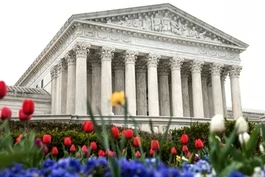
The Supreme Court sides with the therapist# challenging a state ban on the discredited## practice of conversion therapy for LGBTQ children.
And some suspicious trades in# prediction and financial markets## regarding Trump administration policies raise# questions about who's really benefiting.
DAVID HILL, American Gambler Substack:# It's right for us to assume that there## is a lot of insider trading that# goes on, on prediction markets,## just as there's a lot of insider trading# that goes on in the stock market.
(BREAK) WILLIAM BRANGHAM: Welcome to the "News Hour."
President Trump said tonight that the war with# Iran will likely last anot.. but the blockage of the Strait of Hormuz# continues to be a problem for the U.S.,## and the president again lashed out# at allies for not doing more to help.
Iran's de facto blockade of that# waterway has driven up the cost## of oil worldwide and sent American gas# prices to their highest level in years.
Overnight, targets outside the ancient,## historic Iranian city of Isfahan were# set ablaze by U.S.
strikes, home to a## large ammunition depot in one of the country's# main nuclear complexes, now a towering inferno.
President Trump posted this# video to his social media,## projecting U.S.
strength before,# hours later, conveying frustration.## The president said that nations that were upset# by Iran's choking of the Strait of Hormuz,## through which a fifth of the world's oil normally# flows, should take matters into their own hands.
"Go to the strait and just take# it," the president wrote.
"You## have to start learning how to fight# for yourself.
Go get your own oil."
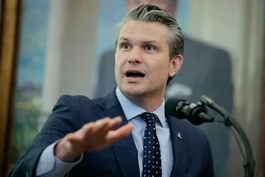
Defense Secretary Pete Hegseth today# directed more blame on U.S.
allies,## who have so far refused to# participate in this war.
PETE HEGSETH, U.S.
Defense Secretary: This is an# international waterway that we use less than most,## in fact dramatically less than most.
So# the world ought to pay attention to be## prepared to stand up.
President Trump's been# willing to do the heavy lifting on behalf of## the free world to address this threat of Iran.# It's not just our problem set going forward.
WILLIAM BRANGHAM: Iran has allowed some ships to# pass through the strait, including from China,## India and Malaysia.
The U.S.
claims up to# 20 tankers are expected to pass through## in coming days.
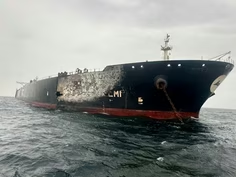
But Iran's attacks# in and around the strait continue,## including a drone strike on a fully loaded# Kuwaiti oil tanker off the coast of Dubai.
The attack punctured its hull and set# the ship ablaze.
The crew managed to put## out the fire before it ignited its cargo# and no oil was spilled.
But attacks like## these have sent shockwaves through global oil# markets.
Dozens of oil and gas facilities have## been targeted and damaged by Iran's retaliation,# including fields, refineries, storage and ports.
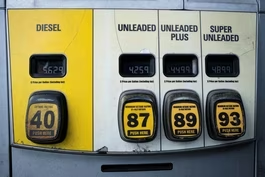
And as fuel prices have soared worldwide, here in# the U.S., the price at the pump hit $4 a gallon,## the highest level since 2022, the national average# up more than a dollar since before the war began.
PETE HEGSETH: President Trump# will make a deal.
He is willing.
WILLIAM BRANGHAM: Secretary Hegseth said# talks were ongoing and gaining strength,## despite Iran's public denials.
But he# said the U.S.
was prepared to ramp up## the war if Iran didn't yield to U.S.
demands.
PETE HEGSETH: We don't want to have to# do more militarily than we have to.
But## I didn't mean it flippantly when I said in# the meantime we will negotiate with bombs.
WILLIAM BRANGHAM: Chairman of the Joint Chiefs# General Dan Caine added that the U.S.
military## campaign was increasingly limiting Iran's# ability to replace what had been destroyed.
GEN.
DAN CAINE, Chairman, Joint Chiefs of Staff:# We remain focused on interdicting and destroying## the logistical and supply chains that feed# these programs.
And this remains a truly## joint effort prosecuted around the clock# from air, land sea, space, and cyberspace.
WILLIAM BRANGHAM: Iran's Revolutionary Guard# hit back today with a new threat, saying it## will soon target U.S.
companies in the region,# including Google, Apple, Intel, and Boeing.
Meanwhile, in Iraq, the U.S.
State Department# said it's aware of the reported kidnapping of## an American journalist there, identified# as Shelly Kittleson by one of the outlets## that she worked for.
A U.S.
official said a# member of an Iranian proxy known as Kataib## Hezbollah was arrested on suspicion# of being involved in the kidnapping.
Today, a defiant Israeli Prime Minister# Benjamin Netanyahu said Iran could no## longer threaten Israel's existence and promised# to speak soon about new alliances in the region.## And the U.S.
is reportedly adding even# further to its forces, dispatching a## third aircraft carrier strike group to# the Middle East, the USS George H.W.
Bush.
But Secretary Hegseth would not stay today# if the U.S.
would deploy ground forces.
PETE HEGSETH: We're not going to# foreclose any option.
You can't## fight and win a war if you tell your# adversary what you are willing to do## or what you are not willing to do,# to include boots on the ground.
WILLIAM BRANGHAM: All options open# to a potentially open-ended conflict.
And so, for an on-the-ground perspective,## we turn to Reza Sayah.
He's the "News# Hour"'s special correspondent in Tehran.
Reza, thank you so much again for talking with us.
When U.S.
officials are talking about# these strikes, they keep stressing that## they are hitting military targets in Iran, not# civilian targets.
Is that your understanding?
REZA SAYAH: Well, I can tell you# firsthand that that's not the case.
Indeed, they are hitting military targets, but# they're also increasingly hitting non-military## targets.
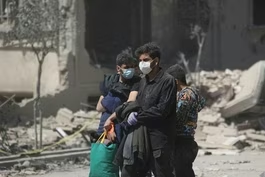
Yesterday, airstrikes knocked out power# in parts of Tehran.
That happened again today,## and also in the island of Qeshm# along Iran's southern coast.
The power is back on, but that's two days in a# row where we have seen power outages.
And that## has many here worried because of President# Trump's threat to hit Iran's power grid.
This morning, state media reported an airstrike# hitting one of Iran's leading pharmaceutical## manufacturing companies.
And this adds to# the list of strikes on non-military sites.## We have seen airstrikes on universities,# fuel storage depots, port facilities,## event and steel factories, and# historical and cultural sites.
WILLIAM BRANGHAM: Reza, what is your# understanding of the diplomatic talks that## are under way?
We have heard conflicting# reports from the president and from the## Iranian government.
What are your sources# telling you about the status of those talks?
REZA SAYAH: Well, I think any real reasonable# person would say that many of Mr.
Trump's## statements about talks are often inconsistent.# One day, he's saying negotiations are happening## and he's winning the war.
The next day,# he's deploying troops, making threats.
So Tehran pretty much dismisses his# statements.
The Foreign Ministry is## often very polite, but military leaders# often mock him.
Tehran's position is,## this is a president that's twice attacked# Iran in the middle of talks.
So they don't## trust him and when it comes to# his claims about negotiations.
Their focus is on defending their# country against what they view as an## illegal attack.
At the same time, the# Foreign Ministry says they're always## prepared for talks if the talks are held# with respect and recognize Iran's rights.
WILLIAM BRANGHAM: Reza, at the beginning# of these attacks, President Trump said he## wanted to create the conditions where# Iranians themselves could rise up,## and thus weaken the Iranian government and allow# individual Iranians to rise up and take power.
How realistic does that seem to you?
REZA SAYAH: Well, at this point, I can tell# you that we're in the fifth week of this war,## and there's been no indication# of an anti-government uprising.
In contrast, almost every day, even on nights# where it's been raining, you have (AUDIO GAP)## of the population joining them, most of# the core supporters of the government,## religious and conservatives, but increasingly# you're seeing more progressive, liberal Iranians.
Obviously, many Iranians were dissatisfied# with this government, but they didn't want## their dissatisfaction to lead to an attack by# the United States in Israel.
So you're seeing## increasingly solidarity among different sectors# of the population for the military troops.
WILLIAM BRANGHAM: All right, that is Reza# Sayah joining us from Tehran in Iran.
Reza, great to talk to you.
Thank you.
REZA SAYAH: Thank you.
WILLIAM BRANGHAM: The steep rise# in gas p.. is the second largest spike in three# decades, and it is hitting Americans'## wallets.
Many have told us how they're# now scrambling to fill their own tanks.
SAMANTHA LOTT, Texas Resident: My name is# Samantha Lott.
I currently live in Denton, Texas.
JAMES LAWRENCE, Nebraska Resident: I'm# Jim Lawrence.
I live in Omaha, Nebraska.
ALEXIS MIMS, Texas Resident:# My name is Alexis Mims.
JAMIE PARDAU, Hawaii Resident: My name is Jamie# Pardau.
And I live in.. JONATHAN TIPTON MEYERS, California# Resident: I'm Jonathan Tipton## Meyers.
I'm a full-time rideshare driver.
As soon as this war started, gasoline# prices jumped up minimum 50 cents,## but in certain areas it was a dollar as well too.
JAMIE PARDAU: My husband and I are making# an effort to combine any trips that we## take into town or to stores, so that we# aren't driving unnecessarily.
I don't## think it ever occurred to me that# our gas would be over $5 a gallon.
ALEXIS MIMS: We are -- we are struggling.
Now## it's not just the groceries that are expensive,# but now it's the gas that is out of control.
SAMANTHA LOTT: I am a community mental# health social worker.
As I'm sure you know,## I do not make a lot of money.
And so having# to use my own car and drive a lot around two## different counties, I'm buying a lot of gas.# Then, in order to make ends meet as well,## I have to deliver groceries on the# side in the evenings and the weekends.
I'm filling up my tank every other# day, and I'm having to pay like $40 to## $50 to do so.
Any money that I get from# my daytime job is usually a month late## for reimbursement.
And so I'm having to# figure out how to make that money stretch## and like what kind of food am I going# to eat this month, that type of thing.
It's really anxiety-ridden right now times for# me and a lot of other people, especially people## that are single and are having to pay all of their# household costs themselves.
It's really difficult.
JAMES LAWRENCE: Right now, my# income is tied to the market.
So,## it's in my retirement accounts.
And# so with the volatility of gas goes the## volatility of the market, and one goes# up, and your bank balance goes down,## and that really is the most concerning thing# about the future.
All of this needs to stabilize.
JAMIE PARDAU: In Hawaii, so much of what we# have purchased in the stores is imported,## and so it isn't really just the cost# of gas that is going to impact our## community.
It's going to be the# cost of just about everything.
JONATHAN TIPTON MEYERS: We're constantly trying# to calculate whether a ride can actually be## profitable for us.
So if you add on an increased# gas price, it just makes making those decisions## even more difficult.
And at the end of the month,# that's a significant raise in your actual price,## in your anxiety, in your ability to drive# safely and maintain your car and do your job.
ALEXIS MIMS: My son is three hours# away in college, and my daughter is## 30 minutes away.
The amount of gas is too# much to go ahead and travel at this time,## so we are forgoing plans for any type# of get-togethers.
But, thankfully,## we have modern technology, so for# now we just keep in touch that way.
SAMANTHA LOTT: I don't really do a lot of things# other than work, just because I can't afford to,## and that's really sad, because in# order to have a well-balanced life,## people need to be able to go do things,# support local businesses, hang out with## their friends.
And those are kind of luxuries# at this point that I just truly can't afford.
WILLIAM BRANGHAM: So how long are# gas prices expected to stay high,## and, more broadly, how bad a shock will# this war deliver to the global economy?
For that, we turn again to Cliff Kupchan.# He is chairman of the Eurasia Group,## which is an international consulting firm.
Cliff, so good to have you# back on the "News Hour."
So you have heard from these people about how# difficult it is for them just to fill their tanks.## Gas is over $4 a gallon, Brent crude at over 118# a barrel.
If this war continues, as the president## said tonight, even for a couple more weeks or# maybe longer, how much worse could this get?
CLIFF KUPCHAN, Research Director,# Eurasia Group: It could get a lot worse.
The Strait of Hormuz is so critical to the# international economy, for oil, for LNG, for## helium, for chips, for food, for fertilizer.
It is# just a choke point for the international economy.## I don't think that, for the foreseeable future --# I think this war, I think, is going to get worse.
Judge President Trump by his actions, which# is sending more equipment to the Gulf,## not by something he might have said today# about caring about opening the Gulf.
So I## think this is going to be a stranglehold on the# economy.
It's going to rise prices and raise## prices in many sectors and stoke inflation in# countries around the world.
It's a real problem.
WILLIAM BRANGHAM: You touched on a few# of those other products that come through## the Gulf.
Apart from energy supplies, what# other industries will those mostly affect?
CLIFF KUPCHAN: Well, again, helium, which is# critical to making advanced chips for A.I.,## aluminum, petrochemicals, fertilizer,## and food prices.
Those are the# main ones.
But that's a whole lot.
And especially for countries that import food,## it's going to be a real battle to keep the books# balanced and to keep inflation under control.
WILLIAM BRANGHAM: Do you think that# consumers, or maybe even more importantly,## the market has taken on board this# idea that this could get so much worse?
CLIFF KUPCHAN: No.
Unfortunately, I think that markets, which I can# speak .. but markets have had their head in the sand.# I think markets still have their head in the## sand.
The market rally today, in part on# President Trump's comments that he could## end the war without opening the Strait of# Hormuz, that's just really wishful thinking.
President Trump also sent a third aircraft# carrier to the Gulf today.
He's sending more## troops to the Gulf.
It's -- I think markets are in# denial that there's a strong chance we get ground## forces in Iran and that prices go up even further# towards the $130 level, $130 a barrel for Brent.
It's going to get bad.
WILLIAM BRANGHAM: Do you really believe,# judging by what you're saying, that.. conflict will escalate, that, despite# what the president has been saying... CLIFF KUPCHAN: I do.
I do.
President Trump has -- again, I'm not going to put# a judgment on it, but he's now attacked Iran twice## in the middle of ongoing negotiations.
I think# that, as an analyst, it's just not useful to track## his day-to-day words.
It's much more useful to# track the administration's day-to-day movements,## which is putting men and a whole lot# of metal and hardware into the region.
So I -- yes, I think it's going to get worse.# It may not gone more than two or three weeks,## but I think we're going to see a lot# of combat and bombing before then.
WILLIAM BRANGHAM: The president# again reiterated this point that,## if nations are not willing to help reopen# the strait and they're thirsty for more oil,## that they ought to just buy that oil from the# United States.
Is that a realistic exchange?
CLIFF KUPCHAN: No.
Global markets a.. Energy prices are going to stay high as# long as the Strait of Hormuz is closed,## and alternative sources are hard to# come by, especially for LNG.
So the## president's comments really don't speak# to how energy markets work, unfortunately.
WILLIAM BRANGHAM: All right, that is# Cliff Kupchan of the Eurasia Group.
Always great to hear from you.# Thank you so much for being here.
CLIFF KUPCHAN: Thank you, sir.
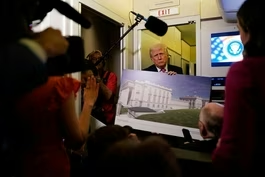
WILLIAM BRANGHAM:## In the day's other headlines: A# federal judge today ordered the## Trump administration to stop construction of# its $400 million White House ballroom project.
District Judge Richard Leon sided with# a preservationist group that called for## further reviews and input from Congress.
In# his opinion, the judge wrote that Trump is## the steward of the White House, not its owner,# and that -- quote -- "No statute comes close## to giving the president the authority he claims# to have."
But the judge also delayed enforcement## of his order for 14 days and acknowledged# that the administration is likely to appeal.
Also today, a separate federal judge# ruled that President Trump's executive## order that barred federal funding# for NPR and PBS is unconstitutional.## Judge Randolph Moss said the order violated# those groups' First Amendment rights.
While PBS and NPR leadership both celebrated# today's decision, the ruling will likely have## little effect on their immediate financial health.# That's because the Republican-controlled Congress## voted to claw back the roughly half-a-billion# dollars in annual funding last year.
Still,## it could allow Congress to provide# future money should it choose to do so.
Turning overseas, a group of 12 top European# diplomats visited Ukraine today to mark four## years since Russia's massacre in# the town of Bucha outside Kyiv.## They placed candles on a memorial# to honor the more than 400 people## who were killed there.
Russia invaded Bucha# early on in its war, now in its fifth year.
In Russia today, thick smoke rose from# an oil storage facility at a port in the## Baltic Sea near St.
Petersburg.
Ukraine has# targeted energy infrastructure in that area## for the past week.
A Kremlin spokesperson# downplayed the strikes and vowed to respond.
DMITRY PESKOV, Spokesman for Vladimir# Putin (through translator): All critical## facilities important to Russia's.. protected.
If airspace is being made available# for hostile terrorist activity against Russia,## this obliges us to draw the appropriate# conclusions and take appropriate measures.
WILLIAM BRANGHAM: Ukrainian# officials are hoping their## long-range drone strikes in the region# will prevent Moscow from profiting off## its oil exports amid global concerns over# energy supplies brought on by the Iran war.
In Gaza, health officials say two# Israeli airstrikes killed at least## five people today.
Palestinians in Khan# Yunis mourned a father and his 2-year-old## son who died in one of the strikes.
Israel# has not yet commented on either incident.
Meanwhile, in Central Gaza, a# chaotic and emotional scene,## as a group of 11 toddlers were reunited with# their families.
They had been evacuated as## premature newborns back in late 2023 amid# violence brought on by the Israel-Hamas war.## One father described his reunion as -- quote# -- "the most important moment of his life."
SAMER LULU, Father of Evacuated Toddler# (through translator): Our feelings are## indescribable.
She is my first da.. because of the reality we live in.# We hope our children's future will## not be filled with the tragedy or suffering# they faced at the beginning of their lives.
WILLIAM BRANGHAM: A total of 31 premature# babies had been evacuated to Egypt.
Doctors## say four died after arriving, though# the fate of the others remains unknown.
An update now on a story we brought to you# last night.
A Russian tanker carrying more## than 700,000 barrels of oil arrived in Cuba today.# It is the first such delivery in three months,## and it's expected to provide up to 10 days of# Cuba's energy needs.
The Trump administration## allowed the vessel to proceed despite# an ongoing oil blockade of the island.
That blockade has led to a series of blackouts# and further crippled the country's economy.## Despite this delivery, the White House says it# has not changed its broader policy towards Cuba.
A panel of high-level U.S.
officials# voted today to exempt offshore oil## drilling in the Gulf of Mexico from rules# related to the Endangered Species Act.
The## decision came at the request of# Defense Secretary Pete Hegseth,## who cited a threat to U.S.
energy# production during the ongoing war with Iran.
Critics say the move could threaten a# rare whale species and harm other kinds## of marine life.
The panel is chaired by the# interior secretary, and it's commonly called## the God Squad because its actions can# decide whether a species lives or dies.
NASA has begun its 24-hour countdown to# humanity's first flight to the moon in## more than half-a-century.
After weeks of# fuel leaks and other glitches, officials## say Artemis II is finally set to launch tomorrow# night from the Kennedy Space Center in Florida.
At a press event today, weather# experts said the odds of a favorable## condition tomorrow are at a promising 80 percent.
MARK BURGER, NASA Launch Weather Officer:# Weather has been a nuanced thing for us at## times here in the generation# phase of this mission.
But,## again, look outside right now.
Great# weather.
There's nothing here that## is screaming a no-go for the entirety of# the window for any one of these attempts.
WILLIAM BRANGHAM: The four astronauts# of the Artemis crew are set to become## the first lunar visitors since# Apollo 17 back in the early 1970s,## but they won't land on the moon's surface or# even orbit it.
Instead, they will zip past the## moon's far side and then head back to Earth in# a trip that's planned to last less than 10 days.
On Wall Street today, stock surged amid# hopes for an end to the Iran war.
The Dow## Jones industrial average jumped more than# 1,100 points.
The Nasdaq added nearly 800## points, or almost 4 percent.
The S&P 500# posted its biggest gain since last May.
And we have a unique passing of note.# Sugar "The Surfing Dog" has died.## The mixed breed rescue pup from Huntington# Beach, California, was a five-time dog surfing## world champion and the canine inducted into the# Surfers Hall of Fame.
Wearing a life jacket,## she often rode solo, but sometimes# alongside her owner, Ryan Rustan.
Sugar also spent time comforting# veterans as a therapy dog.
The## city of Huntington Beach called her a# local legend whose impact reached far## beyond the shoreline.
Sugar "The# Surfing Dog" was 16 years old.
Still to come on the "News Hour":# communities rebrand Cesar Chavez## Day following sexual assault allegations# against the late labor leader; pardons## and prediction markets raised questions about# who's making money during the Trump presidency;## and the next stage for the Washington National# Opera after its departure from the Kennedy Center.
A Colorado law that bans what's called# conversion therapy for LGBTQ youth hit a## potentially far-reaching roadblock# at the U.S.
Supreme Court today.
In an 8-1 decision, the justices sided# with a Christian counselor who argued## that the law violated her First Amendment rights.
Our justice correspondent, Ali# Rogin, has more on the ruling.
ALI ROGIN: William, the majority of# justices cast doubt on whether the## state of Colorado can ban licensed# therapists from talking to their## minor patients about their sexual# orientation or gender identity.
Supporters of the law argue the ban was# necessary to protect children from the## practice of conversion therapy that they say# is harmful.
In the court's majority opinion,## Justice Neil Gorsuch said -- quote# -- "Colorado may regard its policy## as essential to public health and safety,# but the First Amendment stands as a shield## against any effort to enforce orthodoxy# in thought or speech in this country."
Last fall, the "News Hour" spoke to Kaley# Chiles, the therapist at the center of the case.
KALEY CHILES, Licensed Professional# Counselor: The care that is at stake## in this lawsuit is that we are allowed to# speak freely and that we are allowe.. by the product of that, sort through# feelings, sensations, thoughts, beliefs.
ALI ROGIN: The ruling sends the case# back to a lower court to weigh in on## if the law is constitutional.# Colorado is about one of two## dozen states that have banned# conversion therapy for minors.
For more on today's decision, I'm joined now# by the "News Hour" Supreme Court analyst,## Amy Howe, co-founder of SCOTUSblog.
Amy, great to see you again.
AMY HOWE: Good to see you too.
ALI ROGIN: So, in this argument,# the therapist made the.. because she was doing talk therapy with her# clients, talking them through these issues,## that this really was a violation, this ban is# a violation of her First Amendment protections.
Did that seem to land with the majority?
AMY HOWE: It did indeed.
The state had argued that states have long# .. and so that the ban was part of an effort# to regulate conduct, rather than speech,## so that the First Amendment wouldn't apply.
And to# the extent that it regulated speech like Chiles',## it did so only incidentally, sort of# as part of the regulation of conduct.
But the majority didn't buy that# argument at all.
Justice Neil Gorsuch,## writing for the majority, said the# First Amendment is not a word game## and said that what she's doing is# speech, and the state is regulating that.
What this case was about was whether or not# the lower courts applied the correct standard,## the correct test to determine whether or not# the conversion therapy ban was constitutional.## Chiles argued that the lower court# should have applied a less deferential,## more stringent test called strict scrutiny# precisely because her conduct was, in fact,## speech, her talk therapy was speech, and# therefore the First Amendment was involved.
And the Supreme Court agreed with her.# It didn't go ahead and actually apply## that test.
Instead, it sent the# case back to the lower courts.
ALI ROGIN: The court kept coming back to# this idea of viewpoint discrimination,## that this law allows therapists to affirm a# person's identity, but not discourage that.
Why was that framing so important in this room?
AMY HOWE: It was essential, I think, in no small# part because you have, when you have viewpoint## discrimination, in the Supreme Court's view, you# have the state choosing a side in the debate.
And so you have the state saying you can affirm# a client's gender identity, but you can't work## with them to try to realign their gender identity# to the one that they were assigned at birth.
It## seemed pretty clear after oral argument that# Kaley Chiles was likely to win in some form.
It was a little bit of a surprise that it wound# up being 8-1, with justice Ketanji Brown Jackson## being the only dissenter.
Justice Elena Kagan# and Justice Sonia Sotomayor joined the majority.## Justice Kagan wrote a concurring opinion in# which she said, this might have been a different## case if we have a law that regulated content,# but didn't discriminate based on viewpoint.
ALI ROGIN: You mentioned Justice Ketanji# Brown Jackson, the lone dissenting voice.
And in her dissent, she really# focused on the harm that she## would argue is done potentially# to children who undergo conversion## therapy.
She wrote -- quote -- "Like it or# not, treatment standards exist in America,## and those standards necessarily reflect the# expert medical community's current beliefs## about the safety and efficacy of various medical# treatments, whatever those beliefs might be."
Beyond Justice Jackson's dissent,# how did the issues of the potential## harm and concerns about conversion therapy# play into this argument and this opinion?
AMY HOWE: It was an issue that came up at the# oral argument and then resurfaced again in## Justice Gorsuch's opinion, but relatively# briefly, and he acknowledged that there## is this debate.
The state had relied on it as# the rationale for the conversion therapy ban,## but the opinion sort of downplayed# the consensus among major medical## organizations right now on the idea that# conversion therapy is harmful to LGBTQ teens.
Justice Samuel Alito, I believe, at# the oral argument had pointed out,## and then the opinion made the same point,# that back in the '50s, '60s, and '70s,## major medical associations had called# homosexuality a mental disorder.
And## so the point that the opinion was making was# that these kinds of consensuses can change.
ALI ROGIN: So where does this go from here,## both in terms of this particular# case that gets put back to the## lower courts and the other approximately# two dozen states that have similar bans?
AMY HOWE: So this case will go back to the# lower court for it to apply strict scrutiny,## this very demanding constitutional test.
Both in this case and in the roughly 25 other# states that have similar bans, the Supreme Court## didn't -- sort of tiptoed right up to the line.# It didn't come right out and say that it believed## that the ban, at least as applied to Kaley Chiles,# someone doing talk therapy, was unconstitutional,## but it really strongly signaled that the eight# justices believed that a ban like this was.
And so I think that in the case of Colorado# and in other states that have similar bans,## it's going to be a really tough# sell to try to convince courts## that these laws can survive strict# scrutiny and are constitutional.
ALI ROGIN: Amy Howe, co-founder# of SCOTUSblog, thank you so much.
And we will see you back here tomorrow to discuss## the big birthright citizenship case# that is before the Supreme Court.
AMY HOWE: Looking forward# to it.
Thanks so much, Ali.
WILLIAM BRANGHAM:## Just two weeks ago, cities across# the country were finalizing plans## for celebrations of Cesar Chavez day.
Then an# investigative report from The New York Times## revealed allegations that Chavez sexually# abused women and girls for years, including## Dolores Huerta, with whom he co-founded# the United Farm Workers union, or UFW.
Now many of those cities# are canceling those plans,## and a day that was once a celebration has become# a painful reminder of his now tarnished legacy.
Stephanie Sy reports.
STEPHANIE SY: On a day that once celebrated# him, communities are now moving swiftly to## distance themselves from disgraced labor# leader Cesar Chavez, who died in 1993.
A New York Times investigation this# month uncovered evidence that Chavez## sexually abused women and girls for years# while leading the farmworkers movement.
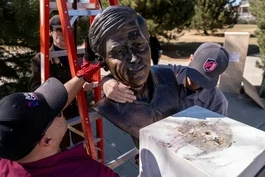
LUVIAH ROBLES, Student, San Francisco State# University: Hearing about these allegations## is definitely a hard thing to digest,# but it's also a hard thing to ig.. STEPHANIE SY: Cities like Milwaukee and# Austin canceled celebrations entirely,## while others emphasized the movement over the man.# In Denver, where a Chavez statue was dismantled,## activists instead celebrated Si Se# Puede Day, in English, Yes We Can.
And the patch of grass that bore Chavez's name# for two decades had a new handwritten sign,## Dolores Huerta Park, after the woman who# co-founded the United Farm Workers union.## Huerta herself, now 95, was revealed by The# New York Times to have been raped by Chavez.
GERALDO CADAVA, Northwestern# University: I'm hoping that,## even though this is really difficult# news and devastating news to absorb,## that it might give some new life to the farmworker# movement to get out from under his shadow.
STEPHANIE SY: Geraldo Cadava is a professor of## history and Latino studies# at Northwestern University.
GERALDO CADAVA: I think historians have already# made the move toward recognizing that the United## Farm Workers was a broader social movement.# I think what placing Dolores Huerta at the## foreground of the movement now does, on the one# hand, it acknowledges women's contributions and## the idea that women have always been part of# the union and were central to its successes.
I guess I would only caution against just simply# replacing Chavez with Huerta and lionizing her,## coming to lionize her in the same way# that we lionized Cesar Chavez,because## to replace one hero with another hero could# also stunt the movement in some ways, I think.
WOMAN: Women who speak up.
STEPHANIE SY: Last week, both Minnesota and# California, which was the first state to## recognize Chavez's birthday as a holiday, quickly# passed new laws renaming March 31 Farmworkers Day.
STATE SEN.
SUZETTE MARTINEZ VALLADARES# (D-CA): This is not about one narrative.## It's about honoring generations of# sacrifice, of resilience and hope.
STEPHANIE SY: And the UFW itself# canceled its planned events,## calling the allegations against# Chavez shocking and indefensible.
Taken together, it marked a nearly unthinkable# fall from grace for the late civil rights icon,## once mentioned in the same breath as# Martin Luther King Jr.
and whose name## and image adorn schools, street signs# and murals nationwide, those tributes,## once a point of pride, now a source# of pain in cities like Los Angeles.
RAUL CLAROS, Founder, California Rising:# Cesar Chavez Avenue needs to be replaced.## I have a 10-year-old little girl who lives# in that building on Cesar Chavez, who today,## after school, I'm going to have to sit down# around the dinner table and explain to her## why we're out here doing this, what the# rumors, the allegations and the facts are.
STEPHANIE SY: There, the Board of# Supervisors has now voted to erase## Chavez's name from county streets and# buildings.
Phoenix has done the same.
Betty Guardado is a member of the city council.
BETTY GUARDADO, Phoenix City Councilmember: For# us to be able to act on this as fast as we did,## it just means that we're not going to tolerate# this type of behavior and that we're going## to continue to hold everyone accountable,# that we will continue to lift the victims,## that we will continue to do# the right thing as a city.
STEPHANIE SY: Still, what's next will likely# be tougher than removing street signs,## a full reckoning with Chavez's# legacy, both the vital role he## played in advancing civil rights and the# disturbing truth of his sexual abuse.
In a letter to the public this afternoon, the# Cesar Chavez Foundation said: "During this## time of painful internal reflection, we do not# want to lose sight of the very real threats our## community currently faces.
We cannot let# this moment fracture what so many worked## so hard to build," a sentiment echoed by the# current president of the UFW, Teresa Romero.
TERESA ROMERO, President, United Farm Workers:# You know, we have in one hand Cesar Chavez,## the man who committed horrible acts that we're# not going to justify, that we don't condone.
On the other hand, we have# Cesar Chavez, the organizer,## who brought thousands and thousands of people# together to be able to work for farmworkers.## And, unfortunately, those two# things came from the same man.
STEPHANIE SY: For the "PBS# News Hour," I'm Stephanie Sy.
WILLIAM BRANGHAM: The Pentagon today is strongly# denying a report by The Financial Times that## Defense Secretary Pete Hegseth's stockbroker# was seeking to make large investments in major## defense companies in the days right before# the U.S.
and Israel first struck Iran.
That report is raising yet more# concern about the many people in## and around the Trump administration who# seem to be profiting in unusual ways.
White House correspondent Liz# Landers takes a closer look.
LIZ LANDERS: Early last week, as the United States# and Iran continued to exchange strikes in the## Middle East, there was a spike in the crude oil# futures trading volume around 6:49 a.m.
Eastern## time.
A few minutes later, at 7:05 a.m., the# president posted on his social media platform## that he was suspending strikes on Iranian power# plants and energy infrastructure for five days.
The stock market opened up and oil prices went# down.
A combined $800 million in trades was## made.
The timing of the market movement# could be coincidental, but it produced## a windfall all the same.
And traders aren't# just getting rich in traditional marketplaces.
Polymarket, a prediction marketplace# where individuals can bet on anything## from sports to politics, has seen several# users bet specifically on U.S.
military## action related to Iran and rake in money.# Before the president's latest announcement## claiming the U.S.
and Iran were actively# engaged in productive talks, several newly## created accounts bet nearly $160,000 that a# cease-fire will happen by March 31 or April 15.
After the president's comments, the value# of those bets doubled and stand to pay out## to $1 million if the cease-fire# happens by April 15.
Who's behind## these bets?
Polymarket and other online# prediction market sites like Kalshi allow## users to place bets anonymously so the# identity of the bettor remains unknown.
But potentially lucrative payouts like# these have raised concerns about the## possibility of insider trading, says# David Hill, a journalist who writes## about gambling for "Rolling Stone" and hosts# the podcast "American Gambler Book Club."
DAVID HILL, American Gambler Substack: I# think that it's right for us to assume that## there is a lot of insider trading# that goes on prediction markets,## just as there's a lot of insider trading# that goes on in the stock market.
You know,## lots of people know the outcomes of these things# prior to the public knowing them.
And so some## people are going to be opportunistic# about that and take advantage of it.
LIZ LANDERS: Polymarket, which calls itself# the world's largest prediction market,## announced new rules last week clarifying three# categories of prohibited insider trading conduct,## banning trading that involves# stolen confidential information,## illegal tips, and trading by# people who can influence outcomes.
They even specifically give an example about# military members betting on military operations,## advising that's banned.
It's raising questions# about the morality of betting on these actions,## which inevitably involve life-or-death situations.
DAVID HILL: I personally would not want to make a# bet on whether or not somebody would live or die.
I think that one of the things# that's a concern here is that,## if there is a market on something like death,# that there is sort of moral hazard involved,## right, and that people shouldn't be allowed# to wager on predicting somebody's death,## not just because it's moral, but also# because there may be -- that it creates## these sort of perverse incentives, and that# people's lives are involved and are at stake.
LIZ LANDERS: Kalshi told us that# government employees are not permitted## to place predictions on geopolitical# markets and said it does not comment on## potential investigations.
Polymarket did# not respond to questions from PBS News.
There are at least eight bills in Congress# seeking to regulate prediction markets,## including a bipartisan House bill that# would bar elected government officials,## senior federal staffers and their families# from trading in prediction markets.
But these platforms aren't the only way that# people are profiting off of politics these## days.
For others with ties to the president# or who claim to have connections to him,## there's another lucrative business opportunity# that's emerged, lobbying for presidential pardons.
Trump's prolific use of his clemency powers# has been controversial from the beginning.
DONALD TRUMP, President of the United States:# We hope they come out tonight, frankly.
LIZ LANDERS: Hours after he# was sworn in for a second term,## he pardoned more than 1,500 defendants# involved in the January 6 Capitol attack.## Dozens of other high-profile pardons have# followed, involving political figures,## business leaders and people with personal# connections to the president or his allies.
And lobbyists have stepped in# to help facilitate who can get## through to the administration, earning millions.
Ken Vogel is a reporter for The New York Times.
KEN VOGEL, The New York Times: In the first# year of Trump 2.0, we saw $5.2 million in## lobbying fees disclosed for pardon-related# or clemency-related lobbying efforts.
And## that was eight times more than what we saw in# the final year of the Biden administration.
LIZ LANDERS: Vogel says this has created## a sort of pay-for-play mentality# during the Trump administration,## where people with money and connections# can skip to the front of the pardon line.
KEN VOGEL: It's created this sort of pardon# industrial complex that in some ways seems to## turn on its head the idea that the people who# are most deserving All right,e the ones who## are going to get clemency, and instead# sort of reward people who either have## connections or the ability to pay people who have# connections to get directly to President Trump.
LIZ LANDERS: And while President Trump in## his speeches says attacking# fraud is a major priority... DONALD TRUMP: We're cracking# down on the Somali scams,## ending the brazen and shameless# theft of taxpayer dollars.
(CHEERING) LIZ LANDERS: ... his decisions about who gets# a pardon seem to be at odds with that.
More## than 50 of the pardons and commutations he# has made in his second term are for fraud.## White-collar offenses such as money laundering,## bank fraud and wire fraud are among the# most frequent crimes he has wiped clean.
In a statement, the White House press secretary,# Karoline Leavitt, said -- quote -- "President## Trump exercises his constitutional authority to# issue pardons and commutations at his discretion.## Anyone spending money to lobby for pardons# is foolishly wasting their money.
The Trump## administration has a robust pardon review# process, which includes White House counsel,## the Department of Justice and ultimately# the president himself as the final decider."
Many of the people granted clemency# by Trump had their financial penalties## and restitution forgiven, totaling tens of# millions of dollars.
But for their victims: KEN VOGEL: They're appalled.
To them, this is# sort of an, like, insult to injury.
And these## pardons and in some cases even the commutations# wipe away those obligations, those financial## obligations.
So this is sort of taking money out# of the victims' pockets, or at least stopping an## avenue that might otherwise result in them# getting at least some compensation for the## financial losses that they have incurred at the# hands of these people who have gotten pardons.
LIZ LANDERS: For people in the White House# orbit, there is potentially big money to be## made trading in the currency of access to either# information or to the ear of the president.
For the "PBS News Hour," I'm Liz Landers.
WILLIAM BRANGHAM: Earlier this month, the# board of what is now called the Trump-Kennedy## Center formally approved the president's# plan to close the center for two years.
Meanwhile, the Washington National Opera,## which is one of the center's largest arts# organizations, had already announced that it## was leaving.
That exit is one of the most# consequential in a year full of turmoil.
Senior arts correspondent Jeffrey Brown# reports for our Art in Action series,## which explores the intersection of art and# democracy, part of our Canvas coverage.
JEFFREY BROWN: A rehearsal for "The# Crucible," a 1961 opera by Robert## Ward based on Arthur Miller's seminal# 1953 play about the Salem witch trials.
Miller wrote it as a warning about# injustice and mass hysteria in the## McCarthy era anti-communist trials of# his time.
Now, says Francesca Zambello,## artistic director of the Washington National# Opera, it has new relevance for ours.
FRANCESCA ZAMBELLO, Artistic# Director, Washington National Opera:## I think that everyone in this country,# whatever side of the fen.. is certainly wondering what is happening with our# legal system, what is happening with democracy,## are the -- is the Constitution still serving# us today, is it serving us right now?
And our democracy is on trial now.
JEFFREY BROWN: Few in the art world have been# quite so caught up in the political maelstrom## as the WNO and Zambello, whom we met recently at# the company's rehearsal studios in Washington.
FRANCESCA ZAMBELLO: Let's focus# everybody, OK?
Great, thank you.
MAN: Places for top of show, please.
JEFFREY BROWN: Founded in 1956,# now celebrating its 70th season,## the opera company has performed at the Kennedy# Center since the center's opening in 1971,## bringing some of the world's greatest singers# to its grand Opera House and other stages.
In 2011, it signed a so-called affiliation# agreement to formalize its relationship,## making it one of the center's# tentpole organizations.## But everything changed with# Donald Trump's second term.
FRANCESCA ZAMBELLO: This last year has been# something I could never have imagined.
I could## not have dreamt this up.
Last February, there was# literally a coup d'etat at the Kennedy Center.
JEFFREY BROWN: That's how it felt to you?
FRANCESCA ZAMBELLO: It absolutely# felt like a coup d'etat.
JEFFREY BROWN: The longtime leadership, respected# arts leaders fired.
New leadership put the## president himself as chair in its place, a new# requirement that arts groups break even or earn## a profit on every production, contrary to how# most opera, dance and theater groups operate,## with their need to plan far into the# future and experiment with their art forms.
Leading artists canceled performances.# Audience members stayed away.
FRANCESCA ZAMBELLO: The building felt# politicized.
Everyone who worked in the building,## if they did not march in lockstep with the new# management, were fired.
The audiences felt this,## I think, incredible burden that everything# was about us or them, about the two parties,## whereas we have always been an apolitical# building, an apolitical arts institution.
JEFFREY BROWN: In the crucible, J'Nai Bridges,# one of today's leading mezzo-sopranos,## sings the role of Elizabeth Proctor,# falsely accused of being a witch.
When Bridges first signed on, she fully# expected to perform at the Kennedy Center,## even as she wrestled with going ahead.
J'NAI BRIDGES, Mezzo-Soprano: I was a bit# hesitant because it's a tricky thing to navigate,## you know?
Not everyone was for my choice of# performing at the Kennedy Center.
I felt that## the role in the opera is so relevant that# it was almost, in a sense, a protest.
So I## really felt like, OK, as uncomfortable# as this might feel, I'm ready for it.
But then things changed.
And I# have to say that I am relieved.
JEFFREY BROWN: You are relieved?
J'NAI BRIDGES: Yes, I'm relieved, .. JEFFREY BROWN: That stunning decision announced# in January by WNO leadership and its board,## to leave the newly renamed Trump# Kennedy Center and go out on its## own.
The drop in ticket sales and donor# support meant the shows could not go on.
And, says Zambello, there was more.
FRANCESCA ZAMBELLO: I think that by# making the move away from the center,## we made a big statement.
JEFFREY BROWN: Which is?
FRANCESCA ZAMBELLO: Wh.. civil society.
But I was very concerned# knowing what it's like to be homeless.## A theater company, an opera company, a# ballet company, you can't be homeless.
JEFFREY BROWN: But you are,# in a sense, homeless now.
FRANCESCA ZAMBELLO: I think we're# now part of a bigger picture,## where now we're part of a bigger community.
JEFFREY BROWN: You're changing the nature of home.
FRANCESCA ZAMBELLO: I'm changing the nature of# home and I'm making it about geographic diversity.
JEFFREY BROWN: Now the WNO is performing# in theaters across the D.C.
area and## further afield in different size# halls for different productions.
"Treemonisha," an opera by Scott# Joplin, performed to a packed and## appreciative crowd at Lisner Auditorium in# Washington, the same venue as "The Crucible.
"## It's a full circle moment.
The company's# first ever performance was here in 1957.
A May production of "West Side Story"# will be put on in two different forms,## fully staged at the Lyric Baltimore and a## smaller production at Strathmore Music# Center outside Washington in Maryland.
FRANCESCA ZAMBELLO: I'm thinking of this as a new# kind of creative freedom, that we are producing in## different venues that really are appropriate# for the works that we will be presenting.
JEFFREY BROWN: And she says the company will# continue its American Opera Initiative, which## fosters new operas by contemporary composers.# For its part, the new Trump-Kennedy Center board## recently formally approved an early termination# of its agreement with the WNO, having earlier## claimed the parting of ways was its decision# due to a financially challenging relationship.
What now?
Can the Washington National Opera# survive, even thrive independently?
Grand## opera now becomes a grand experiment.
When we met# Bridges during rehearsals, she was optimistic.
J'NAI BRIDGES: So many people are excited to# support what we're doing.
I know that theater will## be filled with an audience that wants to support# WNO, this great company, and art and artists.
JEFFREY BROWN: Francesca# Zambello sees even higher stakes.
FRANCESCA ZAMBELLO: I think that the arts# are certainly under attack right now.
I## think that many people don't believe# that they're necessary.
And if all of## us as artists and as people working# in arts organizations do not stand## up to the injustices that are around# us, then we are not doing our jobs.
JEFFREY BROWN: Zambello says the# Washington National Opera will## soon announce its productions# and venues for next season.
For the "PBS News Hour," I'm# Jeffrey Brown in Washington, D.C.
WILLIAM BRANGHAM: And that is the "News Hour" for#tonight.
I'm William Brangham.
On behalf of the entire "News Hour"# team, thank you so much for joining us.
 New
NewBlackouts raise alarm as Iran fears infrastructure strikes
Video has Closed Captions
Tehran power outages raise alarm as Iranians fear strikes on critical infrastructure (3m 42s)
 New
NewCommunities rebrand César Chavez Day after abuse allegations
Video has Closed Captions
Communities rebrand César Chavez Day as abuse allegations taint his legacy (5m 37s)
 New
NewHow spike in gas prices could ripple through global economy
Video has Closed Captions
How the spike in gas prices could ripple through the global economy (8m 18s)
 New
NewNews Wrap: Judge halts White House ballroom construction
Video has Closed Captions
News Wrap: Judge orders halt to Trump's White House ballroom construction (7m 16s)
 New
NewSupreme Court rules against Colorado conversion therapy ban
Video has Closed Captions
Supreme Court sides with therapist challenging Colorado ban on conversion therapy (7m 5s)
 New
NewTrades, pardons spark questions over presidency profits
Video has Closed Captions
Prediction markets, pardons spark questions over who’s profiting from Trump’s presidency (7m 12s)
 New
NewTrump lashes out at allies as Iran war chokes key oil route
Video has Closed Captions
'Go get your own oil': Trump lashes out at allies as Iran war chokes key oil route (4m 42s)
 New
NewWashington National Opera leaves Kennedy Center for new home
Video has Closed Captions
Washington National Opera finds new stage after split with Kennedy Center (7m 42s)
Providing Support for PBS.org
Learn Moreabout PBS online sponsorship
- News and Public Affairs

FRONTLINE is investigative journalism that questions, explains and changes our world.

- News and Public Affairs

Amanpour and Company features conversations with leaders and decision makers.
One Question with Becky Ferguson











Support for PBS provided by:
Major corporate funding for the PBS News Hour is provided by BDO, BNSF, Consumer Cellular, American Cruise Lines, and Raymond James. Funding for the PBS NewsHour Weekend is provided by...