
Market to Market - May 8, 2026
Season 51 Episode 5138 | 26m 50sVideo has Closed Captions
Commodity market analysis with Kristi Van Ahn - Kjeseth.
On this edition of Market to Market ... Prices in the cattle complex — both high and low — get the attention of the Justice Department. One U.S. state grows 99% of the nation’s hazelnuts. It hasn't been easy. And, commodity market analysis with Kristi Van Ahn - Kjeseth.
Problems playing video? | Closed Captioning Feedback
Problems playing video? | Closed Captioning Feedback
Market to Market is a local public television program presented by Iowa PBS
Market to Market - May 8, 2026
Season 51 Episode 5138 | 26m 50sVideo has Closed Captions
On this edition of Market to Market ... Prices in the cattle complex — both high and low — get the attention of the Justice Department. One U.S. state grows 99% of the nation’s hazelnuts. It hasn't been easy. And, commodity market analysis with Kristi Van Ahn - Kjeseth.
Problems playing video? | Closed Captioning Feedback
How to Watch Market to Market
Market to Market is available to stream on pbs.org and the free PBS App, available on iPhone, Apple TV, Android TV, Android smartphones, Amazon Fire TV, Amazon Fire Tablet, Roku, Samsung Smart TV, LG TV, and Vizio.
Providing Support for PBS.org
Learn Moreabout PBS online sponsorship[Paul Yeager] Coming up on Market to Market -- prices in the cattle complex, both high and low, get the attention of the Justice Department.
One U.S.
state grows 99% of the nation's hazelnuts and it hasn't been easy.
And commodity market analysis with Kristi Van Ahn-Kjeseth next.
♪♪ [Announcer] I wouldn't be here without my customers.
Yeah, I'd like to thank the customers.
They're very dear to our hearts.
It's about the people that you're working with and the relationships that you have.
Thank you.
Thank you.
Thank you.
Thank you from the bottom of my heart.
♪♪ [Announcer] Tomorrow.
For over 100 years, we've worked to help our customers be ready for tomorrow.
Trust in tomorrow.
Information is available from a Grinnell Mutual agent today.
[Announcer] Support for Market to Market has been provided by a bequest from Philip Lietz of Alta, Iowa, in recognition of public television's commitment to agricultural programming.
[Announcer] Market to Market is made possible in part by a grant from the Corporation for Public Broadcasting.
This is the Friday, May 8th edition of Market to Market, the Weekly Journal of Rural America.
[Yeager] Hello, I'm Paul Yeager.
The conflict in Iran has impacted fuel prices and several parts of the economy.
So far, it has yet to affect hiring.
New figures released Friday reveal 115,000 new jobs were added in April.
That's above forecasts, but below March's reading.
The unemployment rate was unchanged at 4.3%.
New home sales shot up 7.4% in March as lower prices and builder incentives are helping drive sales.
Supplies still remain tight for existing properties.
The U.S.
Trade balance grew by 4.3% in March to $60.3 billion, as the number of imports swung higher.
More beef is coming into the U.S., widening the deficit as American producers deal with smaller herd sizes.
There are also questions and answers that the Department of Justice would like to get from inside the U.S.
Beef industry.
Now, back in 2020, the DOJ opened an investigation into the big four meat packers looking for evidence of price manipulation as cattle prices dropped and beef prices at the counter surged during the pandemic.
Tyson Cargill, JBS and National Beef are back in the crosshairs of investigators.
Laurel Bauer reports.
[Narrator] The Department of Justice held a press conference this week to announce its launch of an investigation into the top four meat packers over possible antitrust violations.
[Todd Blanche] In the beef industry, the big four processors control over 85% of the beef processing market.
Multiple plant closures across the country, the current market structure and high concentration in the industry indicate anti-competitive activity.
[Narrator] The big four meat Packers under investigation are Tyson Foods and Cargill Incorporated, both controlled by U.S.
Owners.
A national Beef and JBS, both under Brazilian ownership.
The DOJ is investigating possible inflation of consumer prices and suppression of payments to ranchers.
[Brooke Rollins] Industry consolidation reduces options for our ranchers looking to sell their cattle.
It weakens their negotiating power, and it risks reliance upon a single buyer.
As ranchers face fewer options for selling their animals, the Big four grow stronger and stronger.
[Narrator] The DOJ claims the concentration among the Big Four allows packers to dictate prices.
However, industry experts say the picture is far more complicated, pointing out that market consolidation in the packing industry has been roughly unchanged over the past three decades.
[Derrell Peel] Packers have been the subject of suspicion and accusations for well over a century by some elements of the cattle industry, as well as politicians at various times.
And it's ironic in some sense, that we're doing this now, because Packers have lost millions and millions of dollars in the current market environment.
[Narrator] Over the past several years, the cattle industry has been facing persistent drought, high operational costs, and an aging workforce.
The shrinking herd is expected to keep beef prices elevated for the foreseeable future.
[Brooke Rollins] As of January 1st of this year, we have about 86.2 million head of cattle and calves in America.
That is the lowest since the 1950s.
And this year we're looking to be slightly down again.
In the past decade alone, we've lost over 17% of our cattle ranchers.
More than 100,000 ranches across this country are no more.
[Narrator] President Trump signed the executive order to investigate price fixing in the food supply chain late last year.
Attorney General Blanche says the DOJ has reviewed more than 3 million documents and contacted hundreds of stakeholders, including ranchers, cattlemen, producers and processors.
[Derrell Peel] So at a time when packers are losing enormous amounts of money, we're accusing them of manipulating the markets.
And, you know, frankly, if they were, they're not very good at it because they're still losing millions of dollars.
[Narrator] For Market to Market, I'm Laurel Bower.
[Yeager] The first commercial hazelnut orchard was planted in Oregon in 1903.
Today, the state grows nearly all of the nation's hazelnuts.
Growers are facing some obstacles to continued success, but won't let a few challenges get in the way.
Colleen Bradford Krantz has our cover story.
[Narrator] Oregon became America's hazelnut capital more than a century ago, partially because of what it didn't have that other areas did.
A tree killing fungus.
But that advantage didn't last.
Eastern filbert blight, which native hazelnut trees tolerate, but which kills European varieties that many growers prefer, was accidentally introduced in Oregon in the 1950s.
Producers in the state's Willamette Valley, which had previously benefited from its geographic isolation, could only watch and wait as the fungus crept across the region.
[Nik Wiman] It slowly started to move through our industry in the Willamette Valley in the 80s through up until recently.
And so, but already we had so much infrastructure built around hazelnut production that hazelnut growers really wanted to come up with a solution to that problem.
[Narrator] Oregon State University researchers set out to breed hazelnut varieties more resistant to the blight.
After decades of plant breeding, they succeeded, releasing key new resistant varieties.
Starting in 2008.
Miller Hazelnut Farms, a family operation that has been growing hazelnuts near Hubbard, Oregon, since 1944, replaced 16 acres of wheat and seed crops with the new resistant trees.
Matt Miller and his family would later add more resistant trees to the mix.
[Matt Miller] So eastern filbert blight wasn't as much of an issue.
So, all of a sudden at that time, grass seed, which is a big crop here in the valley, we're known as the grassy capital of the world here.
A lot of the grass seed markets were in the tank.
So, they started just planting acres and acres and acres of hazelnuts.
[Narrator] As hazelnuts can take from 7 to 10 years to hit full production.
USDA count of bearing acres shows a notable increase, beginning about a decade after the resistant varieties were released.
The acreage grew 206% between 2009 and 2024, climbing from 28,700 acres to 88,000 acres.
But success brought new vulnerability, as most of those new orchards were hitting full production volume.
President Trump's first trade war began setting off a series of events that caused hazelnut prices to drop dramatically.
[Matt Miller] Historically, Oregon has had a niche market in China for the In-shell hazelnut market.
So, we sell nuts to China just like this, not shelled.
So, there's like a I don't I think it's northeast of Beijing.
There's like a cultural area there that they view hazelnuts as sacred.
And they liked Oregon hazelnuts because of their size.
They're big.
They're really attractive looking.
And the quality is the best in the world.
So, we Oregon had this little niche market that was 25% of above market price, roughly depending on the year.
So, the start of the trade war, we lost 40% of our gross revenue because of that.
[Narrator] A trade route that had previously allowed the hazelnuts to reach China indirectly without getting hit by a tariff was now closed off.
To add insult to injury, Oregon State experts confirmed in 2024 that the blight had mutated, overcoming the resistance gene in the specially bred hazelnut trees.
[Nik Wiman] Recently, we're learning that there have been some genetic changes in the disease itself that have allowed it to overcome the resistance gene that we've relied heavily upon, so we're still really dependent on improving our genetics for the long-term sustainability of this industry.
[Narrator] If Oregon hazelnut growers, who produce 99% of the U.S.
Crop have proven anything, though, it's that they don't give up easily.
Recently, prices have rebounded.
The country of Turkey, the world's largest hazelnut producer responsible for about 70% of the planet's crop, experienced a spring, frost and drought, damaging the country's nut production in Oregon, these overseas weather events helped boost hazelnut prices by about 40% over last year.
Market demand has also begun to shift from in-shell to shelled hazelnuts.
About half of U.S.
Hazelnuts are still exported, with Canada now the biggest buyer.
Ferrero Hazelnut Company, the Italian maker of hazelnut spread, Nutella and hazelnut chocolates, is the biggest single buyer of Oregon hazelnuts.
It announced in November 2024 that it was investing $170,000 toward hazelnut research at Oregon State, and a similar amount was sent to Rutgers University.
Oregon State feels confident they can use biotechnology to accelerate their traditional plant breeding program, Wyman said.
They hope to then produce trees with multiple genes of resistance through natural plant breeding.
[Nik Wiman] With gene editing, or genetically modified.
We still feel that their consumer is not going to be open to either one, especially our target European market.
So, we're very cognizant of that.
And so, we're going to use those tools to their greatest effect to assist the traditional breeding.
[Narrator] In the meantime, orchard owners can prune and use fungicides to help keep infected trees productive for much longer than they would have in the past.
[Matt Miller] Right now, what we have, we have the tools in the toolbox.
40 years ago, when we as an industry first faced this issue, we didn't know what sprays were.
We didn't know how to control it.
We didn't know the life cycle.
We didn't know anything.
Now we know how to battle it.
There is blight in these trees, but depending on how you manage, it determines if it'll last seven years.
Once you get blight or 35 years all on how you manage it.
[Narrator] Miller has learned that careful planning and patience is key.
[Matt Miller] I mean, all farming is a long-term play, but this is really a long-term play.
I mean, you plant an orchard and it's like I said, ten years to recoup your investment.
But farming is a school of hard knocks.
No matter how educated you are.
[Narrator] For Market to Market, I'm Colleen Bradford Krantz.
[Announcer] Next, the Market to Market report.
[Yeager] The war produced large swings in the trade this week, while weather kept the pressure up on.
Prices for the week ending May 8th.
The nearby wheat contract lost $0.19, and the July corn contract fell by $0.09.
The soy complex appears to be pinning hopes on the president's trade visit with China.
The July soybean contract added a nickel, while July meal improved $0.40 per ton.
July cotton strengthened $0.51 per hundredweight.
June Class three milk futures declined a penny.
The livestock market was lower.
June cattle lost 410.
August feeders cut 795.
And the June lean hog contract weakened by 265.
In the currency markets, the U.S.
Dollar index fell by 30 ticks.
June crude oil subtracted 711 per hundredweight or per barrel, that is, Comex gold gained $104.50 per ounce, and the Goldman Sachs Commodity Index was off by almost 29 points to settle at seven 3042.
Here now to lend us her insight on these and other trends is regular market analyst Kristi Van Ahn-Kjeseth.
Hello, Kristi.
[Kristi Van Ahn-Kjeseth] Hello.
[Yeager] The wheat story has been one this spring that has been.
It's proved some optimism, but it's come at a cost, especially domestically because of the weather.
The rain giveth and taketh in wheat country.
[Van Ahn-Kjeseth] Right.
[Yeager] Why is this market now look like it's almost in buying territory.
[Van Ahn-Kjeseth] Yeah.
I think you just needed to keep the story going.
And I think right now we know that it's dry.
You know that conditions are poor in winter wheat, but you haven't had anything to really accelerate it more.
We know that we've lost a good chunk of market share for exports.
Our exports are up.
Don't get me wrong, but it's nothing to say, hey, this is phenomenal.
We are shipping all of this wheat.
We're going to make up for it.
We still have an overabundance of supply in the US, so we need a little bit more of a story.
And maybe you're just sitting here on a pause waiting to get actual yield results and then kind of can build from there.
But I agree, it didn't take long to say, hey, we need to watch this pretty closely because you could be finding that retracement level to step back in as a buyer.
[Yeager] I know that Western Nebraska is not the entire market, but the drought conditions there in that part of the state and other areas, maybe not as heavy wheat as other places, but that drought story, what is it going to take to get that back to the front page, maybe for the spring crop?
Not necessarily this winter crop.
[Van Ahn-Kjeseth] Yeah.
Spring wheat is what we deal with a lot more often than the rest of the wheat complex.
And I think that is exactly what's going to happen next.
Western North Dakota, where you grow a lot of spring wheat is starting to get very, very dry.
And honestly, even though we're not on the drought monitor, Minnesota, parts of Iowa, even coming down here, seeing the dust rolling, I do not think it's going to be long until you have that story of being a little bit dry in some of these areas, into the central to Western Corn Belt.
And I do think that people are fearful that what is happening in winter wheat country could spread over to the key growing areas for some of these corn, beans, wheat areas.
So, I think that's going to be a major watch.
I do think it needs to light up on the drought monitor, and we're not quite seeing that yet.
[Yeager] Let's talk about this corn story.
You mentioned the dust you see in the area that's on the new crop side.
Let's talk this old crop.
Why is the old crop so strong right now and so reactionary to the war headlines?
[Van Ahn-Kjeseth] Yeah, I think a lot of it is managed money buying.
You know, last Tuesday to Tuesday we're going to get updated numbers today.
But last Tuesday to Tuesday, when we got the release, they had bought almost 8000 contracts of corn.
So, I think you see that managed money wanting to be a part of this market and driving it higher.
Also, demand has been very good for corn, which is great because we grew a ton of corn this year.
So, I think when you look at it, you can see futures running.
But what I've been hearing the most and seeing the most is a lot of producers.
Cash price is not changing all that much because basis is widening along the way.
On a rally, which is typical, you really need to treat both the futures market and basis completely separate.
And look at both of them to get your cash price.
But what we've seen is that you're just not getting anywhere on that cash price.
I think that just shows you how much corn we had around this year.
[Yeager] Let's go to that new crop story then in the dust.
Planting progress, right about the five-year average on corn, little behind on beans.
At what point, I mean, it looks like we're going to have one heck of a good week to put a lot of corn in the ground.
So, what's that going to do come Monday?
[Van Ahn-Kjeseth] Yeah, I really do think that you're going to be able to catch up and kind of accelerate.
And that's one thing that gets talked about over and over again is how quickly you can plant these days, right?
It's not like it was five years ago.
It's so much better.
It's so much quicker, more efficient when you're looking at it.
And so, I think it's not going to take long for us to catch up.
What I am hearing from so many people is that they are planting a near ideal conditions, but that if they don't follow that up with rain, it could be a story.
And so, I think you have that on the backdrop.
But so far what I've heard from people is that it's going very smooth.
Once they can get in.
And it's been pretty good.
[Yeager] What are people talking about in the corn market specifically?
Are they going are they having any regret for not making sales on this run up early in the week?
[Van Ahn-Kjeseth] Yeah, I think to a degree.
But, you know, luckily we had a nice bounce back today, which helps that situation.
What I will preach is that you are not far off from our highs.
Of that 505 off these futures.
So, you're really not that far off of that.
If you're having some fear.
When we came down earlier this like midway through this week and we started to crash and you felt really bad, just know that we are not that far away and the carries are still good in the market, especially to March.
So, you can be looking out to there.
I just want to remind people that each year is a different year.
Yes.
But last year this was kind of that same situation.
Once these markets turned, there was no looking back.
And it was a very difficult year and very difficult, difficult conversations for a lot of producers until we got to this round of payment.
And then we're able to see this market rally really patched up.
Some producers.
[Yeager] Moving to beans.
The Fridays trade was very positive for the week.
We, you know, ended positive.
I said in the open pinning to trade.
Why is that back into being so impactful and so much of a shadow on this soybean market right now?
[Van Ahn-Kjeseth] Yeah, I think any time you can see those meetings going to happen or they get canceled, it just grabs the market's attention.
What I want to remind people is that every time you've seen President Trump and President XI meet, it has been a buy the rumor, sell the fact type of a situation.
Even though you've came out of these meetings with Semi-productive conversations, even when they committed to buying some, you really were like, oh, okay, great.
They bought it.
And then that selling pressure comes back.
So just be aware of that.
This is typical that that buying comes in prior to the meeting, but the longevity of it sometimes is questionable.
And I do fear that beans are set up for a big movement one way or the other, and that this meeting is going to set that tone.
[Yeager] Well, we haven't said the F word yet at all in this discussion.
We need to get to it because Joel and Oklahoma has a question for you, and it applies to both corn and beans.
With the sky high fertilizer.
That's the F word that I met.
Come on, people, we know what we're talking about here.
And diesel prices for the foreseeable future.
Do you see opportunities for farmers to consider shifting to other crops in 27, or does the age-old motto, we plant corn and soybeans because we've always planted corn and soybeans hold true no matter what the input cost realities are?
[Van Ahn-Kjeseth] Yeah, I think it could shift maybe a few, but I do not see it playing a huge role where I think it does.
Is it just really pushes producers back to soybeans?
So, we're on year two of very heavy corn acres.
I mean, I guess we have to confirm those right in June, but we're on track to have higher, you know, not higher year over year, but just still high corn acres that you're looking at this situation.
You're saying if fertilizer prices are as high as they are, do we just see people say, hey, I'm going to take my luck with soybeans and go that route?
What I do think people have also gotten into is that comfortability of being able to deliver where they want to deliver.
With your core crops.
We've put up a lot of crush facilities.
Our ethanol plants, and so you have these areas that really give you an ease of delivery.
And I think that plays a role into keeping them in the core crops.
[Yeager] Are you defending $12 right now?
What are you doing?
[Van Ahn-Kjeseth] Yeah, absolutely.
I think that when you got through $12, you really it opens up price counts to about 1252 in my opinion.
So, I do think there are those chances there.
But we have been moving on marketing for new crop across the board.
And I think it's so important to be doing that.
I've been told over and over leading up to this, if I could just get $12 futures, that's where I need to make money and we're there.
So, let's make sure we do something.
[Yeager] All right, doing something.
The government is interested in the livestock complex.
Not really sure.
That was the big market mover.
If it was maybe more of a cycle situation that happened.
But last week at this time, we were sitting pretty high.
Now we're off completely in the complex.
What's moving this market right now?
[Van Ahn-Kjeseth] Yeah, I think when you're talking about the cattle markets, one story that I'm going to be watching really closely is that China came in and they said they're not going to buy as much Brazilian beef.
Earlier in this year, we lowered some tariffs from Brazil.
So, I'm just fearful that.
Are you going to see that extra beef from Brazil that's not going to China?
Sneak into our market because we know we are struggling to really come in here and increase our inventory levels.
And because of that, even with these dry conditions in so many areas, you're really going to put a pause on that.
So, I think that's a market I'm watching very closely is saying, do we start to see those imports work their way into the U.S.?
I'm not too worried about Mexico right now with that border.
I think that you've had enough cases pop up that that's kind of still on the backdrop that they aren't focusing on that.
But overall, when you look at the cattle markets, fundamentally we're still secure.
But if you get those stories of Brazil beef hitting it, I do think that would be problematic.
[Yeager] Well, China's also told the U.S.
No on some imports of beef.
They don't want any of that.
Maybe that's one of those other side conversations that could happen when she and Trump get together.
But let's talk about retention.
You mentioned the drought situation and the feeder market.
Is there a pause on retention now, or are we having to sell some things because of the drought conditions?
And we're back into that cycle again?
[Van Ahn-Kjeseth] No.
I don't think it's necessarily I just don't think a lot has changed or given the ability for us to come in here and start to ramp things up.
[Yeager] All right, let's go hog market for a little bit because again, there's been some peaks, but it seems like we're headed back down to a valley right now.
What is this all about?
[Van Ahn-Kjeseth] Yeah, there's two situations in hogs right now.
You have your summer contracts and then you kind of have your deferred contracts like December.
December is not that far off of its highs.
So, you know, you still have those levels, but summer contracts have gotten a sizable pullback that we're looking at this as probably a buy opportunity to cover up some hedges from about a month ago.
I do think on the charts you're looking at getting into a territory where you could be a buyer here.
What we need to see is demand start to pick back up every about three weeks.
We seem to be having good export numbers, but we need to see that a little bit more consistent.
[Yeager] Real quick summer grilling season happening.
Do you see that favorable to either of these two markets?
Or maybe the poultry market?
[Van Ahn-Kjeseth] I do think so.
I mean, we continue to see just the given dynamic of the United States and population in general being protein heavy.
I think that's something that's really grown in this next era of generation, that they're very protein heavy consumption.
So, I think that's something we'll see.
I'm a little bit worried about the recent stories in hogs that that might sway some people from buying, even though it has nothing to do with the consumption of pork.
It's just that general thought process that might keep people away.
[Yeager] Well, you kept us here for a while.
Kristi, thanks for answering all of our questions.
We've got a few more.
I got a good one.
I think I'm going to lead off Market Plus with.
Thanks, Kristi.
[Van Ahn-Kjeseth] Thank you.
[Yeager] All right.
Kristi, everybody.
Kristi Van Ahn-Kjeseth and you've been watching the analysis portion of our program.
In a moment, we will continue our discussion in an online only segment.
Find it by searching Market Plus with Kristi Van Ahn-Kjeseth.
That's K-J-E-S-E-T-H wherever that you get your podcast.
You can also go on to our website of markettomarket.org to listen.
The Flipboard magazine that we compiled this week was full of stories on trade, tariffs and weather.
See what stories we're reading that are impacting rural America.
Follow Market to Market reading material or click the link that's on our website.
Next week we are going to see in Iowa how they rev up fans on dirt tracks, as well as the drivers in the rural communities.
Thank you so much for watching.
Have a great week.
♪♪ Market to Market is a production of Iowa PBS, which is solely responsible for its content.
[Announcer] Market to Market is made possible in part by a grant from the Corporation for Public Broadcasting.
[Announcer] Support for Market to Market has been provided by a bequest from Philip Lietz of Alta, Iowa, in recognition of public television's commitment to agricultural programming.
♪♪ [Announcer] I wouldn't be here without my customers.
Yeah, I'd like to thank the customers.
They're very dear to our hearts.
It's about the people that you're working with and the relationships that you have.
Thank you.
Thank you.
Thank you.
Thank you from the bottom of my heart.
♪♪ [Announcer] Tomorrow.
For over 100 years, we've worked to help our customers be ready for tomorrow.
Trust in tomorrow.
Information is available from a Grinnell Mutual agent today.
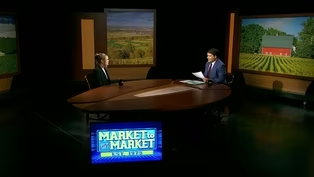
Market Plus with Kristi Van Ahn-Kjeseth
Video has Closed Captions
Clip: S51 Ep5138 | 11m 58s | Three big stories for next week are leading Kristi Van Ahn-Kjeseth in our Market Plus - China, acres (11m 58s)
Providing Support for PBS.org
Learn Moreabout PBS online sponsorship
- News and Public Affairs

Top journalists deliver compelling original analysis of the hour's headlines.

- News and Public Affairs

Today's top journalists discuss Washington's current political events and public affairs.
One Question with Becky Ferguson











Support for PBS provided by:
Market to Market is a local public television program presented by Iowa PBS