NJ Spotlight News
NJ Spotlight News: March 31, 2026
3/31/2026 | 26m 46sVideo has Closed Captions
Watch as the NJ Spotlight News team breaks down today’s top stories.
We bring you what’s relevant and important in New Jersey news and our insight. Watch as the NJ Spotlight News team breaks down today’s top stories.
Problems playing video? | Closed Captioning Feedback
Problems playing video? | Closed Captioning Feedback
NJ Spotlight News is a local public television program presented by THIRTEEN PBS
NJ Spotlight News
NJ Spotlight News: March 31, 2026
3/31/2026 | 26m 46sVideo has Closed Captions
We bring you what’s relevant and important in New Jersey news and our insight. Watch as the NJ Spotlight News team breaks down today’s top stories.
Problems playing video? | Closed Captioning Feedback
How to Watch NJ Spotlight News
NJ Spotlight News is available to stream on pbs.org and the free PBS App, available on iPhone, Apple TV, Android TV, Android smartphones, Amazon Fire TV, Amazon Fire Tablet, Roku, Samsung Smart TV, and Vizio.
Providing Support for PBS.org
Learn Moreabout PBS online sponsorship>> From NJPBS studios, this is "NJ Spotlight News," with Mark Cooper.
>> Hello, and thanks for joining us tonight.
I'm Joanna Gaggis.
Brianna Vannozzi is off.
Coming up in the broadcast, Governor Mikey Sherrill gets the benefit of the doubt.
We'll get you the latest on the poll numbers from FDU on how New Jersey voters think she's doing in her first months in office.
Plus, a $500 million deal to lease a new school in Newark draws controversy.
The developer is a big political donor to the mayor.
And later we talk with a social media expert on the historic verdict against MEDA and YouTube as they're found liable for harming kids on their platforms.
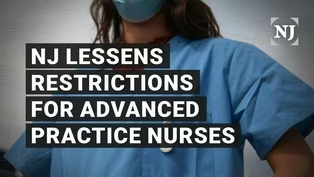
But first, advanced practice nurses now have more freedom to practice health care in New Jersey without the oversight of a physician.
Governor Sherrill signed a law this week that eliminates restrictions for certain APNs, allowing them to prescribe medication, practice primary and behavioral health care, and perform various injections, like IV therapy and cosmetic injections.
This law extends a provision that Governor Murphy had put into place during the COVID-19 pandemic in an effort to expand health care access to residents, especially in rural areas.
Since then, legislators say that more than 45 percent of APNs have practiced without an overseeing physician, without any adverse incidents reported.
And many practices like med spas and surgery centers have opened or expanded their offerings.
But as the time ran out on that provision, those centers that rely on advanced practice nurses were worried they'd have to shut their doors.
This law alleviates that concern.
It applies to APNs with 5,000 hours of clinical practice.
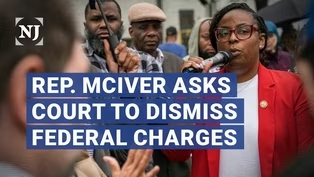
Congresswoman Lamonica McIver is once again asking the courts to throw out the federal assault charges brought against her by the Trump administration's Department of Justice.
McIver's legal team filed a brief this week asking an appeals court to dismiss the charges that stem from a scuffle outside the immigration detention center Delaney Hall in Newark last May.
A lower court declined to dismiss the case.
The assault charges were first brought by former U.S.
Attorney Alina Haba, who accused the congresswoman of interfering with and assaulting federal officers during a scuffle outside Delaney Hall that erupted when Newark Mayor Ras Baraka was arrested.
MacGyver's attorneys argue the incident was part of a congressional oversight visit that grants her immunity, and that the charges were filed purely for political reasons because of her opposition to the Trump administration's immigration crackdown.
If convicted, McIver faces up to 17 years in federal prison.
The government now has 30 days to respond to her request.
Coming up, how do New Jersey voters think Governor Sherrill's doing just a couple months into the job?
We'll get you the latest poll numbers next.
Funding for NJ Spotlight News provided by the members of the New Jersey Education Association.
Making public schools great for every child.
It's been a little more than two months since Governor Sherrill took office, but so far she has the support of most New Jerseyans.
Today, Fairleigh Dickinson University released independent approval poll taken during Cheryl's tenure.
They found that about 6 of every 10 voters approves of the job the governor is doing.
About 34 percent disapprove and 8 percent said they're just not sure.
Let's get into it.
With us now is Dan Cassino, professor of government and politics at Fairleigh Dickinson University and executive director of the FDU poll.
Dan, great to have you with us.
There's a whole lot on the line for Governor Sherrill right now.
She's just beginning to negotiate her first budget.
But what did you hear from New Jersey voters as you polled them?
So we saw that Sherrill's base, you know, Democrats, progressives, liberals, are almost universally behind her.
She has almost 90% approval among those groups.
Now, that's not surprising.
We live in a very polarized time.
People like their own party.
What was surprising is the number of Republicans who gave her reasonable marks at this point.
22% of Republicans said she was doing a good job.
14% of MAGA voters say they approve of the job she's doing right now.
That's really good for Sheryl going into these negotiations when she is going to have to use that sort of political capital to try and get her budget proposal through the legislature in Trenton.
Were there any questions you asked specifically about what it is they approve of what she's done so far or how she's approaching the job?
We don't get into that.
And the reason is that people will give you an answer that really has nothing to do with their actual opinions.
People have lots of opinions.
They don't know where they came from, but they'll tell you lots of stories about it.
Certainly, people would have been telling us about the things that are the big political issues at the moment, about affordability, about opposition to Donald Trump.
That's what they're going to tell us about, even though we don't think that's actually what's driving it, especially since people have relatively little information about the governor at this point because of the tsunami of news that comes out of Washington on a daily basis.
Let me ask you this, you did get granular in terms of how you broke down both political sides.
Help us understand how you broke down the left into three groups and the right into three groups.
Sure, so we actually ask people about their party, Democrat, Republican, Independent.
But then we also ask people how else they would describe themselves.
We give them a whole bunch of words, you know, liberal, moderate, conservative, but also things like libertarian, socialist, nationalist, MAGA voter.
We give them a whole bunch of other options and let them say whatever they want in response to those.
We find that actually gives us a better idea of where voters are standing.
And that lets us break out how progressives are feeling versus how liberals are feeling and how conservatives versus how MAGA voters are feeling.
We've actually seen a significant drop in the number of MAGA voters in New Jersey.
As recently as 2024, before the '24 presidential election, most Republicans in New Jersey said they were also MAGA voters.
Now that's only about 37 percent.
And we've seen a bigger drop among independents saying they're MAGA voters.
It used to be, you know, a large portion of voters in New Jersey were MAGA.
Now it's only about 16 percent of the voters.
And that And I want to clarify, 37 percent of Republicans at the time, or right now, see them, excuse me, 37 percent of Republicans then saw themselves as MAGA.
Right now, only 16 percent of New Jersey voters.
Do I have that right?
No.
So it would be -- it was 54 percent of Republicans back in 2024.
It's now down to about 37 percent of Republicans see themselves as MAGA voters.
It was at one point, I think, in the high 20s percent of MAGA voters overall in New Jersey, and now we're down to about 16 percent.
When we look at Governor Sherrill, obviously, we're just out of two months that she's been in office, not a whole lot of time.
But how do these early kind of benefit-of-the-doubt numbers compare to when Governor Murphy first took office or when Governor Christie first came in.
Yeah, I went and dug up some of the data on our early approval numbers for both Murphy and Christie and these numbers do seem a little bit higher than we had for them.
They're both trending in the mid-50s, 53, 54, 55 percent, so 58 is a little bit higher.
And I think that is mostly driven by the increasing levels of polarization that we have now.
Essentially, Democrats are more likely to say they approve of a Democratic governor than Republicans were under Christie or Democrats were under Phil Murphy.
I think what's going on in Washington has just pushed people into these really hard partisan identities.
I mean, 9% approval among Democrats.
You know, they like everything she's doing.
I would say also the Sheryl administration would push back on the idea that these are just honeymoon numbers.
They've already said, no, no, no, this is a reflection of what Sheryl has already done in office in those two months.
You did talk to voters about whether or not they agree with her approach to the Trump administration.
She has come out swinging since she took office, fighting the Trump administration, both kind of verbally out there in her speeches, as well as action that her attorney general and she are taking.
What did you hear from voters in terms of how they want or whether they want her to work with President Trump?
Yes, we asked voters whether Governor Sherrill should work with President Trump or whether she should defy him.
And surprisingly, we found that even though Democrats by and large want her to defy President Trump, most New Jersey voters are saying they want her to work with President Trump.
Forty-one percent of voters in New Jersey said that she should work with Trump.
Thirty-one percent say that she should defy him.
What's interesting there is the 26 percent who, unprompted, said, "It depends."
And that really points to a view of pragmatism among New Jersey voters.
Basically, they want Sheryl to work with President Trump when she can.
And it's only really a core of the Democratic Party that says, "No matter what he does, we don't want you to work with him.
We want you to defy him."
Dan, this goodwill that the governor has right now is not guaranteed to last.
What could she try to accomplish while she has it?
What should she try to accomplish?
I would go farther than that.
I would say it's guaranteed not to last.
We see this with every elected official.
They are put in office to make hard decisions.
Hard decisions necessarily upset some people.
And so the longer in office, the more people get upset, the more the approval numbers tend to drop.
So while she's got these high approval numbers, this is her political capital to push through the budget, to push the legislation that matters to her and get that done while she still has that high level approval, while she can still kind of bully legislators with those high approval numbers.
Later in the term, it's going to be harder and harder to do that.
All right.
Dan Castino, Executive Director of that FDU poll, thanks for taking some time today.
Always a pleasure.
A new elementary school is coming to Newark.
That might typically be lauded as a positive, but residents in the state's largest city are outraged at the cost of the deal.
$500 million to rent an existing property from a developer who, they say, donated a significant sum to Mayor Rasbaraca's gubernatorial campaign.
Our urban education writer Julie O'Connor has been covering the story and joins us now.
Julie, great to talk to you.
What's happening here?
What can you tell us about this property and the deal that was made with the Newark Board of Education?
There are two elements to this story.
First, during the school board meeting last week, the district of Newark announced this potential lease plan.
It would be half a billion dollars, paying $1 million per month over a 30-year period.
And then the district would not own the building at the end.
It would have the option to purchase the building for an amount that it could negotiate.
And district officials have said, you know, this is about addressing overcrowding in the Ironbound neighborhood, which has been an issue for a very long time.
But district residents and others have raised a few criticisms.
First, I mean, the district's pursuing a very unusual strategy here.
Usually, the state pays to build buildings, school buildings in Newark and other cities, and then the district owns the building at the end.
Here, the district would not own the building, and the district would have to use money from its own budget for the lease instead of the state paying.
And critics are calling the lease price massive.
And the second element of the story is that it turns out that the developer in question, who district officials would not name during the school board meeting last week, was a top donor to Newark Mayor Razzaracca's campaign for governor last year.
I found his name in a public record filing with the state treasury.
His name is Scott Fields.
He owns a trucking company in Newark.
Mayor Razzaracca says that this is unrelated.
He says he had absolutely nothing to do with this deal, that the mayor's office, the city, and the district are completely separate entities.
- Let me jump in there, Julie, because for context, residents are pointing to, and you highlighted in your reporting, the cost of a high school being built, which we know high schools typically tend to be more expensive than elementary schools.
And a new high school, brand new, is estimated to be around $134 million.
So compare those numbers and the differences in what it would look like when you're building a new high school as you start to lay out, versus this rental.
- Yeah, I mean, the cost has raised serious questions.
Newark, for this potential lease deal, would be spending roughly what some districts spend just to educate a student.
Currently Newark spends about $25,000 per student.
But if you think about it, under this lease agreement for a building to house about 667 students, the district would be paying an extra 15 to 20K per student annually for the building alone.
So that has raised serious questions, and so has the process.
I mean, it was a noncompetitive process.
There was no bidding.
The district says that in this type of lease process, they don't need to do bidding.
But it has raised a lot of questions among Newark residents and others outside of Newark.
This is a four-story building.
The address is 56 Freeman Street.
As you said, 667 students.
This is not the first time that the Newark Board of Education has come under fire for spending.
I know in, I think, just two years ago, they had to return $33,000 to the state for money that they spent on a staff fund day.
Have you heard anything from state officials in terms of responding to this deal or anything from any elected officials saying this is not a wise use of property tax dollars in the state?
The bigger issue here, I mean the larger debate, is that currently the governor and the legislature are hashing out the budget.
They have to do that before July 1st.
And Newark, you know, for urban districts, usually the state pays to build buildings and also the state tends to give more aid to urban districts for schools.
And that's because of court rulings that have said that in low wealth communities that have a smaller property tax base, the state still has the obligation to provide a decent education for kids.
And it has the responsibility to make up that gap.
And so, you know, Republicans who are upset about cuts to suburban district, budget cuts to suburban districts, which are getting less state aid, are pointing to this lease, potential lease agreement as an example of what they argue is wasted spending in Newark.
And so that's why Newark and this deal have particularly come under fire.
Yeah, and of course, the schools development authority is typically the one that handles the entity that handles new building and it can be a very, very slow process.
There are many districts that feel that they don't have repairs to their buildings that are needed or new buildings built.
But going back to the mayor's response to this, yes, Scott Fields was a major donor, $92,500 to his campaign.
Again, he says, this has nothing to do with me.
What are residents saying?
Residents wonder.
I mean, the mayor says, you know, he says it had nothing to do with me.
Look, I don't -- he says I don't talk to the superintendent or to the school board about lease agreements or real estate deals or contracts.
He says that the mayor's office, school board, totally separate entities.
But I think residents are wondering just in general, like, why was Scott Fields picked?
This was a noncompetitive process.
Did it have anything to do with his political connections in the city?
And also, they're just raising big questions about the price of the lease.
Is this an appropriate amount, or is it too much?
And if it's too much, why is it too much?
Why is the district looking to make this agreement that would cost so much more than just waiting for the state money to come in?
And the district, of course, says that it doesn't want to wait, that overcrowding is a serious concern, and that it needs to move ahead quickly to create a new school building.
Conceivably, they could build four buildings for the amount that they're spending on this lease.
Where is the deal right now?
Is it a done deal?
Is it signed, sealed, delivered?
It's not a done deal.
I believe that the school board will, you know, they've sent it to the Office of the State Comptroller, to the DOE for review, and then I believe there will be a final vote by the district.
All right.
Julie O'Connor, our urban education writer, thanks as always.
Thanks Joanna.
A landmark verdict was reached last week that found Meta and YouTube are liable for harming kids with their social media platforms.
Meta is the company that owns Facebook and Instagram.
The case was first brought by a young woman named Kaylee, who accused the companies of intentionally addicting young people with their algorithms.
A jury agreed and awarded Kaylee a total of $6 million in damages for the mental health harms she suffered as a result.
And a separate case in New Mexico also found MEDA liable for harming kids' mental health and safety.
These decisions are likely to have massive impact on future cases brought against the companies.
I'm joined by a podcaster who's been covering it all the risks these sites pose to children.
Her name is Nikki Petrosi and she's the founder of Scrolling to Death.
Nikki, thanks so much for joining us.
Great to have you on the show.
Thank you for having me.
There's a lot of emotion tied to this verdict that came in.
What were you feeling as you watched it come down?
I was in the courtroom as they went through all of those yeses and we definitely didn't expect to win on every count.
This was a test case.
This was the first case to be tried of thousands.
And usually we don't win, the plaintiff doesn't win these test cases in the bellwether consolidated format.
And so we weren't expecting it.
There was a lot of emotion.
Many different parents were in that courtroom who have lost children to social media harms and just the physicality of receiving that news, the jolting of the news and the emotion behind that.
It was a lot to process.
I feel like it's still settling in today.
Can you go through some of the counts that came in as guilty?
Absolutely.
And so Meta and YouTube were both negligent in the design or operation of their platforms.
This negligence was a substantial factor in causing harm to the plaintiff, Kaylee.
Meta and YouTube both were found to have reasonably known that the design of their operation was dangerous when used by a minor, and that they did not warn users.
There was a fail to adequately warn of the danger.
Again, this failure to warn was a substantial factor in causing harm to Kaylee.
And even further, there was punitive damages decided on.
And so what was found was that YouTube and Meta were negligent in the design of their platform.
These companies were shown through clear and convincing evidence to be acting with malice, oppression or fraud in the conduct of their business practice.
And so they were found to be a danger to society and were punished through additional damages.
Nikki, through your podcast and just through your coverage on social media, you interact with countless parents.
You talked about those who are in the courtroom.
Can you just bring to life a couple examples of how young people have been harmed by these algorithms, by these policies?
There are so many different ways.
I think most importantly, the addiction to the platform.
So these companies' internal documents showed that they were developing different functionality to addict young people.
They were actually studying the young teenage brain, pointing to areas of the brain within the slides and labeling them as opportunities in order to addict young people.
And so that has been shocking to see the internal documents, but then we have actual families in that courtroom whose children were so damaged by these platforms and so addicted to them in addition to being served content that glorified suicide, that glorified eating disorders, that connected them with predators, connected them with drug dealers who sold them a pill made with fentanyl.
And so there are so many ways that these platforms are harming children and parents who've lost those children are rising up everywhere and celebrating this verdict but also hoping for more change.
That's my next question because while we have this verdict and in one case there were damages that were provided, does this get to the heart or to the root of changing these companies practices moving forward?
So unfortunately when one family brings a case against companies like this there is an award, there's damages awarded but what we want is these companies to change their harmful platforms, right?
And that's not something that a one single family can enforce and so what we're going to see with the larger lawsuits coming from state attorneys generals and also from school districts, thousands of school districts have also sued these same companies, we're going to see injunctive relief awarded and that means that the companies will be forced to make their platforms safer, remove the addictive functionality, and so we will see changes on that level in addition to lawmakers all over the country are drafting bills to try to get those passed to force the companies to make these changes.
And then just looking at legal precedent, there are, as you're talking about cases that have been filed, we know there are thousands of cases out there right now.
Does this legal precedent then set up a greater potential for win in those cases as well?
Each individual case has to be tried individually with a jury based on the evidence in that case.
But that's not to say that societally knowledge about these harms and what we're seeing in those internal documents isn't reaching the feeds of everyday people and they will take that information with them as they look at these cases.
And so we do think that this will be a snowball effect of wins and we are so excited about that because what we all want are the companies to be protecting children instead of exposing them to harm.
We're talking right now about Meta and YouTube.
Those are the two that were, that the case found guilty, but also Snap and TikTok settled with the plaintiff prior to this going to trial.
Are they now, let me ask it this way, are they exempt now from any liability?
- That is a great question and thank you for asking because no, they are still defendants on the thousands of other cases.
They just settled this one case.
And in actually what I heard from the plaintiff attorney Mark Lanier is that in this case with KGM, with Kaylee, TikTok and Snapchat were amplification defendants, meaning that she started using those platforms much later and a lot of the harm occurred once she started using YouTube and Meta's platforms.
And so in this case, it was more direct to focus on the platforms that harmed her more.
But Snapchat and TikTok are very much still defendants that will be looked into on the next case and the thousands following.
I have to ask, so much of your coverage is focused on what's happening in these legal cases.
But is there any signal that there could be congressional oversight here?
Any legislative response to what these companies have now been proven to be doing?
Absolutely.
And advocacy groups all over the country have been sending these internal documents directly to lawmakers.
I know we've been in contact with many who are drafting bills right now, but there's also a lot of pressure from the big tech companies.
They're spending over $50 million a year lobbying against online safety bills that would protect children.
And so we're fighting a big fight there.
And I really am hopeful that lawmakers will step up and do the right thing.
I just want to talk to you quickly about your podcast Scrolling to Death.
How did this start?
How did you get involved in this work?
Thank you.
So I used to have my own social media management company.
So I was on the other side of this managing social media and you know flip the script back in 2023.
There was a surgeon general's warning stating that when kids or young people spend more than three hours on social media, it doubles their risk of anxiety and depression.
And I thought that was a really important thing for us to know.
And I also started learning about parents who were alleging that their children died because of something that happened on social media.
And I thought this was so important, given that kids are asking for access younger and younger that we need to have all the information at hand as parents before we make those choices so that we can protect them.
My goal was to create a safe space to share information in a productive way just to educate parents.
You talk about kids who are dying and I know you just posted recently about the blackout challenge that's been around for years.
It's not even new.
What were you highlighting there in terms of these types of videos?
Right, so another child had passed away from the blackout challenge or the choking challenge.
And this was a nine-year-old who saw it on social media.
And the thing is that kids are going to post things, people are going to post things, and these companies, due to a 30-year-old law, can't be held liable for what gets posted on the platforms.
But unfortunately, these companies are pushing harmful content to young children.
And so this young nine-year-old girl named Jacqueline, I believe in Texas, was pushed through the algorithm a choking challenge video, which then led her to try it, and she unfortunately passed away.
And I've been interviewing parents, parent survivors of choking challenge victims for many years.
And so the companies are aware that this type of dangerous deadly challenge is so prevalent on their platforms and they have the technological ability to remove it.
And they obviously are not, given that we are still losing children to this devastating challenge.
>> Yeah, something you continue to highlight.
Thank you so much for all of this insight.
I really appreciate you coming on to talk about it.
Thank you so much.
Alright, that's going to do it for us tonight.
I'm Joanna Gagas.
For the entire team here at NJ Spotlight News, thanks for being with us.
We'll see you right back here tomorrow.
NJM Insurance Group.
Serving the insurance needs of residents and businesses for more than 100 years.
Look at these kids.
What do you see?
I see myself.
I became an ESL teacher to give my students what I wanted when I came to this country.
The opportunity to learn, to dream, to achieve, a chance to belong and to be an American.
My name is Giulia Torriani-Crompton and I'm proud to be an NJEA member.
[Music]
 New
NewMcIver asks court to dismiss Delaney Hall assault charges
Video has Closed Captions
'I am not backing down, even as this administration tries to intimidate me,' says McIver (1m 13s)
 New
NewNew Jersey advanced practice nurses gain more independence
Video has Closed Captions
Law gives highly trained professionals freedom to work without physician oversight (1m 13s)
Providing Support for PBS.org
Learn Moreabout PBS online sponsorship
- News and Public Affairs

Top journalists deliver compelling original analysis of the hour's headlines.

- News and Public Affairs

FRONTLINE is investigative journalism that questions, explains and changes our world.
One Question with Becky Ferguson











Support for PBS provided by:
NJ Spotlight News is a local public television program presented by THIRTEEN PBS