
How spike in gas prices could ripple through global economy
Clip: 3/31/2026 | 8m 18sVideo has Closed Captions
How the spike in gas prices could ripple through the global economy
The steep rise in gas prices amid the Iran war is the second-largest spike in three decades, and it's hitting Americans' wallets. We hear from people scrambling to fill their tanks and William Brangham discusses how bad a shock this war could deliver to the global economy with Cliff Kupchan, chairman of the Eurasia Group, an international consulting firm.
Problems playing video? | Closed Captioning Feedback
Problems playing video? | Closed Captioning Feedback
Major corporate funding for the PBS News Hour is provided by BDO, BNSF, Consumer Cellular, American Cruise Lines, and Raymond James. Funding for the PBS NewsHour Weekend is provided by...
Support provided by:

How spike in gas prices could ripple through global economy
Clip: 3/31/2026 | 8m 18sVideo has Closed Captions
The steep rise in gas prices amid the Iran war is the second-largest spike in three decades, and it's hitting Americans' wallets. We hear from people scrambling to fill their tanks and William Brangham discusses how bad a shock this war could deliver to the global economy with Cliff Kupchan, chairman of the Eurasia Group, an international consulting firm.
Problems playing video? | Closed Captioning Feedback
How to Watch PBS News Hour
PBS News Hour is available to stream on pbs.org and the free PBS App, available on iPhone, Apple TV, Android TV, Android smartphones, Amazon Fire TV, Amazon Fire Tablet, Roku, Samsung Smart TV, and Vizio.
Providing Support for PBS.org
Learn Moreabout PBS online sponsorshipWILLIAM BRANGHAM: The steep rise# in gas prices because of this war## is the second largest spike in three# decades, and it is hitting Americans'## wallets.
Many have told us how they're# now scrambling to fill their own tanks.
SAMANTHA LOTT, Texas Resident: My name is# Samantha Lott.
I currently live in Denton, Texas.
JAMES LAWRENCE, Nebraska Resident: I'm# Jim Lawrence.
I live in Omaha, Nebraska.
ALEXIS MIMS, Texas Resident:# My name is Alexis Mims.
JAMIE PARDAU, Hawaii Resident: My name is Jamie# Pardau.
And I live in.. JONATHAN TIPTON MEYERS, California# Resident: I'm Jonathan Tipton## Meyers.
I'm a full-time rideshare driver.
As soon as this war started, gasoline# prices jumped up minimum 50 cents,## but in certain areas it was a dollar as well too.
JAMIE PARDAU: My husband and I are making# an effort to combine any trips that we## take into town or to stores, so that we# aren't driving unnecessarily.
I don't## think it ever occurred to me that# our gas would be over $5 a gallon.
ALEXIS MIMS: We are -- we are struggling.
Now## it's not just the groceries that are expensive,# but now it's the gas that is out of control.
SAMANTHA LOTT: I am a community mental# health social worker.
As I'm sure you know,## I do not make a lot of money.
And so having# to use my own car and drive a lot around two## different counties, I'm buying a lot of gas.# Then, in order to make ends meet as well,## I have to deliver groceries on the# side in the evenings and the weekends.
I'm filling up my tank every other# day, and I'm having to pay like $40 to## $50 to do so.
Any money that I get from# my daytime job is usually a month late## for reimbursement.
And so I'm having to# figure out how to make that money stretch## and like what kind of food am I going# to eat this month, that type of thing.
It's really anxiety-ridden right now times for# me and a lot of other people, especially people## that are single and are having to pay all of their# household costs themselves.
It's really difficult.
JAMES LAWRENCE: Right now, my income is tied# to the market.
So, it's in my retirement## accounts.
And so with the volatility of# gas goes the volatility of the market,## and one goes up, and your bank balance goes down,## and that really is the most concerning thing# about the future.
All of this needs to stabilize.
JAMIE PARDAU: In Hawaii, so much of what we# have purchased in the stores is imported,## and so it isn't really just the cost# of gas that is going to impact our## community.
It's going to be the# cost of just about everything.
JONATHAN TIPTON MEYERS: We're constantly trying# to calculate whether a ride can actually be## profitable for us.
So if you add on an increased# gas price, it just makes making those decisions## even more difficult.
And at the end of the month,# that's a significant raise in your actual price,## in your anxiety, in your ability to drive# safely and maintain your car and do your job.
ALEXIS MIMS: My son is three hours# away in college, and my daughter is## 30 minutes away.
The amount of gas is too# much to go ahead and travel at this time,## so we are forgoing plans for any type# of get-togethers.
But, thankfully,## we have modern technology, so for# now we just keep in touch that way.
SAMANTHA LOTT: I don't really do a lot of things# other than work, just because I can't afford to,## and that's really sad, because in# order to have a well-balanced life,## people need to be able to go do things,# support local businesses, hang out with## their friends.
And those are kind of luxuries# at this point that I just truly can't afford.
WILLIAM BRANGHAM: So how long are# gas prices expected to stay high,## and, more broadly, how bad a shock will# this war deliver to the global economy?
For that, we turn again to Cliff Kupchan.# He is chairman of the Eurasia Group,## which is an international consulting firm.
Cliff, so good to have you# back on the "News Hour."
So you have heard from these people about how# difficult it is for them just to fill their tanks.## Gas is over $4 a gallon, Brent crude at over 118# a barrel.
If this war continues, as the president## said tonight, even for a couple more weeks or# maybe longer, how much worse could this get?
CLIFF KUPCHAN, Research Director,# Eurasia Group: It could get a lot worse.
The Strait of Hormuz is so critical to the# international economy, for oil, for LNG, for## helium, for chips, for food, for fertilizer.
It is# just a choke point for the international economy.## I don't think that, for the foreseeable future --# I think this war, I think, is going to get worse.
Judge President Trump by his actions, which# is sending more equipment to the Gulf,## not by something he might have said today# about caring about opening the Gulf.
So I## think this is going to be a stranglehold on the# economy.
It's going to rise prices and raise## prices in many sectors and stoke inflation in# countries around the world.
It's a real problem.
WILLIAM BRANGHAM: You touched on a few# of those other products that come through## the Gulf.
Apart from energy supplies, what# other industries will those mostly affect?
CLIFF KUPCHAN: Well, again, helium, which is# critical to making advanced chips for A.I.,## aluminum, petrochemicals, fertilizer,## and food prices.
Those are the# main ones.
But that's a whole lot.
And especially for countries that import food,## it's going to be a real battle to keep the books# balanced and to keep inflation under control.
WILLIAM BRANGHAM: Do you think that# consumers, or maybe even more importantly,## the market has taken on board this# idea that this could get so much worse?
CLIFF KUPCHAN: No.
Unfortunately, I think that markets, which I can# sp.. but markets have had their head in the sand.# I think markets still have their head in the## sand.
The market rally today, in part on# President Trump's comments that he could## end the war without opening the Strait of# Hormuz, that's just really wishful thinking.
President Trump also sent a third aircraft# carrier to the Gulf today.
He's sending more## troops to the Gulf.
It's -- I think markets are in# denial that there's a strong chance we get ground## forces in Iran and that prices go up even further# towards the $130 level, $130 a barrel for Brent.
It's going to get bad.
WILLIAM BRANGHAM: Do you really believe,# judging by what you're saying, that.. conflict will escalate, that, despite# what the president has been saying... CLIFF KUPCHAN: I do.
I do.
President Trump has -- again, I'm not going to put# a judgment on it, but he's now attacked Iran twice## in the middle of ongoing negotiations.
I think# that, as an analyst, it's just not useful to track## his day-to-day words.
It's much more useful to# track the administration's day-to-day movements,## which is putting men and a whole lot# of metal and hardware into the region.
So I -- yes, I think it's going to get worse.# It may not gone more than two or three weeks,## but I think we're going to see a lot# of combat and bombing before then.
WILLIAM BRANGHAM: The president# again reiterated this point that,## if nations are not willing to help reopen# the strait and they're thirsty for more oil,## that they ought to just buy that oil from the# United States.
Is that a realistic exchange?
CLIFF KUPCHAN: No.
Global markets a.. Energy prices are going to stay high as# long as the Strait of Hormuz is closed,## and alternative sources are hard to# come by, especially for LNG.
So the## president's comments really don't speak# to how energy markets work, unfortunately.
WILLIAM BRANGHAM: All right, that is# Cliff Kupchan of the Eurasia Group.
Always great to hear from you.# Thank you so much for being here.
CLIFF KUPCHAN: Thank you, sir.
 New
NewBlackouts raise alarm as Iran fears infrastructure strikes
Video has Closed Captions
Tehran power outages raise alarm as Iranians fear strikes on critical infrastructure (3m 42s)
 New
NewCommunities rebrand César Chavez Day after abuse allegations
Video has Closed Captions
Communities rebrand César Chavez Day as abuse allegations taint his legacy (5m 37s)
 New
NewNews Wrap: Judge halts White House ballroom construction
Video has Closed Captions
News Wrap: Judge orders halt to Trump's White House ballroom construction (7m 16s)
 New
NewSupreme Court rules against Colorado conversion therapy ban
Video has Closed Captions
Supreme Court sides with therapist challenging Colorado ban on conversion therapy (7m 5s)
 New
NewTrades, pardons spark questions over presidency profits
Video has Closed Captions
Prediction markets, pardons spark questions over who’s profiting from Trump’s presidency (7m 12s)
 New
NewTrump lashes out at allies as Iran war chokes key oil route
Video has Closed Captions
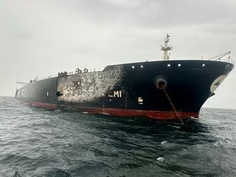
'Go get your own oil': Trump lashes out at allies as Iran war chokes key oil route (4m 42s)
 New
NewWashington National Opera leaves Kennedy Center for new home
Video has Closed Captions
Washington National Opera finds new stage after split with Kennedy Center (7m 42s)
Providing Support for PBS.org
Learn Moreabout PBS online sponsorship
- News and Public Affairs

FRONTLINE is investigative journalism that questions, explains and changes our world.

- News and Public Affairs

Amanpour and Company features conversations with leaders and decision makers.
One Question with Becky Ferguson











Support for PBS provided by:
Major corporate funding for the PBS News Hour is provided by BDO, BNSF, Consumer Cellular, American Cruise Lines, and Raymond James. Funding for the PBS NewsHour Weekend is provided by...