
Pope Leo calls for stronger regulation of AI
Clip: 5/25/2026 | 7m 36sVideo has Closed Captions
Pope Leo warns AI should be 'disarmed' in manifesto on potential dangers
Pope Leo called for artificial intelligence to be “disarmed” in his first papal encyclical, urging major regulation to protect against potential risks, including war and economic dislocation. Amna Nawaz discussed more with Christopher Hale, who writes “Letters from Leo” on Substack.
Problems playing video? | Closed Captioning Feedback
Problems playing video? | Closed Captioning Feedback
Major corporate funding for the PBS News Hour is provided by BDO, BNSF, Consumer Cellular, American Cruise Lines, and Raymond James. Funding for the PBS NewsHour Weekend is provided by...
Pope Leo calls for stronger regulation of AI
Clip: 5/25/2026 | 7m 36sVideo has Closed Captions
Pope Leo called for artificial intelligence to be “disarmed” in his first papal encyclical, urging major regulation to protect against potential risks, including war and economic dislocation. Amna Nawaz discussed more with Christopher Hale, who writes “Letters from Leo” on Substack.
Problems playing video? | Closed Captioning Feedback
Where to Watch PBS News Hour
PBS News Hour is available to stream on pbs.org and the PBS app.
Providing Support for PBS.org
Learn Moreabout PBS online sponsorshipAMNA NAWAZ: Pope Leo called for artificial intelligence to be disarmed in his first papal encyclical, calling for major regulation to protect against potential risks, including war and economic dislocation.
POPE LEO XIV, Leader of Catholic Church: Artificial intelligence needs to be disarmed.
The word is strong, I know, but deliberately chosen because this moment needs words capable of attracting attention, awakening consciences, and indicating paths forward for humanity.
AMNA NAWAZ: Leo signed the text on May 15, 135 years after his namesake, Pope Leo XIII, signed his own transformational document on workers' rights during the Industrial Revolution.
For nearly 400 years, popes have used encyclicals to impart Catholic teachings.
In his more-than-42,000-word text, Leo wrote -- quote -- "It's not enough to invoke ethics in the abstract.
Robust legal frameworks, independent oversight, informed users, and a political system that does not abdicate its responsibility are required.
A more moral A.I.
is not enough if that morality is determined by a few."
I'm joined now by Christopher Hale, who writes Letters From Leo on Substack.
Welcome.
Thanks for being here.
CHRISTOPHER HALE, Editor, Letters From Leo: Thank you for having me.
AMNA NAWAZ: So, you wrote that line, Leo's line calling for A.I.
to be disarmed, is the line to remember from his papacy.
Why?
CHRISTOPHER HALE: When he first got elected on May 8, 2025, he said that he wanted a peace that was unarmed and disarming.
So this phrase is something he uses again and again and again.
I think it's noteworthy that he used that phrase to describe peace, because the biggest part of this encyclical was not theology.
It was not even economics.
It was war.
CHRISTOPHER HALE: He's very concerned about the use of A.I.
in war in particular.
So I think it's a very good description of what he's hoping for.
AMNA NAWAZ: Who do you think he was talking to in delivering that message?
CHRISTOPHER HALE: I really think there was really two main audiences.
It was the government here in Washington and around the world and Silicon Valley itself.
Christopher Olah, of course, was there in the room with him.
Anthropic had that infamous fight with a Pentagon in February, and the White House ended up blacklisting them for government contracts.
I think that Pope Leo XIV, from my sourcing, found that Anthropic was courageous in that decision and standing up to the government.
But there's also a third source I think he's speaking to as well that's getting a little less attention.
He's really speaking to consumers.
He wants us on our phones less.
He wants face-to-face encounters.
He wants children and families to have dinner without phones, so a little less screen time.
So he's talking to everyone, in fact.
AMNA NAWAZ: I want to jump into a little more of what Pope Leo had to say, but you mentioned Christopher Olah.
And we should note here that there were some pointed critiques of A.I.
companies in Pope Leo's remarks.
Despite that, Anthropic co-founder Chris Olah, as you mentioned, was invited to be there and to speak.
Here's a part of what he had to say.
CHRISTOPHER OLAH, Co-Founder, Anthropic: A.I.
development is concentrated in a handful of wealthy nations.
How will we ensure that the gains of A.I.
are shared globally?
We do not have a mechanism for this.
It is an unsolved problem.
And it is the kind of problem the church has historically refused to let the world ignore.
AMNA NAWAZ: Why invite Olah to the Vatican and what did you take away from his remarks?
CHRISTOPHER HALE: I think that the reality of it is, is the church cannot be Luddite.
They can't simply reject technology.
A lot of people were hoping actually for harsher critique of A.I.
and -- but Leo XIV says that A.I.
is in fact inevitable and we need to find good actors to play with.
And I think he saw in Christopher Olah, quite frankly, unlike some of his competitors, someone who is willing to play ball with ethics.
I have been working in this industry for a long time.
Really, the Vatican has been doing this for a decade reaching out to A.I.
companies.
And more than anyone else, Anthropic has played ball, unlike its competitors.
AMNA NAWAZ: There were, as you mentioned, some big existential views on what war in particular.
Pope Leo talked about the use of A.I.
in war as a sin, a betrayal of the just war doctrine.
What did you make about the way he talked about that, the just war doctrine?
Folks will remember there was a lot of back-and-forth about this when Vice President J.D.
Vance criticized the pope for weighing in on the war in Iran.
What did you take away from it?
CHRISTOPHER HALE: The American people are definitely getting a theology lesson, St.
Thomas Aquinas, St.
Augustine coming up again and again.
I think what he was saying is just war doctrine really is a six-centuries old tradition that didn't really imagine a world where human actors were not being the ones to make decisions.
Pope Leo XIV is aghast by war.
He was very aghast by the beginning of the war in Iran, when 168 children were killed at that school in Iran, from forward.
But I think that he actually thinks there's two levels of war.
There's the atrocity of war waged by humans.
But I think he finds the idea of war waged by machines against human to be even more of an atrocity.
So he wants the Catholic social justice theory, a just war theory to really address this head on going forward.
AMNA NAWAZ: It was striking the way the encyclical covered so many concerns around A.I.
about risks to children and society and so on.
He also wrote this.
He said: "The pursuit of greater profits cannot justify choices that systematically sacrifice jobs."
What exactly is the pope calling for here?
CHRISTOPHER HALE: I think he's calling for regulation, much to the chagrin of many in Washington.
J.D.
Vance famously goes to Europe in February 2025 at the beginning of his term and says we need to stop talking less about guardrails and disruption and talk more about innovation.
And Pope Leo XIV is saying actually we do need to talk about guardrails.
We do need to talk about disruption.
Leo XIII was really concerned about the Industrial Revolution, what it would do to workers.
It really gave birth to the labor movement and to labor unions.
I think Leo XIV is looking for some kind of social movement as well, again, safeguarding against the atrocities that might come from economic dislocation due to A.I.
AMNA NAWAZ: Separate from A.I., we do need to note that the pope made an historic apology for the Vatican's role in legitimizing slavery, for the failure to condemn it for hundreds of years.
He called it a -- quote -- "wound in the Christian memory, one from which we cannot consider ourselves detached."
That's a very big moment for the church.
Why this moment and why make that message in this way?
CHRISTOPHER HALE: You know, he is the first U.S.-born pontiff.
He knows, in the flesh, in his own experience, his own demographics, his own roots the effects of American slavery.
And so I think it's twofold.
I think he realizes it's the 250th anniversary of his home country, and we're not hearing a lot about the failures and sins of the American past in our own government.
So I think he's actually putting his voice out there as a moral leader globally.
But also it's very clear that he sees that there could be affronts to human dignity not dissimilar to slavery coming forth in this era as well.
And I think he fears that A.I.
could exasperate that problem.
AMNA NAWAZ: He did announce very early in his papers that he considered A.I.
to be the biggest challenge facing humanity today.
Wrap up everything you heard in the encyclical today, everything you read, and in terms of how it informs his papacy moving forward.
CHRISTOPHER HALE: You know, Pope Leo XIV is a consumer of Western media.
He's the first pope to own a cell phone, to own an Apple Watch, to send an e-mail.
So he experiences the technological revolution in the flesh.
So when he was writing this document, he was not writing about something he read about.
He's writing about something he's experienced.
And so I think his own experience informs us.
And he's concerned not just for humanity, but for our posterity.
He is the pope of our children.
And that's, I think, his biggest concern.
AMNA NAWAZ: Christopher Hale, man behind the Letters from Leo Substack, great to have you here.
Thank you so much.
CHRISTOPHER HALE: Thank you for having me.
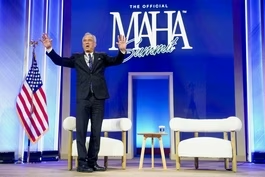
MAHA backers grow frustrated with Trump's health policies
Video has Closed Captions
Some MAHA backers grow frustrated with Trump's health policies (8m 5s)
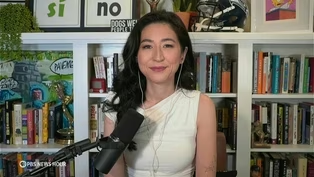
Mina Kimes on hosting the Scripps National Spelling Bee
Video has Closed Captions
Mina Kimes on the 'big game feel' of the Scripps National Spelling Bee (6m 31s)

News Wrap: Calif. chemical tank no longer explosion risk
Video has Closed Captions
News Wrap: Southern California chemical tank no longer a threat to explode (5m 38s)
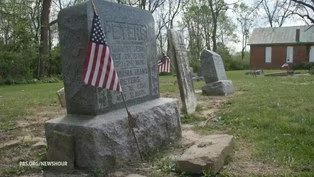
Ohio volunteers locate graves of Revolutionary War veterans
Video has Closed Captions
Ohio volunteers locate and honor graves of Revolutionary War veterans (9m 18s)
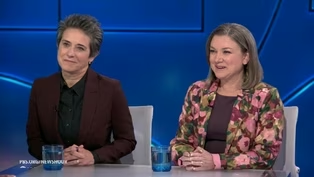
Tamara Keith and Amy Walter on direction of DNC leadership
Video has Closed Captions
Tamara Keith and Amy Walter on Democrats concerned about direction of DNC leadership (8m 38s)
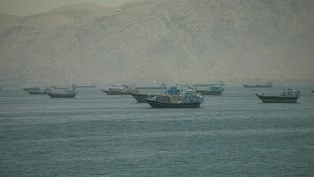
U.S. and Iran suggest peace progress, but deal not imminent
Video has Closed Captions
U.S. and Iran suggest progress on peace talks, but deal ‘not imminent’ (5m 54s)
Providing Support for PBS.org
Learn Moreabout PBS online sponsorship New Episode
- News and Public Affairs

Today's top journalists discuss Washington's current political events and public affairs.

- News and Public Affairs

FRONTLINE is investigative journalism that questions, explains and changes our world.
One Question with Becky Ferguson
 New Episode
 New Episode
 New Episode


 New Episode
 New Episode
 New Episode
 New Episode
Support for PBS provided by:
Major corporate funding for the PBS News Hour is provided by BDO, BNSF, Consumer Cellular, American Cruise Lines, and Raymond James. Funding for the PBS NewsHour Weekend is provided by...