
The Tehachapi Railroad Loop Still Powers California Trade
Clip: Season 9 Episode 1 | 8m 40sVideo has Closed Captions
The railroad loop that transformed California trade.
The Tehachapi Loop is one of California’s most important feats of railroad engineering. Built in the 19th century, it allows trains to climb steep mountain terrain by looping over themselves. Still in use today, the loop remains a vital link in the state’s freight network, connecting regions and supporting the movement of goods across California.
Problems playing video? | Closed Captioning Feedback
Problems playing video? | Closed Captioning Feedback
Lost LA is a local public television program presented by PBS SoCal
The Tehachapi Railroad Loop Still Powers California Trade
Clip: Season 9 Episode 1 | 8m 40sVideo has Closed Captions
The Tehachapi Loop is one of California’s most important feats of railroad engineering. Built in the 19th century, it allows trains to climb steep mountain terrain by looping over themselves. Still in use today, the loop remains a vital link in the state’s freight network, connecting regions and supporting the movement of goods across California.
Problems playing video? | Closed Captioning Feedback
Where to Watch Lost LA
Lost LA is available to stream on pbs.org and the PBS app.
Providing Support for PBS.org
Learn Moreabout PBS online sponsorshipDoug, Tehachapi is a town about 70 to 80 miles as the crow flies north of Los Angeles.
A lot of Southern Californians maybe have never even been here.
No, they can't spell it, that is a sure thing.
Yet this is one of the most important places in the history of Southern California.
The modern metropolis of Los Angeles might never have come into existence without a single feat of engineering.
In 1876, the Transcontinental Railroad finally crossed the mountain ranges that divided Southern California from the rest of the country, and it changed everything.
I'm headed to the Tehachapi Depot Museum up in Kern County to meet with local historian Doug Pickard.
Well, come on up here, and I'll show you some more of what we have here.
This is a railroad map of the State of California.
Most Californians know there's the big Central Valley surrounded by mountains.
The first Intercontinental Railroad or Transcontinental went over Donner Pass, Truckee, and went to Omaha.
This was 1869, the Transcontinental Railroad.
Correct.
As soon as they finished that, they knew they wanted to build down towards Los Angeles and Southern California.
They started building our railroad here.
There were several different choices of how to get over the mountains, but Tehachapi was deemed the best choice.
Because the Sierra Nevada is just such an imposing mountain range.
Right.
When this railroad going south was originally chartered with the government, it was to go through Tehachapi and then go over to the Colorado River.
In 1872, the citizens of Los Angeles, they voted $600,000 plus an already existing LA and San Pedro Railroad that they were going to give them to change the route and build into LA.
I shouldn't use the word bribe, but I think it was a- Yes, an incentive.
We could call it an incentive.
They did effectively bribe the railroad company into making Los Angeles a terminus, which was a huge decision in the history of LA.
This is a big bell.
-Yes.
It weighs over 300 pounds.
We have the documentation that it was put on an engine that was built in 1913 for the Union Pacific Railroad.
It's not working.
[bell ringing] It works.
That's more of an outdoor bell.
[music] Nathan, I'd like to introduce Mark McGowan.
-Mark, pleased to meet you.
-Pleased to meet you.
Mark went to high school in Tehachapi and went to work for the railroad.
He was a signal maintainer, I think, if I got that right.
Signalman, yes.
You explain these, tell what they do and stuff, and I'll go in and see if I can make them work.
Cool.
Mark, I've been to a lot of gardens, but I think this might be my first signal garden.
All of these signals belong to my first boss, whose name was Bill Stokoe.
These were all, at one time, in his backyard.
They donated them to the museum.
They have been put back.
These all worked in Bill's backyard, and they all work here.
The signals Mark showed me were once part of the vast network of track connecting Southern California to the rest of the nation.
There's just one problem with train history.
You never quite know when history is going to come rumbling through.
[train horn] I didn't see the engine to know which train it is.
You can feel the train moving here.
Oh, yes.
If you had a seismometer, that would register.
The spot where two sets of tracks met in 1876, on a homestead in the Santa Clarita Valley known as Lang Station, is celebrated as California's golden spike moment.
None of it would have been possible without a feat of engineering some 50 miles to the north, where the railroad had to climb nearly 4,000 feet through the Tehachapi Pass.
Tehachapi is actually the most important piece of track built for Southern California's history because it was the most challenging.
Yes.
An engineer by the name of William Hood, who had got his experience building the first cross-country railroad up by Donner Pass, they put him in charge of building the railroad down through here.
He had a certain limiting grade.
He just added a whole bunch of climbing track around in a circle, which has become known as the Tehachapi Loop.
Like switchbacks if you're on a hiking trail or a mountain road.
Trains are just so much more sensitive to grades than automobiles, right?
-Oh, yes.
The iron or steel would just slip.
Amazingly, do you know that all these engines carry sand?
If the wheels start to slip, he can push a button, and it'll put sand in front of the wheel.
If that's not the problem, what is?
Just too much power?
The amount of power.
Yes.
He had learned from experience that there was a certain angle.
He shouldn't make it any steeper.
2.2%.
Going downhill, it's just as bad.
You don't have brakes.
Enough brakes.
Maybe even worse, really.
Back in the old days, they would have a man riding on top of each car.
If the engineer needed brakes, he'd blow the whistle, and the guys would all go trying to put the brakes on by hand on each car.
-They're called brakemen, right?
-That's right.
People come from all over the world that are train nuts to see the loop.
Well, let's go take a look at the real thing.
Works for me.
Doug took me to a spot on the old highway between Tehachapi and Keene, a vantage point that hasn't changed much in 150 years, to see the loop for ourselves.
When you look at it here in person, you can really see that this was a huge undertaking, as was most of the construction of the Transcontinental Railroad and then the linkage between Northern and Southern California.
Manual labor.
The people who played a big role in that were people who weren't even citizens of this country, and in many cases weren't even permanent residents.
They had come over here to Gold Mountain to raise money for their families and send it back home.
They worked here in really harsh conditions and did the most dangerous work on this railroad.
We're talking about the Chinese laborers.
-Yes.
Go back to not our railroad, but the first Transcontinental.
There were two different companies.
One company was in Omaha, building to the west, the Union Pacific.
Central Pacific was going to the east.
The Union Pacific, they had available to them all the railroad construction workers that had built already to Omaha, so they had a huge pool of labor.
The people here on the West Coast, we didn't have any pool of labor at all.
There were Chinese people that were willing to work.
If we go back to those original days when they were building this track for the first time, all of the food, all of the construction supplies had to be trucked up here on a wagon, probably.
-Wagon, yes.
By wheel, I mean.
Yes.
When we first got down here a half hour ago, I said, if you'd taken Photoshop the freeway out of this picture, you've got what it looked like 150 years ago.
Maybe right now, just to the left of that tree in the middle, you see a light.
Oh, I see it, yes.
-Bingo.
-It's coming up.
Some people might say that the railroad age ended long ago, but America still runs on trains.
Oh, it's going to be a long time before railroads go away.
Everything gets moved.
[train horn]
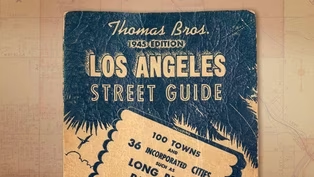
How the Thomas Guide Reveals a Changing Los Angeles
Video has Closed Captions
Clip: S9 Ep1 | 8m 50s | The street atlas that defined how Southern Californian's navigated their city. (8m 50s)
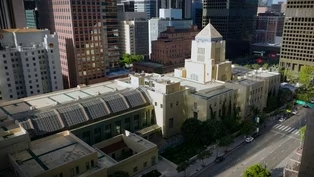
Surfridge, Tehachapi & Thomas Guide: How Southern California Moves (Preview)
Video has Closed Captions
Preview: S9 Ep1 | 30s | Nathan visits Surfridge, the Tehachapi Loop and the largest collection of Thomas Guides. (30s)
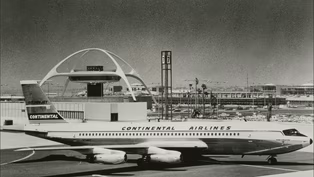
Surfridge: The Beachside Neighborhood Erased by LAX
Video has Closed Captions
Clip: S9 Ep1 | 9m 8s | A lost coastal neighborhood erased by the expansion of Los Angeles airport. (9m 8s)
Providing Support for PBS.org
Learn Moreabout PBS online sponsorship













Support for PBS provided by:
Lost LA is a local public television program presented by PBS SoCal