
World leaders work to ease markets as Trump signals more war
Clip: 4/2/2026 | 4m 53sVideo has Closed Captions
Global leaders work to ease oil price surge as Trump signals more weeks of Iran war
In New York and London, European and Middle Eastern countries tried to develop a plan to reopen the Strait of Hormuz, which has largely been closed since the war in Iran began. Following President Trump's address predicting two to three more weeks of war, the U.S. and Israel continued to bomb Iran, and Iran continued its strikes on Gulf countries and Israel. Nick Schifrin reports.
Problems playing video? | Closed Captioning Feedback
Problems playing video? | Closed Captioning Feedback
Major corporate funding for the PBS News Hour is provided by BDO, BNSF, Consumer Cellular, American Cruise Lines, and Raymond James. Funding for the PBS NewsHour Weekend is provided by...
Support provided by:

World leaders work to ease markets as Trump signals more war
Clip: 4/2/2026 | 4m 53sVideo has Closed Captions
In New York and London, European and Middle Eastern countries tried to develop a plan to reopen the Strait of Hormuz, which has largely been closed since the war in Iran began. Following President Trump's address predicting two to three more weeks of war, the U.S. and Israel continued to bomb Iran, and Iran continued its strikes on Gulf countries and Israel. Nick Schifrin reports.
Problems playing video? | Closed Captioning Feedback
How to Watch PBS News Hour
PBS News Hour is available to stream on pbs.org and the free PBS App, available on iPhone, Apple TV, Android TV, Android smartphones, Amazon Fire TV, Amazon Fire Tablet, Roku, Samsung Smart TV, and Vizio.
Providing Support for PBS.org
Learn Moreabout PBS online sponsorshipAMNA NAWAZ: Today, in New York and London, leaders from European and Middle Eastern countries worked to develop a plan to try and reopen the Strait of Hormuz, which has been largely closed since the war in Iran began.
And after President Trump's speech last night predicting two to three more weeks of war, the U.S.
and Israel continued to bomb Iran today, and Iran continued its strikes on Gulf countries and Israel.
Here's Nick Schifrin.
(SIRENS BLARING) NICK SCHIFRIN: Outside Tel Aviv tonight, the threat is constant.
Iranian missile evaded Israeli air defense, shattering car windshields and puncturing this water pipeline.
It shows how, despite one month of war across Israel and the Gulf, Iran still can project power and display defiance.
Spokesman Elias Hazrati: ELIAS HAZRATI, Spokesperson, Iranian President (through translator): Our missile capabilities are growing stronger day by day.
Moreover, the Strait of Hormuz is in the hands of Iran's powerful forces.
NICK SCHIFRIN: Iran's assault on oil vessels and other energy targets in and along the strait has led to a staggering decline of traffic in what was one of the world's most important oil and natural gas choke points.
Before the war, the number of cargo ships going through the Strait of Hormuz in either direction averaged more than 100 per day.
One month ago, at the start of the war, that number dropped off a cliff and only handfuls of boats that Iran chooses are now transiting.
YVETTE COOPER, British Foreign Minister: We have seen Iran hijack an international shipping route to hold the global economy hostage.
NICK SCHIFRIN: Today, a group of more than 40 countries led by British Foreign Minister Yvette Cooper coordinated plans to reopen the strait after the war ends, this mostly European and Arab coalition, born from behind-the-scenes diplomacy with the U.S., but also because European leaders realized a program to sell American weapons for Ukraine was at threat if Europe didn't respond to President Trump's demand to help open the strait.
YVETTE COOPER: We are focusing on the effective coordination that we need across the world to enable a safe and sustained opening of the strait.
ANTONIO GUTERRES, United Nations Secretary-General: Conflicts do not end on their own.
They end when leaders choose dialogue over destruction.
NICK SCHIFRIN: In New York at the United Nations, diplomats met at the Security Council to debate a draft resolution aimed at authorizing a military mission to protect commercial shipping in and around the Strait of Hormuz from Iranian attacks.
A final vote is expected tomorrow, but a senior official from a country on the Security Council tells "PBS News Hour" Russia could issue a veto.
ABDULLATIF BIN RASHID AL ZAYANI, Bahraini Foreign Minister (through translator): We are confident that this draft resolution is consistent with international law, contrary to what Iran is doing today.
NICK SCHIFRIN: But some European leaders are skeptical of that plan and frustrated with President Trump.
Today, French President Emmanuel Macron accused President Trump of weakening NATO -- quote -- "If you create doubt every day about your commitment, you hollow it out.
And when we're serious, we don't say the opposite of what we said the day before."
DONALD TRUMP, President of the United States: When this conflict is over, the strait will open up naturally.
It'll just open up naturally.
NICK SCHIFRIN: Last night, President Trump argued that Iran's desire to sell oil will mean the problem of the Strait of Hormuz will solve itself.
But President Trump also expressed a desire to escalate, today, posting this video of a U.S.
strike on a bridge that a U.S.
official tells "PBS News Hour" was a planned Iranian resupply route, the view from a nearby family picnicking during the attack terrifying.
And Iran's Foreign Ministry also posted these photos today of what it said was an attack on the century-old Pasteur Medical Research Institute in Tehran.
A U.S.
official denies this was an American attack.
DONALD TRUMP: We're going to hit them extremely hard over the next two to three weeks.
We're going to bring them back to the Stone Ages, where they belong.
In the meantime, discussions are ongoing.
Yet, if during this period of time, no deal is made, we have our eyes on key targets.
If there is no deal, we are going to hit each and every one of their electric-generating plants very hard and probably simultaneously.
NICK SCHIFRIN: The markets did not like that message, opening down, and Brent crude prices spiked, traders apparently disappointed that the president did not signal the end of the war.
And the war continues to reverberate, massive U.S.
airstrikes in Central Iran, in Isfahan province, a critical hub for its nuclear program clouded in apocalyptic smoke, as the U.S.
targets ammunition depots.
The president vows to continue the war for another two to three weeks.
For the "PBS News Hour," I'm Nick Schifrin.
 New
NewArtemis II astronauts embark on voyage around the moon
Video has Closed Captions
Artemis II astronauts embark on voyage around the moon (5m 2s)
 New
NewGulf nations, European allies respond to Trump's Iran speech
Video has Closed Captions
How Gulf nations and European allies are responding to Trump's Iran address (7m)
 New
NewHow 'No Kings' events fit into America's history of protest
Video has Closed Captions
How 'No Kings' rallies fit into America's history of protest (8m 49s)
 New
NewNews Wrap: Planning commission approves ballroom project
Video has Closed Captions
News Wrap: National Capital Planning Commission approves Trump's ballroom project (6m 9s)
 New
NewRepublicans in Congress announce plan to end DHS shutdown
Video has Closed Captions
Republicans in Congress announce plan to end DHS shutdown, but political battle continues (4m 30s)
 New
NewRussian corruption fuels massive casualties in Ukraine
Video has Closed Captions
Russian corruption fuels massive casualties in Ukraine (8m 17s)
 New
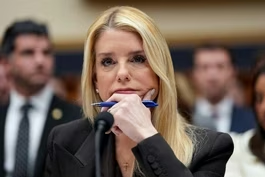
NewWhat's next for the Justice Department after Bondi's firing
Video has Closed Captions
What's next for the Justice Department after Bondi's firing (7m 3s)
Providing Support for PBS.org
Learn Moreabout PBS online sponsorship
- News and Public Affairs

FRONTLINE is investigative journalism that questions, explains and changes our world.

- News and Public Affairs

Amanpour and Company features conversations with leaders and decision makers.
One Question with Becky Ferguson











Support for PBS provided by:
Major corporate funding for the PBS News Hour is provided by BDO, BNSF, Consumer Cellular, American Cruise Lines, and Raymond James. Funding for the PBS NewsHour Weekend is provided by...