
May 25, 2026 - PBS News Hour full episode
5/25/2026 | 57m 46sVideo has Closed Captions
May 25, 2026 - PBS News Hour full episode
May 25, 2026 - PBS News Hour full episode
Problems playing video? | Closed Captioning Feedback
Problems playing video? | Closed Captioning Feedback
Major corporate funding for the PBS News Hour is provided by BDO, BNSF, Consumer Cellular, American Cruise Lines, and Raymond James. Funding for the PBS NewsHour Weekend is provided by...
May 25, 2026 - PBS News Hour full episode
5/25/2026 | 57m 46sVideo has Closed Captions
May 25, 2026 - PBS News Hour full episode
Problems playing video? | Closed Captioning Feedback
Where to Watch PBS News Hour
PBS News Hour is available to stream on pbs.org and the PBS app.
Providing Support for PBS.org
Learn Moreabout PBS online sponsorshipAMNA NAWAZ: Good evening.
I'm Amna Nawaz.
Geoff Bennett is away.
On the "NewsHour" tonight: The U.S.
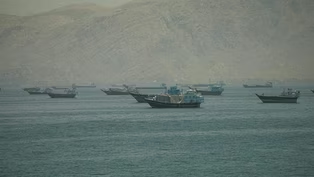
and Iran work toward a deal to end the war, but obstacles remain.
And both sides suggest a breakthrough is not imminent.
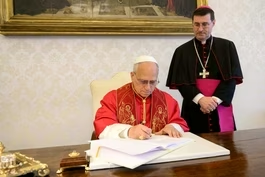
The pope calls for stronger regulation of artificial intelligence in a sweeping manifesto focused on the potential dangers to humanity.
And Judy Woodruff looks at a statewide effort in Ohio to identify the final resting places of thousands who fought in the Revolutionary War.
KRISTA HORROCKS, Ohio Revolutionary War Veterans Graves Project: These grave sites will not live on forever, but to be able to document them is the best thing we can do, because that will outlive all of us.
(BREAK) AMNA NAWAZ: Welcome to the "News Hour."
On this Memorial Day, Iranian and U.S.
officials agree progress to end the war has been made, but how much remains uncertain.
President Trump suggested this weekend that a deal was close, before saying that the U.S.
is in no rush to reach an agreement.
As negotiations resume today in Doha with a visit by senior Iranian officials.
Iran acknowledged an agreement on many points, but said the signing of a deal was not imminent.
Nick Schifrin's been tracking the statements and updates, and he joins us here now.
So, Nick, let's start with the U.S.
The president was very positive over the weekend about the potential for a deal.
NICK SCHIFRIN: He was, yes.
AMNA NAWAZ: What did he say today?
NICK SCHIFRIN: He was very much on the fence about the possibility of a deal today.
This is what he wrote on TRUTH Social this morning: "It will only be a great deal for all or no deal at all, back to the battlefront and shooting but bigger and stronger than ever before, and nobody wants that."
But, as you said, on Saturday, he wrote that an agreement had largely been negotiated.
And that led to prominent public criticism from Israel and some Republican allies that want to restart the war.
So what's in the deal?
A senior administration official brief reporters this weekend.
A European and a regional official confirmed that this is the outline of the deal as it is right now.
In the first phase, Iran would open the Strait of Hormuz and the U.S.
would end its blockade.
Number two, the war would end, including Lebanon.
We will talk, Amna, more about that in a moment.
And the third phase is in principle agreements.
Iran limits its nuclear program and the U.S.
lifts its sanctions.
And if that third point sounds familiar Amna, it is.
That is the core of the 2015 JCPOA nuclear deal and it's also the core of this deal.
So that brings us to the second phase.
Iran would freeze its uranium enrichment for TBD years, likely somewhere between 10 and 20 years, but that is still under the negotiation.
Number two, Iran would export its nearly 1,000 pounds of highly enriched uranium.
The senior administration official admitted there's a question about how precisely to do that, but did say the supreme leader had signed off on that in principle, and an Iranian official has told me that Iran is willing to export to the IAEA, but not to the U.S.
And, thirdly, in exchange for all that, the core of the U.S.
offer, lifting sanctions, unfreezing assets.
A senior administration official said the more accommodations that Iran makes, the more money the U.S.
would free up.
As the official put it -- quote -- "No dust, no dollars," a reference to the enriched uranium.
But the senior administration official acknowledged, Amna, that there is no guarantee, in this person's words, that this makes it through the Iranian system and lots of details to be worked out.
AMNA NAWAZ: Meanwhile, we saw President Trump also try to expand the negotiations?
Tell us about that.
NICK SCHIFRIN: Yes, so the president has spoken multiple times to regional leaders and really beyond the region, some of the people, some of the countries that are helping mediate, and that he is now pressuring them.
And he said that, if Iran and the U.S.
signs this deal, then they must sign a deal with Israel.
This is what he wrote: "I am mandatorily requesting that all countries immediately sign the Abraham Accords."
Now, today, the Abraham Accords includes the UAE, Bahrain, as well as Morocco and Kazakstan in green there.
The president announced today that Saudi Arabia and Qatar would be required to join, followed by Pakistan, Turkey, Egypt and Jordan, and he said, if they don't, they're showing -- quote -- "bad intention."
So, clearly, he's trying to sweeten the deal, but it's left a sour taste in some regional officials' mouths who I have spoken to.
They were very shocked about some of this language, almost the threat that the president made.
And let's be clear, Amna, this is dead on arrival.
The Saudis reiterated today that the only way they will normalize with Israel is that if Israel undergoes a -- quote -- "irreversible path toward Palestinian statehood."
AMNA NAWAZ: You mentioned talking to some Iranian officials.
What are we hearing publicly from Iran today on all of this?
NICK SCHIFRIN: As you said at the top, Iran's top negotiators visited Doha today.
And we have seen in the U.S.
concern about Iran's leadership being fragmented.
Well, Iran's Foreign Ministry spokesperson today did acknowledge some progress, but blamed American leadership for the holdups.
ESMAEIL BAGHAEI, Iranian Foreign Ministry Spokesman (through translator): It is true that we have reached a conclusion regarding a large part of the topics under discussion.
But to say that this means the signing of an agreement is imminent, no one can make such a claim, because policymaking and decision-making in America have become caught in a kind of institutionalized instability.
NICK SCHIFRIN: As for Iran's promises, at this point, Amna, there is no public confirmation that Iran is willing at all to restrict its nuclear program going forward.
AMNA NAWAZ: Meanwhile, this is a war that the U.S.
and Israel launched together in Iran.
What's Israel saying about the possibility of a deal?
NICK SCHIFRIN: Israeli officials publicly questioned the deal, calling it -- quote -- "a bad deal" this weekend.
Today, a senior Israeli official messaged me, saying that the president told Prime Minister Benjamin Netanyahu that the president will remove all of the enriched uranium from Iran, not just highly enriched uranium, all enriched uranium for Iran.
I'm not sure if that's accurate, but Israel is pushing on another subject, and that is Lebanon.
Today, Israel announced that it had hit some 70 sites across the country today, what it called Hezbollah command centers and weapons storage facilities.
Lebanese officials have said that 3,100 people have been killed in Lebanon since March.
Iranian officials do tell, Amna, that part of this deal is Israel stopping in Lebanon, but U.S.
officials today blamed Hezbollah, not Israel, and said that Israel -- quote -- "would never be expected to passively absorb any attacks."
AMNA NAWAZ: We will see what happens next.
Nick Schifrin tracking it all.
Thank you, Nick.
NICK SCHIFRIN: Thank you.
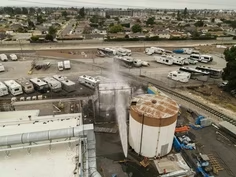
AMNA NAWAZ: We start the day's other headlines in California, where authorities say a large tank full of hazardous chemicals is no longer a threat to explode.
Fire officials say an overnight inspection found that a crack had relieved some of the pressure inside, calling it incredibly positive news.
CHIEF T.J.
MCGOVERN, Orange County, California, Interim Fire Chief: hat the goal was last night was to confirm that there was no pressure in the tank.
We knew there was a crack, but we didn't know if that crack was full thickness and relieved the pressure.
AMNA NAWAZ: Firefighters have been spraying the tank with water since it began overheating last week.
It contains as much as 7,000 gallons of methyl methacrylate.
It's a toxic chemical used to make plastic parts.
Officials say the risk to public safety is ongoing, and evacuation orders remain in place for some 50,000 residents of Garden Grove, California, near Anaheim.
In Washington, D.C., officials say a bystander who was struck in Saturday's shooting near the White House remains in serious but stable condition.
Investigators say the suspect, Nasire Best, had previous encounters with the Secret Service and a history of mental health issues.
The 21-year-old was fatally wounded during a shoot-out with officers.
In a court filing, acting Attorney General Todd Blanche cited the incident as a reason to push forward with President Trump's ballroom project, saying it -- quote -- "underscores the critical need for top-level state-of-the-art security at the White House."
Russia is warning of systematic and consistent strikes on Ukrainian military facilities in Kyiv and is urging foreigners to leave the city.
That's according to a statement from Russia's Foreign Ministry, which says foreign Secretary Sergey Lavrov told Secretary of State Marco Rubio about the impending attacks during a call today.
The readout says Lavrov went so far as to warn U.S.
diplomatic staff to evacuate the city.
The warning comes after Russian forces pounded Ukraine's capital over the weekend.
Authorities say at least two people were killed and more than 90 others injured.
The head of the World Health Organization says at least 220 people have now died from the ongoing Ebola outbreak in Central Africa.
In the Democratic Republic of Congo, the number of suspected cases has now surpassed 900.
And officials say the outbreak is now outpacing response efforts.
At checkpoints between villages in the eastern Ituri province, where the outbreak is believed to have started, health workers are screening people passing through to try to curb the spread of the disease.
SEPHORA, Health Post Worker (through translator): If we see someone with a very high temperature, we hold them here and then we call the ambulance, which will take them to the hospital for appropriate care.
AMNA NAWAZ: Meantime, in neighboring Uganda, health authorities say they found two new Ebola cases, bringing the total there to seven.
Uganda's president has urged his people to stop shaking hands as part of efforts to limit infections.
In Saudi Arabia, the annual Hajj pilgrimage officially starts today.
Officials say more than 1.5 million pilgrims have traveled to Mecca amid soaring temperatures and instability brought on by the Iran war.
Many spend the first day in a vast tent camp in the nearby desert.
Before that, pilgrims were seen circling the cube-shaped Kaaba in the Grand Mosque.
The pilgrimage is one of the five pillars of Islam, and every able-bodied Muslim with sufficient means is expected to take part at least once in their lives.
U.S.
financial markets were closed for the Memorial Day holiday.
Elsewhere, Americans marked the occasion with parades and commemorations for those who've died while serving in the military.
Washington, D.C., hosted what's billed as the nation's largest Memorial Day event, featuring marching bands, veterans, and active military members, among others.
SOLDIER: Present!
SOLDIER: Present!
AMNA NAWAZ: Elsewhere, President Trump laid a wreath at the Tomb of the Unknown Soldier at Arlington National Cemetery.
In his remarks, Mr.
Trump honored the nation's fallen soldiers, saying -- quote -- "We salute them, we exalt them, and we thank them for all that we have and for all that they gave."
And Toshifumi Suzuki, the driving force behind Japan's convenience store culture, has died.
As a businessman, Suzuki took the 7/Eleven brand from a single store in Tokyo in 1974 to an empire of more than 20,000 locations across Japan.
These konbini outlets provide busy office workers and families with sandwiches, rice balls, and fresh meals on the go, a retail experience unlike similar stores in North America.
The Japanese company that operates 7/Eleven said Toshifumi Suzuki died of heart failure.
He was 93 years old.
Still to come on the "News Hour": supporters of the Make America Healthy Again movement share frustration over some Trump administration policies; Tamara Keith and Amy Walter break down the latest political headlines; and we speak to ESPN analyst Mina Kimes about her new role hosting the Scripps National Spelling Bee.
Pope Leo called for artificial intelligence to be disarmed in his first papal encyclical, calling for major regulation to protect against potential risks, including war and economic dislocation.
POPE LEO XIV, Leader of Catholic Church: Artificial intelligence needs to be disarmed.
The word is strong, I know, but deliberately chosen because this moment needs words capable of attracting attention, awakening consciences, and indicating paths forward for humanity.
AMNA NAWAZ: Leo signed the text on May 15, 135 years after his namesake, Pope Leo XIII, signed his own transformational document on workers' rights during the Industrial Revolution.
For nearly 400 years, popes have used encyclicals to impart Catholic teachings.
In his more-than-42,000-word text, Leo wrote -- quote -- "It's not enough to invoke ethics in the abstract.
Robust legal frameworks, independent oversight, informed users, and a political system that does not abdicate its responsibility are required.
A more moral A.I.
is not enough if that morality is determined by a few."
I'm joined now by Christopher Hale, who writes Letters From Leo on Substack.
Welcome.
Thanks for being here.
CHRISTOPHER HALE, Editor, Letters From Leo: Thank you for having me.
AMNA NAWAZ: So, you wrote that line, Leo's line calling for A.I.
to be disarmed, is the line to remember from his papacy.
Why?
CHRISTOPHER HALE: When he first got elected on May 8, 2025, he said that he wanted a peace that was unarmed and disarming.
So this phrase is something he uses again and again and again.
I think it's noteworthy that he used that phrase to describe peace, because the biggest part of this encyclical was not theology.
It was not even economics.
It was war.
CHRISTOPHER HALE: He's very concerned about the use of A.I.
in war in particular.
So I think it's a very good description of what he's hoping for.
AMNA NAWAZ: Who do you think he was talking to in delivering that message?
CHRISTOPHER HALE: I really think there was really two main audiences.
It was the government here in Washington and around the world and Silicon Valley itself.
Christopher Olah, of course, was there in the room with him.
Anthropic had that infamous fight with a Pentagon in February, and the White House ended up blacklisting them for government contracts.
I think that Pope Leo XIV, from my sourcing, found that Anthropic was courageous in that decision and standing up to the government.
But there's also a third source I think he's speaking to as well that's getting a little less attention.
He's really speaking to consumers.
He wants us on our phones less.
He wants face-to-face encounters.
He wants children and families to have dinner without phones, so a little less screen time.
So he's talking to everyone, in fact.
AMNA NAWAZ: I want to jump into a little more of what Pope Leo had to say, but you mentioned Christopher Olah.
And we should note here that there were some pointed critiques of A.I.
companies in Pope Leo's remarks.
Despite that, Anthropic co-founder Chris Olah, as you mentioned, was invited to be there and to speak.
Here's a part of what he had to say.
CHRISTOPHER OLAH, Co-Founder, Anthropic: A.I.
development is concentrated in a handful of wealthy nations.
How will we ensure that the gains of A.I.
are shared globally?
We do not have a mechanism for this.
It is an unsolved problem.
And it is the kind of problem the church has historically refused to let the world ignore.
AMNA NAWAZ: Why invite Olah to the Vatican and what did you take away from his remarks?
CHRISTOPHER HALE: I think that the reality of it is, is the church cannot be Luddite.
They can't simply reject technology.
A lot of people were hoping actually for harsher critique of A.I.
and -- but Leo XIV says that A.I.
is in fact inevitable and we need to find good actors to play with.
And I think he saw in Christopher Olah, quite frankly, unlike some of his competitors, someone who is willing to play ball with ethics.
I have been working in this industry for a long time.
Really, the Vatican has been doing this for a decade reaching out to A.I.
companies.
And more than anyone else, Anthropic has played ball, unlike its competitors.
AMNA NAWAZ: There were, as you mentioned, some big existential views on what war in particular.
Pope Leo talked about the use of A.I.
in war as a sin, a betrayal of the just war doctrine.
What did you make about the way he talked about that, the just war doctrine?
Folks will remember there was a lot of back-and-forth about this when Vice President J.D.
Vance criticized the pope for weighing in on the war in Iran.
What did you take away from it?
CHRISTOPHER HALE: The American people are definitely getting a theology lesson, St.
Thomas Aquinas, St.
Augustine coming up again and again.
I think what he was saying is just war doctrine really is a six-centuries old tradition that didn't really imagine a world where human actors were not being the ones to make decisions.
Pope Leo XIV is aghast by war.
He was very aghast by the beginning of the war in Iran, when 168 children were killed at that school in Iran, from forward.
But I think that he actually thinks there's two levels of war.
There's the atrocity of war waged by humans.
But I think he finds the idea of war waged by machines against human to be even more of an atrocity.
So he wants the Catholic social justice theory, a just war theory to really address this head on going forward.
AMNA NAWAZ: It was striking the way the encyclical covered so many concerns around A.I.
about risks to children and society and so on.
He also wrote this.
He said: "The pursuit of greater profits cannot justify choices that systematically sacrifice jobs."
What exactly is the pope calling for here?
CHRISTOPHER HALE: I think he's calling for regulation, much to the chagrin of many in Washington.
J.D.
Vance famously goes to Europe in February 2025 at the beginning of his term and says we need to stop talking less about guardrails and disruption and talk more about innovation.
And Pope Leo XIV is saying actually we do need to talk about guardrails.
We do need to talk about disruption.
Leo XIII was really concerned about the Industrial Revolution, what it would do to workers.
It really gave birth to the labor movement and to labor unions.
I think Leo XIV is looking for some kind of social movement as well, again, safeguarding against the atrocities that might come from economic dislocation due to A.I.
AMNA NAWAZ: Separate from A.I., we do need to note that the pope made an historic apology for the Vatican's role in legitimizing slavery, for the failure to condemn it for hundreds of years.
He called it a -- quote -- "wound in the Christian memory, one from which we cannot consider ourselves detached."
That's a very big moment for the church.
Why this moment and why make that message in this way?
CHRISTOPHER HALE: You know, he is the first U.S.-born pontiff.
He knows, in the flesh, in his own experience, his own demographics, his own roots the effects of American slavery.
And so I think it's twofold.
I think he realizes it's the 250th anniversary of his home country, and we're not hearing a lot about the failures and sins of the American past in our own government.
So I think he's actually putting his voice out there as a moral leader globally.
But also it's very clear that he sees that there could be affronts to human dignity not dissimilar to slavery coming forth in this era as well.
And I think he fears that A.I.
could exasperate that problem.
AMNA NAWAZ: He did announce very early in his papers that he considered A.I.
to be the biggest challenge facing humanity today.
Wrap up everything you heard in the encyclical today, everything you read, and in terms of how it informs his papacy moving forward.
CHRISTOPHER HALE: You know, Pope Leo XIV is a consumer of Western media.
He's the first pope to own a cell phone, to own an Apple Watch, to send an e-mail.
So he experiences the technological revolution in the flesh.
So when he was writing this document, he was not writing about something he read about.
He's writing about something he's experienced.
And so I think his own experience informs us.
And he's concerned not just for humanity, but for our posterity.
He is the pope of our children.
And that's, I think, his biggest concern.
AMNA NAWAZ: Christopher Hale, man behind the Letters from Leo Substack, great to have you here.
Thank you so much.
CHRISTOPHER HALE: Thank you for having me.
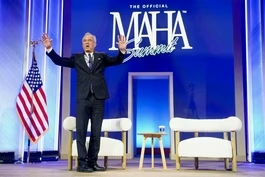
AMNA NAWAZ: When he left the presidential race, Robert F. Kennedy Jr.
galvanized his supporters to vote for Donald Trump, which helped to propel Trump back to the White House.
The president promised to let Kennedy go wild on health care policy.
But as fans of Kennedy's Make America Healthy Again, or MAHA, movement have learned, that promise has limits.
And now some MAHA voters are feeling disillusioned.
Ali Rogin recently spoke to some of them.
NANCY FULLER, MAHA Supporter: I was on a bridge during rush hour.
ALI ROGIN: Ohio mom Nancy Fuller was waving the flag on the nation's health problems long before she supported Robert F. Kennedy Jr.
for president.
Her motivation?
Her son Steve, now 33, a visual artist with autism and epilepsy.
NANCY FULLER: Steve's art is so unique.
And what's fascinating for most artists to appreciate is that there is no draft.
ALI ROGIN: As a child, Steve was nonverbal, and doctors warned he would have a lower quality of life.
Fuller says they had few answers, so she sought them out herself.
I know that your journey with Steve has made you MAHA before MAHA was a slogan.
NANCY FULLER: Exactly.
Steve is like a canary in the coal mine.
He's very sensitive to toxicities in our air, food and water.
And he's singing, and he's calling out to be helped.
ROBERT F. KENNEDY JR., U.S.
Health and Human Services Secretary: Most American children can no longer go fishing with their father and come home and safely eat the fish.
ALI ROGIN: Fuller began following Kennedy as his profile rose as an environmental lawyer and activist speaking out about clean water and pesticides, including against agrochemical company Monsanto, creator of the herbicide Roundup.
NARRATOR: Kills the root, kills the weed.
ALI ROGIN: In 2018, Kennedy helped win an almost $300 million settlement for a man who blamed his cancer on Roundup's active ingredient, glyphosate.
The World Health Organization labeled glyphosate probably carcinogenic to humans in 2015.
Kennedy's controversial opinions on vaccines also resonated with Fuller, who describes herself as -- quote -- "vaccine-hesitant."
She questions whether vaccines played some role in Steve's autism.
Dozens of studies on different vaccines have found no connection to autism.
NANCY FULLER: I am a proponent, actually, of vaccines, but I also think there's a subpopulation of people that are very sensitive.
There could be a contributing factor of the vaccines and the environment to what kind of set off the autism in my son.
I do believe that.
ALI ROGIN: Fuller was thrilled when Kennedy ran for president, but the lifelong Democrat was torn when he dropped out and endorsed Trump.
NANCY FULLER: I did have to kind of hold my nose, because my vote for that ticket was a vote for RFK Jr.
ALI ROGIN: And a vote for him to make good on his campaign promises.
ROBERT F. KENNEDY JR.
: We're going to ban the worst agricultural chemicals that are already prohibited in other countries.
ALI ROGIN: But, in February, the president issued an executive order to increase domestic production of glyphosate, citing national security concerns.
Then Kennedy gave Trump political cover, writing on social media: "I support President Trump's executive order to bring agricultural chemical production back to the United States and that Trump did not build our current system.
He inherited it."
Like many MAHA supporters, Fuller was furious.
NANCY FULLER: When RFK Jr.
put out his statement on glyphosate, I would hope that I would have been a little more honest about it.
I do believe he knows the harm this toxic chemical does to people.
ALI ROGIN: And now the drug company Bayer which owns Monsanto, is lobbying state and federal lawmakers to pass laws protecting it from health-related lawsuits.
WOMAN: Thank you for standing up for our next generation.
ALI ROGIN: Last month, the Supreme Court heard its case as MAHA supporters rallied outside.
The Trump administration urged the court to rule in favor of Bayer.
JON MARTIN, Rallygoer: Well, I will tell you, I'm a conservative and I do support President Trump, but I do not agree with everything he does.
And this is one thing that I was highly disappointed that he did this.
SHERRI BEHNEY, Rallygoer: I thought he would be on board with especially holding people accountable for things.
And having RFK Jr.
in there too I thought would help.
So it is very disappointing.
ALI ROGIN: A recent Politico poll found that a third of Americans now identify as MAHA supporters, and half of them view limiting pesticide use as a core issue of the movement.
ALEX CLARK, Host, "Culture Apothecary": I knew that, if there was an issue with moms that could make or break the MAHA coalition, it was pesticides.
ALI ROGIN: Alex Clark is the host of "Culture Apothecary," a podcast produced by the young conservative group Turning Point USA.
She said her listeners, many so-called MAHA moms, felt betrayed by Trump's executive order on glyphosate.
ALEX CLARK: You know, these voters want fight, fight, fight Trump.
They don't want ballroom Trump.
They want the man who promised to fight the system.
And for MAHA moms, that includes big ag and big chemical.
ALI ROGIN: In what was viewed as a White House attempt to make amends with MAHA, Clark was part of a delegation who met with Trump and other officials last month.
ALEX CLARK: We laid out how upset we were and how upset MAHA voters are on the pesticide issue.
MAHA could absolutely be decisive in the midterms.
The political power of MAHA is that these voters are movable.
And in a midterm, movable voters decide everything.
ELIZABETH FROST, MAHA Ohio: Early on, we were just super, super grassroots.
ALI ROGIN: Voters like Elizabeth Frost, a political consultant and activist in Southern Ohio who worked on Kennedy's presidential campaign.
ELIZABETH FROST: It was such an interesting experience to see this massive tent that Kennedy was able to cast.
People showed up to knock doors for Trump, people who could barely stomach the thought of it, because that was what they wanted to do for the sake of advancing MAHA policies.
ALI ROGIN: Frost now leads the grassroots group MAHA Ohio.
Like many Kennedy supporters who adopted the MAHA label, she feels the Trump administration is dismissing this valuable group.
ELIZABETH FROST: You know, having Kennedy there beside you for your press conferences is not enough.
If Kennedy as the head of HHS isn't being fairly listened to on this issue, we have got a number of major problems for this relationship.
ALI ROGIN: Frost says, ahead of the midterms, she's interested in candidates who aren't afraid to challenge Trump on issues like pesticides, like Republican Thomas Massie in neighboring Kentucky.
He co-wrote a bipartisan bill banning glyphosate manufacturers from legal immunity, but he lost to a Trump-endorsed candidate in his primary.
Would you prefer a candidate backed by Trump and MAGA or someone backed by Kennedy and MAHA?
ELIZABETH FROST: We're very much more aligned with MAHA values than anything that we're seeing coming out of the White House currently, and people are going to show up to vote for change.
ALI ROGIN: Back in Cincinnati, Nancy Fuller says her MAHA values will be a filter in the midterms and that she isn't ready to give up on Kennedy.
NANCY FULLER: I'm not in his shoes, and he's got to pick his battles to bring health to America.
And if that's something that the president of the United States wants to do, I don't want to see him get fired.
I think at the end of the day it's a chess game for him, and he has to move the chess pieces where he can advance health.
ALI ROGIN: In the game of electoral politics, MAHA voters can be kingmakers, and they still have plenty of moves left to make.
For the "PBS News Hour," I'm Ali Rogin in Cincinnati, Ohio.
AMNA NAWAZ: A big week ahead in Republican politics, as President Trump's fight to reshape the Republican Party comes to Texas tomorrow to try to take out another incumbent senator.
And Democrats weigh how to move past 2024 losses with the midterms fast approaching.
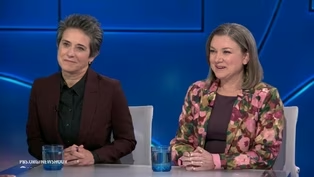
For more on all of this, I'm joined by our Politics Monday duo.
That is Amy Walter of The Cook Political Report With Amy Walter and Tamara Keith of NPR.
It's great to see you both.
AMY WALTER: Hello.
TAMARA KEITH: Good to be here.
AMNA NAWAZ: Quick recap, as I know you have all been following this as well.
President Trump has now, over the past few weeks, helped to oust Indiana state senators who opposed him, Louisiana Senator Bill Cassidy, who voted to convict him in his impeachment trial, Kentucky Congressman Thomas Massie, who opposed some of his policies.
President Trump is now heading to Texas tomorrow to back the attorney general, Ken Paxton, who is trying to unseat the incumbent Senator, John Cornyn.
Tam, what is the president's message here and is it going to work in Texas?
TAMARA KEITH: It certainly could work in Texas.
The president is never more powerful than he is in Republican primaries in red states, and that is what he has proven in all of these cases, is that, among Republican primary voters, he has a lot of sway.
However, the universe is much bigger than Republican primary voters, and some of the actions that he has taken as president recently have caused backlash from within his own party.
Because many other members of Congress, in fact, are running in purple states, purple districts, and don't want to have to run on President Trump's retribution campaigns.
AMNA NAWAZ: Amy, Democrats like this.
They want to run against Ken Paxton in Texas.
AMY WALTER: Yes, they do, yes.
AMNA NAWAZ: Tell us why.
AMY WALTER: Yes, well, he's got a lot of political baggage, not the least of which he was indicted and impeached in the state.
He has personal baggage, and he's a terrible fund-raiser.
So, Texas is a state that is very expensive to run in.
This is going to cost the party a lot of money.
Even if they were to succeed, they're going to have to pour and divert money that was supposed to go to states where they feel like they have a better chance of winning or where they could hold on to incumbents that are in trouble and move it there.
I think last week was also the perfect example of Donald Trump's ability to make the campaign in 2026 more about him and less about what actual voters are interested in, and certainly what Republicans who are up in 2026 would like him to talk about, whether it's going after members of his own party, whether it is the ballroom that he's still fighting for the funding there, and then this anti-weaponization fund.
Literally, if you asked what could the president do to make life harder for his own party, I would point to last week and say, that.
AMNA NAWAZ: Well, Tam, you have been out talking to swing voters for a new project.
What do they think about all of this?
TAMARA KEITH: Yes, the project is called Swing Shift, and I'm talking to about a dozen swing voters who have agreed to keep talking to me over the next three years.
They are not bringing up the president's retribution campaign.
They don't really care about what's happening in Republican primaries.
They're talking about gas prices.
They're talking about grocery prices.
They're talking about the cost of living.
They're talking about wanting to have a better future for their kids.
They have real concerns about the state of the country.
I asked them for a word or phrase to describe the current state of the country.
All of these voters have voted for President Trump some time over the last 10 years.
But they describe it as chaotic, a hot mess, divided.
Three people said divided.
Two people said chaotic.
This is -- there's a great well of dissatisfaction about the current state of the country.
And I think this is the other thing to really keep in mind when we talk about the Republican base.
There's the MAGA base, of which Donald Trump is the king.
There's no doubt about that.
And the MAGA base turns out in primaries.
But there are a whole bunch of people who either identify as Republicans or voted for Republicans who don't identify as MAGA.
They don't -- they're not necessarily anti-Trump.
They just don't center their identity around him.
And it's those voters that we're seeing in polls who are the least enthusiastic for voting.
And so what Donald Trump has done, essentially, both with this retribution campaign, but also with not focusing on the economy and the things people are saying they care the most about, is he's winnowing his base down to its absolute smallest core.
And the rest of those voters are now outside of that.
Now, are they going to show up in November?
Maybe.
Are these Republicans going to vote for a Democrat?
Unlikely, but he's not making it easy.
AMNA NAWAZ: Amy, let me stick with you on this, because we saw the Democrats finally release this autopsy report from the 2024 election loss last week in all its sort of unfinished, heavily notated form.
AMNA NAWAZ: This -- as we have talked about before, this is supposed to be a good time for Democrats.
They're supposed to be carrying momentum leading into this midterm election.
How are you looking at them right now?
AMY WALTER: And, well, let's start with this.
First, an autopsy or a look back on what went wrong is not going to be the reason Democrats win or don't win in '26 or '28.
But I think what it highlighted is the growing frustration among party regulars, activists about the head of the DNC.
DNC has been having so much trouble raising money.
They have been outraised by multiples of I can't even tell you how many, by the RNC.
And here's the thing.
The throw weight, the financial throw weight of the party is not what it used to be back when I started doing this.
They were everything.
Now you have super PACs and billionaires that can fill that void.
What the DNC and the RNC can do though, that makes them very important, they set up the rules for how you get nominated to be your party's person to take the presidency.
They set the dates for when we have primaries and which states go first.
And they have the rules about the delegates.
If voters within the Democratic sphere and the activists in that Democratic sphere don't trust the DNC to do this well, that is very dangerous going into 2028 if people within the Democratic Party are fighting amongst themselves about how the process works.
AMNA NAWAZ: Tam, what do you make of it?
TAMARA KEITH: Yes, I mean, a document that lacks a conclusion about what went wrong is a great metaphor for how things are going right now.
TAMARA KEITH: Democratic voters are dissatisfied with the Democratic Party.
So this autopsy is not necessarily a surprise.
It's sort of more of the same of the way Democratic voters perceive the party.
What I will say, though, is, there were well-crafted autopsies that came after Democrats lost in 2004, after Republicans lost in 2012.
And then the parties nominated people that were definitely not contemplated by those autopsies.
The 2012 autopsy saying that Republicans needed to do immigration reform and really try to win over Latino voters, and then they nominated President Trump.
And, obviously in 2008, President Obama kind of came out of nowhere as well.
So at this point in the cycle, neither of them had burst onto the scene in a way where people would have thought, oh, well that is the solution to this party's problem.
AMNA NAWAZ: Tam, before we go, less than a minute left, but I have to ask you about this, because last week we saw some rare defiance among Republican lawmakers here in Washington, leaving before they acted on the president's priorities.
We know a lot of that concern was over that new anti-weaponization fund, concerns about who's going to get that money.
Do you see that as new pushback?
Is that something we're going to continue to see from them when they return to town?
TAMARA KEITH: I think that Republicans in the Senate are going to have to figure out how to solve that problem, because Democrats are going to put up for a vote amendments that get them to weigh in on that.
And I don't know of many Republicans who want to run on a $1.8 billion slash fund, money from which could go to people who stormed the Capitol on January 6.
AMNA NAWAZ: Tamara Keith, Amy Walter, great to see you both.
Thank you so much.
AMY WALTER: You're welcome.
TAMARA KEITH: You're welcome.
AMNA NAWAZ: Memorial Day was first established after the Civil War, but has become a day to mark all those who died serving in the military.
As the nation celebrates its 250th anniversary, Judy Woodruff reports on a local project to mark our revolutionary origins and the final resting places of some of the nation's first veterans.
It's part of her series America at a Crossroads.
MATTHEW LUCAS, Public Researcher, Ohio Revolutionary War Veterans Graves Project: And today is Turkey Run?
Yes.
Turkey Run Cemetery, Fairfield County.
JUDY WOODRUFF: For nearly a year, Matthew Lucas, often joined by his wife, Brenda, has logged more than 6,000 miles on the hunt for specific markers of Ohio's Revolutionary era history.
MATTHEW LUCAS: So, this one... BRENDA, Wife of Matthew Lucas: This has to be it.
The star has got that thing on it.
MATTHEW LUCAS: Yes, there's a star marker, 1776 marker.
JUDY WOODRUFF: The graves of Revolutionary War veterans.
MATTHEW LUCAS: James Lamb, 79 when he died.
Still a nice stone.
BRENDA: Yes.
JUDY WOODRUFF: Lucas is part of a statewide project of volunteers trying to mark all of the estimated 7,000 Revolutionary War veteran graves in Ohio.
MATTHEW LUCAS: At first, it popped up on my Facebook feed.
So I started doing some research on the project, what they were trying to do.
And I thought, well, I don't know how many Revolutionary War soldiers there are around here.
But let me see if I can find three.
If I can find three Revolutionary graves, I will be happy.
JUDY WOODRUFF: And now you're at?
MATTHEW LUCAS: And now I'm at 490.
Tunis (ph) and Francina (ph).
JUDY WOODRUFF: At each grave, Lucas marks exactly where the site is using GPS, its condition, any markings, and even the direction it faces.
MATTHEW LUCAS: That one is definitely west.
JUDY WOODRUFF: All that information, along with eventually photos, are collected in an online database.
MATTHEW LUCAS: When I found this project going, OK, I can pay honor and respect to them by finding their graves, marking them, acknowledging them.
So it's permanent record, then, forever, that you can look up and see, wait, that's my five-times great-grandfather.
And I know exactly by GPS where they're buried at.
JUDY WOODRUFF: What is it like for you when you find a grave or when you get there and you make the connection, oh, this is it, this is the real place where someone was laid to rest?
MATTHEW LUCAS: I still get butterflies.
I still get excited.
KRISTA HORROCKS, Ohio Revolutionary War Veterans Graves Project: We have probably over 400 known veterans in Hamilton County.
JUDY WOODRUFF: Krista Horrocks is the project manager for the Revolutionary War Veterans Graves Project and works for the Ohio History Connection, a statewide history organization.
KRISTA HORROCKS: These grave sites will not live on forever.
There's nothing we can do to stop the erosion permanently, but to be able to document them is the best thing we can do, because that will outlive all of us.
JUDY WOODRUFF: The project is part of Ohio's 250th Commission, just one of the 56 state and U.S.
territory local planning groups formed for the anniversary.
JOHN DICHTL, President and CEO, American Association for State and Local History: America's history is more than the founding fathers.
It's more than what happens in Washington, D.C.
It's more than what happens in big cities.
It's people's stories from every corner of the country.
JUDY WOODRUFF: John Dichtl leads the American Association for State and Local History, which is supporting local efforts to celebrate the 250th, including by bringing together these state-level commissions.
The focus on local efforts is a lesson from the last major anniversary, the bicentennial in 1976, when national planning was turbulent.
Federal organizers were accused during the Nixon administration of being overly commercial and trying to exploit the bicentennial politically.
And the bicentennial itself occurred less than two years after President Nixon resigned and a year after the U.S.
evacuated from Vietnam.
JOHN DICHTL: Some of the things we saw is that the kind of big, grand efforts to organize often got caught up in politics and funding issues.
So one lesson we took was that it really needed to be grassroots, locally planned, kind of bubbling from the bottom up.
JUDY WOODRUFF: Dichtl says the enthusiasm for the bicentennial also had a lasting impact on history organizations.
More than 30 percent of all history groups that existed in 1980 were founded in the bicentennial era.
JOHN DICHTL: We're not just leaving the 250th to the National Park Service by itself or the National Archives or some commission to find the meaning of and come up with the big programs and projects for it, that people are going to make the semiquincentennial what they want.
And for all the planning you do, you cannot predict how people are going to engage with that, so you really just want to be ready.
JUDY WOODRUFF: Back in Ohio, Krista Horrocks says the grave project is also building on research from around the bicentennial by groups like Sons and Daughters of the American Revolution.
But just as important, she says, it's igniting public participation.
KRISTA HORROCKS: Yes, you can go to an event.
You can go to a reenactment.
All that is super fun.
But to be able to contribute and say, I helped make this project possible, I think that's really what engages people and why we have had so much interest from people who aren't typical historians.
MATTHEW LUCAS: I have been close to this cemetery 100 times.
Never knew it was here.
JUDY WOODRUFF: You never -- there was no marking?
MATTHEW LUCAS: No.
I mean, there's no marker by the road.
There's no marker anywhere that it's back here.
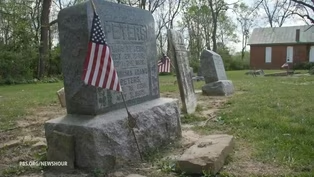
JUDY WOODRUFF: Measuring less than a fifth-of-an-acre, Ritter Cemetery in Pickaway County has exactly one Revolutionary veteran grave, according to historical records.
But the headstone itself is missing.
MATTHEW LUCAS: The worst thing about this cemetery and others is, as you can see, stones are just piled up.
So I actually went through every headstone I could find, hoping to find that stone.
When I didn't, then I did the rest of the research, because I don't want to mark somebody here, unless I'm 100 percent positive that they're here.
JUDY WOODRUFF: Now armed with additional documentation, Lucas marked the site using his phone.
It's for a Hessian soldier who fought for the British, was captured and then decided to join the colonists.
Lucas says he hopes to eventually pinpoint the exact burial location using older records and get a replacement headstone.
MATTHEW LUCAS: So, if I can get that marked, it's just going to be wonderful.
Most of the time spent on the project has been sitting right here, two to three hours every night after work.
JUDY WOODRUFF: For Matthew Lucas, this research has been a crash course in Ohio's colonial history.
MATTHEW LUCAS: Before the project, I had no idea how many, why did they move here, why did they pick Ohio.
And then I slowly found out it's because they were given the land.
The government had no money.
So, instead, we will give you land in the Northwest Territory.
And then maybe you will pick up your roots, pick up your family, go to the middle of nowhere to start a new life over again.
That part just amazes me.
KRISTA HORROCKS: One of the things I have found the most exciting about this project is just being able to do a little bit of research.
JUDY WOODRUFF: Horrocks says the project is a great opportunity for Ohioans to feel a connection to their local community.
And some volunteers have gone above and beyond, cleaning graves, in addition to marking them.
KRISTA HORROCKS: They really lived very incredible lives.
And for the local communities to know that and to be able to own that and say, these are the people who a lot of times helped them establish these little local communities all over Ohio., And then for people maybe even to make those genealogical connections, so finding out this was actually my ancestor and I had no idea, that's, to me, so exciting.
JUDY WOODRUFF: Today is the final day to mark grave sites, but already more than 4,300 have been catalogued.
Over the next couple weeks, researchers will clean up the data and remove any duplicates, with the online database going live again on July 4.
So that's his original stone.
MATTHEW LUCAS: That's his original.
JUDY WOODRUFF: Since we visited with Matthew Lucas in April, he has marked more than 200 additional graves, bringing his total to more than 700, the most out of any volunteer in the state.
MATTHEW LUCAS: Future generations can always just stumble across it.
I mean, the picnics, the parades and all that are wonderful, but this is something that can last so much farther.
JUDY WOODRUFF: Using this milestone moment to document the past for our nation's future.
For the "PBS News Hour," I'm Judy Woodruff in Pickaway County, Ohio.
AMNA NAWAZ: Well, the tournament to crown the nation's top speller is almost here.
The Scripps National Spelling Bee begins tomorrow in Washington, D.C., bringing together 247 finalists from all 50 states.
These spellers emerged from millions of competitors across the nation, all dreaming that this moment from last year could be theirs.
MAN: Your word is Eclaircissement.
FAIZAN ZAKI, Scripps National Spelling Bee Winner: Eclaircissement.
E-C-L-A-I-R-C-I-S-S-E-M-E-N-T.
Eclaircissement.
WOMAN: That is correct.
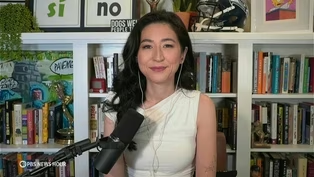
AMNA NAWAZ: And this year, the 101-year-old competition has a new host, ESPN senior writer and NFL analyst Mina Kimes, who I spoke with recently.
Mina Kimes, welcome to the "News Hour."
Thanks for joining us.
MINA KIMES, Host, Scripps National Spelling Bee: Thanks for having me.
AMNA NAWAZ: So we have been promised a revamped version of the bee that you're going to be hosting.
What does that look like?
Tell us about that.
MINA KIMES: Yes, I'm so excited to be joining the broadcast this year.
Embassy Row, who produces "Jeopardy," which I was just on, it's how I got to know them, is producing it for the first time.
And I think with my addition, the goal is to give the bee a big game feel.
I come from sports, and when I watch the National Spelling Bee, to me, it feels like an incredible sporting event.
These are elite competitors.
They deserve to be treated as such and celebrated.
And that's what I really hope to do with all of this.
I think that's what our broadcast hopes to do, is just get everybody invested really quickly in the competition, and then really place an emphasis on that winning moment at the end.
AMNA NAWAZ: The bee winner, we should note here, gets $50,000 in a cash prize.
They get a medal.
They get the Scripps Cup, which is the official trophy of the National Spelling Bee, with some other prizes.
And you have described the bee as having a Super Bowl quality to it.
Tell me about that.
What are the similarities between the NFL athletes you cover and some of these spellers?
MINA KIMES: There's a lot of similarities, and that's been really reinforced to me as I have been doing my prep, watching past spelling bees.
One thing that I find so impressive about these kids, other than their composure, which is certainly a parallel to elite athletes playing on the biggest stage, is the level of preparation and how that shines when they're solving words.
And I want to emphasize the word solving, because I think sometimes, with spelling, we assume it's just memorization, and obviously that is a big part of it for these kids.
But on stage, when you really pay attention to the questions they ask and how they're reacting to them when they have their back-and-forth with the pronouncer, you realize, oh, this isn't just memorization.
They are solving puzzles on stage by gathering information and then thinking back to everything they know about etymology and how words are used in sentences and patterns.
And I think that's really cool and something I really want to highlight.
So drawing that comparison again, it's the preparation, it's the composure, and it's rising to the occasion in such a pressure-filled moment, especially, right, for someone who is under the age of 15.
AMNA NAWAZ: And what about for you as the host?
I mean, you mentioned you're watching past bees.
What else are you doing to prepare?
MINA KIMES: Working on my own pronunciations of the names.
So, mercifully, I'm not pronouncing the words for everybody involved.
That's a good thing.
That is probably the single most important job at the spelling bee.
Jacques Bailly does it.
He is amazing.
But I will be pronouncing and introducing a lot of these kids.
There's over 200 of them at the very beginning.
By the championship, it gets winnowed down.
But the way I view it is that they have done so much preparation leading to this moment.
And for some of them, it's going to be moments on television that they're going to look back at forever.
And so I really want to rise to that occasion myself and make sure not only that I say their names correctly, but I give them their due for getting this far.
And I want to highlight their stories on stage.
AMNA NAWAZ: And we should mention too you're coming to this with some degree of familiarity, not necessarily at this level, but you yourself were a spelling bee champ in elementary school.
You competed as a child.
So you have some sense of what it is they're going through.
Tell me about how that plays into how you're going to host and if that was a happy memory for you, or are there like words that still haunt you to this day?
MINA KIMES: I would say that comparing me as a second elementary school, I won a few bees growing up, to these kids is like comparing a guy sitting on his couch watching the NFL to Patrick Mahomes.
MINA KIMES: They are so much better at spelling than I ever was.
And, in fact, watching them, it kind of makes me realize how far I had to go to get to their level.
But I did love spelling growing up.
I did get to compete in some spelling bees.
One of my favorite memories is here in Los Angeles.
I live here now in L.A., but I actually was an elementary school student in San Pedro.
And I won the San Pedro second grade city spelling bee.
And the thing I remember most about that moment, other than my word, which was receive, which is quite easy, but I'm the second grader, was the trophy that I got.
And I sent the spelling bee folks a picture of that, because the trophy, and this is what I remember, was about half the size of my own body at the time.
So I was very excited to get it.
(LAUGHTER) AMNA NAWAZ: So you have a little bit of sense of what these kids are going through on a different scale.
If you had one piece of advice to give to these kids before they step out on that stage, what would it be?
MINA KIMES: I think the kids have the knowledge and the preparation and they certainly don't need my advice when it comes to the spelling part of it or the problem-solving.
But another big part of this is being on stage and that is something I have a little bit more experience with being on live television.
And I think -- I know that, for a fact, actually, that some of these kids prepare in terms of learning how to calm themselves and breathe.
But I do really think that's so essential to being able to access your preparation and your memories in those moments is taking the time to breathe and figuring out what calms you on stage, because that ultimately leads to the best result.
AMNA NAWAZ: That is ESPN senior writer and NFL analyst Mina Kimes joining us tonight.
Mina, it's such a pleasure to talk to you.
Good luck.
MINA KIMES: Thank you.
AMNA NAWAZ: Remember, there's always a lot more online, including a lightning round Q&A with National Spelling Bee host Mina Kimes.
That is on our YouTube page.
And that is the "News Hour" for tonight.
I'm Amna Nawaz.
As we leave you, we want to share a Memorial Day tribute, courtesy of the U.S.
Air Force Band.
It features a bugler from the Ceremonial Brass performing "Taps" at Culpeper National Cemetery in Virginia.
MAHA backers grow frustrated with Trump's health policies
Video has Closed Captions
Some MAHA backers grow frustrated with Trump's health policies (8m 5s)
Mina Kimes on hosting the Scripps National Spelling Bee
Video has Closed Captions
Mina Kimes on the 'big game feel' of the Scripps National Spelling Bee (6m 31s)
News Wrap: Calif. chemical tank no longer explosion risk
Video has Closed Captions
News Wrap: Southern California chemical tank no longer a threat to explode (5m 38s)
Ohio volunteers locate graves of Revolutionary War veterans
Video has Closed Captions
Ohio volunteers locate and honor graves of Revolutionary War veterans (9m 18s)
Pope Leo calls for stronger regulation of AI
Video has Closed Captions
Pope Leo warns AI should be 'disarmed' in manifesto on potential dangers (7m 36s)
Tamara Keith and Amy Walter on direction of DNC leadership
Video has Closed Captions
Tamara Keith and Amy Walter on Democrats concerned about direction of DNC leadership (8m 38s)
U.S. and Iran suggest peace progress, but deal not imminent
Video has Closed Captions
U.S. and Iran suggest progress on peace talks, but deal ‘not imminent’ (5m 54s)
Providing Support for PBS.org
Learn Moreabout PBS online sponsorship New Episode
- News and Public Affairs

Today's top journalists discuss Washington's current political events and public affairs.

- News and Public Affairs

FRONTLINE is investigative journalism that questions, explains and changes our world.
One Question with Becky Ferguson
 New Episode
 New Episode
 New Episode


 New Episode
 New Episode
 New Episode
 New Episode
Support for PBS provided by:
Major corporate funding for the PBS News Hour is provided by BDO, BNSF, Consumer Cellular, American Cruise Lines, and Raymond James. Funding for the PBS NewsHour Weekend is provided by...