
Appraisal: George Nakashima Grass Seat Chair, ca. 1965
Clip: Season 30 Episode 22 | 4m 2sVideo has Closed Captions
Appraisal: George Nakashima Grass Seat Chair, ca. 1965
Watch Peter Loughrey's appraisal of a George Nakashima grass seat chair, ca. 1965, in 250 Years of Americana.
Problems playing video? | Closed Captioning Feedback
Problems playing video? | Closed Captioning Feedback
Funding for ANTIQUES ROADSHOW is provided by American Cruise Lines and Ancestry. Additional funding is provided by public television viewers.
Support provided by:


Appraisal: George Nakashima Grass Seat Chair, ca. 1965
Clip: Season 30 Episode 22 | 4m 2sVideo has Closed Captions
Watch Peter Loughrey's appraisal of a George Nakashima grass seat chair, ca. 1965, in 250 Years of Americana.
Problems playing video? | Closed Captioning Feedback
Where to Watch Antiques Roadshow
Antiques Roadshow is available to stream on pbs.org and the PBS app.
Buy Now

ANTIQUES ROADSHOW's 2026 Production Tour
Enter now for a chance to win a pair of free tickets to one of the three stops on ANTIQUES ROADSHOW's 2026 Tour. Sweepstakes entry deadline is April 6.Providing Support for PBS.org
Learn Moreabout PBS online sponsorshipGUEST: I went to answer an ad in a penny saver for a mattress set, and I was a starving student in college.
I went to go buy the mattress set, and I saw the chair, and I just fell in love with its design.
And she allowed me to sit in the chair, the owner, but she told me it's not for sale.
And so I said, "Oh, my goodness, I love this chair."
She said, "I'd only sell it to the right person."
I left her my name and my number.
A couple weeks later, she called me and she said, "You're the person."
And she said, "How much could you afford?"
And I said, "Maybe $25."
And she said, "Okay, um, how about $23?"
(chuckling) And so that's what I bought the chair for.
And then a couple years later, I was in a bookstore, and I was looking at a book about Nelson Rockefeller's house.
And there is the chair.
I found this name, George Nakashima.
I just love this chair.
I love the design, and I've used this chair.
It's not something precious.
It's something a part of my life, and it's in my living room.
APPRAISER: It is very early in his career, in the late '40s, after he was interned during World War II in a Japanese camp, he was exposed to Japanese traditional woodworking techniques there.
His first designs, of which this is one of the first designs, had a very strong Japanese traditional feel to it.
Hundreds and even thousands of years of Japanese woodworking had really remained unchanged.
And George was taking those techniques, honoring them, but then shaping that tradition gently towards modernism.
And what this chair is, is it's a very elegant, sophisticated, modern version of a traditional Japanese crafted chair.
By the time he died in 1990, he had been making them continuously for over 40 years.
And his daughter, Mira, is continuing that tradition and making them today.
So there's quite a lot of them that, that are out there.
There are also quite a lot of people who wanted to make chairs that looked like George's.
So how do we know that this is by George?
GUEST: I don't know.
APPRAISER: A couple of little small details.
The grass seat is original.
This is seagrass that's tightly woven, which is a traditional Japanese technique.
It's completely put together with wood pegs.
There's no metal screws or any, uh, kind of nails.
This is all crafted by hand.
You can see that these, uh, side rail spindles here are pegged right here on the side.
That's a traditional woodworking technique, but George had a very specific way of creating those and attaching them to the rest of the structure.
Also, these side rail spindles are shaped by hand, the legs, which are also hand-turned.
Some chairs by other makers never have those types of subtle details.
So this chair is by George Nakashima.
GUEST: That's great.
APPRAISER: Uh, and it's known as the grass seat chair.
And it's very hard to date it, except by looking at the patina.
The original oiled finish is a little worn, but it has a really wonderful, warm patina.
And what year did you buy it?
GUEST: 1986.
APPRAISER: 1986, so George was still alive, uh, at that time.
GUEST: Yes.
APPRAISER: They were made exactly the same between the late '40s and the time you purchased it in 1986.
But I would think that this chair is probably from the mid-1960s.
The wood is American black walnut.
These were made in New Hope, Pennsylvania.
You paid $23 in 1986-- what do you think it's worth today?
GUEST: (sighs) Okay, I'm going to just go for it, I'll say... $2,300?
APPRAISER: That's a pretty good guess.
This chair, at auction, typically sells for between $2,000 and $2,500.
GUEST: Okay!
Uh... Thank you so much.
APPRAISER: Yeah.
They're rarely marked.
I've probably sold 100 of these chairs.
GUEST: Really?
APPRAISER: Over 30 years and I have never seen one that was marked.
Preview: 250 Years of Americana
Video has Closed Captions
Preview: S30 Ep22 | 30s | Preview: 250 Years of Americana (30s)
Appraisal: Paul Revere Jr. Silver Pitcher with Diary, ca. 1775
Video has Closed Captions
Clip: S30 Ep22 | 2m 46s | Appraisal: Paul Revere Jr. Silver Pitcher with Diary, ca. 1775 (2m 46s)
Appraisal: F. Douglass Letter & Free Will Baptist Archive
Video has Closed Captions
Clip: S30 Ep22 | 4m 49s | Appraisal: F. Douglass Letter & Free Will Baptist Church Archive (4m 49s)
Appraisal: Flag Quilt, ca. 1880
Video has Closed Captions
Clip: S30 Ep22 | 2m 43s | Appraisal: Flag Quilt, ca. 1880 (2m 43s)
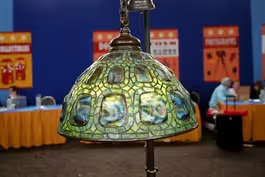
Appraisal: Tiffany Studios Turtle Back Glass Shade
Video has Closed Captions
Clip: S30 Ep22 | 2m 22s | Appraisal: Tiffany Studios Turtle Back Glass Shade, ca. 1915 (2m 22s)
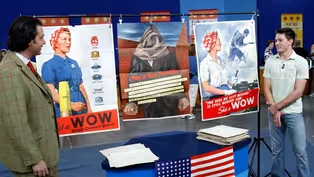
Appraisal: WWII Propaganda Posters
Video has Closed Captions
Clip: S30 Ep22 | 3m 50s | Appraisal: WWII Propaganda Posters (3m 50s)
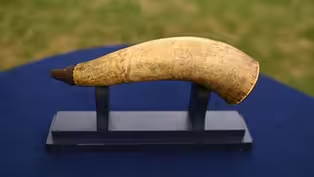
Appraisal: 1775 Abilmeleck Uncus-carved Powder Horn
Video has Closed Captions
Clip: S30 Ep22 | 3m 10s | Appraisal: 1775 Abilmeleck Uncus-carved Powder Horn (3m 10s)
Appraisal: Washington's Inaugural Ball Sash, ca. 1789
Video has Closed Captions
Clip: S30 Ep22 | 3m 33s | Appraisal: Washington's Inaugural Ball Sash, ca. 1789 (3m 33s)
Appraisal: 1954 Fender Stratocaster
Video has Closed Captions
Clip: S30 Ep22 | 51s | Appraisal: 1954 Fender Stratocaster (51s)
Appraisal: 1968 Warhol Campbell's Soup Can Screenprint
Video has Closed Captions
Clip: S30 Ep22 | 3m 18s | Appraisal: 1968 Warhol Campbell's Soup Can Screenprint (3m 18s)
Appraisal: Colt Single-action Army Revolver, ca. 1880
Video has Closed Captions
Clip: S30 Ep22 | 21s | Appraisal: Colt Single-action Army Revolver, ca. 1880 (21s)
Appraisal: Women's Carved Surfboard, ca. 1925
Video has Closed Captions
Clip: S30 Ep22 | 1m 4s | Appraisal: Women's Carved Surfboard, ca. 1925 (1m 4s)
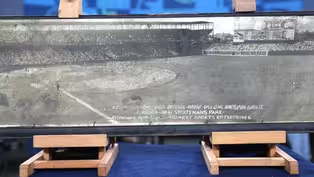
Appraisal: 1941 Sportsman's Park Panorama
Video has Closed Captions
Clip: S30 Ep22 | 3m 11s | Appraisal: 1941 Sportsman's Park Panorama (3m 11s)
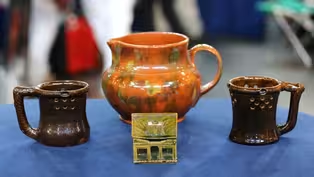
Appraisal: George Ohr Pottery, ca. 1900
Video has Closed Captions
Clip: S30 Ep22 | 4m 37s | Appraisal: George Ohr Pottery, ca. 1900, in New Orleans Hour 2. (4m 37s)
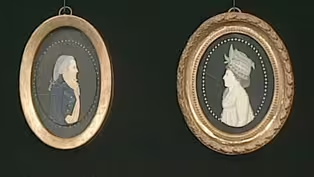
Appraisal: 1796 & 1799 Mary Way Dressed Miniatures
Video has Closed Captions
Clip: S30 Ep22 | 3m 11s | Appraisal: 1796 & 1799 Mary Way Dressed Miniatures (3m 11s)
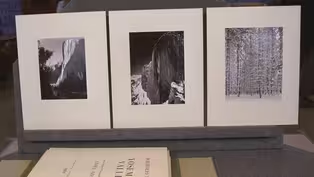
Appraisal: 1960 Ansel Adams Portfolio III
Video has Closed Captions
Clip: S30 Ep22 | 2m 16s | Appraisal: 1960 Ansel Adams Portfolio III (2m 16s)
Appraisal: Gustav Stickley Armchair, ca. 1905
Video has Closed Captions
Clip: S30 Ep22 | 34s | Appraisal: Gustav Stickley Armchair, ca. 1905 (34s)
Appraisal: 1884 Edison Light Bulb & Plaque
Video has Closed Captions
Clip: S30 Ep22 | 2m 36s | Appraisal: 1884 Edison Light Bulb & Plaque (2m 36s)
Appraisal: Claymore Beaded Bag, ca. 1895
Video has Closed Captions
Clip: S30 Ep22 | 1m 55s | Appraisal: Claymore Beaded Bag, ca. 1895 (1m 55s)
Providing Support for PBS.org
Learn Moreabout PBS online sponsorship New Episode
- Home and How To

Hit the road in a classic car for a tour through Great Britain with two antiques experts.
 New Episode
 New Episode










Support for PBS provided by:
Funding for ANTIQUES ROADSHOW is provided by American Cruise Lines and Ancestry. Additional funding is provided by public television viewers.